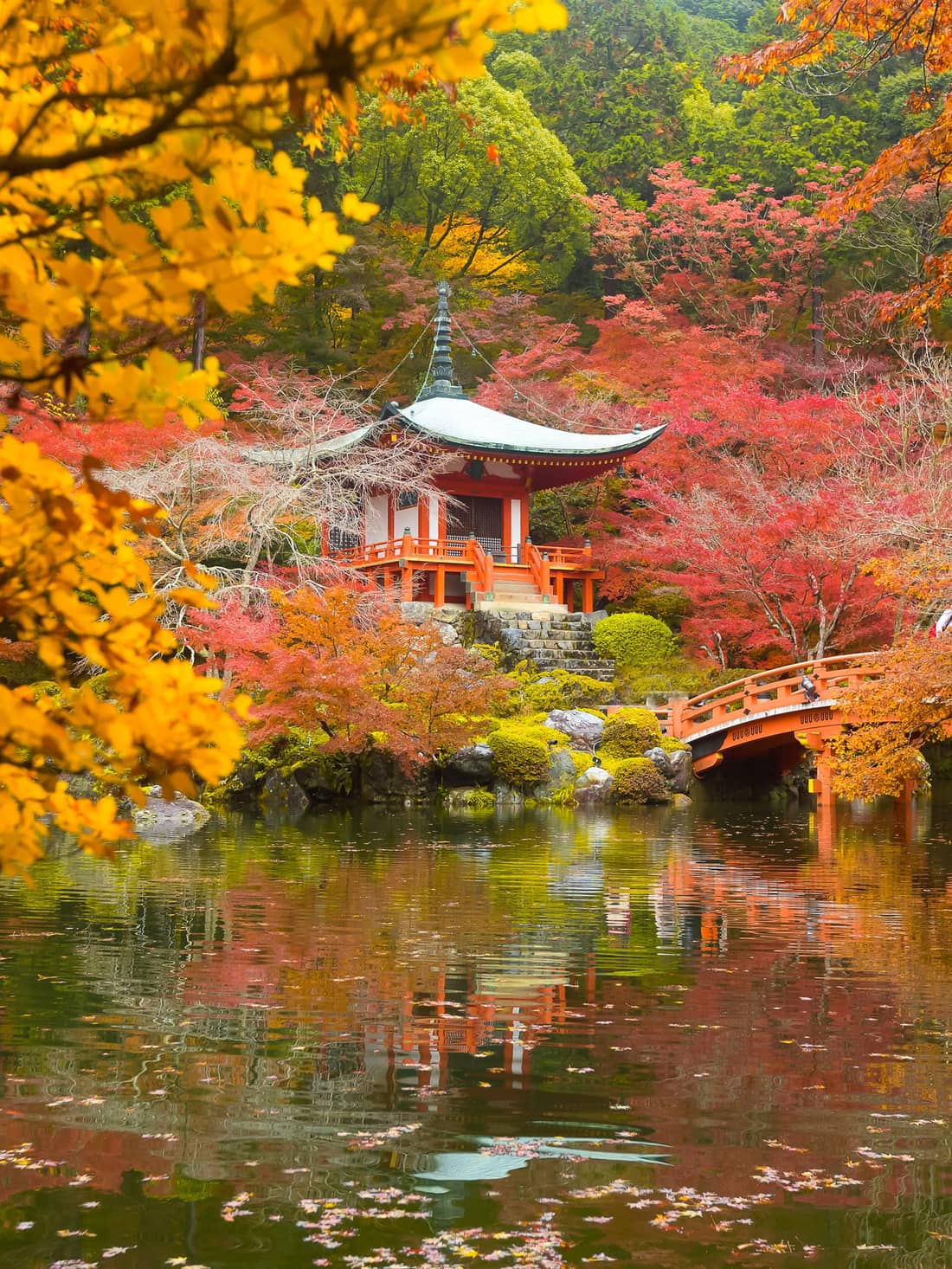

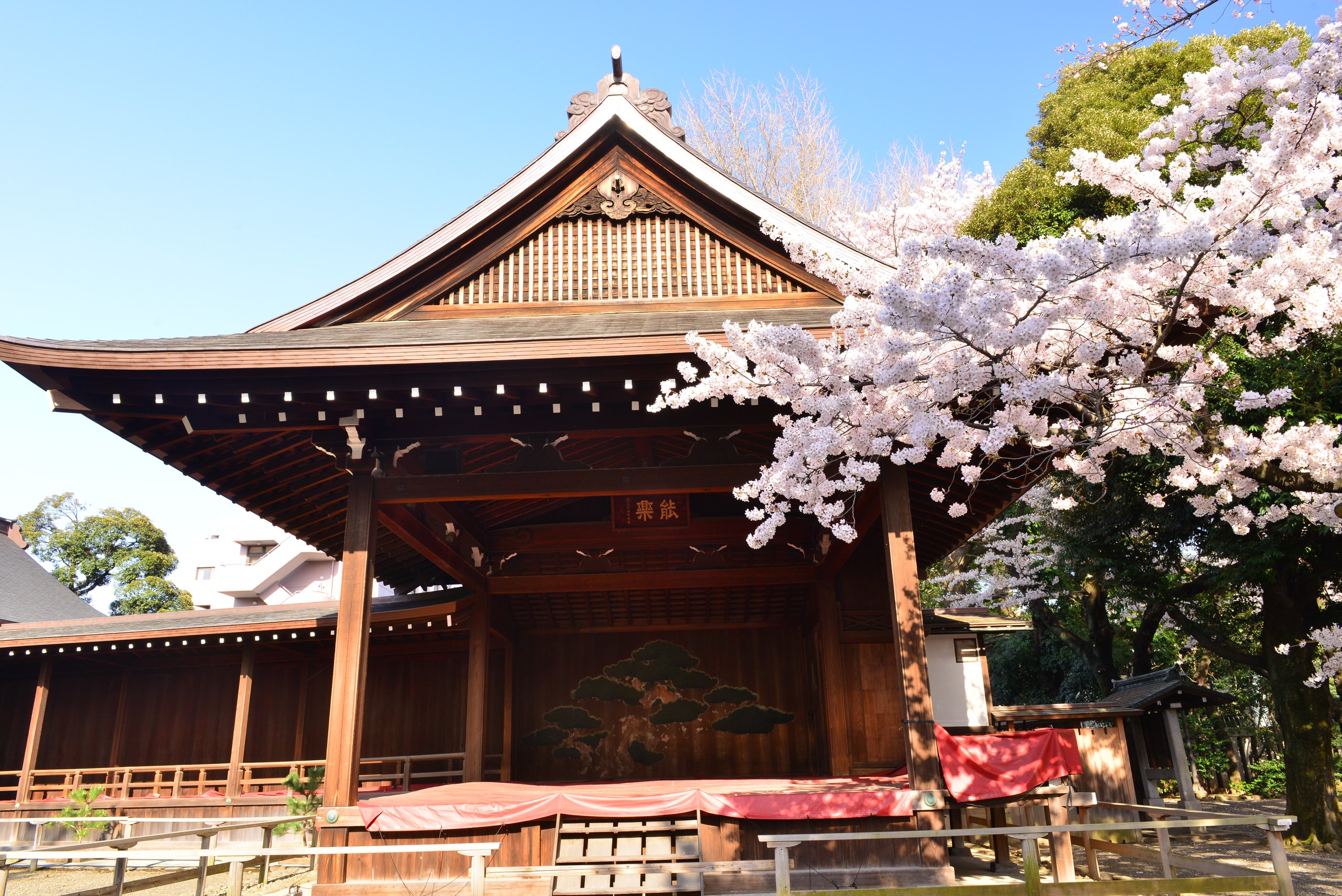
The best time to visit Japan is late March to mid-April, when the cherry trees flower from Tokyo to Kyoto, or mid-October to late November, when the maples turn from Hokkaido down to Kyoto. Both windows bring mild, settled days with afternoons in the high teens and low twenties, and both put Japan's two great seasonal spectacles at the centre of the journey.
On a fine afternoon in early April the light along the Philosopher's Path in Kyoto is filtered pink, the canal beneath the trees carries a skin of petals, and the temperature is a little under twenty degrees. Seven months later, on the hills above Arashiyama, the same city burns red and gold under a sky of the same clear blue. These are the two pictures most travellers carry in their heads before they come, and the climate records explain why: on the Japan Meteorological Agency's normals for 1991 to 2020, Kyoto's April afternoons average 20.1°C and its November afternoons 17.3°C, with the humidity of summer and the cold of the basin winter both well away.
Every other season makes its own case. Winter gives Japan its snow country, its onsen at their most inviting and Kyoto at its quietest. Early summer turns the temples green and sends Hokkaido into flower.
the answer
When is the best time to visit Japan?
For a first journey through Tokyo, Kyoto and the cities between them, the two classic windows are the strongest choice, and between them spring has the more famous spectacle while autumn has the longer one.
The blossom in any one city is brief. In Tokyo the Meteorological Agency's standard tree at Yasukuni Shrine opens, on the thirty-year average, on 24 March and reaches full bloom on 31 March; Kyoto follows at 26 March and 4 April. A week after full bloom the petals are on the water. The autumn colour, by contrast, moves through the country over two months, from the alpine slopes of Daisetsuzan in mid-September to the temple gardens of Kyoto, which the Japan Weather Association's long-run figures place from mid-November into early December at Arashiyama. A November journey can follow the colour south for a fortnight and find it at every stop.
The answer changes with the traveller. For skiing and snow the season is January and February. For the flowers and the cool air of Hokkaido it is late June and July. For the quietest temples in Kyoto it is January, after the New Year holiday.
one month
Best month to visit Japan
If a single month must be named, it is November. The rain has gone: Kyoto receives 73.9 millimetres in November against 117 in April, and Tokyo's November is less than half as wet as its October. The colour is moving through Tohoku at the start of the month and reaches Kyoto by its end. There is no national holiday week to fill the trains, and the schools are in session. April has the blossom, the more celebrated sight of the two, and a short spring holiday and Golden Week at either end of it.
Close behind sit the second half of May, when the green of the maples is new and the weather is warm and settled before the rains, and early December, when the last of the colour lingers in Kyoto in the quiet weeks before the New Year.
the weather
Japan weather by month: Tokyo, Kyoto and Sapporo
The figures below are the Japan Meteorological Agency's climate normals for 1991 to 2020: the average daily high and low for each month, and the month's rainfall or snowfall as precipitation. Tokyo stands for the Pacific coast, Kyoto for the inland basin of the old capital, and Sapporo for Hokkaido.
- January: Tokyo 9.8°C by day and 1.2°C at night, 60 mm; Kyoto 9.1°C and 1.5°C, 53 mm; Sapporo -0.4°C and -6.4°C, 108 mm, nearly all of it snow.
- February: Tokyo 10.9°C and 2.1°C, 57 mm; Kyoto 10.0°C and 1.6°C, 65 mm; Sapporo 0.4°C and -6.2°C, 92 mm.
- March: Tokyo 14.2°C and 5.0°C, 116 mm; Kyoto 14.1°C and 4.3°C, 106 mm; Sapporo 4.5°C and -2.4°C, 78 mm.
- April: Tokyo 19.4°C and 9.8°C, 134 mm; Kyoto 20.1°C and 9.2°C, 117 mm; Sapporo 11.7°C and 3.4°C, 55 mm.
- May: Tokyo 23.6°C and 14.6°C, 140 mm; Kyoto 25.1°C and 14.5°C, 151 mm; Sapporo 17.9°C and 9.0°C, 56 mm.
- June: Tokyo 26.1°C and 18.5°C, 168 mm; Kyoto 28.1°C and 19.2°C, 200 mm; Sapporo 21.8°C and 13.4°C, 60 mm.
- July: Tokyo 29.9°C and 22.4°C, 156 mm; Kyoto 32.0°C and 23.6°C, 224 mm; Sapporo 25.4°C and 17.9°C, 91 mm.
- August: Tokyo 31.3°C and 23.5°C, 155 mm; Kyoto 33.7°C and 24.7°C, 154 mm; Sapporo 26.4°C and 19.1°C, 127 mm.
- September: Tokyo 27.5°C and 20.3°C, 225 mm; Kyoto 29.2°C and 20.7°C, 179 mm; Sapporo 22.8°C and 14.8°C, 142 mm.
- October: Tokyo 22.0°C and 14.8°C, 235 mm; Kyoto 23.4°C and 14.4°C, 143 mm; Sapporo 16.4°C and 8.0°C, 110 mm.
- November: Tokyo 16.7°C and 8.8°C, 96 mm; Kyoto 17.3°C and 8.4°C, 74 mm; Sapporo 8.7°C and 1.6°C, 114 mm.
- December: Tokyo 12.0°C and 3.8°C, 58 mm; Kyoto 11.6°C and 3.5°C, 57 mm; Sapporo 2.0°C and -4.0°C, 115 mm.
Three things stand out. Kyoto is the hottest of the three cities in summer, because the hills that ring it trap the heat, and it averages 33.7°C on an August afternoon. Tokyo's wettest months are September and October, wetter than the rainy season itself, as the autumn rain front and the late typhoons pass over the Pacific coast. And Sapporo is cooler than Tokyo by four to five degrees in high summer, which is the whole of Hokkaido's case in July.
rain
Rainy season and typhoon months in Japan
The rainy season, tsuyu, settles over Honshu in early June. The Meteorological Agency's normal dates put its start at about 6 June in the Kansai region around Kyoto and Osaka and 7 June around Tokyo, and its end at about 19 July for both. It is a season of soft, steady rain, warm and humid, with dry days between the wet ones, and it is the season of the hydrangeas in the temple gardens of Kyoto and Kamakura. Hokkaido has no rainy season at all, which is why June there is clear, green and fresh.
Typhoons reach the main islands mostly in August and September. On the Agency's thirty-year figures about three a year make landfall, and a typhoon's passage usually means a day or two of heavy rain and wind on the Pacific side, followed by some of the clearest air of the year. Hokkaido and the Sea of Japan coast see far fewer.
the holidays
Japanese holidays to plan around in 2027
Three holiday periods fill Japan's trains and hotels with Japanese travellers, and JR Central makes every seat on the Nozomi shinkansen between Tokyo and Hakata reserved-only during all three.
Golden Week comes first. In 2027 Showa Day falls on Thursday 29 April, and Constitution Day, Greenery Day and Children's Day fall on Monday 3, Tuesday 4 and Wednesday 5 May, so the long run of the holiday is Saturday 1 May to Wednesday 5 May, with 29 April standing alone before it. Obon follows in mid-August, traditionally 13 to 16 August, when families go home to welcome their ancestors and Kyoto lights the five fires of the Gozan no Okuribi on its mountains on the night of 16 August; Mountain Day, a national holiday, falls on Wednesday 11 August 2027 just before it. The New Year holiday runs from about 29 December to 3 January. Government offices close, many museums, shops and restaurants close for some or all of those days, and the shrines fill on the first three days of January.
School holidays add to the spring and summer. Tokyo's Edogawa ward schools, for example, break for spring from 26 March to 5 April 2027, the same days the blossom is out in Tokyo, and for summer from 21 July to 31 August.
The New Year in a ryokan is one of the loveliest ways to see the country, and Obon is a moving time to be in Kyoto; both simply ask for the order of the days and the trains to be planned with care.
quiet
Best time to visit Japan for fewer visitors
The quietest weeks in Japan's great sights fall in January and February after the New Year, in the second half of May after Golden Week, in June, and in the first half of December. September, once the Obon travellers are home and before the autumn colour, is quieter again in Kyoto, though it is still warm. In each of these the reward is a temple garden with room to sit in it. Two of them come with a season of their own: January and February bring snow to the north and the Winter Special Opening of closed temple halls in Kyoto, and June brings the hydrangeas and Hokkaido's flowers.
spring
Spring in Japan: cherry blossom season
The cherry blossom moves north through Japan from late March to mid-May. Kyushu and Tokyo flower first, Kyoto and Osaka a few days later, the castle towns of Tohoku through April, and Hakodate and Sapporo, on the Agency's normals, flower on 28 April and 1 May and reach full bloom on 2 May and 6 May. A blossom journey in the south and a second one in Hokkaido a month later are both open to the same traveller in the same year.
Spring runs well beyond the cherry. Plum blossom opens in Kyoto in February and March. Late April brings the wisteria and the azaleas, and May the fresh green of the maples, which the Japanese call shinryoku.
The Classic Cherry Blossom Tour of Japan runs from 30 March to 10 April 2027, and The Cherry Blossom Tour of Hokkaido from 28 April to 10 May 2027, from Hakodate north to Sapporo.
When cherry blossoms bloom in Japan →
summer
Summer in Japan: festivals, and the cool of Hokkaido
Summer on Honshu is hot and humid from mid-July to the end of August, and it is the season of the great festivals. Kyoto's Gion Matsuri runs for the whole of July, its tall decorated floats drawn through the city on 17 and 24 July; the lantern festivals of Tohoku and the five fires of Obon follow in August. The evenings are the best of the day, spent on the wooden decks built out over the Kamo River or on a ryokan veranda in the mountains.
Hokkaido is the other answer to summer. With Sapporo's July afternoons at 25.4°C and no rainy season, the island has its loveliest months in late June, July and August: the lavender of Furano in July, the flower fields of Biei, the lakes of Toya and Shikotsu, and the long light of the northern evenings. The Summer Tour of Hokkaido has two departures in 2027, 25 June to 6 July and 11 to 22 July, and the Wild North Tour of Hokkaido runs from 27 July to 6 August 2027.
autumn
Autumn in Japan: the autumn leaves season

Autumn begins in the mountains of Hokkaido in mid-September, when the alpine shrubs on Asahidake in Daisetsuzan turn red before anywhere else in Japan. Sapporo's standard maple follows, on the Agency's normal, at the end of October. Through October the colour runs down through the beech forests and gorges of Tohoku, at Oirase, Hachimantai and Naruko, and into the Japanese Alps, and in November it reaches Nikko, Hakone, Kanazawa and finally Kyoto and Nara, where the temple gardens keep their colour into the first days of December.
The weather matches the colour. October and November are clear and settled, the air cool enough to walk the hill temples in comfort, and the autumn table is the richest of the year: matsutake, chestnuts, new rice and the first of the season's sake.
In the last week of November the gravel of a Kyoto garden is strewn with red, the maples above it are lit low by the afternoon sun, and the only sound is a bamboo pipe filling a stone basin.
The Autumn Leaves Tour of Northern Japan runs from 2 to 13 November 2027, from the mountain valley of Jozankei above Sapporo to the onsen villages of Tohoku.
winter
Winter in Japan: snow, onsen and a quiet Kyoto
Winter divides Japan along its mountains. On the Pacific side Tokyo, Kyoto and Osaka are cold, dry and sunny, with January afternoons around 9 to 10°C; on the Sea of Japan side and across Hokkaido the snow lies deep from December to March. It is the season of the powder at Niseko, Hakuba and Myoko, of the Sapporo Snow Festival in early February, of snow crab on the coast and of an open-air onsen with snow falling on its rocks. Kyoto, in the weeks after the New Year, is quieter than at any other time.
the north
Hokkaido's different calendar
Hokkaido runs a month or more behind Honshu in spring and ahead of it in autumn. Its cherry blossom opens around the start of May, when Kyoto is already green. Its summer is the coolest in Japan and free of the rainy season. Its colour begins in September, weeks before Kyoto's. Its winter is a true northern winter, with Sapporo's afternoons close to freezing from December to February and the drift ice reaching the Sea of Okhotsk coast from late January. For a traveller who knows the classic windows on Honshu, Hokkaido is a second year of seasons to choose from.
the months
Japan month by month
Each month has its own page in the Japan Edition. In a line each: January is the quietest month in Kyoto and the deepest snow in the north; February brings the snow festival and the first plum blossom; March opens the cherry season in the south; April is the blossom in Tokyo, Kyoto and Tohoku; May is fresh green and the cherry blossom of Hokkaido; June is the rain on Honshu and the clear skies of Hokkaido; July is the Gion Matsuri and the lavender; August is Obon and the cool of the north; September is the heat easing and the north turning first; October is the colour in Tohoku; November is the colour in Kyoto; December is the last maples and the run to the New Year.
the journey
Visiting Japan in any season, privately
The published tours keep to their seasons. For a January of quiet temples, a May of new green or a June of Hokkaido flowers, The Private Collection offers four private journeys, already written and taken on the guest's own dates, with a Tour Director present every day. Essential Japan gives nine days to Tokyo, Kyoto and Osaka. Classic Japan adds two nights at a ryokan in Kinosaki Onsen, Definitive Japan two more beneath Mount Fuji, and Pure Hokkaido runs from Hakodate to Sapporo by way of Noboribetsu and Otaru.
A private chauffeur meets the flight, the cities are joined in first class, and the luggage goes ahead between hotels. The Honshu journeys carry a private tea ceremony in Kyoto and a sake tasting among the breweries of Fushimi; Pure Hokkaido carries a whisky tasting at the Nikka distillery in Yoichi. Whichever month the guest chooses, the Tour Director is there from the first evening to the last.
questions
Questions
What is the best time to visit Japan?
Late March to mid-April for the cherry blossom, and mid-October to late November for the autumn colour. Both bring mild, dry weather, with Kyoto's afternoons averaging 20.1°C in April and 17.3°C in November.
What is the best month to visit Japan?
November. It is drier than April, the autumn colour moves through the country for the whole month, and there is no national holiday week. April is the month for the cherry blossom.
When is Japan least crowded?
January and February after the New Year holiday, the second half of May, June, and early December. Golden Week, Obon in mid-August and the New Year holiday are the busiest times on the trains and in hotels.
When is Golden Week in 2027?
Showa Day is Thursday 29 April 2027, and the main run of holidays is Saturday 1 May to Wednesday 5 May 2027, covering Constitution Day, Greenery Day and Children's Day.
When is the rainy season in Japan?
On Honshu from about 6 or 7 June to about 19 July, on the Japan Meteorological Agency's normals. Hokkaido has no rainy season.
When is typhoon season in Japan?
Typhoons reach the main islands mostly in August and September, with about three making landfall in an average year. Hokkaido and the Sea of Japan coast see far fewer.
What is the best time to visit Hokkaido?
Late June to August for the flowers and the cool summer, early May for the cherry blossom, September and October for the autumn colour, and January and February for snow and skiing.