
Japan in January begins with the New Year, and for its first three days the country stays at home. Shops lower their shutters, the office towers of Marunouchi are dark, and the only crowds in Tokyo are on the approach to Meiji Jingu, where families queue for hatsumode, the first shrine visit of the year. By the second week the pine and bamboo kadomatsu have come down from the doorways, the trains are full of people going back to work, and Kyoto settles into the quietest weeks of its year.
new year
The first days of the New Year
On 2 January the inner gates of the Imperial Palace in Tokyo open for the New Year Greeting, and the Emperor and the imperial family come out on to the long glass-fronted balcony of the Chowaden several times in the course of the day, while the crowd below waves small paper flags of the rising sun. It is one of two days in the year when the Emperor greets the public in person, the other being his birthday, on 23 February.
Each region eats the New Year in its own way, and the soup called ozoni shows it most plainly. In Tokyo square cakes of rice are grilled and dropped into a clear broth with chicken and greens. In Kyoto the mochi is round, simmered rather than grilled, and served in a sweet white miso with slices of taro and daikon, a bowl as pale as the winter light.
The calendar then moves through a run of small days that most visitors never notice. On 7 January households eat nanakusa-gayu, a thin rice porridge with seven green herbs of early spring, to settle stomachs after the feasting. From 8 to 12 January the Ebisu shrine beside Kennin-ji keeps Toka Ebisu for the god of fishermen and trade, and the shopkeepers of Kyoto come through its gate late into the evening for fukuzasa, branches of bamboo hung with gold charms for a prosperous year. On 11 January the kagami mochi, two stacked rounds of rice cake that have sat in the tokonoma since the end of December with a bitter orange on top, are broken with a wooden mallet and eaten: kagami biraki, the opening of the mirror.
kyoto
Kyoto in its quietest weeks
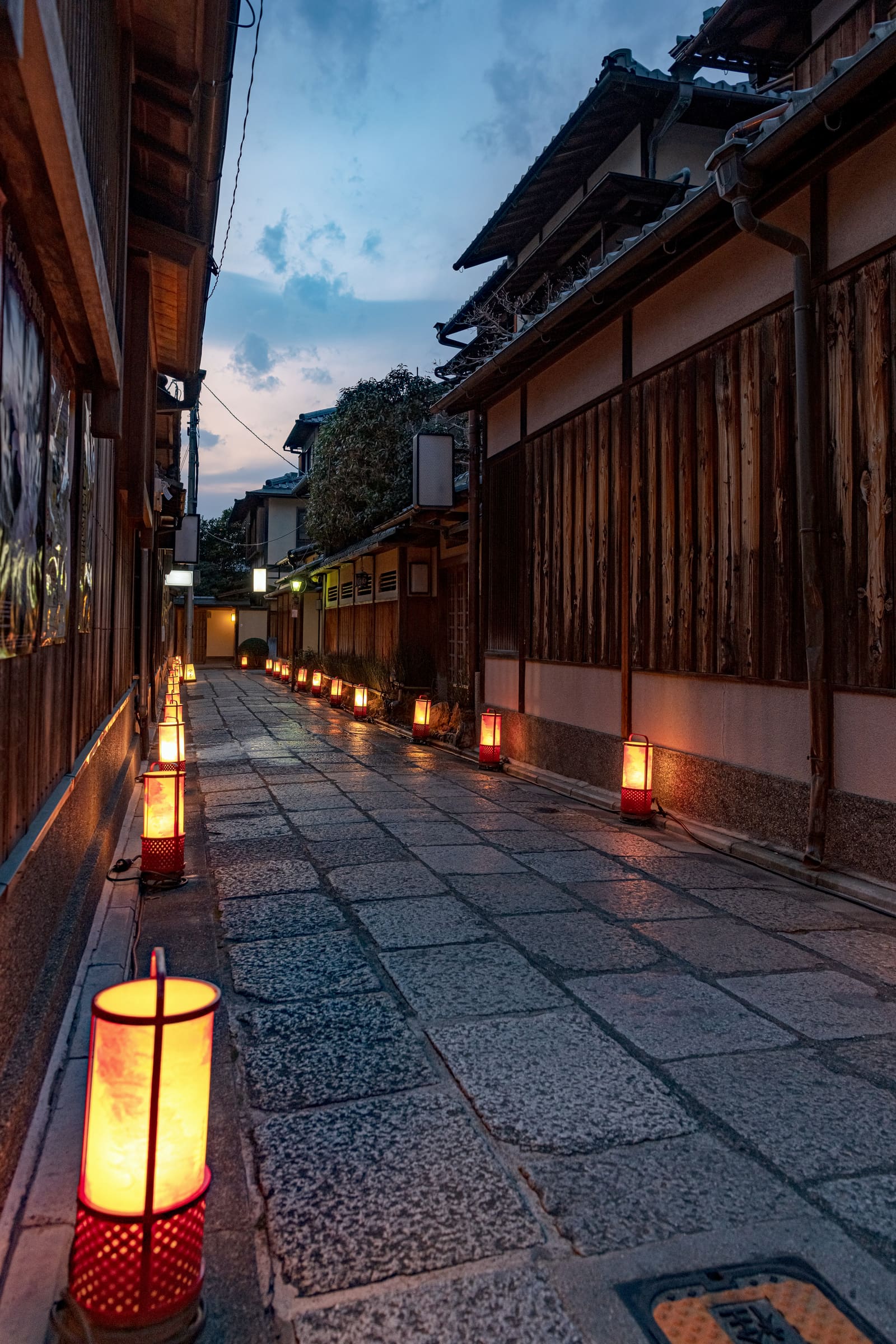
In January there are few visitors in Kyoto. The long hall of Sanjusangen-do, with its thousand and one statues of Kannon standing in rows in the half light, is walked end to end without waiting for anyone. The stone lanes of Ninenzaka and Sannenzaka, which in April move at the pace of a queue, are quiet enough to hear the shopkeepers talking. On the few mornings each winter that follow a night of snow, the gold pavilion at Kinkaku-ji stands over a white garden.
Sanjusangen-do has one crowded day, and it is worth seeing. In the middle of January the temple stages the Toshiya, an archery contest for young people celebrating their coming of age, and hundreds of them, many of the women in long-sleeved furisode kimono, shoot at targets sixty metres (two hundred feet) away along the side of the hall. Coming of Age Day itself, a national holiday, falls on the second Monday of the month, and the same kimono appear at shrines across the country.
nara
Nara sets its hill alight
On the evening of the fourth Saturday in January, Nara burns a mountain. The grass slope of Wakakusa-yama, which rises bare and rounded behind Todai-ji and Kasuga Taisha, is set alight after a display of fireworks, and for the better part of an hour the whole hill glows orange above the roofs of the old capital. The Wakakusa Yamayaki is watched from the lawns of Nara Park, among the deer.
the north
Snow country, and the winter table
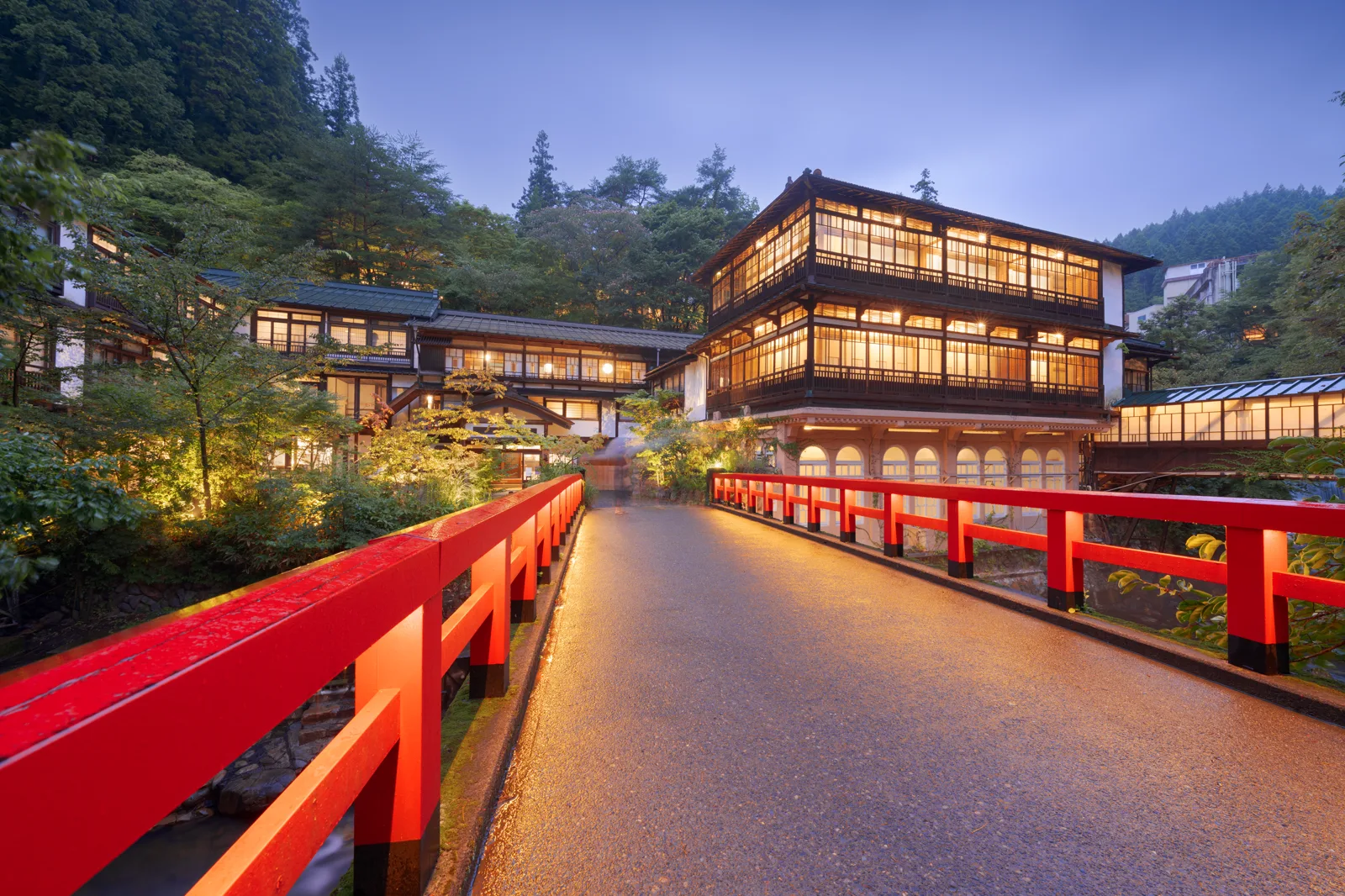
January is the height of winter in Hokkaido. Niseko has the dry powder that skiers cross the world for, and in the Nagano mountains, at Jigokudani, the macaques sit in a steaming pool with snow settling on their heads. In the valley of Ginzan Onsen in Yamagata the wooden inns stand four storeys high along a narrow river, snow on every eave and balcony, and after dark the gas lamps are lit along the water.
On the Japan Sea coast it is the height of the crab season. At Kinosaki Onsen the matsuba crab, the snow crab of the San'in coast, comes to the ryokan table grilled, boiled and finally as a rice porridge made in the pot it was cooked in. Along the same sea, at Himi on Toyama Bay, the winter yellowtail are landed at their fattest, and kanburi from Himi is sold under that name in the markets of Kanazawa and Kyoto, cut thick as sashimi or swished through a pot of broth as buri-shabu.
In the hot spring towns this is the onsen's own season: a cedar tub in the open air with snow on the rocks around it, and the steam rising into the cold.
the weather
January weather in Tokyo, Kyoto and Sapporo
The country is divided in January by its mountains. A cold wind from Siberia crosses the Sea of Japan, gathers moisture over the water and drops it as snow on the ranges that face that sea, which is why Niseko, Shirakawa-go and the San'in coast are white. The same wind arrives on the Pacific side dry and bright, and Tokyo has its clearest skies of the year, with rain on only four or five days in the month.
The Japan Meteorological Agency's normals for 1991 to 2020 give a January day in Tokyo 9.8°C (50°F), falling to 1.2°C (34°F) at night. Kyoto sits a little lower, at 9.1°C and 1.5°C (48°F and 35°F), with the damp cold of a city in a basin. Sapporo stays below freezing, at -0.4°C and -6.4°C (31°F and 20°F), and its 108.4 millimetres of precipitation falls almost entirely as snow.
closures
What closes over the New Year
The first three days of January, shogatsu, are the one time in the year the whole country closes. Banks, most museums, many restaurants and the smaller shops shut from around 29 December to 3 January, and the department stores that do open are given over to the New Year sales and their lucky bags, fukubukuro. The shinkansen is full in the days either side of it, as families travel home and back. From the second week everything opens again, and January becomes one of the two quietest months of the year in Tokyo and Kyoto, February being the other.
Japan in winter: where to go, and why it is worth it →
the journey
A private journey through Japan in January
Kyoto's quietest weeks and the deepest snow of the north fall in the same month, and The Custom Tour of Japan can join them in one private journey: one party, its own dates, from five nights, planned and run by Luxury Japan Travel with a Tour Director beside the party every day and a private car and driver in each city. A week of Kyoto in its quiet, with a temple garden opened after its gates have closed for the day, can lead to Kinosaki, where the matsuba crab is served one course at a time in a suite with its own onsen.
Or the journey goes north, to a villa in the Niseko forest with two private onsen and a guide who knows where the powder fell overnight, and an outdoor onsen in falling snow at the end of each day.