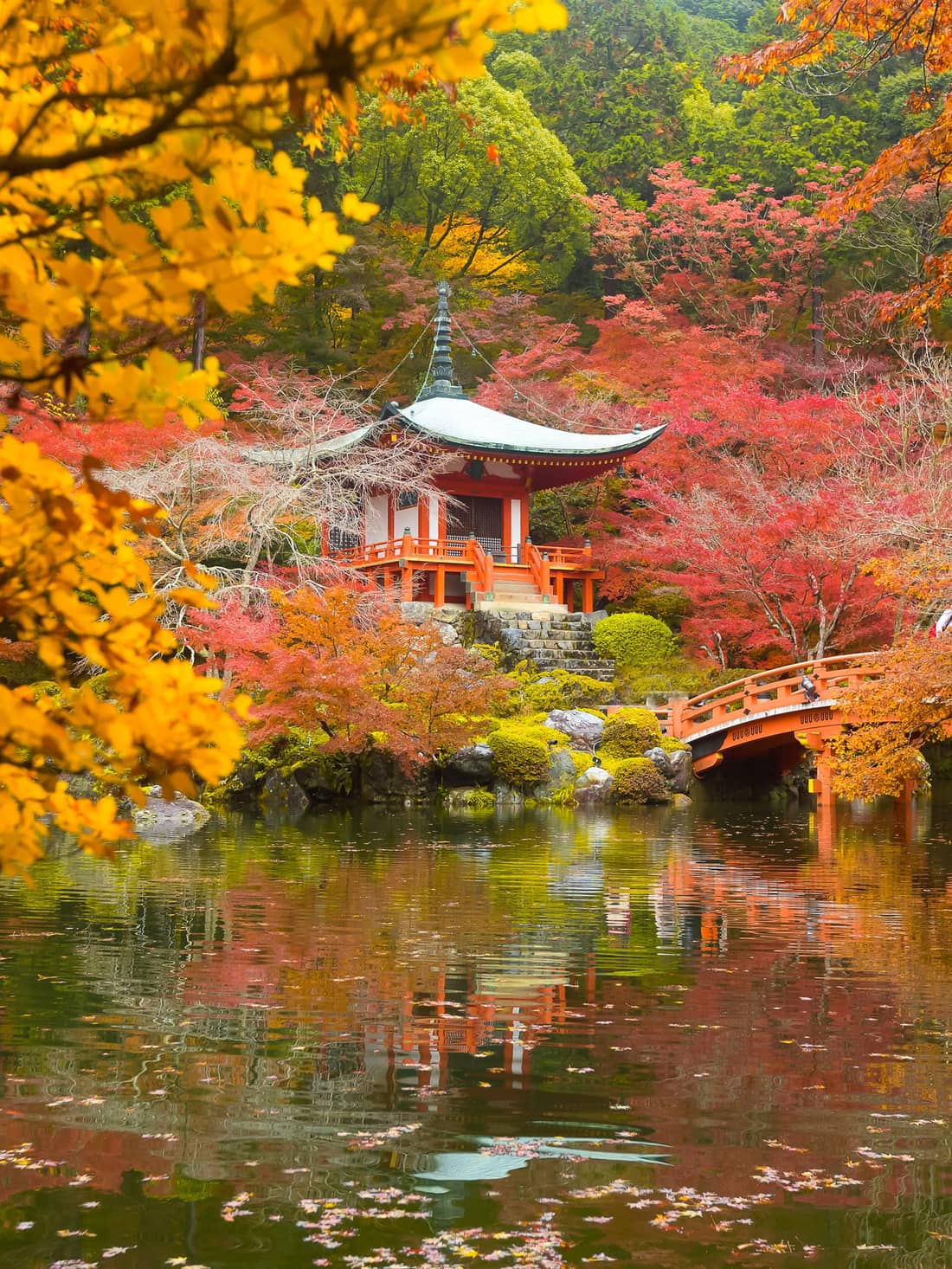

Japan in October is the month to walk. The heat has gone, the air between the rain is clear and cool, and the autumn colour is coming down the country from the north: from the Daisetsuzan mountains in Hokkaido, through the Hakkoda mountains of Aomori and along the Oirase gorge, and down to the forty-eight hairpin bends of the Irohazaka road above Nikko. Kyoto and Tokyo are still green, and their turn comes in November.
kyoto
Kyoto's October festivals
The month opens at Kitano Tenmangu with the Zuiki Matsuri, from 1 to 5 October, a harvest festival for the god of the shrine. Its portable shrine is roofed with the dried stems of the taro plant, zuiki, and decorated with vegetables, grains and dried flowers worked into scenes and figures by the farmers of the district, and it is carried through the streets of the north-west of the city.
On 22 October Kyoto has two festivals. By day the Jidai Matsuri, the festival of the ages, walks from the Kyoto Imperial Palace to Heian Shrine, a route of some four and a half kilometres (nearly three miles): about two thousand people in the dress of every period of the city from the Meiji Restoration back to the eighth century, from samurai in armour to court ladies in the layered robes of the Heian period, in a procession two kilometres long. After dark, in the village of Kurama in the hills north of the city, the young men of the village carry burning pine torches up the lane to the Yuki Shrine, calling as they go, and the whole valley smells of pine smoke.
the festivals
Festival floats in the mountains and in Nagasaki
In the mountains of Gifu, the old town of Takayama has its autumn festival on 9 and 10 October, when the tall festival floats of the Hachiman Matsuri, carved, lacquered and hung with brocade, are drawn through the streets of the merchant quarter. One of them carries karakuri, mechanical puppets worked by strings from inside the float, which perform on its upper tier before the crowd.
At the other end of the country, Nagasaki stages the Kunchi at Suwa Shrine from 7 to 9 October, the festival of a port that traded with China and the Dutch through the centuries when Japan was otherwise closed to the world. Each neighbourhood presents its dance only once in seven years, and the turns are spectacular: a Chinese dragon chasing a golden ball, and a great wooden ship on wheels spun round and round on the stone square before the shrine.
the table
The new rice and the black beans
October is the month of shinmai, the new rice, served plain in the ryokan at breakfast, glossy and faintly sweet. Matsutake are in the markets, and the classic way to eat them is dobin-mushi, a clear broth steamed in a small earthenware teapot with the mushroom, a piece of hamo and a slice of citrus, poured into a cup and drunk before the solids are eaten. Chestnuts come to the table in rice and in sweets, and persimmons are hung to dry under the eaves of the farmhouses.
For a few weeks in October, and at no other time, the greengrocers of Kyoto and Osaka sell the Tamba black soybean as edamame, still in the pod. The beans are grown to be dried for the New Year, and picked green they are larger, sweeter and nuttier than any ordinary edamame, boiled in salted water and eaten warm.
the weather
October weather: clear and mild
On the Meteorological Agency's 1991 to 2020 normals October is Tokyo's wettest month, at 234.8 millimetres, a little more than September; the rain comes in spells, and the days between them are dry and clear. Tokyo's days reach 22°C (72°F) and its nights 14.8°C (59°F), and Kyoto is at 23.4°C and 14.4°C (74°F and 58°F), warm enough in the afternoon to walk in shirtsleeves. In Sapporo the days are down to 16.4°C (62°F) and the nights to 8°C (46°F).
the calendar
Sports Day, and the weekends in the mountains
The second Monday of October is Sports Day, a national holiday. The gorges and mountain roads of Tohoku and Nikko are busy at weekends while the leaves are turning, and the roads to them are slow. Kyoto is calmer than it will be in November.
the journey
Travelling in Japan in October
The Custom Tour of Japan builds October around the party that travels it, on its own dates and from five nights. It can stand its guests on the route of the Jidai Matsuri by day and in the pine smoke of Kurama by night on the same 22 October, walk them through Takayama's merchant quarter as the festival floats are drawn past, and set a matsutake dobin-mushi before them at dinner. A Tour Director is with the party every day, and a private car and driver wait in each city.