

Without reservation. At first light on the Shirakawa canal in Gion, before the city has woken, the only sound is the water under the stone bridges and the petals settling on it, and the branches lean so low over the lanes that a teahouse lantern glows pink through them. For a fortnight in late March and early April the blossom crosses Tokyo, Kyoto and Osaka, and Japan does what it has done for more than a thousand years: it stops, sits down beneath the trees and gives the afternoon to them. No other season carries this feeling. None rewards knowing the country more.
The question is asked because the season has two faces. One is the famous bridge at noon on a Saturday, shoulder to shoulder. The other is the same city an hour earlier, or a lane further on, or a garden across the river, where the blossom is just as full and the hour belongs to the few who knew to be there. The trees are the same. Everything else is knowledge.
the reward
What the season gives
For a week the whole country looks up. Salarymen eat their lunch on a bench beneath a single tree; a grandmother photographs her grandson against a branch outside a convenience store; the evening news carries the bloom's progress up the map as seriously as the weather. The Kamo river in Kyoto becomes one long, slow party along its banks, and the old canals of Gion carry the petals down past the teahouse doors.
Hanami means sitting down. Rugs are laid beneath the trees, food and sake are brought out, and a whole afternoon is given to the canopy overhead. The emperor's court in Kyoto kept it with poetry; the townspeople of Edo kept it along the Sumida river, where the shogun Tokugawa Yoshimune planted cherries so that all of the city could join in. Japan has never stopped.
After dark the season changes key. Yozakura, the blossom by night, is a tradition of its own: in Maruyama Park, at the top of Gion, the great weeping cherry is lit from below and stands against the black hill like a fountain of pale light, and along the Chidorigafuchi moat in Tokyo the lit branches lean so far over the water that the blossom is seen twice, once in the air and once on the dark surface beneath it. The night is cool, and the paper lanterns of the food stalls sway along the paths.
And then the season lets go. About a week after full bloom the wind begins to take the petals, and there is a word for that too, hanafubuki, a snowstorm of flowers. Standing in one beneath the weeping cherries of the old palace park in Kyoto, the petals turning in the light and settling on the shoulders of strangers, the question of whether it was worth it does not arise.
the crowds
How crowded is Japan in cherry blossom season?
Full, at the famous names. Japan received a record 42.7 million overseas visitors in 2025, and the blossom brings Japan's own travellers out in the same fortnight, with the schools on their spring break and the business year beginning in April. Along the Meguro river in Tokyo the ward's mayor has asked visitors to walk a one-way route and keep their voices low for the neighbours. In Gion, signs at the mouths of the private lanes have turned visitors away since April 2024.
The crowd is narrow. It keeps to a handful of places, at a handful of hours, at the weekend. A canal walked in the long light of late afternoon, a temple garden on a Tuesday, the palace moat at dusk when the boats have gone in: these are the same season, entire, and they are a matter of knowing the city, never of luck.
And the crowd itself is part of the pleasure, a good-natured one. On the morning of a company hanami the newest employees are sent out early with a blue tarpaulin to claim a patch of lawn, a custom called bashotori, and by dusk the same lawn is a long table of colleagues, sake and grilled skewers beneath the lanterns.
the room
Where to stay in cherry blossom season
In this fortnight the room decides the season. A room in Gion or Higashiyama puts the lanes, the canals and the evening at the door: the walk at dawn before the city stirs, the return at dusk with the lanterns lit, and no taxi queue at the start of any day. In Tokyo, a hotel near the Imperial Palace puts the moat at Chidorigafuchi within a walk, its cherries arched over the water.
Luxury Japan Travel keeps its cherry blossom guests in Gion for exactly this reason. The blossom of Kyoto is best known from inside the old city, and the old city keeps its loveliest hours for those already in it.
Kinosaki, on the Japan Sea, keeps the season in its own way. Guests of the town's ryokan walk the willow-lined canal in yukata and wooden geta between its seven public bathhouses, and in April the cherries along the Otani river lean over the little stone bridges, their petals carried down on the current past the inn doors.
the weather
What is the weather like in cherry blossom season?
Mild, fresh and changeable. On the Japan Meteorological Agency's thirty-year normals, Kyoto's April days average 20.1°C and its nights 9.2°C; in the last ten days of March the afternoon reaches about 15.5°C and the night falls to about 5°C. Tokyo runs a fraction cooler by day. Rain falls on about nine days of April in both cities.
There is a word for the cold that so often comes with the blossom: hanabie, the flower chill. A morning of clear sun turns to a cool wind by mid-afternoon, and the evening picnics are wrapped in coats and blankets. Rain has its own beauty in the season. Petals cling to wet paving stones, the moss in the temple gardens deepens to a darker green, and a branch above a dark wall burns brighter than it did in the sun.
later
Later, and further north
The season offers a second spring a month later. The front reaches Hakodate and Sapporo in late April and early May, around 2 and 6 May for full bloom on the long-run normals, and at Matsumae, on Hokkaido's southern tip, some two hundred and fifty varieties of cherry carry the bloom for close to a month. The parks of the north are wider and its towns further apart, and the spring there has an openness Kyoto's never will. Our Hokkaido cherry blossom tour is timed to it, from 28 April to 10 May 2027.
calmly
How to see the cherry blossom calmly
- A room in the old quarters: Gion and Higashiyama in Kyoto, the palace moat in Tokyo.
- Three nights in Kyoto, enough for the quieter gardens as well as the famous ones.
- Hours chosen for the light: the canals and moats in the soft light of late afternoon, the parks for a long lunch beneath the trees, the lit branches after dark.
- Hanami taken sitting down, a rug beneath the trees, a meal and a slow afternoon.
- One break from the cities: a night at an onsen town on the Japan Sea, or two at the foot of Mount Fuji.
- A small party, moving through the season as one, at its own pace.
None of this is a secret. It is the way the season has always been kept: as an occasion to be arranged, never a sight to be chased.
A twelve-day cherry blossom itinerary for Japan →
Japan cherry blossom season 2027: the forecast, city by city →
the tour
The Classic Cherry Blossom Tour of Japan, 2027
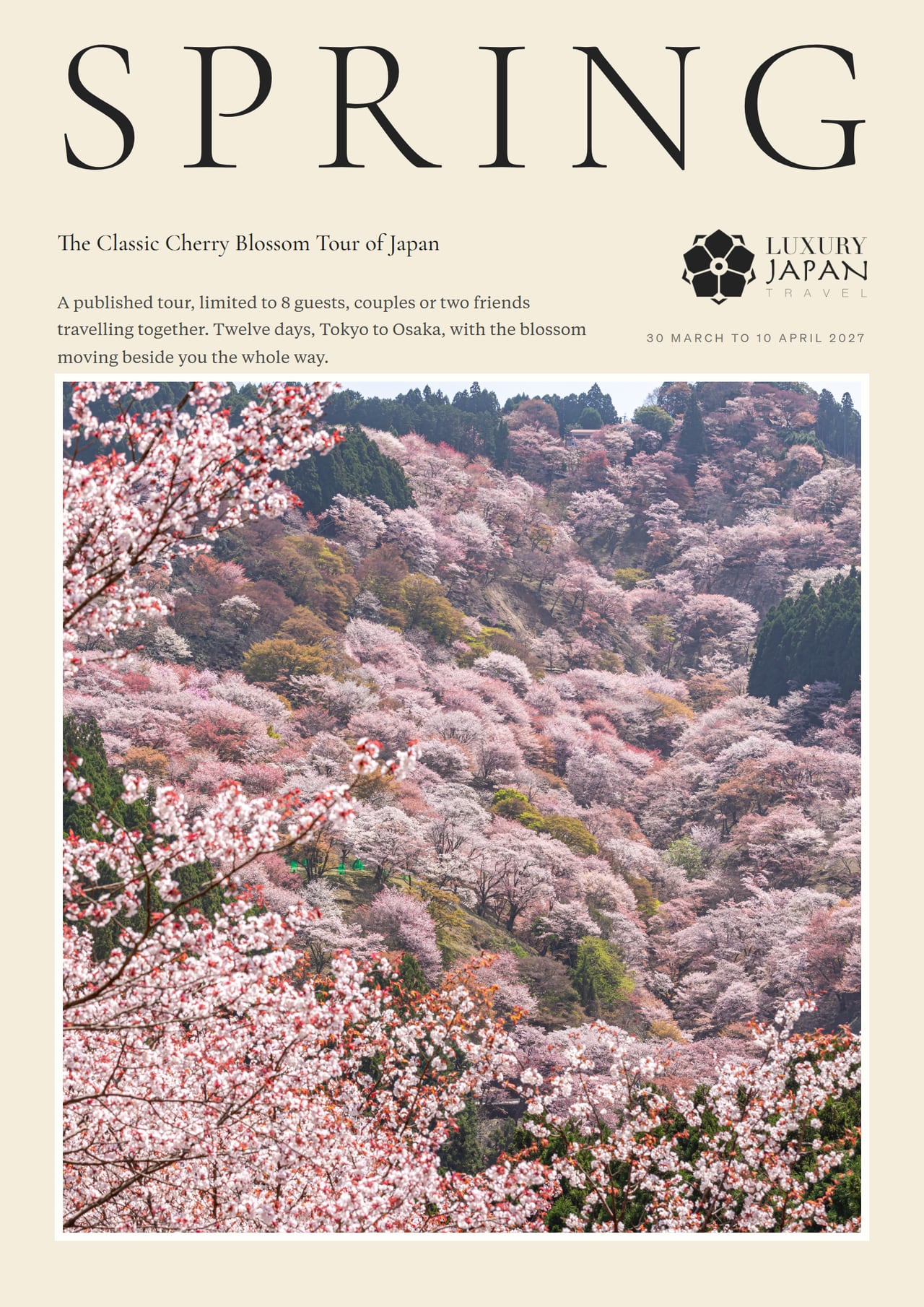
The Classic Cherry Blossom Tour of Japan is the season kept this way. From 30 March to 10 April 2027 it travels from Tokyo by way of Mount Fuji to Kyoto, Kinosaki and Osaka. Three of its nights are in Gion; two are at the foot of Fuji, each room with its own open-air bath with Fuji in view; one is in Kinosaki, the onsen town of seven public bathhouses. It sits down twice for hanami, beneath the trees of Yoyogi Park and in the park of the Kyoto Imperial Palace, with bentos from Michelin-starred kitchens.
It is limited to 8 guests and guaranteed to run from two, led every day by Luxury Japan Travel's own Tour Directors.
questions
Questions
Is cherry blossom season in Japan worth it?
Without reservation. It is the most beautiful fortnight of the Japanese year, and it belongs to those who know where to be in it: a room in the old quarters, three nights in Kyoto, and hanami taken sitting down beneath the trees.
How crowded is Japan during cherry blossom season?
Full at the famous places, at midday and at the weekend, when Japan's own travellers are out beside the visitors from abroad. Early morning, late afternoon and the quieter gardens keep the season calm.
Where is the best place to stay in Kyoto in cherry blossom season?
Gion and Higashiyama, where the canals, the lanes and the blossom are at the door, at dawn before the city stirs and at dusk when the lanterns are lit.
What is the weather like in Japan in cherry blossom season?
Mild and changeable: Kyoto averages 20.1°C by day and 9.2°C at night in April, and late March is cooler, about 15.5°C by day. Rain falls on about nine days in April, and a warm layer is wanted for the evening.