
Japan in July is the month of the summer festivals, and in Kyoto it is the month of the Gion Matsuri. The festival of Yasaka Shrine runs for the whole of July, as it has in some form for more than a thousand summers, and on 17 July its great wooden floats, the tallest of them rising some twenty-five metres (eighty feet) to the tip of its spear, are pulled through the centre of the city by teams in cotton happi coats, turned at each corner on split bamboo by main strength. In the Kyoto region the rainy season ends, on the Meteorological Agency's average, on 19 July, and the full heat of the Japanese summer arrives within days of it.
kyoto
The Gion Matsuri, day by day
The festival is a month of ceremonies, and the procession is only its most public day. On 2 July the representatives of the float neighbourhoods meet at the city hall for the kujitori, a lottery that fixes the order of the procession, though a few floats keep a place that is never drawn, and the Naginata-boko always leads. In the second week the floats are assembled in the streets without a single nail, their timbers lashed together with straw rope in knots that each neighbourhood has tied the same way for generations.
The evenings before the procession, from 14 to 16 July, are the part of the festival most loved in Kyoto. The streets of the old merchant quarter around Shijo and Muromachi close to traffic, the floats stand assembled in the streets hung with paper lanterns, and children sing the old songs that sell the festival charms, chimaki, from beside the floats. Some of the old merchant families open the front rooms of their townhouses and set out their folding screens for passers-by to see, which is why these nights are also called the screen festival, byobu matsuri.
On the morning of the 17th the twenty-three floats of the first procession set out, with the Naginata-boko at their head. On its upper platform rides the chigo, a boy of the city chosen as the festival's sacred page, who does not set foot on the ground for days beforehand, and who with a single stroke of a sword cuts the rope of sacred straw strung across Shijo street to open the way. A second procession, smaller and quieter, follows on 24 July, the same day as the Hanagasa, a parade of flower-decked hats, dancers and geiko. The float festival was inscribed by UNESCO as intangible cultural heritage in 2009.
The festival has its own fish. Hamo, the pike conger, is so much a part of the month in Kyoto that the Gion Matsuri is also called the hamo festival. Its flesh is full of fine bones, and a Kyoto cook cuts through the bones without breaking the skin, some two dozen strokes of a heavy knife to every three centimetres (an inch), then blanches it until it opens like a white flower, to be eaten with a sour paste of pickled plum.
high summer
Cool water, eel and fireworks
Kyoto answers the heat with water. For the Mitarashi Matsuri at Shimogamo Shrine, in the last days of July, visitors take off their shoes and wade knee-deep through the cold spring-fed pool at the foot of the Mitarashi shrine, each carrying a lit candle to the altar on the far side, for good health through the summer.
The country eats eel for the same reason. On doyo no ushi no hi, the day of the ox in the hottest weeks of the summer, which falls in the second half of July, the unagi restaurants have queues at the door, and the eel is split, grilled over charcoal and brushed with a sweet soy glaze.
In Osaka the Tenjin Matsuri takes place on 24 and 25 July, and on the second evening a procession of around a hundred boats lit by lanterns moves along the Okawa river under fireworks. Tokyo's great night of fireworks comes on the last Saturday of the month, when the Sumidagawa display rises over the river at Asakusa, the successor to a summer display first staged on the Sumida in the eighteenth century.
hokkaido
The cool of the north
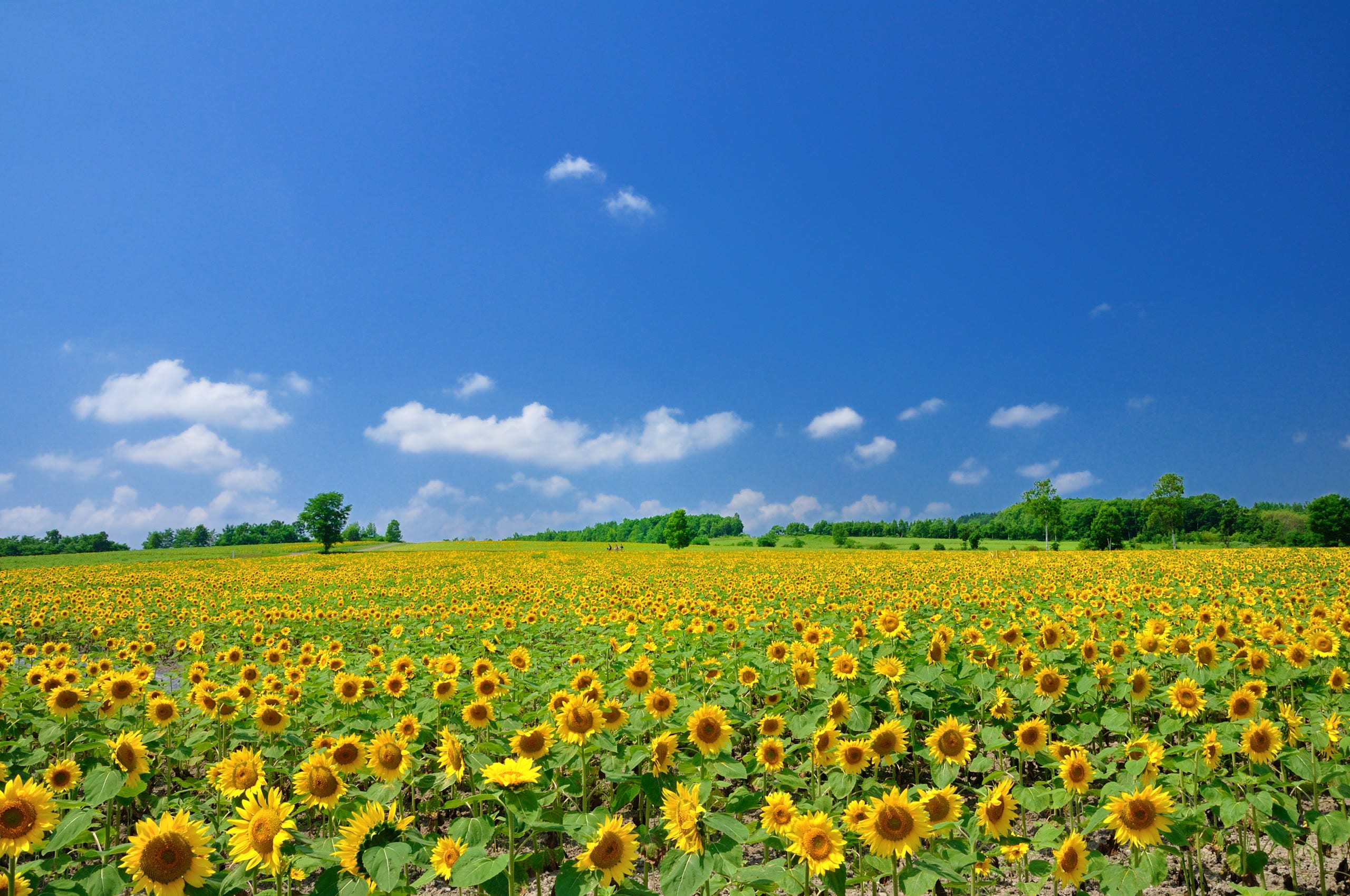
While Kyoto is at 32°C, Hokkaido is mild. The lavender on the hills at Furano is in colour through July, in bands of purple beside the red of the poppies and the white of the baby's breath. At Farm Tomita in Nakafurano, where the fields were first planted for the perfume industry and kept on after it had gone, the hillside rows run down towards the Tokachi range. The air at Asahidake in the Daisetsuzan mountains is cool enough for a jacket.
the weather
July weather: the rains end and the heat begins
Kyoto, closed in by its hills, is the hottest of the three cities in July: 32°C (90°F) by day and 23.6°C (74°F) at night on the Meteorological Agency's 1991 to 2020 normals, against Tokyo's 29.9°C and 22.4°C (86°F and 72°F), where the sea breeze takes a little of the edge off. Sapporo, at 25.4°C and 17.9°C (78°F and 64°F), has the warm, dry days of a northern summer.
the calendar
Marine Day and the school holidays
Marine Day, a national holiday, falls on the third Monday of July. The streets of central Kyoto fill on the evenings before 17 July and on the morning of the procession, and the city's hotels are full for all of it. The school summer holidays begin around 20 July, and travel inside Japan rises with them.
The Hokkaido summer tour, July 2027 →
the journeys
Hokkaido tours in July
Two journeys go north into that cool July air. The Summer Tour of Hokkaido departs for the second time in 2027 from 11 to 22 July, twelve days that give a day to the lavender of Furano in the older fields away from the farm shop, two nights to Lake Shikotsu in a suite with its own open-air onsen at the water's edge, and a night above Lake Toya, where fireworks open over the caldera every night of the summer and are watched from the onsen on the terrace. On this July departure alone, the journey can carry on east for three days to Lake Akan and the marshes of Kushiro.
The Wild North Tour of Hokkaido follows from 27 July to 6 August 2027. It opens in the alpine country of Daisetsuzan, where a ropeway lifts guests above the Sounkyo gorge to slopes still threaded with steam, then gives three nights to the World Heritage coast of Shiretoko, read from the calm of a boat, before the blue-black of Lake Mashu and a living Ainu community on the shore of Lake Akan. Both tours are limited to 8 guests, with Tour Directors who travel every mile beside them.