
Japan in November is the month of the maples. The colour that began on the mountains of Hokkaido in September reaches Tokyo and Kyoto in the second half of the month, and the temple gardens turn red and gold: the valley of two thousand maples below the Tsutenkyo Bridge at Tofuku-ji, the hillside of Eikan-do, and the moss under the trees at Sanzen-in in Ohara. The Japanese have gone out to look at them since the Heian court rode into the hills to answer the leaves with poetry, and the word for it, momijigari, the hunt for the maples, is still used.
kyoto
Kyoto in the maples
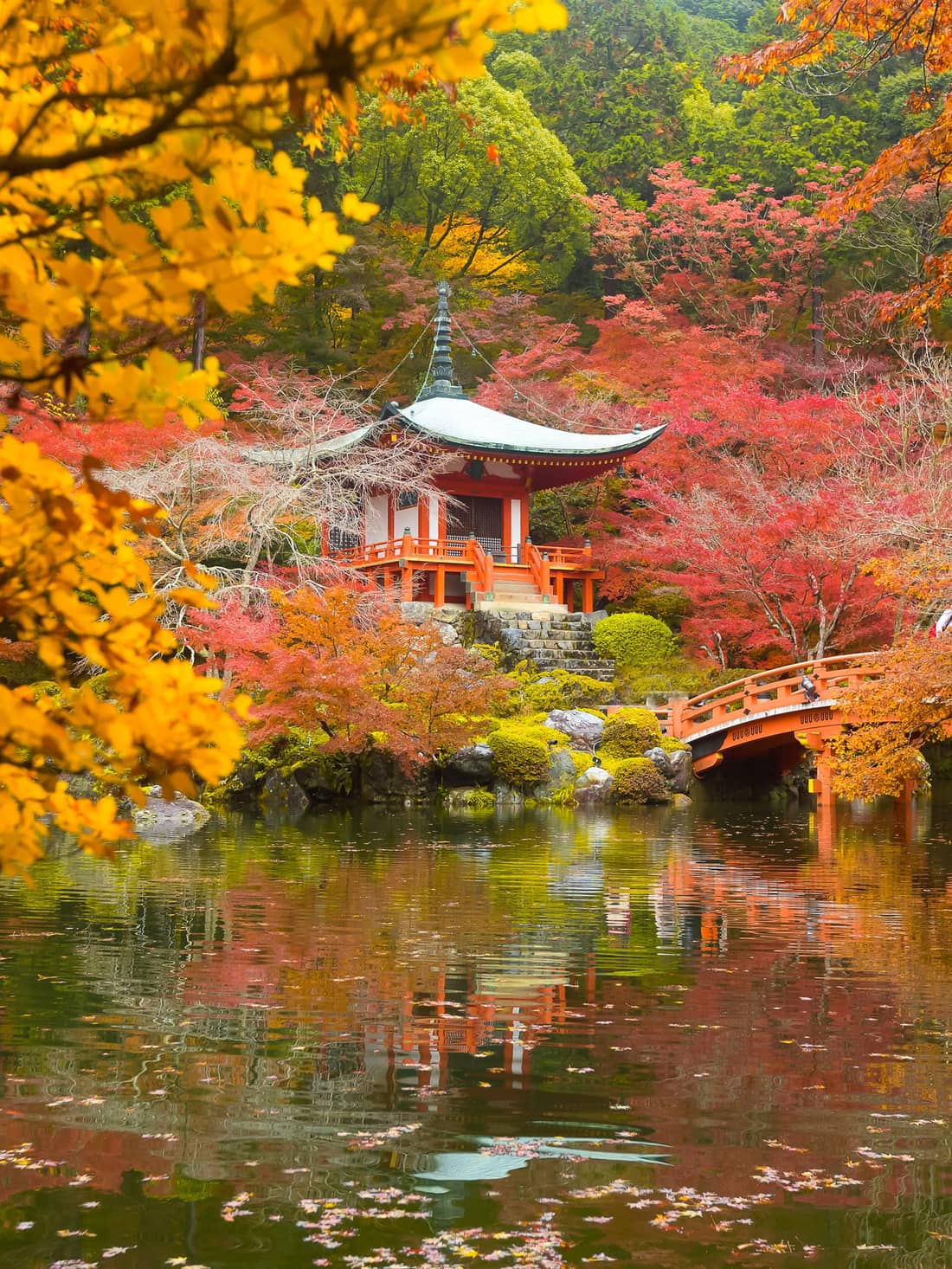
Eikan-do, whose full name is Zenrin-ji, has long been called Momiji no Eikan-do, Eikan-do of the maples, and some three thousand trees stand around its pond and climb the hill to its pagoda. In the evening the garden opens again for a lit viewing, and the maples are doubled in the dark water of the pond.
On the second Sunday of the month Arashiyama stages its Momiji Matsuri, and boats carrying musicians and dancers in the costume of the court drift on the Oi river below the maple-covered slopes of Mount Arashi, in thanks to the god of the mountain for its colour. In the first ten days of November the geiko and maiko of Gion Higashi dance the Gion Odori at the Gion Kaikan, beside Yasaka Shrine, the only one of Kyoto's five geisha dances staged in the autumn.
On 15 November, Shichi-Go-San, families take their children to the shrines in kimono to give thanks for their health, and the children carry long bags of red and white chitose-ame, the thousand-year sweet. In the same weeks the pickle shops of Kyoto begin to sell senmaizuke, the Shogoin turnip sliced so thin it is translucent and pickled with kelp and a little vinegar, a taste the city keeps through the winter.
tokyo
Tokyo in gold
Tokyo's autumn colour is yellow. The avenue at Jingu Gaien runs between two lines of ginkgo, a hundred and forty-six trees clipped to a tapering shape and planted in order of height so that the avenue seems longer than it is, and when the leaves fall they cover the pavement in gold. On the days of the rooster in November, by the old calendar two or three in a month, the Otori shrines stage the Tori no Ichi, and at the one in Asakusa the stalls sell kumade, bamboo rakes decorated with masks, gold coins and rice sheaves, to rake in the coming year's fortune. When a sale is made, the stallholders clap it out in unison.
the season
The Japan Sea and the north
On 6 November the crab season opens on the Japan Sea, and the first matsuba crab of the winter comes into the harbours of the San'in coast. Further east, in Ishikawa, the same day brings the kobako-gani, the small female snow crab, which is landed only until 29 December; the Kanazawa kitchens pick it and pack the shell with its own orange roe and the brown miso, and serve it cold with a little vinegar. In Kanazawa the gardeners of Kenroku-en begin to tie the yukitsuri, the ropes that protect the pines through the snow, from 1 November.
The far north still has its colour in the first days of the month. The Oirase gorge in Aomori runs for fourteen kilometres (nine miles) of waterfalls under beech and maple, a stream walked beside on a path that stays close to the water the whole way.
the weather
November weather: cool and clear
The nights cool quickly in November, and the change in temperature between day and night is what turns the maples. On the Meteorological Agency's 1991 to 2020 normals Kyoto drops from 17.3°C (63°F) by day to 8.4°C (47°F) at night, and Tokyo from 16.7°C (62°F) to 8.8°C (48°F). Sapporo is at 8.7°C and 1.6°C (48°F and 35°F), and the first snow of the winter has usually fallen there by the time the month begins.
the calendar
Two holidays, and the busiest weeks in Kyoto
Culture Day on 3 November and Labour Thanksgiving Day on 23 November are national holidays. November is the busiest month of the year in Kyoto after April; the temples in the east of the city, Tofuku-ji and Eikan-do among them, are crowded while the maples are in colour.
Japan autumn tours 2027, side by side →
the journey
Travelling in Japan in November
November opens with The Autumn Leaves Tour of Northern Japan, from 2 to 13 November 2027, which follows the last and deepest colour of the north from the mountains above Sapporo down to the valleys of Yamagata. It walks the Oirase gorge stretch by stretch, the car waiting at each, spends two nights in the beech forest at Nyuto Onsen, and closes at the gas-lit valley of Ginzan and on a private wooden boat down the Mogami River, through the canyon the poet Basho descended in 1689. It is limited to 8 guests.
Kyoto in its maples, from the lit pond at Eikan-dō to the Gion Odori and the first senmaizuke in the pickle shops, is travelled on the Custom Tour of Japan, a private journey designed for one party on its own dates, from five nights.