
Japan in August is the hottest month of the year in Tokyo and Kyoto, and the month of Obon, when families return to the towns they came from to welcome home the spirits of their ancestors. For a few days in the middle of the month the offices empty, the trains to the provinces are full, and the cemeteries are swept and hung with lanterns. On the night of 16 August Kyoto sends the spirits back: fires are lit on five mountains around the city, and the great character dai, meaning large, burns on the slope of Daimonji above the eastern edge of the city.
obon
Calling the ancestors home in Kyoto
Obon in Kyoto begins a week early, at a small temple on the road up to Kiyomizu-dera. Rokudo Chinno-ji stands where medieval Kyoto believed the border between this world and the next ran, and from 7 to 10 August the people of the city queue at its gate to ring the mukae-gane, the welcoming bell. The bell hangs out of sight inside its tower, and it is rung by pulling a rope that runs through a hole in the wall, so that the sound comes out of the dark; the spirits are said to hear it and find their way home. The families buy sprigs of koyamaki, a kind of umbrella pine, on the way out, for the spirits to ride on.
16 august
The five fires
The Gozan no Okuribi is lit on the evening of 16 August, beginning at eight o'clock with Daimonji in the east and passing round the city in a slow circle, each fire following a few minutes after the last. The characters myo and ho come next, on two hills to the north, then the outline of a ship, funagata, then a second dai on the mountain to the north-west, hidari daimonji, and last the torii gate of Toriigata above Saga. Each burns for about half an hour. They are watched from the banks of the Kamo river, from rooftops, and from the upper rooms of the ryokan and restaurants along the water, and the old custom is to catch the reflection of the dai in a cup of sake and drink it, for a year's good health.
A week later, on 23 and 24 August, the temple of Adashino Nenbutsu-ji in the far west of Arashiyama lights a candle before each of its eight thousand small stone Buddhas and memorial stones, gathered over the centuries from the graves of people whom no family remembered. The Sento Kuyo, the service of a thousand lights, takes place after dark, and the field of flickering stone is one of the quietest sights of the Kyoto summer.
the festivals
The summer festivals of the north
The first week of August belongs to Tohoku, and three of its great festivals fall within days of each other. In Aomori, from 2 to 7 August, the Nebuta carries huge illuminated figures of warriors and gods, built of painted paper over wire frames, through the streets at night to drums and flutes. In Akita, from 3 to 6 August, the Kanto festival raises bamboo poles hung with dozens of lit paper lanterns, some of them twelve metres (forty feet) tall, and the performers balance them on a palm, a forehead, a shoulder or the small of the back. In Sendai, from 6 to 8 August, the Tanabata festival hangs the arcades of the city centre with great streamers of paper, like vast paper jellyfish, each made by the shops beneath it.
In the middle of the month the people of Tokushima, on Shikoku, dance the Awa Odori from 12 to 15 August, four nights of dancing groups moving through the town in straw hats and cotton kimono to shamisen, drums and flutes. And every week of August there are fireworks somewhere, over rivers and bays, with the crowds dressed in yukata on the banks.
hokkaido
The cool of the north
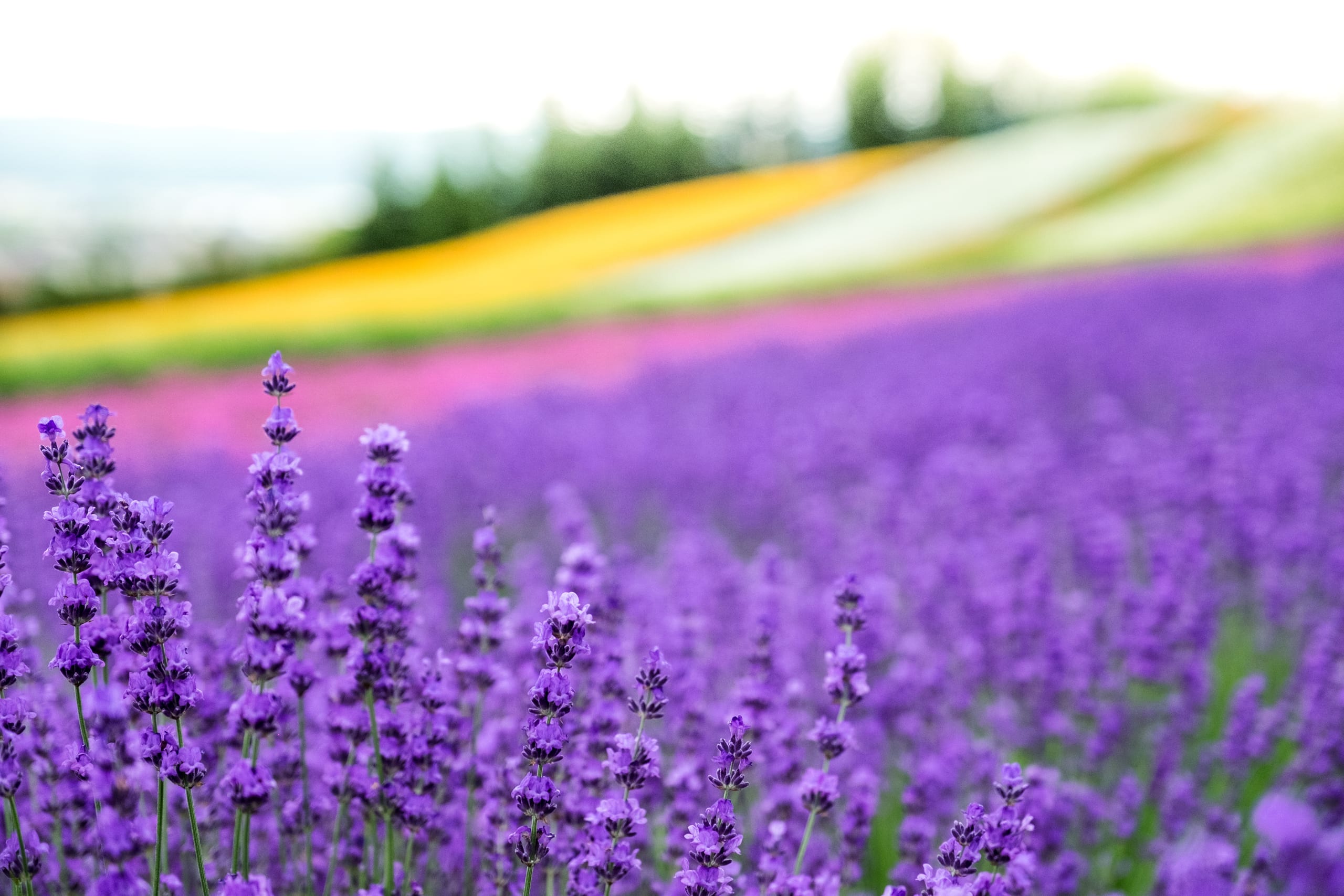
Hokkaido is the coolest place in Japan in August, with a Sapporo afternoon some seven degrees cooler than one in Kyoto. The sunflowers and the late lavender are out in the fields around Biei and Furano, and at Hokuryu, west of Asahikawa, some one and a half million sunflowers cover a single hillside. On the Shiretoko peninsula at the north-eastern tip of the island the cliffs of the World Heritage coast fall straight into the Okhotsk Sea.
At the table August is the month of white peaches from Okayama and Yamanashi, and of kakigori, shaved ice as fine as snow, poured with green tea syrup in Uji or with fresh fruit in Tokyo. In Hokkaido it is the season of the Yubari melon, grown in a former coal town in the hills east of Sapporo, with orange flesh and a netted rind, and sold in pairs in wooden boxes.
the weather
August weather: the hottest month
Kyoto in August is the hottest of the country's great cities, a basin in which the heat settles and stays: on the Meteorological Agency's 1991 to 2020 normals its days reach 33.7°C (93°F) and its nights do not fall below 24.7°C (76°F). Tokyo is at 31.3°C and 23.5°C (88°F and 74°F), and the humidity is high in both. Sapporo, at 26.4°C and 19.1°C (80°F and 66°F), is the relief.
the calendar
Obon week and Mountain Day
Mountain Day, the national holiday on 11 August, opens the Obon break for many. Obon week, around 13 to 16 August, is one of the three great travel weeks of the Japanese year, with Golden Week and the New Year, the trains and domestic flights full in both directions, and many small family restaurants and shops close while their owners go home. The centres of Tokyo and Osaka are quieter than usual during the week itself, because so many of the people who live there have left.
the journey
A Hokkaido tour into early August
The Wild North Tour of Hokkaido spends the turn of the month in the coolest country in Japan, eleven days from 27 July to 6 August 2027. It gives three nights to Utoro on the Shiretoko coast, where a boat runs quietly beneath the cliffs of the World Heritage shore, its engine idled to a hush, while eagles turn overhead, whales roll in the strait and a brown bear works the green tideline with no interest in the boat at all.
From there the road crosses the caldera country, past the blue-black of Lake Mashu, to two nights beside a living Ainu community of carvers on the shore of Lake Akan, then a day in the great Kushiro wetland of the red-crowned crane. The journey closes on Lake Shikotsu, with three nights in a suite whose open-air onsen faces the clearest water in the north, as the rest of Japan settles into its hottest month. It is limited to 8 guests, and its Tour Directors travel every mile of it beside them.