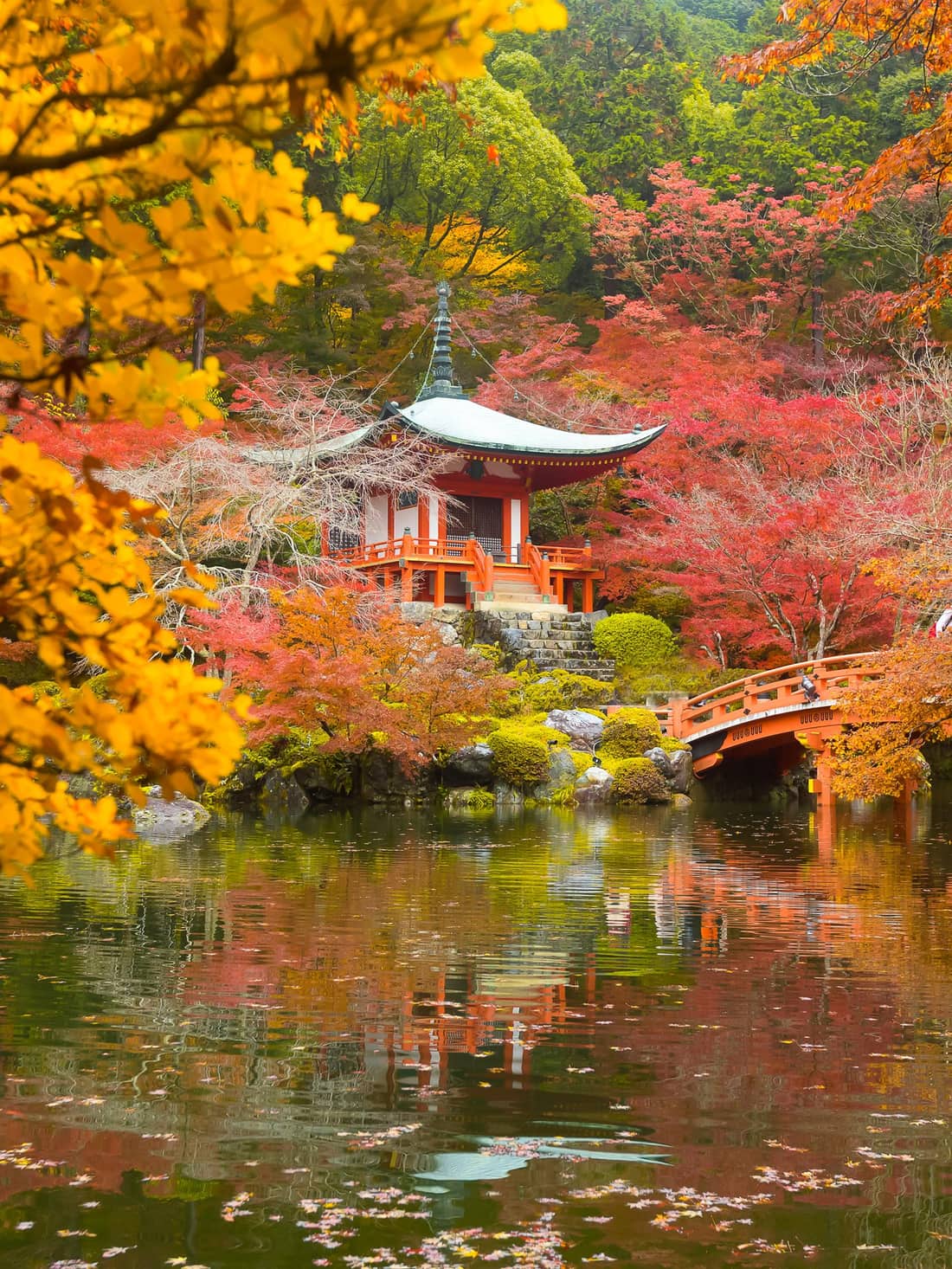

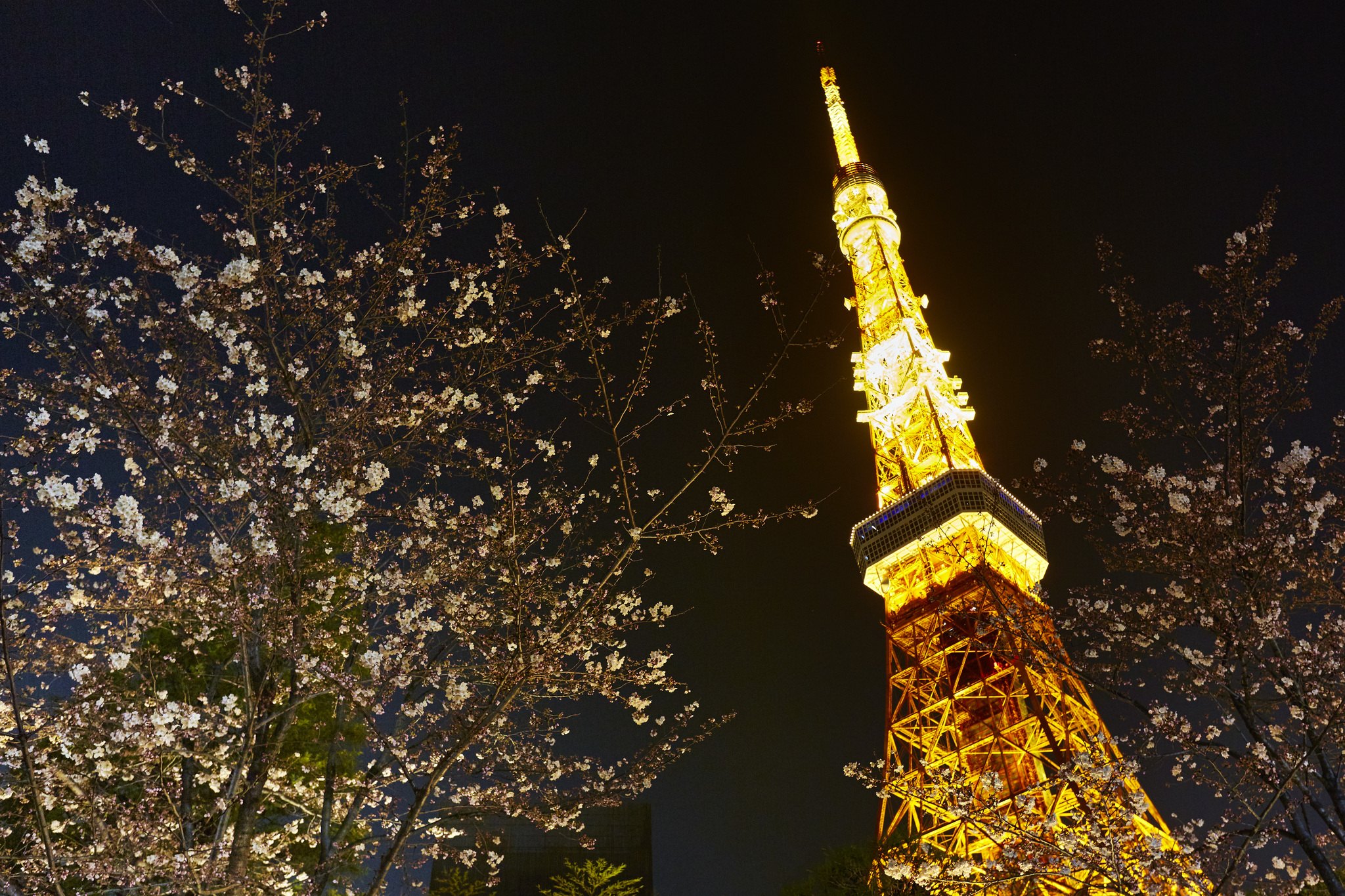
Twelve days carry a cherry blossom journey through Japan with room to breathe: three nights in Tokyo, two at the foot of Mount Fuji, three in Kyoto, one at the onsen town of Kinosaki on the Japan Sea, and two in Osaka. The route runs west from the capital, where the trees open a few days ahead of Kyoto's, to the mountain, the old capital and the sea, and it ends a short drive from Kansai's international airport.
The shape matters more than the stops. Most spring itineraries of Japan list the same names; the good ones decide how long to stay in each, where to stop moving, and which afternoon to leave empty. What follows is the route in that spirit, place by place, with the reasons.
| Days | Place | Nights | The cherry blossom there |
|---|---|---|---|
| 1 to 3 | Tokyo | 3 | The Chidorigafuchi moat, the Meguro river, Yoyogi Park, Ueno |
| 4 and 5 | Mount Fuji | 2 | The Chureito Pagoda above Fujiyoshida, with Fuji behind it |
| 6 to 8 | Kyoto | 3 | The Keage Incline, Maruyama Park, the Imperial Palace park, the canals of Gion |
| 9 | Amanohashidate and Kinosaki Onsen | 1 | The willow and cherry canal of Kinosaki |
| 10 and 11 | Osaka | 2 | Osaka Castle Park, the Okawa riverbanks |
| 12 | Osaka to the airport |
This is the route The Classic Cherry Blossom Tour of Japan takes, from 30 March to 10 April 2027, by Luxury Japan Travel, for 8 guests.
tokyo
Tokyo: three nights for the capital's moats and rivers
Tokyo comes first because it opens the season. On the Japan Meteorological Agency's thirty-year record, the standard tree at Yasukuni Shrine flowers around 24 March and reaches full bloom around 31 March, a few days ahead of Kyoto, and the city holds its cherry blossom along water: the old moats of the Imperial Palace, the Meguro river in Nakameguro, the Sumida in Asakusa.
Three nights are the right number. One afternoon goes to hanami proper, a rug on the grass at Yoyogi Park under the Somei Yoshino; one morning goes to the Chidorigafuchi moat, where the branches lean far out over the water and the rowing boats sit beneath them; one day goes to the older city, Asakusa and the temple lanes of Yanaka, where the cherry avenue through Yanaka Cemetery draws the whole neighbourhood out each spring. The first night is for arriving. Nothing else.
fuji
Mount Fuji: two nights at the foot of the mountain
From Tokyo the shinkansen runs south-west along the Tokaido line to Mishima, the station for Fuji, and the road climbs from there to the Fuji Five Lakes. Two nights here, never one. Fuji hides behind cloud for days at a time, and two days give the mountain two chances to show itself clear, from the room's own open-air bath with Fuji in view.
The picture everyone has seen is taken here, at Arakurayama Sengen Park above Fujiyoshida: the five-storey vermilion Chureito Pagoda, the cherry trees on the slope below it and Fuji perfectly centred behind. The climb is 398 stone steps through some 650 cherry trees to the platform beside the pagoda, built in 1962 as a memorial to the city's war dead. The cherries on the mountain's cooler slopes open later than the capital's, in early to mid-April by Yamanashi Prefecture's own reckoning, and the mountain and the pagoda are the reason to come; blossom on the slope is the gift on top.
kyoto
Kyoto: three nights at the centre of the journey
Kyoto is the reason most people make the journey, and it gets the most nights. Its standard tree flowers around 26 March and reaches full bloom around 4 April in an average year, and for that week the city gives itself to the season: the canopy closing over the old cargo slope of the Keage Incline, the weeping cherry of Maruyama Park, the Shirakawa canal running between willow and cherry below the teahouses of Gion.
Three nights allow three different Kyotos. A day for the great sights: the vermilion torii of Fushimi Inari, in their thousands up the mountain, Nanzen-ji and the incline, the Golden Pavilion at Kinkaku-ji. A day for the quieter gardens, chosen for where the season stands, and a long hanami in the park of the Kyoto Imperial Palace, where the city's own families come with their rugs. And one evening in Gion, inside a teahouse rather than outside it, with geiko and maiko.
The east of the city is the place to stay. A hotel in Gion or Higashiyama puts the lanes, the canals and the evening at the door.
kinosaki
Kinosaki Onsen: one night on the Japan Sea
Kinosaki is the stop that changes the rhythm of the journey. North of Kyoto, the road crosses to the Japan Sea by way of Amanohashidate, a 3.6-kilometre sandbar of some five thousand pines across Miyazu Bay, counted with Matsushima and Miyajima among the three great views of Japan. Beyond it lies Kinosaki, an onsen town of willow, stone bridges and seven public bathhouses, where guests leave the ryokan after dinner in yukata and wooden geta and walk from bath to bath along the canal while the cherry trees lean over the water.
One night is enough. After eight days of cities, a ryokan dinner of the San'in spring and a morning bath before breakfast reset the pace for the last stretch.
osaka
Osaka: two nights to finish
The road south from Kinosaki ends at Osaka Castle, its keep above a park of some three thousand cherry trees and the great stone walls of its moats. Toyotomi Hideyoshi began the castle in 1583; the present keep, rebuilt in 1931 with the donations of the city's own people, rises 55 metres above Nishinomaru Garden and its three hundred trees. Osaka's own trees reach full bloom around 4 April on the long-run average, the same week as Kyoto's, and the city keeps one more surprise: the Japan Mint's riverside avenue of late, double-flowered cherries, opened to the public for a single week in mid-April.
Two nights let the journey end slowly: a morning in Minami along the Dotonbori canal, an afternoon free for the cherry banks of the Okawa or for nothing at all, and a last dinner at a sushi counter. The airport is an easy drive the next morning.
the journeys
Between the stops
The distances are short and the trains are fast, which is why the route works in twelve days. Tokyo to Mishima, the station for Fuji, is about forty minutes on the Hikari shinkansen, and the road from Mishima to Fujiyoshida about fifty kilometres. From Mishima, the Tokaido line reaches Kyoto in about two hours. Kyoto to Amanohashidate is about two hours, and from Kinosaki the road runs south through the Hyogo mountains to Osaka.
Two habits keep those days easy. The first is the Green Car, first class on the shinkansen, where the seats are wide and the carriage quiet even in the busiest week of the year. The second is the luggage sent ahead: Japan's forwarding services carry a suitcase from one hotel to the next overnight, so the party moves through the country with nothing heavier than a coat.
shorter or longer
Ten days, or two weeks
With ten days, Kyoto keeps its three nights and Fuji its two, and Tokyo and Kinosaki give up a night each. The nights never come from Kyoto.
With two weeks or more, the season continues south and west. Nara's deer move beneath the cherry trees among its great temples, and the mountain of Yoshino above it holds some thirty thousand cherry trees in four bands up the slope, flowering from the foot to the summit between late March and mid-April. Beyond lie Hiroshima and the island of Miyajima, where the great vermilion torii of Itsukushima stands out in the tide.
the tour
The Classic Cherry Blossom Tour of Japan follows this route
This is the route of The Classic Cherry Blossom Tour of Japan, from 30 March to 10 April 2027: three nights in Tokyo, two at Mount Fuji, each room with its own open-air bath with Fuji in view, three in Kyoto, one in Kinosaki and two in Osaka. You stay in the finest luxury hotels and ryokan in Japan, each one chosen personally by us for its luxury, its comfort and its setting. It travels first class on the shinkansen, sends the luggage ahead on the long days, and sits down twice for hanami, at Yoyogi Park and in the Kyoto Imperial Palace park, with bentos from Michelin-starred kitchens.
It is limited to 8 guests and guaranteed to run from two, led every day by Luxury Japan Travel's own Tour Directors. One extension carries it on to Nara, Yoshino, Hiroshima and Miyajima.
questions
Questions
How many days does a cherry blossom trip to Japan need?
Twelve days give the season room: three nights in Tokyo, two at Mount Fuji, three in Kyoto, one at Kinosaki Onsen and two in Osaka. Ten days work if Kyoto keeps its three nights.
What is the best route for cherry blossom in Japan?
Tokyo first, where the trees reach full bloom a few days before Kyoto's on the long-run average, then Mount Fuji, Kyoto and Osaka. A night on the Japan Sea at Kinosaki Onsen, between Kyoto and Osaka, breaks the cities.
How many nights does Kyoto need in cherry blossom season?
Three. One day for the great sights, one for the quieter gardens and a long hanami, and one evening in Gion.
Should a cherry blossom trip to Japan begin in Tokyo or Osaka?
Begin in Tokyo and end in Osaka. Tokyo's trees reach full bloom a few days before Kyoto's and Osaka's in an average year, and Kansai's airport sits an easy drive from Osaka at the end.