
The right Japan itinerary for ten days is three nights in Tokyo, three in Kyoto with a day in Nara, two at a ryokan in the onsen town of Kinosaki and one in Osaka, flying in to Tokyo and home from Kansai. Nine nights, four hotels, three train journeys in first class, and the luggage sent ahead every time.
Somewhere past Fukuchiyama, on the seventh afternoon, the limited express leaves the last of the towns behind and follows the Maruyama River north between cedar slopes towards the Sea of Japan. That morning was a tea room in Kyoto. By late afternoon there is a yukata laid out on the tatami at Kinosaki, and the willows along the canal are moving in the wind off the coast. Ten days is the shortest journey with room for that afternoon.
the length
Is 10 days enough for Japan?
Yes. Ten days is enough for Tokyo, Kyoto, Nara, a ryokan and Osaka, and it is the shortest length at which a journey to Japan includes a night on tatami without cutting Kyoto short. It is not enough for Mount Fuji and Kinosaki and Hiroshima together: each of those adds two nights, and a ten-day route takes one of them, never three.
The arithmetic is plain. Ten days is nine nights. Tokyo needs three, because the first is lost to the flight. Kyoto needs three, because Nara takes a whole day of its own. That leaves three, and the strongest use of them is two at an onsen ryokan and a single night in Osaka, close to Kansai International Airport for the flight home. A shorter week keeps to the cities; a fortnight adds Mount Fuji and slows every stop.
day one
Day one: arriving in Tokyo, Nihonbashi
From Haneda the car reaches Nihonbashi in about half an hour. The hotel occupies the upper floors of a tower in Nihonbashi Muromachi, the old merchant quarter of Edo, with Tokyo Station a short walk away and an underground passage to the Mitsukoshimae subway. It is the right address for a ten-day route because the shinkansen on day four is ten minutes from the lobby.
The first evening is a short walk to the bridge that gave the district its name. Tokugawa Ieyasu raised the first Nihonbashi in 1603 and made it the point from which the five great roads out of Edo were measured; the stone arch there now dates from 1911, and a bronze plate set in the road marks kilometre zero for the national highways of Japan.
One level up, the stay moves to the palace moat in Marunouchi, fifteen minutes' walk away, the rooms turned to the old stone walls.
day two
Day two: the palace gardens, Ginza and Tsukiji
The East Gardens of the Imperial Palace open on the old ground of Edo Castle, and they close on Mondays and Fridays, so the two Tokyo days are ordered around them: if the second day falls on a closing day, the gardens move to the third. From the Otemon gate the paths climb through the old enclosures to the stone base of the keep. The great fire of 1657 destroyed the tower, the base was relaid within a year, and the keep itself was never raised again: the shogun's council judged that a country at peace no longer needed it.
Ginza is a walk south, its department-store food halls on the lower floors and its galleries in the side streets. Beyond it lies the Tsukiji Outer Market, about 460 shops packed into a few blocks: knife makers, kelp and bonito merchants, tea dealers, and counters where tamagoyaki comes off long copper pans in folded layers. Lunch is eaten standing, a skewer and a cup at a time.
day three
Day three: Senso-ji, Asakusa and Meiji Jingu
Asakusa is entered under the Kaminarimon, whose red paper lantern stands 3.9 metres high and weighs about 700 kilograms, with the gods of wind and thunder in their bays on either side. Nakamise-dori runs on to Senso-ji. Behind the main hall, the side streets of Asakusa keep the workshops of the old city: makers of brushes, of wooden combs, of the rice crackers toasted over charcoal at the shopfront.
The afternoon crosses the city to Meiji Jingu. The great torii on its gravel approach is the largest wooden torii of the myojin style in Japan, twelve metres high, cut from a single Japanese cypress some 1,500 years old and raised in 1975 after lightning destroyed the first gate in 1966. The evening is Shibuya, a few minutes south, its crossing seen from above as the lights change.
day four
Day four: by Nozomi to Kyoto, Kiyomizu-dera and Gion
The Nozomi from Tokyo reaches Kyoto in about 130 minutes. In first class the seats run two and two, and seat D, on the right side heading west, is the one for Mount Fuji: about forty minutes out, around Shin-Fuji, the mountain stands clear of the rice fields for a few minutes on a fine day. The luggage has gone ahead by road and is waiting in the room.
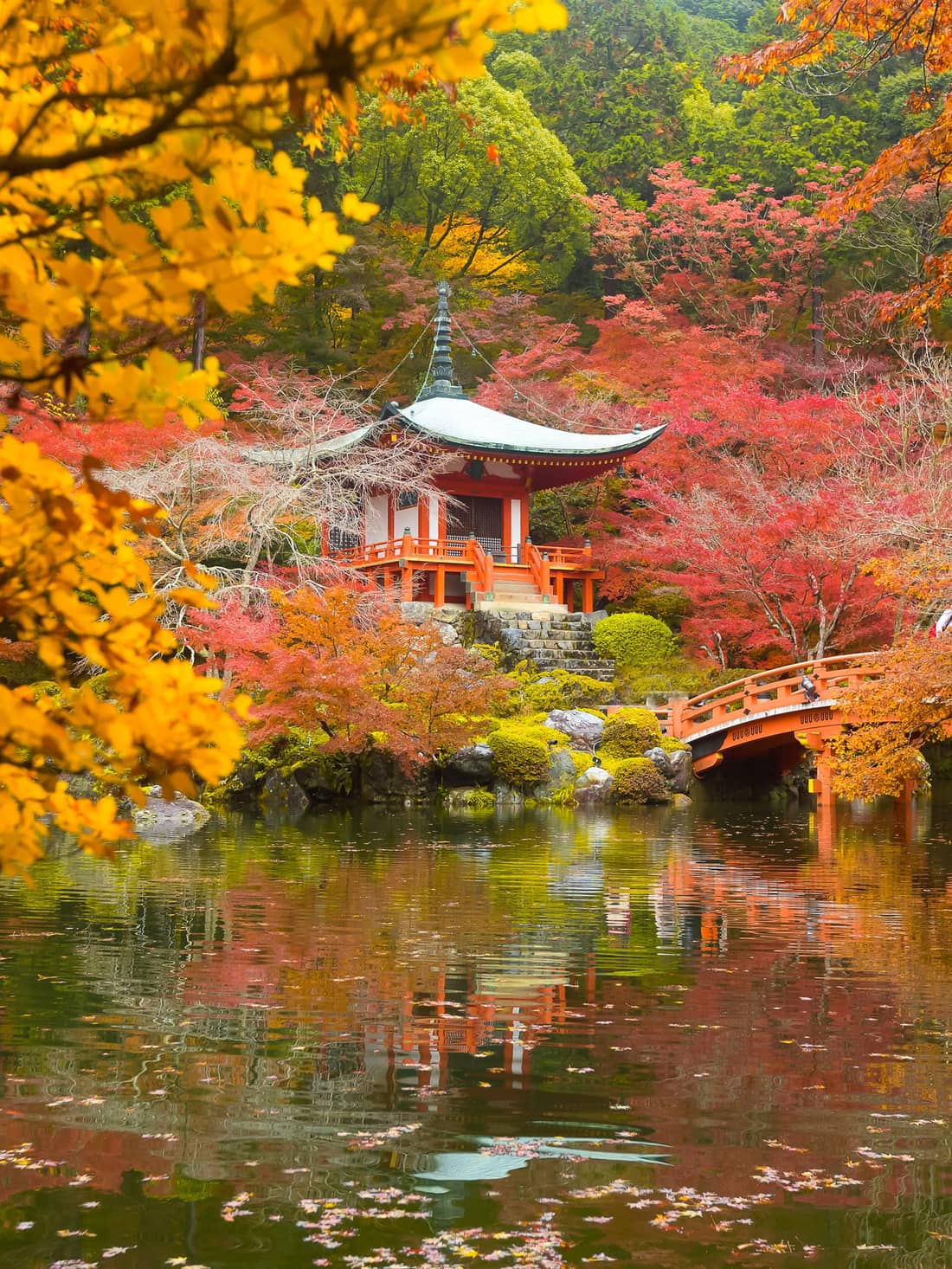
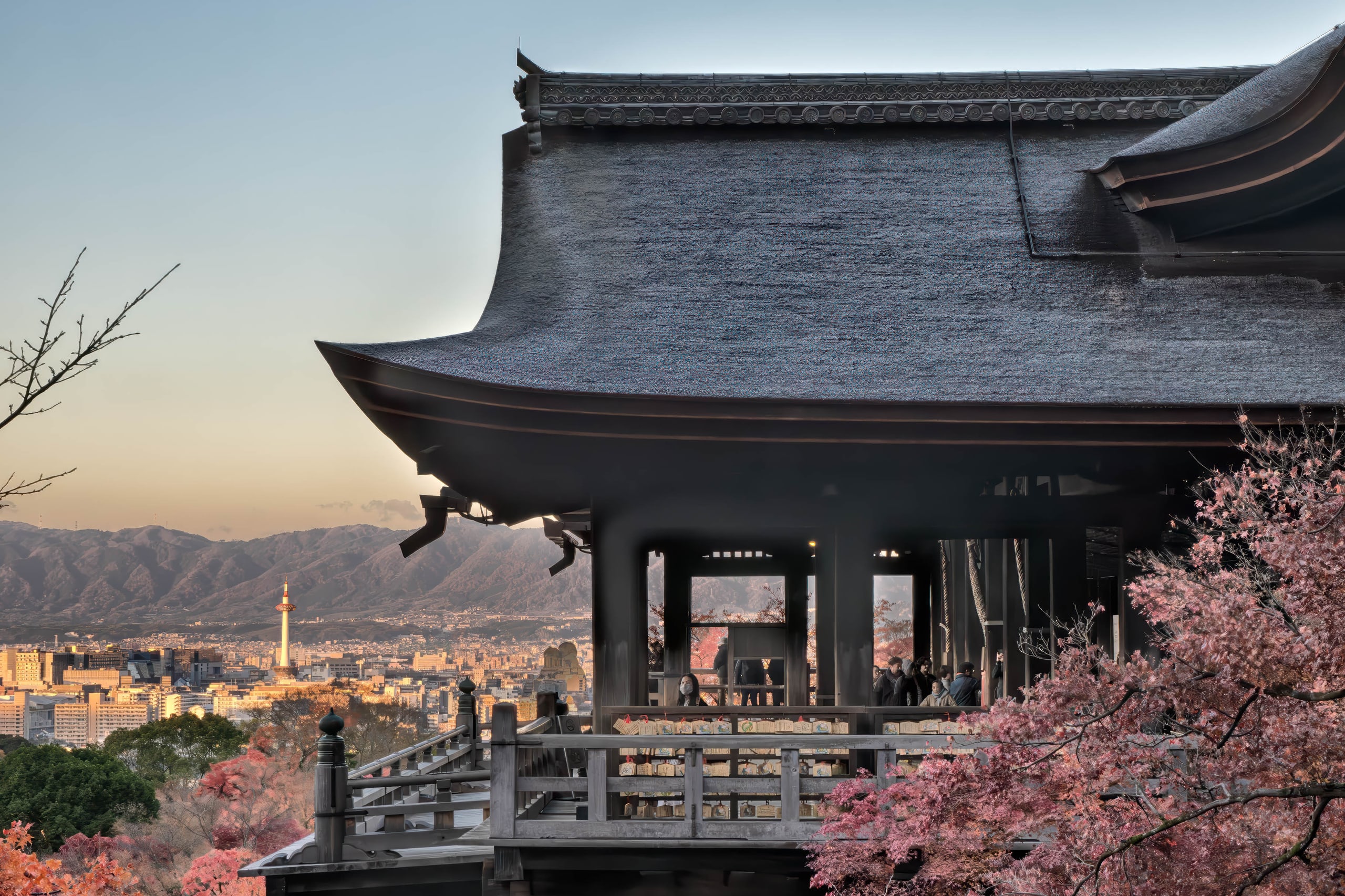
The Kyoto hotel stands in Higashiyama, between Yasaka Shrine and Kodai-ji, and from its door the stone slopes of Ninenzaka and Sannenzaka climb to Kiyomizu-dera. The temple was founded in 778; its main hall was rebuilt in 1633, and the stage that projects from it stands nearly thirteen metres above the slope on eighteen pillars of zelkova, joined without a single nail. To jump from the stage of Kiyomizu is still the Japanese phrase for a decision taken with the whole heart.
The evening goes downhill into Gion, along Hanamikoji and the Shirakawa canal, as the teahouse lanterns are lit.
One level up, the stay is a pavilion in the north-west of the city, in a forest garden of thirty-two hectares at the foot of Hidari Daimonji, a few minutes from Kinkaku-ji.
day five
Day five: Kinkaku-ji and Arashiyama
Kinkaku-ji began as the retirement villa of the shogun Ashikaga Yoshimitsu, who took the estate in 1397. The gold pavilion seen today is younger than it looks: a novice monk burned the original in 1950, and the present building was completed in 1955. The garden around the pond is the old one.
Arashiyama fills the afternoon, on the western rim of Kyoto where the Katsura River leaves the hills. The bamboo grove runs along a path between tall green stems that close overhead, and Togetsukyo, the moon-crossing bridge, carries a name the Emperor Kameyama gave it after watching a full moon seem to cross it from a boat. It is 155 metres long; the present bridge dates from 1934, and only its railings are cypress, over a frame of concrete.
day six
Day six: Fushimi Inari, Nara and sake in Fushimi
Fushimi Inari lies in the south of Kyoto on the road to Nara, and the two belong to the same day. The shrine was founded in 711 and is the head of some 30,000 Inari shrines across Japan; more than 10,000 vermilion torii climb Mount Inari behind it, each one the gift of a business or a family.
Nara is about an hour beyond. Before the Great Buddha comes the Nandaimon, Todai-ji's great south gate, completed in 1203, where two guardian kings of wood stand just over 8.4 metres tall in the bays; the sculptors Unkei and Kaikei and their workshop carved them in sixty-nine days. The deer of the park, 1,465 of them at the count of July 2025, are regarded as messengers of the gods, since the deity of Kasuga Taisha is said to have come to Mount Mikasa riding a white deer.
On the way back, Fushimi itself, the brewing district below the shrine, where nearly forty breweries draw on the soft water beneath the town. A tasting there sets the district's sake side by side, and the willow-lined canal runs past the old brewery walls of black timber.
day seven
Day seven: tea, Nishiki Market and the train to Kinosaki
The last Kyoto morning is the tea ceremony: a tatami room, the host's kettle on a sunken hearth or a brazier depending on the month, the bowl turned so that its front faces the guest before it is set down. It lasts about an hour and is slow by design.
Nishiki Market follows, the covered street the city calls Kyoto's kitchen: about 400 metres long and less than four wide, its stalls selling pickles, dried fish, tofu skin, knives and Kyoto vegetables. The custom here is to eat what is bought at the stall that sold it, never on the move, and the street is better for it.
The limited express Kinosaki leaves Kyoto Station in the afternoon and reaches Kinosaki Onsen in about two and a half hours, with a first-class carriage on board. The line runs through the hills of Tanba and Tajima, and the cases have gone ahead to the ryokan.
day eight
Day eight: Kinosaki Onsen and a ryokan of seven generations

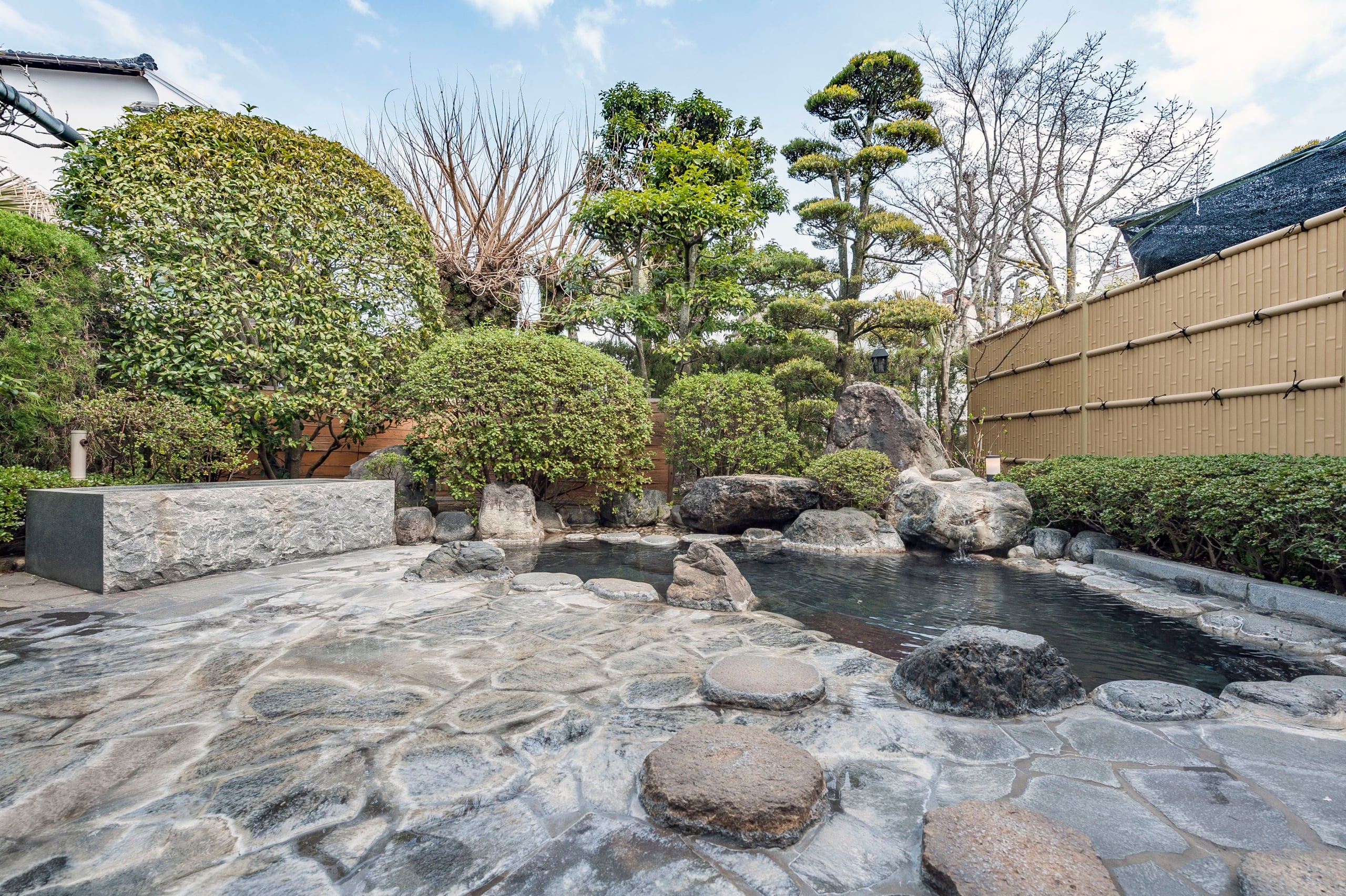
The ryokan has been kept by one family through seven generations, and its tatami rooms open onto a garden of pines, moss and stone lanterns. Kinosaki is the kind of town where the street is part of the ryokan: guests walk out in yukata and wooden geta to the seven public bathhouses along the willow-lined canal, and each bathhouse keeps its own closing day in the week, so the round changes with the calendar. One level up, the stay is a suite at the same ryokan, or its sister ryokan, kept by the same family in forest on the edge of the town.
The ropeway climbs Mount Daishi from beside the temple gate in about seven minutes. At the middle station stands Onsen-ji, the temple that has guarded the springs for centuries; at the summit, on a clear day, the Maruyama River runs out to the Sea of Japan below the deck. The novelist Shiga Naoya came to Kinosaki for three weeks to recover from an accident in Tokyo, and the short story he wrote from that stay, At Kinosaki, has kept the town on the map of Japanese letters ever since.
From the summit in the late afternoon, the town below is a line of grey tile roofs along the canal, steam rising from the bathhouse chimneys, and the river runs out silver to the sea.
Both dinners are kaiseki at the ryokan, Tajima beef among the courses.
day nine
Day nine: the Kounotori to Osaka, the castle and Dotonbori
The limited express Kounotori runs from Kinosaki Onsen to Osaka Station in about two hours and forty minutes, first class again, and once more the luggage travels separately. The hotel stands on the edge of Osaka Castle Park, and the castle keep rises over the trees outside the windows on the park side.
Toyotomi Hideyoshi began the castle in 1583, on the site of a fortified temple, to be the seat of a Japan he meant to rule entire, and an hour on the paths inside its moats explains the scale of that ambition better than any museum case. In the evening, Dotonbori: a canal dug between 1612 and 1615, now lined with the lit signs of the city's appetite, and the counters where takoyaki is turned in its iron moulds as it is ordered.
One level up, the stay is on the Okawa River in the north of the city, its upper floors over the water.
day ten
Day ten: Kuromon Market and home from Kansai
The last morning is Kuromon Market, named for the black gate of the temple Enmyo-ji that once stood beside it: about 150 shops along 580 metres, a quarter of them fishmongers, with scallops grilled in the shell and slices of fatty tuna sold by the piece. Then the car to Kansai International Airport, about an hour, and the flight home.
the other ten days
Another ten days in Japan: Kanazawa or Mount Fuji
Two changes keep the same shape. Kanazawa can take Kinosaki's two nights: the Kagayaki runs from Tokyo in about two and a half hours, and the Hokuriku Shinkansen to Tsuruga and the Thunderbird beyond carry the journey on to Kyoto, so the route becomes Tokyo, Kanazawa, Kyoto and Osaka. Or two nights beneath Mount Fuji, on the shore of the lake, can stand between Tokyo and Kyoto in place of the onsen town on the Sea of Japan.
A room with a private onsen beneath Mount Fuji →
Shinkansen first class and GranClass, explained →
Supreme Class, the shinkansen's private cabins →
For travellers who would rather go independently with the days written down, the Expert Japan Itinerary is a day-by-day itinerary for journeys of up to fifteen days, written for independent travel: every hotel, train and sight in order.
The Expert Japan Itinerary, written for independent travel →
the journey
This 10-day itinerary as a private journey
Classic Japan, a journey of The Private Collection, is this route with one more night in Osaka: eleven days, three nights in Tokyo, three in Kyoto with the day in Nara, two at a ryokan of seven generations in Kinosaki and two in Osaka, taken privately on the guest's own dates with a Tour Director present every day.
A private chauffeur meets the flight and returns the guests to the airport at the end. Every journey between cities is made in first class and the luggage goes ahead between hotels, so the journey north to Kinosaki is an afternoon at the window with nothing to carry. The private tea ceremony in Kyoto, the sake tasting in Fushimi and both kaiseki dinners at the ryokan are part of it, and the walk between the seven bathhouses in yukata is the guests' own.
questions
Questions
Is 10 days enough for Japan?
Yes. Ten days covers three nights in Tokyo, three in Kyoto with a day in Nara, two at a ryokan in an onsen town such as Kinosaki and a last night in Osaka. It is not enough for Mount Fuji, Kinosaki and Hiroshima together; a ten-day route takes one of them.
What is a good 10-day itinerary for Japan?
Tokyo for three nights, Kyoto for three with a day trip to Nara, Kinosaki Onsen for two at a ryokan, and Osaka for one, flying in to Tokyo and home from Kansai International Airport. It needs four hotels and three train journeys.
How many days in Tokyo and Kyoto in a 10-day trip?
Three nights in each. Tokyo's first night is lost to the flight, and Kyoto needs its third night so that Nara and Fushimi Inari can share a full day without taking one from the city's own temples.
Is Kinosaki Onsen worth including?
Yes, for two nights. It is about two and a half hours from Kyoto by limited express, and its seven public bathhouses along a willow-lined canal, walked between in yukata, give a ten-day journey its ryokan nights.
How does a 10-day trip travel between cities in Japan?
By train in first class: the Nozomi from Tokyo to Kyoto in about 130 minutes, the limited express Kinosaki from Kyoto in about two and a half hours, and the Kounotori to Osaka in about two hours and forty minutes. The luggage is sent ahead to each hotel by road.
Which hotels suit a 10-day Japan itinerary?
In Tokyo, high over Nihonbashi, ten minutes from the shinkansen; in Kyoto, in Higashiyama between Yasaka Shrine and Kodai-ji; in Kinosaki Onsen, a ryokan kept by one family for seven generations; in Osaka, over the castle park. One level up: the palace moat in Tokyo, a forest garden in the north of Kyoto and the Okawa River in Osaka.