
Late in the afternoon beneath Mount Fuji, on the shore of the lake, the only sound in the room is water running over the lip of the private onsen on the terrace. Steam lifts off the surface into air that has turned cold off the lake. Across the water the mountain stands white above the far shore, and as the sun drops behind the western ridges the snow on its upper slopes turns from white to pink and then to a slow grey-blue, the colour leaving the summit last of all.
A room with its own onsen near Mount Fuji is built for one purpose: watching the mountain through the whole of its day. Fuji is a mountain of moods. Cloud gathers around the summit as the air warms and lifts again toward evening, haze softens the outline on a summer afternoon, and the cold of a winter day sharpens the snow line until it looks cut from paper. A traveller passing through sees one of those moments. A guest in the water on the terrace watches them change, one into the next, without leaving the onsen.
One distinction matters here as it does everywhere in Japan. An onsen is water from a hot-spring source, defined in Japanese law by its temperature and its minerals, and a fine tub filled from the tap is a private bath, however handsomely it is built. Around the Fuji lakes the spring is close at hand, and the best rooms draw on it.
the lake
Choosing the lake
The Fuji Five Lakes lie on the mountain's northern side, and each frames Fuji differently. Kawaguchiko, the lowest at around 830 metres and the only one of the five with an island, has the most ryokan and hotels, and the composition most travellers know before they arrive: water in the foreground, the cone rising clean beyond it, a town and its small harbour along the near shore. Yamanakako, the largest and the highest at close to 980 metres, is broader and more open, with a long sweep of shoreline and a wider range of angles on the mountain, from straight across the water to oblique.
West of them, Saiko, Shōjiko and Motosuko are joined by underground water and share a surface level near 900 metres. Shōjiko is the smallest of the five, half wooded and intimate. Saiko runs deeper. Motosuko is the deepest of all, more than 120 metres at its centre, and the view of Fuji across its water from the northern shore is the one printed on the back of the 1,000 yen note issued from 2004.
For a stay with a private onsen, the lake decides more than the scenery. What matters is how the mountain is seen from the room itself: across a garden, over a low roof, or straight ahead from the water, so that a guest settling into the onsen faces Fuji without turning. A window placed carelessly shows the mountain in a gap between buildings. A terrace sited with care puts it at the centre of the afternoon.
heat and cold
Heat and cold
The hot spring beneath these rooms is younger than it looks. Fuji Kawaguchiko Onsen opened in 1992, when wells drilled on the northern shore of the lake reached hot water, and dozens of ryokan and hotels around the lake now pipe it into their onsen. It is a calcium and sodium spring, rich in sulphate and chloride, gentler than the sulphurous water of Japan's older volcanic onsen towns and soothing after a long day's travel.
The rooms worth the journey are built on the contrast of hot water and cold air. An open-air onsen, the rotenburo, or a half-open one, the han-rotenburo, brings the season into the water: wind off the lake, the sharp cold of a winter night, the soft air of April, the heavier warmth of a summer evening. An indoor bath behind glass is more sheltered, and gives up that edge.
Fuji's visibility follows the seasons. The cold months give the clearest and most frequent views, with dry air and a hard line to the snow. Summer brings more haze. Spring brings a mountain still white to its shoulders above a greening shore, and autumn returns a clarity close to winter's without the cold. In every season the water stays hot, and the mountain is watched from it whenever the cloud draws back.
the rhythm
An afternoon, an evening and a morning
A stay of this kind works as a sequence. Arriving in the afternoon gives time to learn the lake before dinner. An onsen before the meal meets the outside air while there is still colour in the sky. Dinner draws on Yamanashi's mountain and lake table, river fish, wild mushrooms, miso and rice, with the prefecture's peaches or grapes to finish, kept plain enough to sit easily beside the view. After breakfast the mountain is there across the water again, its snow bright in the clean light of the morning.
Few mountains have been photographed as often as this one, and its public viewpoints come with tripods and coach parties. A private terrace with its own onsen gives the same mountain to two people, for a night or two, at whatever pace the sky sets.
When the summit is in cloud, the lake carries the view: a heron working the shallows, light moving on still water, a boat crossing between the shores, rain drawing rings on the surface until dusk takes the far bank. Then the cloud lifts from the snow, and the mountain stands across the lake again.
A luxury onsen ryokan room, in Kyoto →
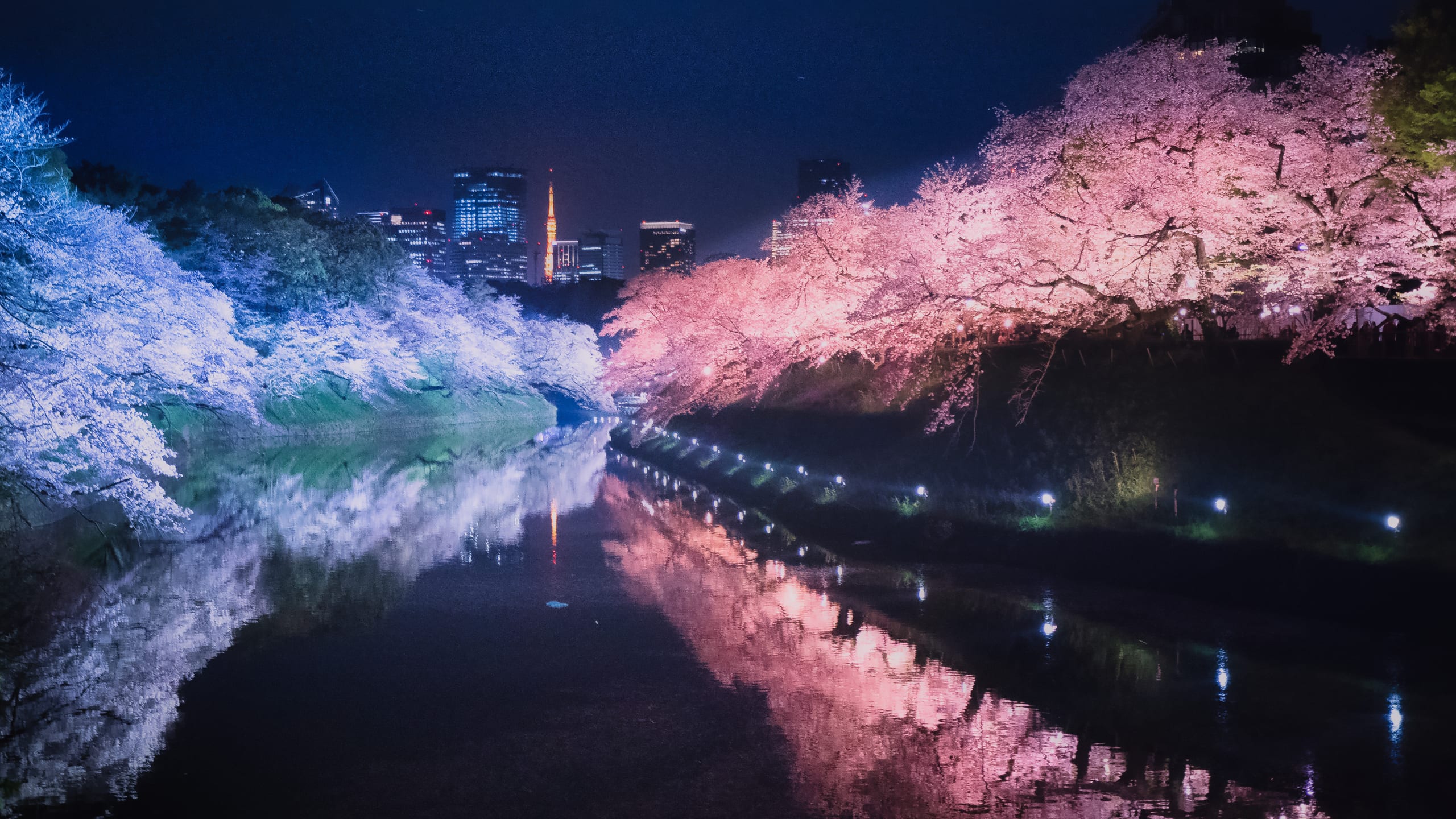
The Classic Cherry Blossom Tour of Japan gives this experience two nights at the centre of its spring journey, beneath Mount Fuji at Hotel Kaneyamaen, in a Japanese garden at Fujiyoshida. Each room has its own open-air bath with Fuji in view, the afternoons are left free for the water and the view, and both evenings end with a kaiseki dinner.