
Japan specialists keep a standard answer for travellers who have already seen Kyoto three times: Kanazawa.
The reasoning is historical. Kanazawa, on the Japan Sea coast of central Honshu, was the seat of the Maeda clan from 1583 to 1868. The Maeda governed Kaga, the richest domain in Japan after the Tokugawa shoguns themselves, and because a wealthy lord with an army was a lord the shoguns watched, they spent their fortune on craftsmen, tea masters, Noh actors and gardeners instead. The result was a provincial capital whose accumulation of culture rivalled Kyoto's in several disciplines: lacquer, silk dyeing, Noh, the tea ceremony and the beating of gold leaf.
The second reason is what the city was spared. Kanazawa was never bombed in the Second World War, and its wooden teahouse streets, its samurai lanes and the canals that run beside their earthen walls stand much as they did in the nineteenth century.
It is also nearer than it was. The Hokuriku shinkansen reached Kanazawa from Tokyo in 2015, in about two and a half hours, and since the line was extended to Tsuruga in 2024 the journey from Kyoto takes about two hours, on the Thunderbird express to Tsuruga and the shinkansen on from there.
the garden
Kenroku-en, the garden of six attributes
The garden of Kenroku-en, beside the old castle grounds, is counted as one of the three great gardens of Japan, with Kairaku-en in Mito and Koraku-en in Okayama, and it is the most deliberately composed of the three. Its name was given in 1822 by Matsudaira Sadanobu, a senior official of the shogunate, and it comes from a Song-dynasty account of the gardens of Luoyang, which argued that six virtues rarely live together in one landscape: spaciousness and seclusion, artifice and antiquity, running water and the long view. The name means the garden that combines all six.
The garden makes the argument in stone and water. On the edge of the Kasumigaike pond stands the Kotojitoro, a stone lantern with two legs of unequal length, one in the water and one on the bank, whose shape recalls the bridge that supports the strings of a koto. Nearby is the oldest fountain in Japan, built in 1861, which has no pump at all: it rises from the difference in height between the pond above and the jet below.
From 1 November each year the gardeners begin the yukitsuri, raising tall poles beside the great pines and fanning ropes from the top of each pole to the branches, so that the weight of the Japan Sea snow is carried by the ropes and not the limbs. The cones of rope over the pines are the image of the city in winter.
what remains
The teahouse streets and the samurai quarter
Higashi Chaya, the eastern teahouse district, is the largest surviving group of wooden chaya of the Edo period in the city: two parallel streets of fine latticed facades, kimusuko, behind which geiko still entertain. In 2001 it became only the second teahouse district in Japan, after Gion in Kyoto, to be protected by the state as a group of traditional buildings. The Shima teahouse, built in 1820, is open to visitors, and its upstairs rooms, where the guests sat, face the small stage where the geiko danced.
Nagamachi, the samurai quarter below the castle, keeps its earthen walls and the narrow Onosho canal, the oldest channel in the city, which dates from the years the Maeda arrived. Kazuemachi, the smallest of the chaya districts, faces the Asano river and is the quietest of them at dusk.
The castle itself was rebuilt in part in the late twentieth century, but its Ishikawa-mon gate of 1788 survives, roofed in tiles of lead that weather to a pale grey-white, and the walls are faced in the black-and-white lattice of namako plaster. Across the street from the garden stand two buildings of the present age: the 21st Century Museum of Contemporary Art, a low glass circle by the architects SANAA, opened in 2004, where visitors stand under the water of Leandro Erlich's Swimming Pool; and the D. T. Suzuki Museum by Yoshio Taniguchi, a spare building around a still pool of water, in memory of the Kanazawa-born scholar who carried Zen to the West.
the craft
Gold leaf, silk and clay
Ishikawa, of which Kanazawa is the capital, produces some ninety-nine per cent of the gold leaf made in Japan. A small ingot of gold is beaten, between sheets of specially prepared paper, until it is about a ten-thousandth of a millimetre thick, so thin that light passes through it green. The leaf is laid on lacquerware, folding screens, temple altars and tea utensils, and, these days, on soft-serve ice cream.
Kaga-yuzen, the city's hand-painted silk, is dyed in five colours, indigo, crimson, ochre, grass green and an old purple, and it paints flowers as they are in nature, a leaf eaten by an insect at the edge or turning brown, where Kyoto's yuzen prefers them perfect. Kutani porcelain, made in the villages to the south since about 1655, is known at a glance by its deep greens, yellows, purples and blues. And the Ohi family has fired tea bowls in the city since 1666, soft amber-glazed pieces in the tradition of raku, the present head of the family the eleventh to bear the name Chozaemon.
the table
The Kaga table
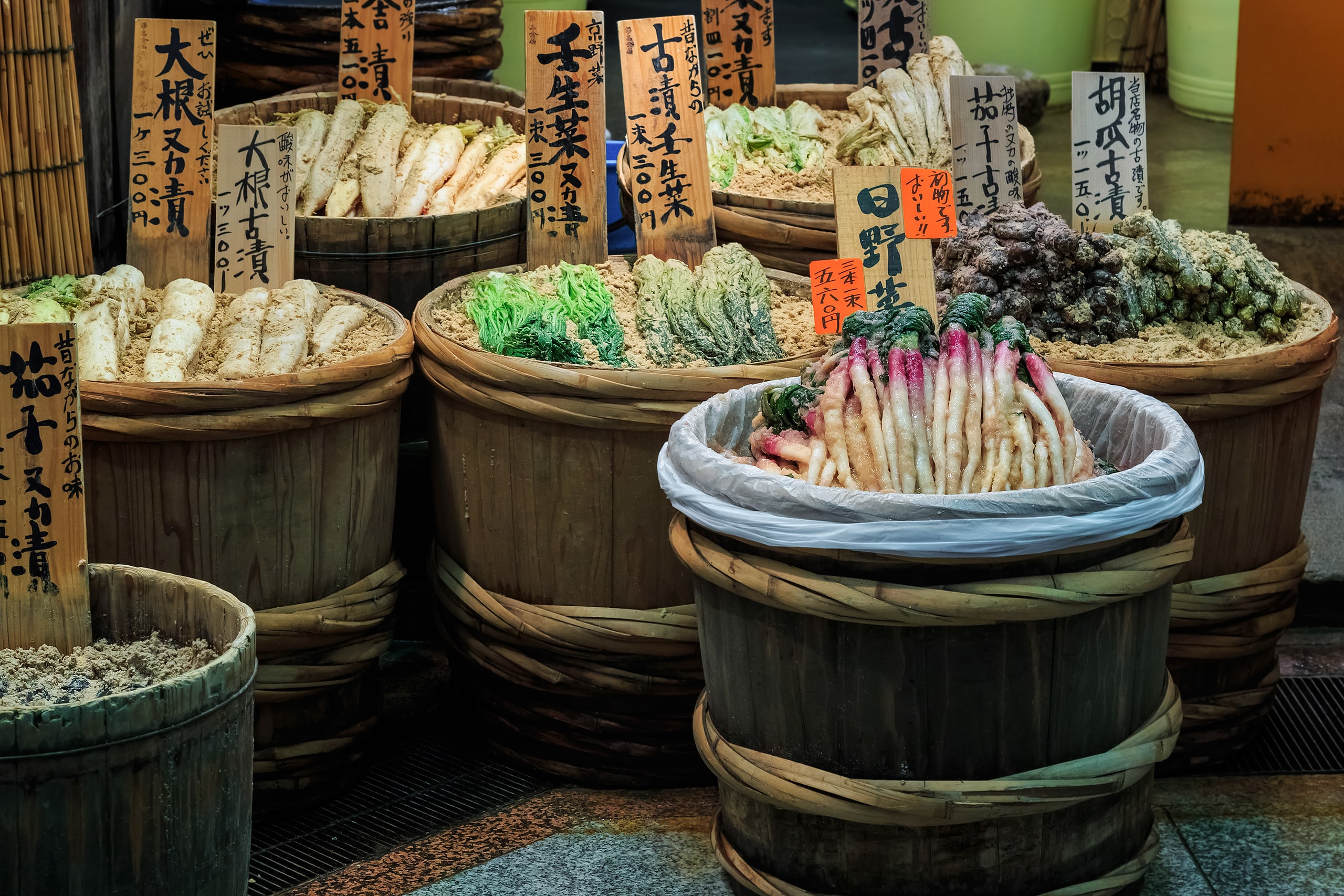
Omicho Market has fed the city for some three hundred years, about a hundred and seventy stalls under one roof near the station. In winter the stalls are stacked with snow crab, including the small female kobako-gani, landed only from November to the end of December, and with the winter yellowtail of Himi, and all year with nodoguro, the rosy blackthroat seaperch that the Hokuriku coast prizes above any other fish, grilled so the rich skin crisps.
The dish the city claims as its own is jibuni, slices of duck dusted in flour and simmered in a sweet soy broth with wheat gluten and greens, the flour thickening the broth as it cooks, and it is served in a lidded lacquer bowl with a dab of wasabi on the side.
the seasons
Kanazawa through the year
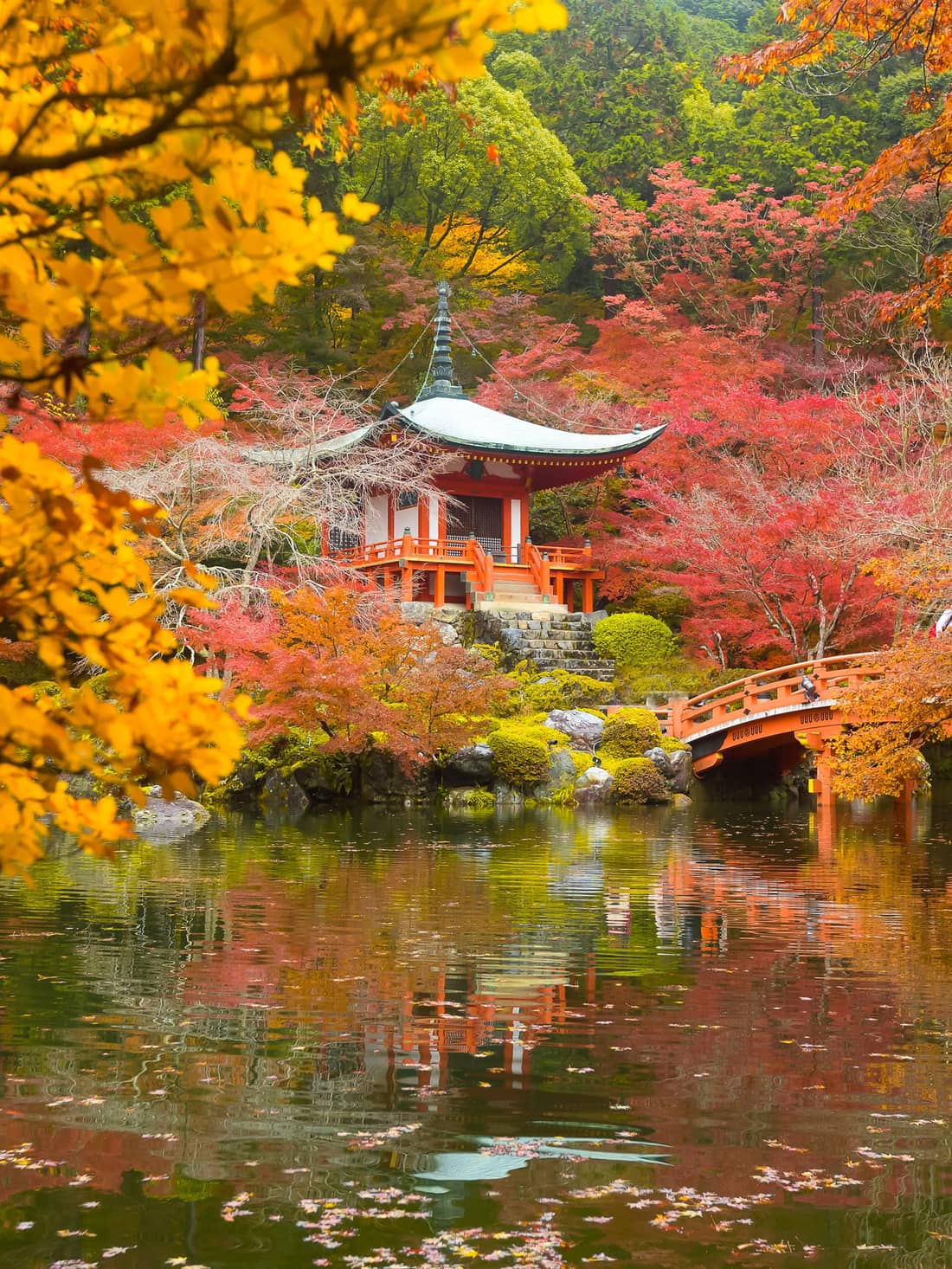
Autumn and winter give Kanazawa its fullest character. In November the maples and ginkgo of Kenroku-en turn as the gardeners raise the yukitsuri over the pines, and the crab season opens on the coast. In January and February the snow lies on the roofs of Higashi Chaya and the ropes in the garden bear its weight.
Kyoto gardens: the great Japanese gardens and how to read them →
the journey
Kanazawa on a private journey
The Custom Tour of Japan brings Kanazawa into a private journey on the party's own dates, from five nights, and gives the city the two nights it deserves. The day can open the door of a lacquer studio, where a craftsman lays down a coat thinner than paper on a bowl that must cure before the next is added, and talks the party through it as he works. A Tour Director is beside the guests throughout, and Kenroku-en under its ropes, the lattice of Higashi Chaya at dusk and a bowl of jibuni follow at the pace the city sets.