
The mistake begins at the map. Tokyo sits to the east, Kyoto to the west, a straight line joins the two on the page, and then the planner starts adding places: Kanazawa, Hakone, Hiroshima, Naoshima, Takayama, Nikko, Nara, the Fuji lakes, and Hokkaido too if the page still has room. From above, the route looks impressive, a clean line touching every name worth knowing. On the ground it becomes luggage, station platforms, short nights, rushed breakfasts, and the particular exhaustion of having travelled a great distance without properly arriving anywhere.
A Japan itinerary succeeds on rhythm. The country's railways make distance look almost effortless, and that ease tempts a traveller into poor design. A two-hour transfer is never only two hours: there is the packing, the checkout, the walk to the station, the ticket gates, the platform, the arrival, the luggage again, and the loss of leaving one place before it has settled. The best routes alternate, between city and countryside, speed and stillness, ryokan and hotel.
begin with the season
Begin with the season
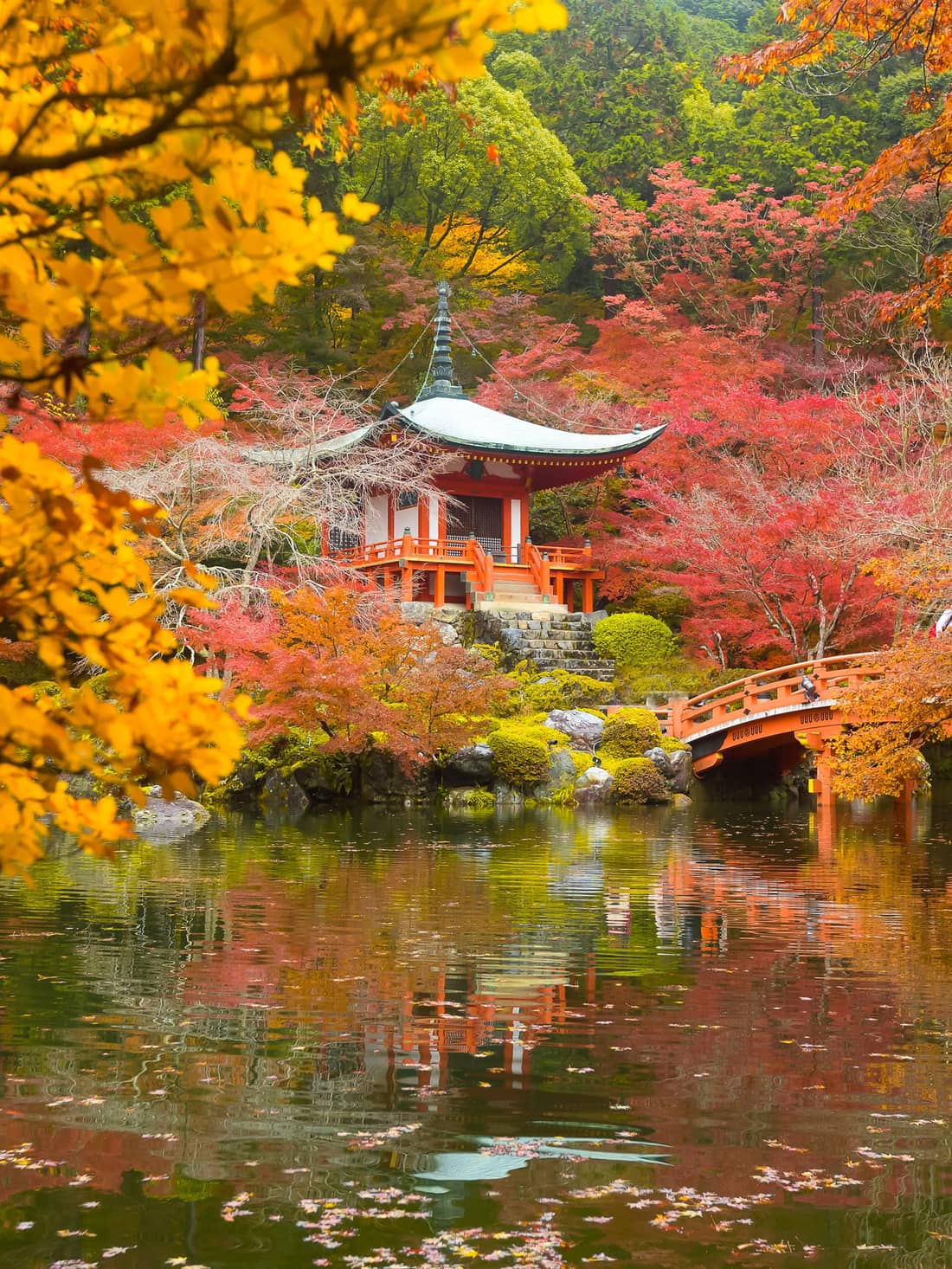
Season comes first, because it decides the shape of the route. Cherry blossom moves through Japan from south to north in spring, opening in Kyushu and Tokyo in late March and reaching Hokkaido in late April and early May. Autumn colour runs the other way, from north to south and from mountain to plain, over a longer window than the blossom. A route that knows the direction of its season travels with it.
In summer the country divides: heat and humidity in Kyoto, Osaka and Tokyo, a temperate, open season in Hokkaido, and festivals that fill particular cities for a few days at a time. Winter gives the clearest contrasts of all: the snow country of the Japan Sea coast, the cranes of eastern Hokkaido, dry bright days in the Pacific cities, and a Kyoto garden almost to itself in January. A route that starts from the season stops asking where to go in the abstract and asks what the country offers in that month.
the golden route
The golden route, reconsidered
Tokyo, Kyoto and one or two well-chosen additions remain the strongest first Japan itinerary. Tokyo gives scale, design, food and a city of many centres; Kyoto gives depth, old quarters and streets that reveal themselves by the hour. The difficulty is never choosing them. It is giving them too few nights.
Three nights in Tokyo after a long flight is the minimum for recovery and orientation. Four nights in Kyoto is where the city begins to make sense; a traveller who arrives late, sees one or two crowded sites and eats badly because the day ran long leaves believing that Kyoto is overrun. Each addition should have a clear purpose: the Fuji lakes for Mount Fuji and the onsen, Kanazawa for its gardens and crafts, the Seto Inland Sea for art, architecture and ferries, Takayama for a mountain town. They do not all belong in one journey.
Length decides what the route can carry. Twelve nights take in Tokyo, one mountain or lake stop, Kyoto and a single extension to the west. Fourteen can add Kanazawa or the Inland Sea, provided the night comes from somewhere else instead of being added on top. Beyond that the railways make almost anything reachable, and the real limit becomes fatigue. A base saves the nights spent packing: from Kyoto, Osaka is fifteen minutes away by Shinkansen and Nara under an hour by limited express, so neither needs a change of hotel, while Hiroshima and Miyajima, under two hours away, are better given a night of their own.
nights and transfers
Nights, transfers, and what to leave out
The number of nights spent in a place matters more than the number of places on the route:
- One night is rarely a stay: little more than an arrival and a departure, useful near an airport or as a deliberate pause, but wrong as the main rhythm of a route.
- Two nights give one full day, workable but tight.
- Three nights give two full days, with room for weather or a change of plan.
- Four nights let a city begin to make sense.
- Five nights in Kyoto or Tokyo are well spent once the surrounding region and its tables are added.
Transfers deserve the same honesty. The Shinkansen from Tokyo to Kyoto is quick and comfortable, and it still shapes the day. A move into ryokan country, by Shinkansen, then a limited express, then a car to an inn with a fixed dinner hour, is a different order of planning, and a beautiful ryokan becomes a stressful one when the arrival is left to chance. Takkyubin, the luggage forwarding service, sends cases ahead from one hotel to the next and makes light travel possible, provided the dates and addresses are settled before the journey begins. Small details decide these days. Travelling west from Tokyo on the Tokaido Shinkansen, Mount Fuji appears on the right-hand side, from the E seats, for a few minutes beyond Shin-Fuji, and on that line a case larger than 160 centimetres in total dimensions needs its own space, reserved with the seat. The day after arrival should be kept light, and the day before departure is never the day for ambition.
Leaving places out is the hardest part of planning Japan, and the part most often skipped. No two- or three-week route can contain the whole country, and a journey does not need Tokyo, Kyoto, Osaka, Nara, Hakone, Kanazawa, Takayama, Hiroshima, Naoshima and the Alps inside two weeks. It needs a coherent arc, and a place that does not serve the arc belongs to another journey.
A theme sharpens the arc. A first visit is built around Tokyo, Kyoto and one strong contrast; a food-led route leans towards markets, a counter seat and a ryokan kitchen; a season-led route follows the blossom, the colour or the snow; a repeat visit can leave the main corridor out altogether. Pace matters as much as selection. A ryokan night after two dense city days, and an afternoon with nothing arranged, are what let everything else in the journey sink in.
Independent planning has its pleasures: maps, timetables, hotel research and seasonal forecasts, all building anticipation before the journey begins. Research gathers places, and the design of a route is mostly the work of deciding which of them to leave out.
Japan is full of small consequences that only appear on the ground. A hotel on the far side of a large station adds a long walk to every outing. A temple seen at its busiest hour feels ordinary, when the same garden at a quieter hour would have been the best thing of the week. A transfer that looks neat on a screen comes apart once real luggage and a fixed dinner time are added to it. A route planned by someone who plans Japan for a living accounts for all of this, and it is built around what this particular journey is meant to be, instead of other people's photographs.
Shinkansen first class and GranClass, explained →
Supreme Class, the shinkansen's private cabins →
Hiring a private guide in Japan: costs and options →
A luxury Japan itinerary: fourteen days, day by day →
A first trip to Japan: where to go and how long →
Luxury travel to Japan, region by region →
A Japan itinerary for 10 days →
A Japan itinerary for 7 days →
The Expert Japan Itinerary: a Japan itinerary planned in full, day by day →
For a traveller who wants to plan and travel independently, that design work is what Luxury Japan Travel's Expert Japan Itinerary provides. The team that runs its tours plans every day in full, from the order of the towns to the hotels and ryokan for each night, the room worth asking for and the table worth planning an evening around. It arrives as one complete written itinerary within seven working days, with one revision included.