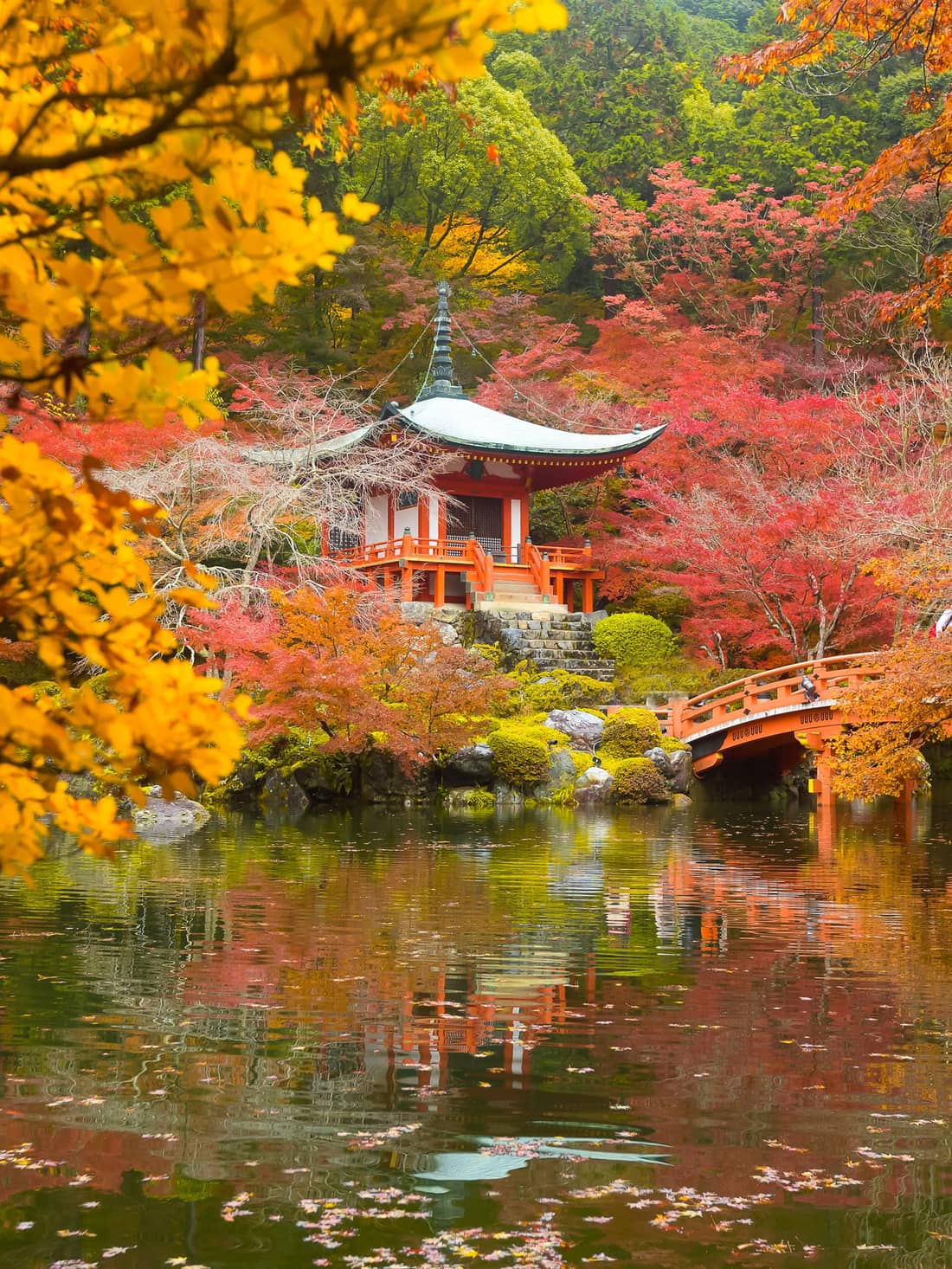

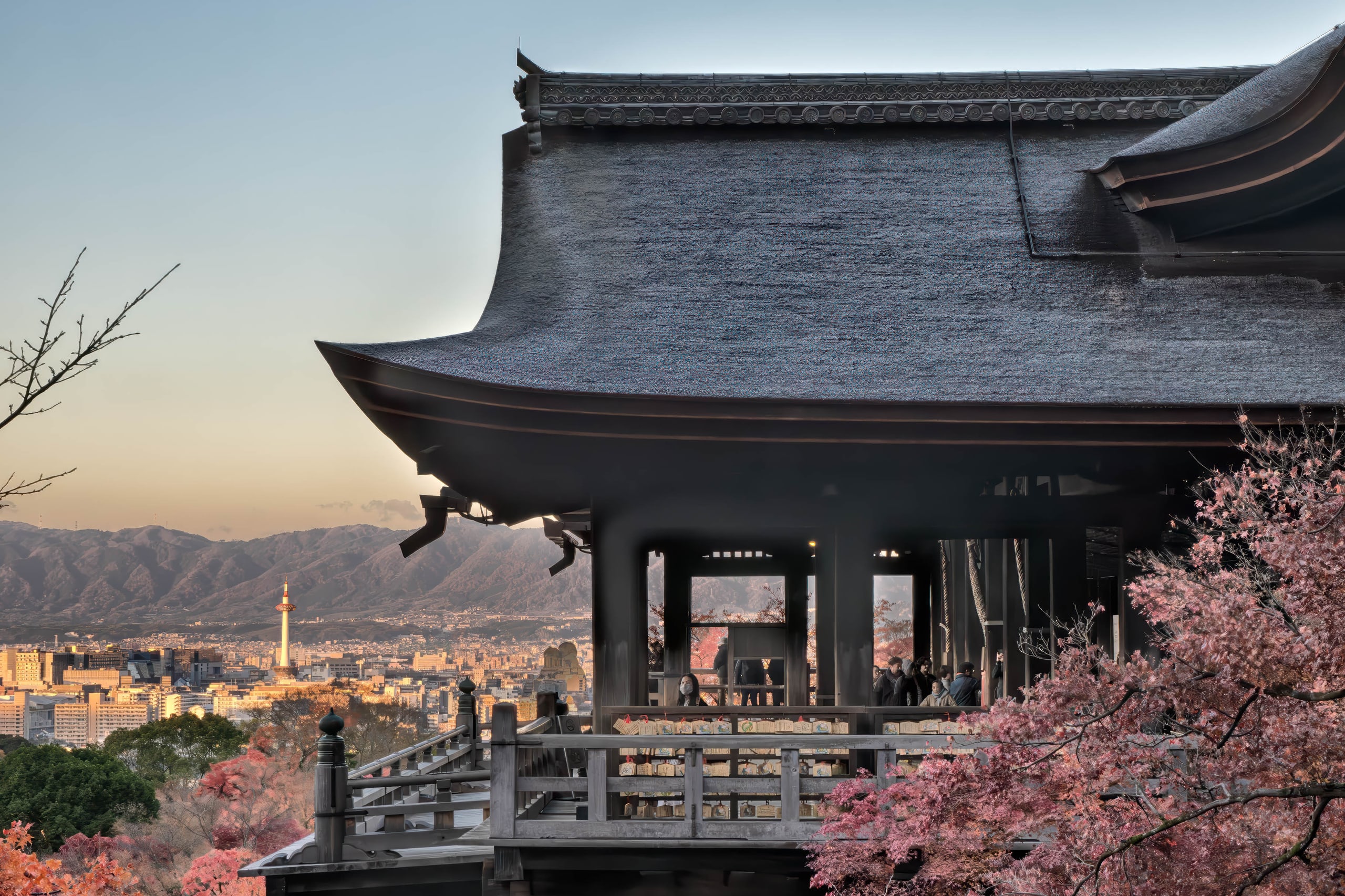
A tea ceremony in Kyoto is a host preparing matcha for guests in a tea room, by a sequence of gestures fixed four centuries ago: the guests walk a garden path, rinse their hands at a stone basin, enter by a low door, admire a scroll and a flower, eat a sweet, and receive a bowl of tea, which they turn before drinking. Taken privately, with a tea master in a proper tea room, it is the hour in Japan that explains the most about the rest of the country: the alcove in a ryokan room, the order of a kaiseki dinner and the restraint of a Kyoto garden all come from it.
The sound comes first. Before anything is said, the iron kettle in the corner, the kama, has begun to sing over its charcoal, a low and steady breath the tea world calls matsukaze, the wind in the pines. The room is four and a half mats. There is a scroll in the alcove with five characters brushed in black, and beneath it, in a bamboo vase, a single camellia bud. The host enters without a word and sets down the tea bowl.
the sequence
What happens at a Japanese tea ceremony
The order is fixed. The full form is the chaji, three to four hours with a meal; most visitors meet a shorter gathering for sweets and tea, which walks the same path.
The roji and the tsukubai
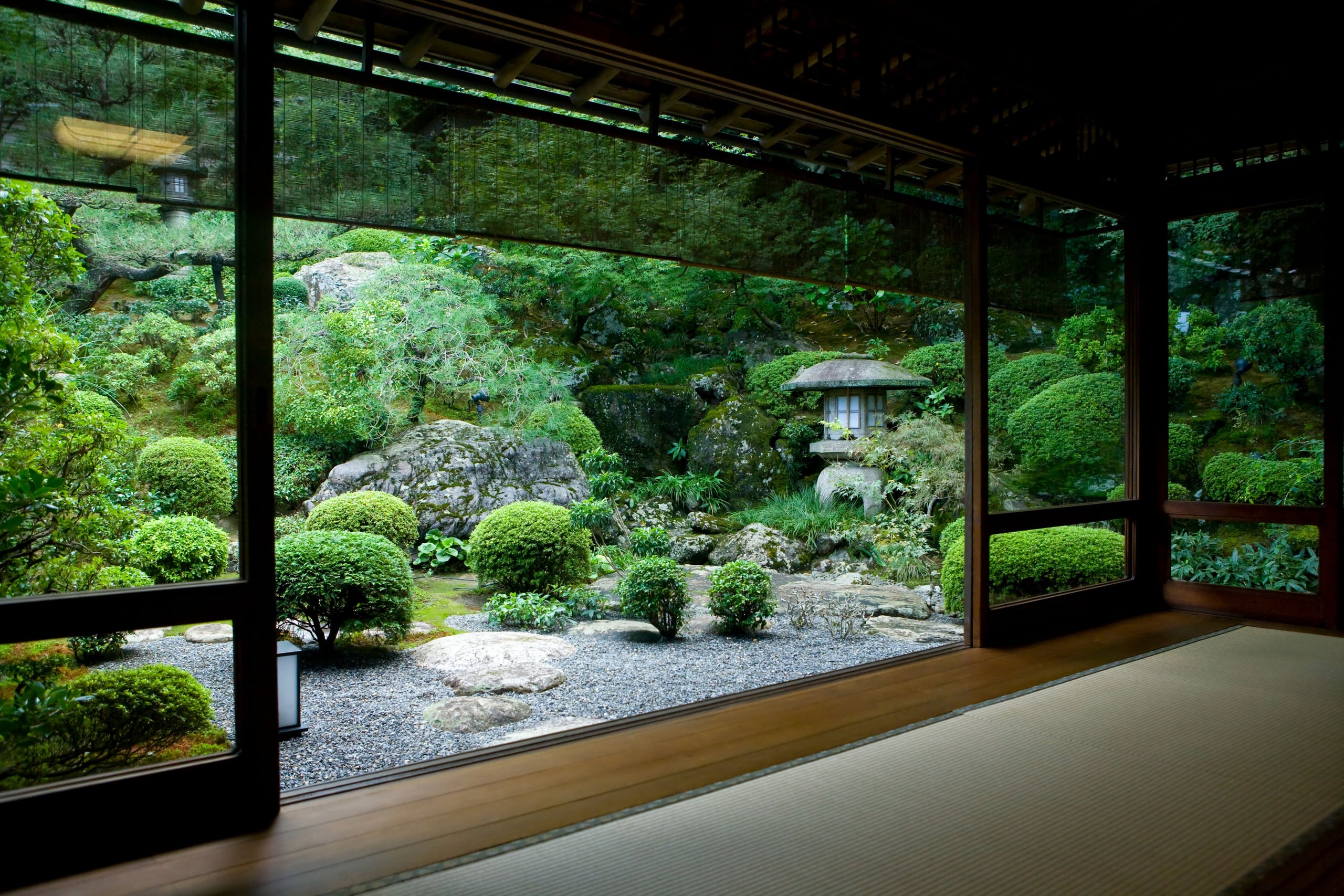
The ceremony begins outside, on the roji, the dewy path: a narrow garden of moss, stepping stones and clipped shrubs that leads from the street to the tea room and is meant to leave the street behind. The stones are watered before the guests arrive, so that they shine. Partway along sits the tsukubai, a low stone basin fed by a bamboo pipe, where each guest kneels, takes the ladle and rinses the hands. The basin is set low on purpose. No one, however grand, uses it standing.
The nijiriguchi
The nijiriguchi, the guest entrance of a wabi tea room, is a square opening barely wider than the shoulders, and the guests pass through it on their knees. Rikyu is credited with it, and the story told in every tea room is that a samurai had to leave his swords outside to fit through. Inside, the lord and the merchant sat on the same tatami.
The tokonoma: scroll and flowers
The first thing a guest does inside is go to the tokonoma, the alcove, kneel, bow, and look. The scroll is chosen for this gathering and no other: a line of Zen calligraphy, a poem, a single character. Below it is chabana, the tea flower, one or two stems in a vase of bamboo or unglazed clay, arranged so lightly that they seem to have been picked on the walk in. The scroll sets the theme of the afternoon, and a good host builds everything that follows around it.
The kama, the charcoal and the season
The place of the kettle changes with the season. From May to October it sits on a furo, a brazier on the mat, set away from the guests to keep the heat from them; in November the furo is put away and the kettle moves to the ro, a hearth sunk in the floor at the centre of the room, which draws the guests in towards the warmth. Opening the hearth is called robiraki, and November also brings kuchikiri, the cutting of the seal on a tea jar filled at the May picking and left to mature through the summer. The tea world treats it as its new year.
The sweets
Wagashi are eaten before the tea, never with it, taken from the tray onto a fold of kaishi paper and cut with a small pick. A moist sweet, shaped and coloured for the month, comes before the thick tea; small dry sweets, pressed sugar or a crisp wafer, come before the thin, so that the sugar is still on the tongue when the bitter tea arrives.
Koicha and usucha
There are two teas, and most visitors only ever taste one. Koicha, thick tea, uses about three times as much matcha as the thin, kneaded with the whisk rather than beaten until it is glossy and dense, and it is passed from guest to guest in a single bowl, each guest wiping the rim before passing it on. It is the solemn heart of a formal gathering, and the quietest minutes of it. Usucha, thin tea, follows: whisked to a light froth, one bowl for each guest, and the moment the room relaxes and conversation begins.

The bow and the turn of the bowl
The host sets the bowl down with its front, the most beautiful face of the glaze, turned towards the guest. The guest bows, lifts the bowl onto the left palm, and turns it clockwise twice with the right hand, so as not to drink from the face that has just been offered. After the last sip the rim is wiped with the fingertips, the bowl is turned back, and the front faces the host again.
Admiring the utensils
At the end the principal guest asks to see the utensils, and the host lays them out: the tea caddy, the bamboo scoop, the bowl. Then come the questions, and they are the conversation the whole afternoon has been leading to. Who made the bowl? What is the scoop's name? A chashaku carved by a tea master is given a poetic name, and the answer reveals what the host was thinking when the gathering was planned.
the meaning
What the tea ceremony means: wabi, ichigo ichie and Sen no Rikyu
Chanoyu, hot water for tea, is the Japanese name, and chado, the way of tea, is the name for it as a discipline. Neither means ceremony. What looks ceremonial to a visitor is hospitality, refined until nothing is left in it that does not serve the guest.
Its shape is the work of Sen no Rikyu, born in the merchant city of Sakai in 1522, who served tea to the two men who unified Japan, Oda Nobunaga and Toyotomi Hideyoshi. Rikyu took the tea of the great halls, with its Chinese celadon and lacquer, and turned it towards wabi, the beauty of the plain and the slightly imperfect: he preferred a black Raku bowl shaped by hand to a flawless import, and a room of two mats to a hall. In 1587 he was among the hosts of Hideyoshi's Grand Kitano Tea Gathering at Kitano Tenmangu, where tea was served to more than a thousand guests. Four years later he died at Hideyoshi's order, and his descendants teach his tea in Kyoto to this day.
Ichigo ichie, one time, one meeting, is the phrase every tea room in Kyoto knows. It comes from Rikyu, by way of his pupil Yamanoue Soji, who wrote that a guest should honour the host as though the meeting would never come again, and it was given its lasting form in the nineteenth century by Ii Naosuke, a lord and a tea master. The same host and the same guests may well meet again, though never with this scroll in the alcove and this light on the paper screen.
the schools
Urasenke, Omotesenke and Mushakojisenke: the three Sen schools of Kyoto
Sen Sotan, Rikyu's grandson, divided the line among three of his sons, and all three still stand within a few streets of each other in Kamigyo, the old northern quarter of Kyoto. Omotesenke keeps Fushin-an on Ogawa-dori at Teranouchi. Urasenke, whose name means the Sen family at the back, keeps Konnichian behind it on the same street. Mushakojisenke keeps Kankyuan a short walk south, on the street that gives it its name. Their headquarters are private, not visitor attractions, but the lane outside, with its earthen walls and plain gates, carries more of the history of tea than any museum, and walking it is worth the detour.
The schools differ in small things that their students notice at once. Urasenke whisks its thin tea to a fine, even foam across the whole surface. Omotesenke whisks less and leaves a crescent of clear green tea showing, like a new moon on a pond. Mushakojisenke whisks lightest of all, with a whisk whose tines are left straight for the purpose.
the tea rooms
The historic tea rooms a visitor can see
Taian is the one that matters most. It stands at Myoki-an, a Zen temple in Oyamazaki, on the southern edge of Kyoto Prefecture, and it is attributed to Rikyu himself: a tea room of two tatami mats, built around 1582, the oldest surviving tea room in Japan and one of only three designated National Treasures. It is seen by advance reservation, made about a month ahead, and the room itself is barely two metres square.
Kodai-ji, in Higashiyama, is the easier visit and a better one than most guidebooks allow. On the hillside above its garden, joined by a short corridor, stand Kasa-tei and Shigure-tei, two tea rooms in Rikyu's taste said to have been brought from Hideyoshi's Fushimi Castle, both Important Cultural Properties. Kasa-tei, the umbrella pavilion, takes its name from its ceiling of bamboo rafters radiating from a centre point like the ribs of a paper umbrella; Shigure-tei rises to a second storey, unusual for a tea room. Kodai-ji was founded by Hideyoshi's widow, Nene, in his memory.
Kitano Tenmangu keeps the memory of the Grand Kitano Tea Gathering with a tea offering on 1 December, the shrine's own remembrance of Hideyoshi's thousand guests.
the tea
Uji, the tea country of Kyoto
Every bowl in a Kyoto tea room begins in the hills to the south. The priest Eisai brought tea seeds from Song China in 1191; the monk Myoe planted them at Kozan-ji in Toganoo, north-west of the city, and from there carried them to Uji, where the river mists and the sloping fields suited the plant. The Ashikaga shoguns kept tea gardens at Uji in the fifteenth century, and one of them, Okunoyama, is still worked. In the sixteenth century, to satisfy tea masters like Rikyu, Uji's growers began shading the fields for weeks before the spring picking, which softens the bitterness and deepens the green. That is the origin of matcha as it is drunk today. Gyokuro, the shaded leaf tea, was created in the Uji area in 1835.
Uji is a short train ride south of central Kyoto, with Byodo-in beside the river and the tea merchants' street on its approach. Much of Kyoto's tea is now grown further into the hills, in Wazuka, which alone produces about half of it. An afternoon with a tea master in Uji, where the leaf grows, is the natural companion to a ceremony in the city.
the difference
A commercial demonstration or a private ceremony
Most visitors to Kyoto meet the tea ceremony in a converted room off a shopping street, seated in rows with up to a dozen others, for forty-five minutes to an hour. A host in kimono demonstrates the preparation, an assistant explains in English, everyone whisks a bowl of their own, and there are photographs. It is pleasant, though a Japanese guest would hardly call it a tea ceremony.
There is no roji, so the street is never left behind, and no scroll chosen for the day. The bowls have no makers to ask about, and the host is already thinking of the group booked for the next hour.
At a private ceremony a tea master of one of the Sen schools receives the party in a proper tea room, with its own garden path and its own basin, and prepares the tea for them alone. The bowl the guest drinks from has a maker and a history, and the master will tell it. There is time to ask why the kettle sits where it does and why the door is so low. A guest who has spent one such afternoon reads every temple alcove and garden in Kyoto differently afterwards.
the verdict
Is a tea ceremony in Kyoto worth it?
Yes, if it is private and the tea room is real. A traveller with one afternoon to give to Japanese culture should give it to this before anything else, because so much of Japan grows from the tea room: chakaiseki, the meal of the formal chaji, is the ancestor of kaiseki itself, and the single flower in a ryokan alcove is chabana. A private ceremony is worth building a day in Kyoto around. A group demonstration is not worth the afternoon.
the practical
How long it lasts, and what to wear
A private gathering for sweets and thin tea runs about an hour, with time after it to talk with the host; a full chaji, with its charcoal, its meal, thick tea and thin, runs three to four hours.
Guests dress as they would for a good lunch: plain, subdued colours, nothing loud. Rings, bracelets and watches come off before the tea room, since metal can mark a bowl that is two hundred years old, and clean white socks go on, because shoes stay at the door and the tatami is part of the room's beauty. Kimono is never expected of a visitor.
The etiquette fits in two sentences. Guests follow the host and the guest beside them, bow when the bowl is set down, and turn it twice before drinking and back again after. They ask about the scroll and the bowl, because admiring them is the guest's part and the host has been waiting to be asked.
Late in the afternoon the host gathers the utensils and carries them out, one by one, in the reverse of the order they came in. The guests are left with the kettle, still breathing over its charcoal, and the camellia bud in its vase, which will not open before tomorrow. Outside, the stones of the roji are drying in the last of the light.
the journey
A private tea ceremony on The Private Collection
Each of the three Honshu journeys of The Private Collection, Essential Japan, Classic Japan and Definitive Japan, includes a private tea ceremony in Kyoto, taken on the guests' own dates. A host prepares the matcha for the party alone, and the Tour Director, who is with the guests every day, explains each gesture as it is made, from the warming of the bowl to the whisk. The same day ends with kaiseki at a two-Michelin-star restaurant in Kyoto, the grand descendant of the meal served at the chaji.
questions
Questions
Is a tea ceremony in Kyoto worth it?
Yes, if it is private and takes place in a proper tea room with a tea master. It is the root of so much of Japanese culture, from the ryokan alcove to kaiseki, that an hour of it changes how the rest of Japan is seen. A crowded forty-five-minute demonstration is not worth the afternoon.
What happens at a Japanese tea ceremony?
Guests walk a garden path, rinse their hands at a stone basin, enter the tea room by a low door and admire the scroll and flower in the alcove. They eat a sweet, then receive a bowl of matcha, turn it twice clockwise before drinking, and at the end admire the utensils and ask about them.
How long does a tea ceremony in Kyoto last?
A private gathering for sweets and thin tea runs about an hour. A full chaji, with a meal, thick tea and thin tea, lasts three to four hours. Commercial demonstrations in Kyoto run forty-five minutes to an hour.
What should you wear to a tea ceremony?
Guests wear plain, subdued clothes and clean white socks, since shoes are left at the door. Rings, bracelets and watches are taken off so they cannot mark the bowls. Kimono is never expected of a visitor.
What is the difference between koicha and usucha?
Koicha, thick tea, uses about three times as much matcha, is kneaded rather than whisked, and is shared from a single bowl. Usucha, thin tea, is whisked to a light froth and served in a bowl for each guest. Both are matcha; most visitors only ever taste usucha.
Which tea ceremony schools are in Kyoto?
The three Sen schools, all descended from Sen no Rikyu: Urasenke, Omotesenke and Mushakojisenke. All three keep their headquarters within a few streets of each other in Kamigyo, in the north of the city.
Can visitors see Sen no Rikyu's tea room?
Yes. Taian, at Myoki-an in Oyamazaki, the tea room attributed to Rikyu and a National Treasure, is seen by reservation made about a month ahead. At Kodai-ji in Higashiyama, the tea rooms Kasa-tei and Shigure-tei, in Rikyu's taste, stand on the temple's hillside.