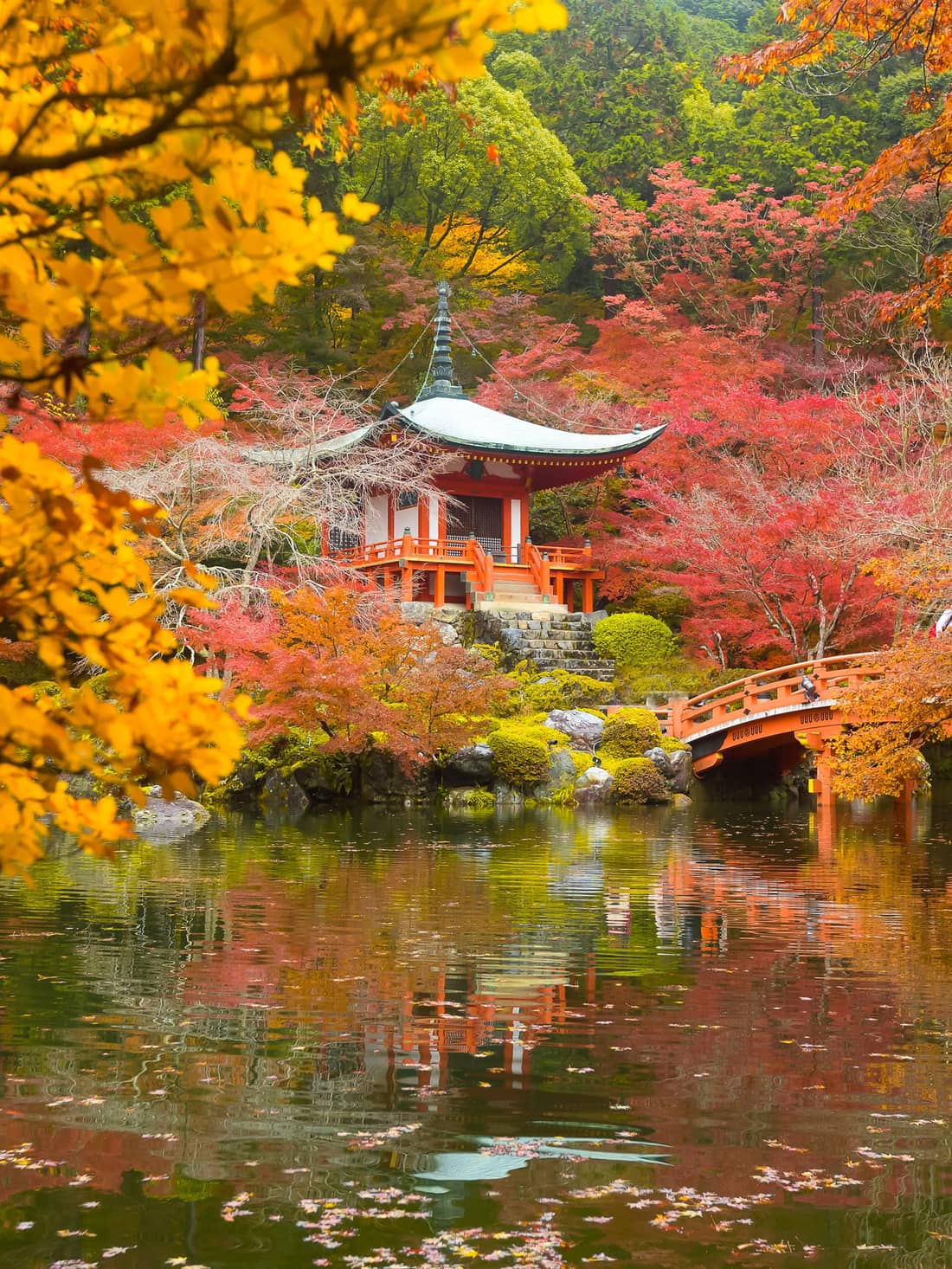

The best food tour in Japan is routed the way a serious eater would route it, city by city and coast by coast, each evening built around a table worth crossing the country for: Edomae sushi at a cypress counter in Tokyo, kaiseki in a Kyoto ryotei, snow crab on the Sea of Japan in November, sea urchin and whisky in Hokkaido. Made that way, a culinary tour of Japan is the most rewarding journey the country offers.
It begins in a kitchen before the first guest arrives. A sheet of kombu has steeped in cold water since the afternoon; the pot is brought slowly towards the boil and the kelp lifted out before it can turn the stock bitter. A handful of shaved katsuobushi goes in, sinks, and is strained away a minute later. What is left is clear and pale gold, smells faintly of the sea and of smoke, and will carry every course of the evening without announcing itself once.
That stock is the thread through everything that follows, from the soup bowl of a Kyoto kaiseki to the batter of an Osaka takoyaki.
the thread
What is a culinary tour of Japan?
A culinary tour of Japan is a journey planned around the table: the cities and coasts chosen for what is eaten there, the season chosen for what is landed or harvested, and the meals planned as carefully as the hotels. Its subject is washoku, the traditional dietary culture of the Japanese, which UNESCO inscribed on its list of intangible heritage in December 2013. Its common ground is dashi.
Dashi explains why Japanese food tastes the way it does. In 1908 the chemist Kikunae Ikeda, curious about the savour of kombu stock, isolated glutamate from the kelp and named the taste it carried umami; his pupil Shintaro Kodama later found inosinate in katsuobushi, the smoked, dried and fermented skipjack that is shaved into the pot. Together the two do more than either alone, which is why the classic stock uses both. The kelp comes overwhelmingly from Hokkaido, which produces more than ninety per cent of Japan's natural kombu. The fish comes largely from Makurazaki, at the southern tip of Kyushu, which makes some forty per cent of the nation's katsuobushi. A single bowl of clear soup in Kyoto therefore joins the two ends of the country.
It did so long before refrigeration. In the Edo period the kitamaebune, the northern trading ships, carried Hokkaido kombu down the Sea of Japan coast, round Shimonoseki and up the Inland Sea to Osaka, the merchant city known as the kitchen of the nation. The route is still called the kombu road, and Osaka's stock is built on it.
the verdict
Is it worth doing a food tour in Japan?
Yes, when the tour is created around the great tables of the country. The street-food walking tour, three hours through a market or an evening through the alleys of an entertainment district with a guide and a dozen tastes, is a pleasant introduction and an honest one. It shows how a city snacks: a skewer of grilled scallop at Kuromon, a square of rolled omelette at Tsukiji, a paper boat of takoyaki at Dotonbori. It cannot show how Japan dines.
Japan's great cooking happens behind a cypress counter of eight seats, in the private room of a ryotei, in the dining room of a ryokan, and none of it is reached by walking in off the street. Many of the counters that matter receive guests only through a hotel concierge, and some only on the introduction of someone they already know. A journey created around those tables, and around the seasons that fill them, is how Japan is eaten at its best. The markets belong in it too, eaten through slowly with someone who knows the stallholders, as the prelude to dinner.
tokyo
Tokyo: the sushi counter and the markets
Tokyo is where the journey should start, because it has more Michelin stars than any city in the world: the 2026 guide gives three stars to twelve of its restaurants. Behind the figure is a city of thirty-seat rooms and eight-seat counters where a cook spends a lifetime on a single form.
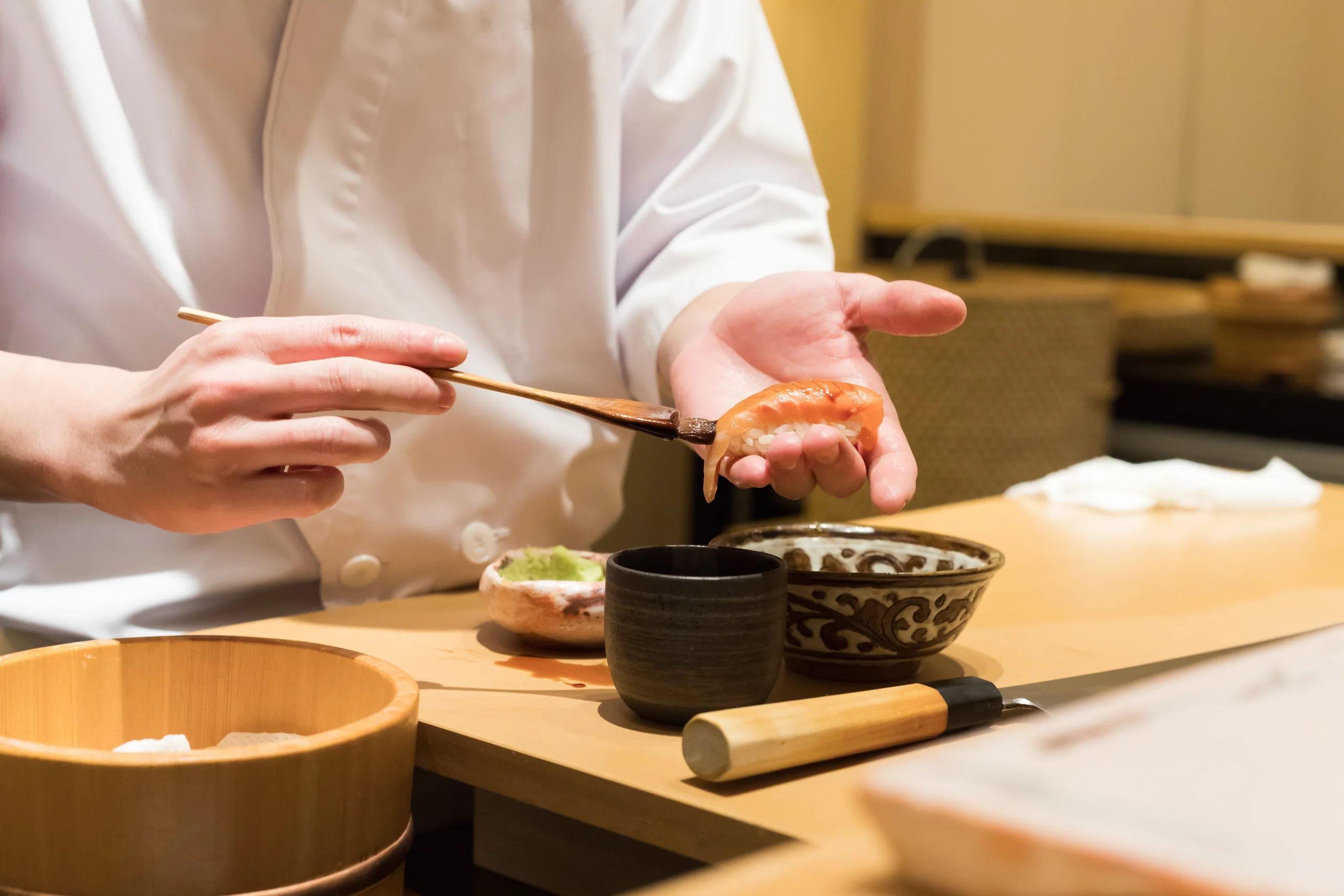
The form that defines it is Edomae sushi. Edomae means "in front of Edo", the bay before the shogun's castle, and the style grew up around fish from that water, cured, marinated or simmered before it met the rice: kohada salted and vinegared, tuna steeped in soy, conger eel simmered and brushed with a reduced glaze. At the counter the chef sets each piece down the moment it is made, and the order of the evening is the chef's.
The sushi counter: Edomae and the rhythm of omakase →
The fish now comes through Toyosu. On 11 October 2018 the old wholesale market at Tsukiji closed after more than eighty years and its auctions moved across the water to Toyosu, where the tuna sale goes on with the same bells and hand signals. The Tsukiji Outer Market did not move. Its lanes of some 460 shops still sell knives, kombu, dried bonito, pickles and tea to the city's cooks, and it is the market to walk through with an appetite: tamagoyaki from a square copper pan, oysters opened to order, tuna cut at the stall.
kyoto
Kyoto: kaiseki, obanzai and the tea country of Uji
Kyoto's cooking was shaped by the tea room. When Sen no Rikyu settled the form of the wabi tea ceremony in the late sixteenth century, the light meal served before the tea became cha-kaiseki: a few courses, each of the season, meant to prepare the guest for the tea. The grander kaiseki of the ryotei and the ryokan grew from it, and Kyoto keeps the strictest version of both. The 2026 Michelin guide gives six of the city's restaurants three stars, most of them Japanese kitchens working in that tradition.
Kaiseki: the art of the seasonal meal →
The other Kyoto is domestic. Obanzai, a word first used in print in 1964 for the everyday cooking of Kyoto homes, means small dishes built on vegetables, tofu and a little fish, simmered, dressed with sesame or pickled, with nothing wasted. Yudofu belongs to the same economy. It began in the Zen kitchens around Nanzen-ji, where meat was forbidden and tofu carried the meal, and it is no more than squares of tofu warmed in a pot of kombu stock. The secret is the city's soft water, which gives Kyoto tofu its clean, faintly sweet taste of the bean.
Nishiki Market runs for 390 metres through the centre of the city under a covered roof, and Kyoto has shopped there for some four hundred years. It is the pantry of everything above: pickles in cedar tubs, dried fish, yuba skimmed from soy milk, wheat gluten in a dozen colours.
South of the city lies Uji, the tea country. Eisai brought tea seeds from China in 1191; Uji's growers later learned to shade their bushes under straw before the spring harvest, which gave the leaf its sweetness and gave Japan matcha. Sencha followed in 1738, gyokuro in 1835. A tasting of the three, prepared by someone who grows and blends them, teaches more about Kyoto's palate than any dinner.
osaka
Osaka: kuidaore and the city's counters
Kyoto, the old saying goes, ruins itself on clothes, and Osaka on food. Kuidaore, to eat oneself to ruin, is the word the city wears with pride, and it describes a place that prefers a counter to a dining room and a cook who talks to the guest while working.
Kappo is Osaka's gift to Japanese dining. The name joins katsu, to cut, and po, to cook, and the form is simple: a counter around the chef's board, the guest choosing on the spot and watching it made. It is kaiseki brought down from the private room and given a conversation. Osaka's top end is smaller than Kyoto's, with three restaurants at three stars in the 2026 guide, and its pleasures run wider, from kappo and sushi to the kushikatsu and okonomiyaki of the old neighbourhoods. Kuromon Market, which the city calls its kitchen, runs about 580 metres with some 150 shops, and is eaten from stall to stall: scallops grilled in the shell, fatty tuna, wagyu seared on a skewer.
the crab coast
The Sea of Japan coast: when is snow crab season?
Snow crab season opens on 6 November, and the whole coast keeps the date. At Kinosaki Onsen the first boats bring in matsuba-gani, the snow crab of the San'in coast, and from then until March the ryokan dinners turn to it: sashimi of the raw leg, the crab grilled over charcoal, then simmered in a pot, the meal closed with rice cooked in what is left. Along the coast in Fukui the same crab is landed as Echizen-gani, its season running to 20 March.
Kanazawa has its own version. The female crab, kobako-gani, small and full of roe, is fished for only about six weeks across November and December, and the city treats its arrival as an occasion. Omicho Market, gathered near the castle by the Kaga domain in 1721, keeps some 180 shops of fish, vegetables and small counters, and in that season the crab is stacked in red rows along the aisles.
the beef
Wagyu: Kobe, Tajima and Matsusaka
Kobe beef is a designation with rules of its own. It is selected from Tajima beef, the meat of Tajima cattle born, raised and processed in Hyogo prefecture, and only the carcasses that reach a marbling score of six or above may carry the name. Tajima beef is therefore the wider family and Kobe its chosen part, and in the ryokan of northern Hyogo, Kinosaki among them, Tajima beef appears at dinner as naturally as the crab.
Matsusaka, in Mie, keeps a stricter rule of its own: only heifers of the Japanese Black breed, raised in the designated district around the city, may be sold as Matsusaka beef. Beef of either name is rich enough to be eaten a few slices at a time, seared on a teppan or swished through a pot of dashi.
the sake
Sake country: Fushimi, Nada and Niigata
Sake is mostly water, and the brewing regions are defined by theirs. Nada, the five brewing districts strung along the shore of Kobe and Nishinomiya, has brewed since about 1330 and still makes just over a quarter of Japan's sake. Its Miyamizu is a hard water, rich in minerals that drive a vigorous fermentation, and it gives a firm, dry sake that the trade long called otokozake, the masculine style. Fushimi, in the south of Kyoto, draws a soft spring water that ferments slowly into onnazake, rounder and gentler. Niigata, on the snowy Sea of Japan coast, has eighty-nine breweries, more than any other prefecture, and made its name on tanrei karakuchi, the clean, dry style, brewed from its own Gohyakumangoku rice.
Sake in Kyoto: the brewery in Nishijin →

the north
Hokkaido's table: crab, sea urchin and whisky
Hokkaido feeds the country, and the cold water around it gives the sweetest seafood in Japan: hairy crab and king crab, scallops from the Sea of Okhotsk, sea urchin heaped over rice so that the rice barely shows. In Hakodate the morning market fills some 250 shops with crab, salmon roe, sea urchin and the squid that is the city's own, and its lanes of small restaurants serve the catch in bowls over rice.
The northern table: Hokkaido's food →
West of Otaru, at Yoichi, Masataka Taketsuru founded the Nikka distillery in 1934, choosing the town because its cold, damp sea air was the nearest thing in Japan to the Scotland where he had learned to distil. Its pot stills are still fired directly with coal, a method Scotland itself has almost entirely given up, and the smoke shows in the glass.
the booking
Do the best restaurants in Japan need reservations?
They do, and a seat at the most sought-after counters is the hardest thing in Japan to come by. Their seats are spoken for long before the night, a number receive guests only through a hotel concierge, and a few take a first-time guest only on the introduction of a regular, a custom Kyoto calls ichigensan okotowari. A seat that opens on a given night goes to someone the counter already knows.
A culinary journey is therefore planned from the table outwards: the meals first, then the nights around them, then the hotels.
For anyone setting the menu of a first visit, the dishes themselves, from ramen to fugu, are a subject of their own.
the journey
A private food tour of Japan, created around the table
At the end of a Kinosaki dinner in November the crab pot comes back to the table one last time. Rice and a beaten egg go into what is left of the stock, the lid goes on, and a few minutes later the bowl that closes the meal tastes of everything that went before it, and of the kombu that began it.
The Custom Tour of Japan is a journey created around evenings like that one, for one party, on the dates they choose, from five nights. The meals come first and the route follows them: a table with three stars or the whole counter in Tokyo, a chef brought to the ryokan, the Nada brewery, a tea master in Uji, a whisky distillery in the north. A private car and driver wait every day, and a Tour Director travels with the guests from the first dinner to the last. For a route already drawn, The Private Collection carries the same instinct on fixed private journeys: its Honshu routes include sushi in Tokyo and again in Osaka, kaiseki in Kyoto and a sake tasting in Fushimi, and every one of them includes a market walk eaten from stall to stall.
questions
Questions
Is it worth doing a food tour in Japan?
Yes, when it is created around Japan's great tables. A street-food walking tour shows how a city snacks; a journey created around the counters, the ryotei, the ryokan dinners and the seasons shows how Japan dines, and that is where its great cooking is.
What is the best food tour in Japan?
The best food tour in Japan is defined by its reservations, its route and its season: sushi in Tokyo, kaiseki in Kyoto, the counters of Osaka, snow crab on the Sea of Japan coast from November, wagyu, the sake regions and Hokkaido, each evening built around a table worth the journey. A private journey planned from the table outwards does this best.
What food is each region of Japan known for?
Tokyo for Edomae sushi, Kyoto for kaiseki, obanzai, tofu and Uji tea, Osaka for kappo counters and street food, the Sea of Japan coast for snow crab, Hyogo and Mie for Kobe and Matsusaka beef, Nada, Fushimi and Niigata for sake, and Hokkaido for crab, sea urchin, kombu and Yoichi whisky.
When is snow crab season in Japan?
Snow crab season on the Sea of Japan coast opens on 6 November and runs to March, to 20 March for Echizen-gani in Fukui. The female kobako-gani of Ishikawa is fished for only about six weeks in November and December.
Do you need reservations for the best restaurants in Japan?
Yes. The seats at the most sought-after counters are spoken for long before the night, many receive guests only through a hotel concierge, and some take a first-time guest only on the introduction of a regular.
What is a culinary tour of Japan?
A culinary tour of Japan is a journey planned around the table, with the cities, coasts and season chosen for what is eaten there and the meals planned as carefully as the hotels. It runs through Tokyo, Kyoto, Osaka and the Sea of Japan coast, and north to Hokkaido.