
A luxury Kyoto tour with Luxury Japan Travel is one of three things: three nights in Gion in the cherry blossom or the maples, as part of a published tour; three nights inside a private journey of The Private Collection, on dates the party chooses; or a Custom Tour of Japan that gives the city as many days as a party wants. Every one of them sees Kyoto with a Tour Director who knows it street by street, and with a car waiting at the end of each lane.
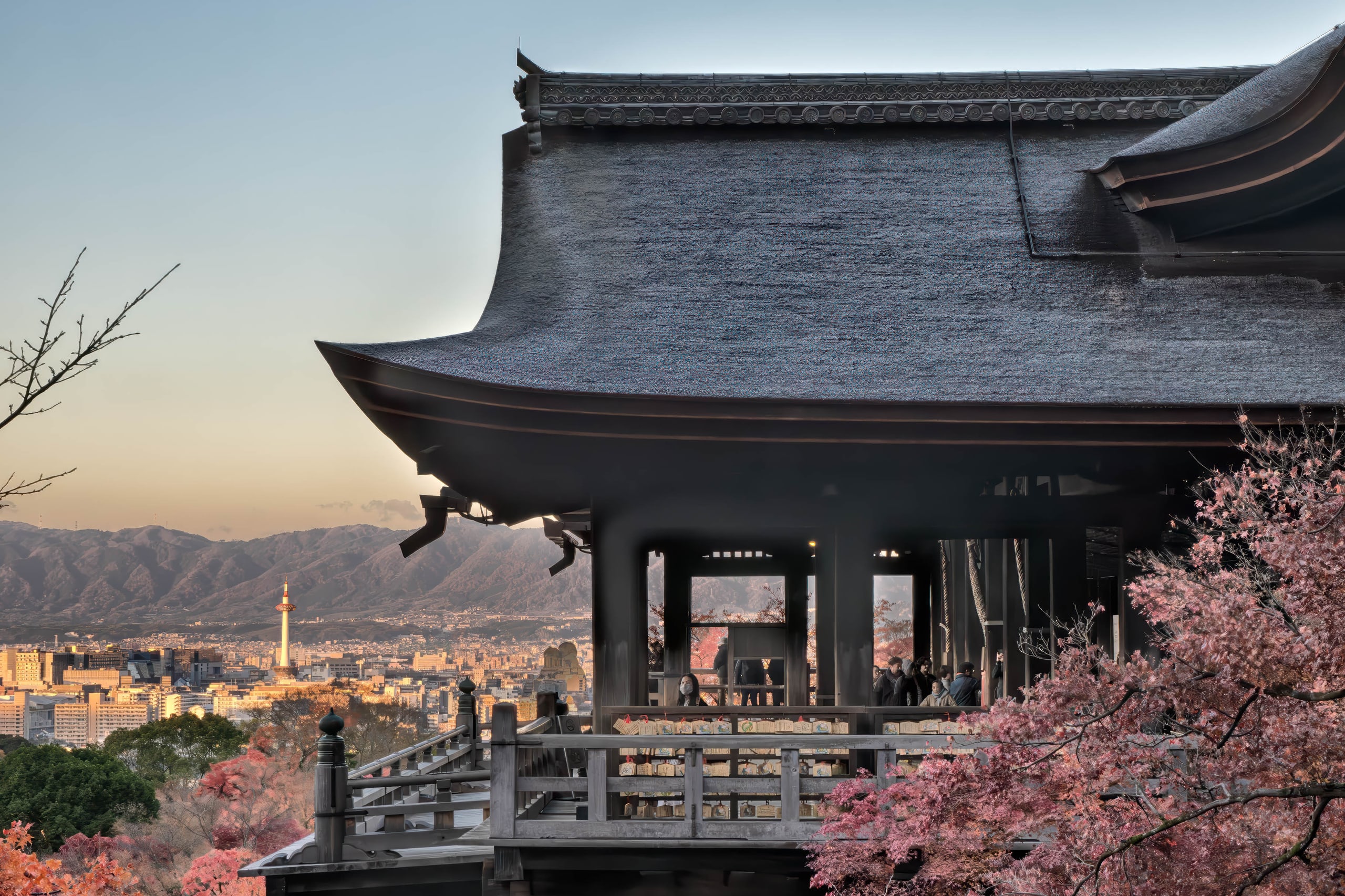
The city repays that knowledge more than any other in Japan. Kyoto has some sixteen hundred Buddhist temples and four hundred Shinto shrines, and seventeen temples, shrines and a castle, in the city and in neighbouring Uji and Otsu, are inscribed together by UNESCO as the Historic Monuments of Ancient Kyoto. No visitor sees more than a fraction of them, and the art of a Kyoto tour lies in the choosing: the garden that takes the afternoon light, the temple a kilometre from the famous one where a single gardener rakes moss beneath a maple.
in blossom
Kyoto in the cherry blossom
The Classic Cherry Blossom Tour of Japan reaches Kyoto on its sixth day and stays three nights in the old streets of Higashiyama. The cherry trees of the Keage Incline arch overhead in a long canopy of blossom, and the thousand vermilion gates of Fushimi Inari climb the hill behind the shrine. The Golden Pavilion at Kinkaku-ji stands over its pond. One afternoon is given to a hanami picnic laid on rugs in the park of the Kyoto Imperial Palace, where the families of the city come to sit under the same trees.
On the eighth evening a private room in a Gion teahouse is set for the group. Geiko and maiko dance, pour the sake, and lead the old games of the ozashiki, and then they sit with the guests and talk about a life of training seldom seen from beyond the lantern-lit lane. The tour runs from 30 March to 10 April 2027, twelve days from Tokyo to Osaka.
The Classic Cherry Blossom Tour of Japan, with three nights in Kyoto →
in maple
Kyoto in the maples
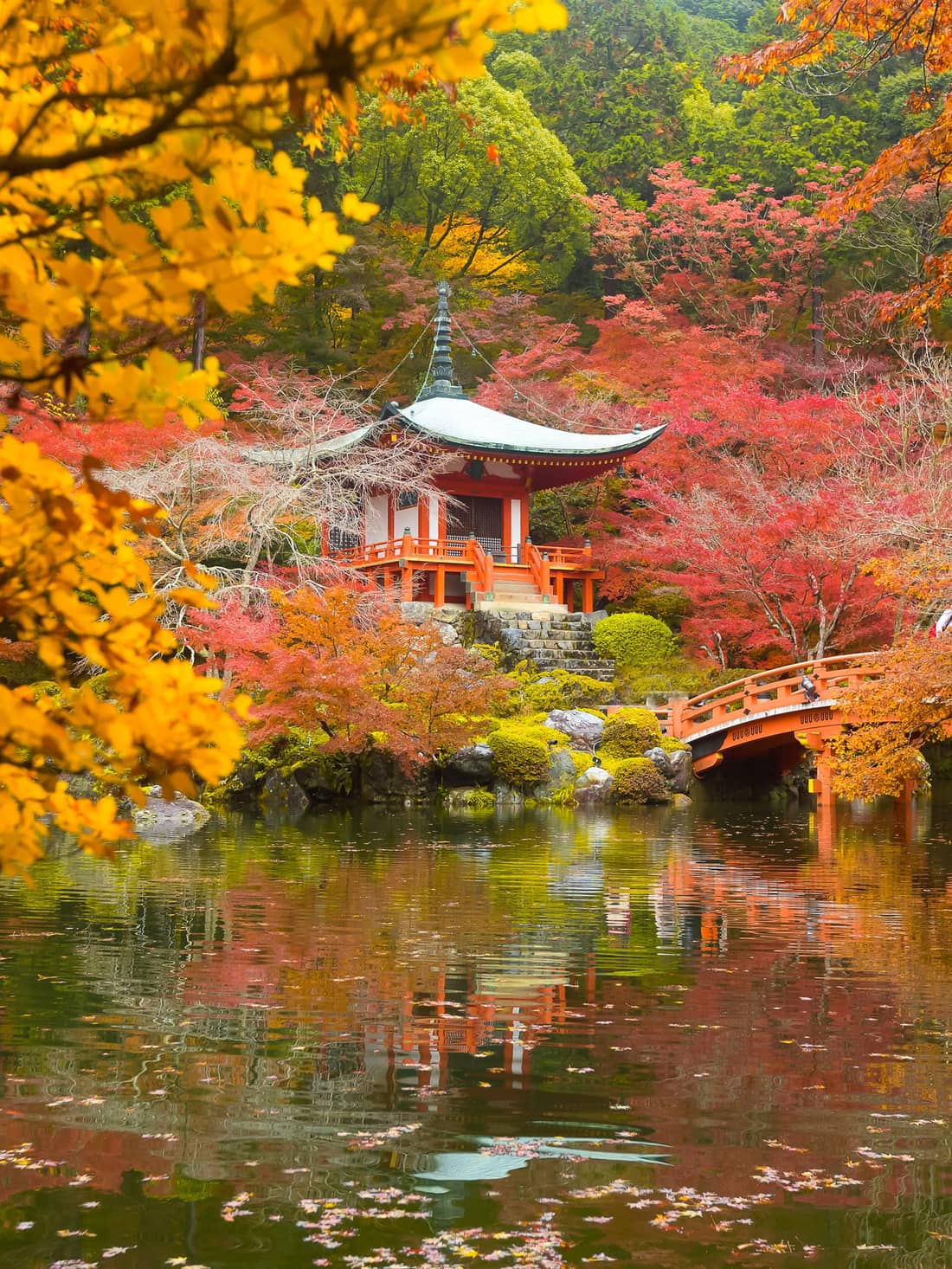
The Autumn Leaves Tour of Japan comes to Kyoto in late November and stays at the same hotel. A morning belongs to Tofuku-ji, where two thousand maples fill the valley below the Tsutenkyo Bridge, and the afternoons to the quieter gardens, chosen for where the season stands when the group arrives. A day is given to Nara, among the deer and the great temples, and the teahouse evening is spent in Kamishichiken, the oldest of the five geiko districts of Kyoto, beside the shrine of Kitano Tenmangu. Its 2026 departure is sold out, and it runs again from 23 November to 4 December 2027.
the collection
A private Kyoto tour on chosen dates
Between the published tours and the Custom Tour sits The Private Collection: four journeys already written, travelled privately by one party on its own dates. Three of them give Kyoto three nights in a hotel in Gion. Essential Japan takes in Tokyo, Kyoto and Osaka in nine days; Classic Japan adds two nights at a ryokan in Kinosaki Onsen; Definitive Japan adds two more beneath Mount Fuji.
The Kyoto of all three is the same, and it is the Kyoto a first visit should see. There is a private tea ceremony, the bowl turned and set down in a room of four and a half mats. There is kaiseki at a restaurant of two Michelin stars, a day out among the deer and the bronze Buddha of Nara, and the Tour Director every day, with the car at the door.
Classic Japan: Tokyo, Kyoto, Kinosaki Onsen and Osaka, privately →
in private
Kyoto for one party: the Custom Tour
A Custom Tour of Japan is built around Kyoto alone, from five nights, or gives the city a week inside a longer journey. The days are made from what the party loves. In Nishijin a weaver works an obi of silk brocade on the loom, a few centimetres a day, and talks as the shuttle passes. In Uji a tea master makes tea where the leaf is grown. A temple garden in the east of the city opens after its gates have closed, the raked gravel still pale in the last light and a monk on hand to explain what the garden is. In the evening a noh stage is lit for the party alone.
Outside the two great seasons Kyoto is a different city, and a Custom Tour travels in any of its months: the moss gardens at their greenest in the June rain, the Gion Matsuri through July, or the temples close to empty in January, with snow on the roof of Kinkaku-ji on the mornings it falls.
the rooms
Where to stay in Kyoto
Where a party sleeps in Kyoto decides how the city feels at either end of the day. The published tours stay in the machiya streets between Yasaka Shrine and Kodai-ji, with the stone slopes of Ninenzaka and Sannenzaka a walk from the door and the teahouse lanes of Gion a few minutes away, so that an evening there ends with a short walk home.
The published tours' hotel, between Yasaka Shrine and Kodai-ji →
A Custom Tour chooses from the whole of the city. There is a machiya, a townhouse of one's own with a maple in its courtyard. There is a ryokan of eighteen rooms in the centre of the city, and another a few streets away, founded in 1818 and kept by one family for generations, each of its rooms with a bath of fragrant koyamaki wood. There is a pavilion in a forest garden at the foot of Hidari Daimonji in the north of the city, one of twenty-six rooms, suites and pavilions under the trees, and a ryokan upstream of Arashiyama which guests reach by its own boat on the Oi river, the car left behind at the landing.
Closer to the old city, a hotel of nine suites stands on the street of the antique dealers in Gion, every one with a balcony over the Shirakawa canal. Another stands low against the hill beside Kodai-ji, above the stone lanes, its windows on the Yasaka pagoda. A third faces the garden of Toyokuni Shrine near Sanjusangen-do, and a fourth is built round Shakusui-en, a pond garden laid out at the end of the Heian period, more than eight hundred years ago.
The quarter decides the choice. Higashiyama puts the eastern temples at the door and Gion within a stroll. Takagamine and Arashiyama give up the evening walk for a forest and a river. The centre of the city, around Fuyacho and Muromachi, puts the old merchant streets and the market within reach, and leaves the car to carry the party to the hills.
by application
The Kyoto that opens by application
Some of the great places of Kyoto cannot simply be walked into. The Katsura Imperial Villa, the seventeenth-century villa whose plain pavilions and garden so moved the German architect Bruno Taut when he saw them in 1933, is seen only on a guided tour by application to the Imperial Household Agency; the Shugakuin Imperial Villa, its rice terraces and upper garden looking out over the city from the foot of Mount Hiei, is visited the same way. At Saiho-ji, the moss temple, a visitor copies a passage of the sutras by hand before walking into the garden.
A private tour sets these on the right days and fills the hours around them with what lies near: Katsura with the bamboo and the river at Arashiyama, Shugakuin with the villages of Ohara in the hills behind it.
the kagai
The five geisha districts
Kyoto has five kagai, the districts where geiko and maiko live, train and entertain: Gion Kobu, the largest; Gion Higashi beside it; Pontocho, the narrow lane along the Kamo river; Miyagawa-cho south of Shijo; and Kamishichiken, the oldest, beside the shrine of Kitano Tenmangu in the north-west. Each keeps its own school of dance and its own public performances, the Miyako Odori of Gion Kobu and the Kitano Odori of Kamishichiken in spring, the Kamogawa Odori of Pontocho in May, the Gion Odori of Gion Higashi in November. An evening in a teahouse, the ozashiki, is arranged through the teahouse itself, and the districts are best walked with someone who can say which teahouse is which.
Gion itself stays open to everyone: Hanamikoji, the Shirakawa canal and the approach to Yasaka Shrine. From 2024 only a short run of private lanes behind the teahouses has been closed to visitors, signed in three languages, with a fine of 10,000 yen for walking in.
the crafts
The crafts of the city
Kyoto was the capital for more than a thousand years, and the crafts that served the court are still practised in the streets where they began. The Nishijin weavers work the richest brocades on hand looms at a few centimetres a day. The dyers of Kyo-yuzen paint silk by hand with rice-paste resist, and the potters of Kiyomizu-yaki still work on the slope below Kiyomizu-dera. On a private tour the party goes into the workshops, watches the work at close range, and in some of them sits at the bench.
the days out
Day trips from Kyoto: Nara, Uji, Ohara and Kibune
Kyoto sits at the centre of a ring of quieter places, each an hour or less by car. Nara was the capital before Kyoto, and its Todai-ji keeps a Buddha of bronze some fifteen metres tall in one of the largest wooden halls on earth, with the park's deer bowing for crackers at the gate.
Uji, south along the river, grows the tea that Kyoto drinks, and its Byodo-in, the Phoenix Hall of 1053, stands over its pond exactly as it appears on the ten-yen coin. Ohara, in the hills to the north-east, has the moss and the cedars of Sanzen-in in a valley of farms. In summer the restaurants of Kibune, in the valley beside Kurama, build their dining platforms over the river, the kawadoko, and lunch is taken with the water running a few centimetres beneath the tatami, several degrees cooler than the city below.
the calendar
Kyoto by month
The cherry blossom and the maples are Kyoto's two famous seasons, and the city keeps ten other months that are each worth a journey. On 15 May the Aoi Matsuri walks a court procession in Heian dress from the Imperial Palace to the Kamo shrines, hollyhock leaves on every hat. July belongs to the Gion Matsuri, whose great wheeled floats, some of them hung with Flemish tapestries, are drawn through the centre of the city on 17 and 24 July. On the night of 16 August the Gozan no Okuribi lights five great fires on the mountains around the city, written characters and the shapes of a boat and a torii gate, to send the ancestors home, and on 22 October the Jidai Matsuri walks a thousand years of costume from the palace to Heian Shrine.
Winter is the quietest season in Kyoto. In January and February the temples are close to empty, the special winter openings show rooms and paintings otherwise kept closed, and the plum blossom at Kitano Tenmangu arrives before the cherry.
Luxury Japan tours for 2027, every season side by side →
the journey
A private tour of Kyoto in any month
The Custom Tour of Japan gives Kyoto as many days as a party wants, from five nights, in whichever month it chooses: the court procession of the Aoi Matsuri in May, the moss gardens in the June rain, the floats of the Gion Matsuri in July, the maples of Tofuku-ji in autumn or the quiet temples of January. A Tour Director who knows the city street by street is with the party every day, and a private car waits at the end of each lane, so a morning at a Nishijin loom, an afternoon in the tea fields of Uji and an evening in a Gion teahouse fit into a single day.
Katsura and Shugakuin, the imperial villas that open only by application, are set on the right days of the journey, and the hotel is chosen from the whole of the city, from a townhouse of the party's own in Higashiyama to a ryokan reached by boat above Arashiyama.
questions
Questions
What does a luxury Kyoto tour include?
Every one of them has a Tour Director who knows the city street by street and a private car at the end of each lane. The published tours and The Private Collection stay three nights in Higashiyama, between Yasaka Shrine and Kodai-ji; the published tours add an evening with geiko and maiko in a private teahouse room, and The Private Collection a private tea ceremony and kaiseki at a restaurant of two Michelin stars. A Custom Tour chooses its hotel and its days from the whole of the city.
How many days are enough for Kyoto?
Three nights is the least that does Kyoto justice: a day in the temples of the east, a day in the west at Arashiyama and Kinkaku-ji, and a day out to Nara or Uji. Five nights lets the city slow down, with room for a garden opened by application, a craft workshop and a teahouse evening.
Is a private tour of Kyoto worth it?
Yes. Kyoto's best hours depend on choosing the right temple at the right time of day, and a private tour with a Tour Director and a car places each visit where it is quietest and joins places a day of trains and taxis would keep apart.
What is the most luxurious hotel in Kyoto?
Among ryokan, the two most celebrated stand a few streets apart in the centre of the city, one of eighteen rooms, the other founded in 1818 with a bath of koyamaki wood in every room. Among hotels, a pavilion in the forest garden at Takagamine, one of nine suites over the Shirakawa in Gion, and a ryokan above Arashiyama reached by its own boat stand at the top of the city.
Where is the best area to stay in Kyoto?
Higashiyama, around Gion and Yasaka Shrine, is the best base for a first visit, with the eastern temples and the teahouse streets on foot. The centre of the city suits a ryokan stay, and Arashiyama or Takagamine suit a party that wants a river or a forest at night.
Is Gion closed to tourists?
No. Gion's public streets, Hanamikoji and the Shirakawa canal remain open to every visitor. From 2024 a short run of private lanes behind the teahouses is closed, with a fine of 10,000 yen for entering.
Can visitors see the Katsura Imperial Villa?
Yes, on a guided tour by application to the Imperial Household Agency, with tours in English at set hours. The Shugakuin Imperial Villa is visited the same way.