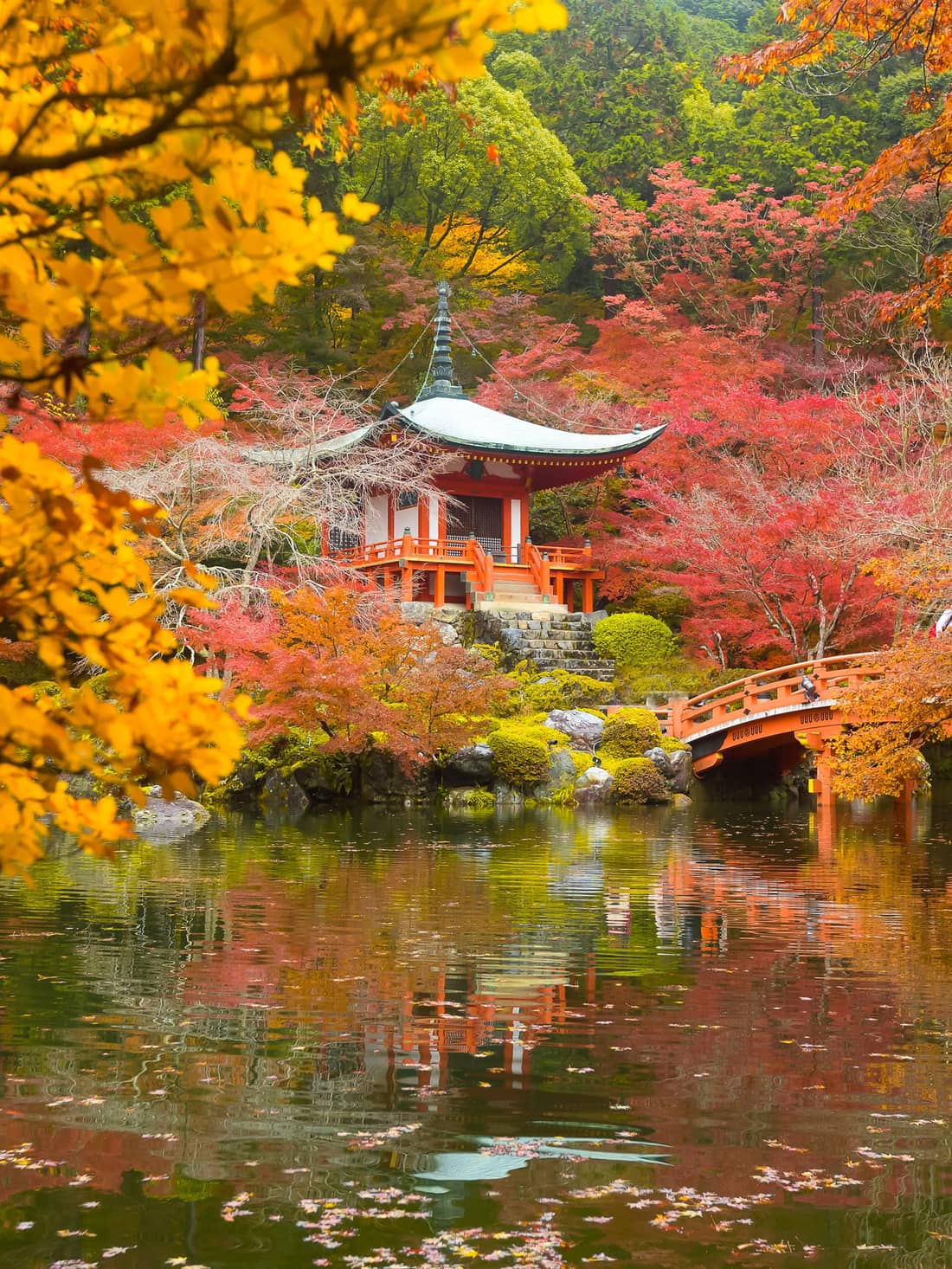

The first red leaves appear high in the eastern hills before the city admits that autumn has arrived. Down in the lanes the shop curtains still move in mild air and the Kamo River runs broad and silver. Then the basin turns. Maples deepen behind walls, ginkgo drops gold onto the pavements, and the slopes of Higashiyama begin to glow above the roofs.
Kyoto in autumn is the old capital at its most composed. The cold air of late November sharpens every line in the city: the edge of a tiled roof, the darkness of old timber, the green of moss, the difference between open light on the river and shade in the lanes beneath the hills. Against all of it the maples burn red, and Kyoto's autumn is that red seen against dark wood, stone and water.
the basin
The basin and the hills
The city sits in a basin, enclosed by mountains on three sides, and the colour begins at height and comes down into the streets. The hills turn first, then the sloping roads and old temple approaches, then the gardens behind their walls, and last the ginkgo avenues of the lower city.
Higashiyama is the eastern wall. In late November the slopes behind the old quarters become a layered ground of maple, cedar, pine and roof tile, set behind the city like a painted screen, and from certain streets a single flash of red above a wall changes the whole view. The morning light reaches these hills before the centre of the city has warmed; by afternoon the shadows lengthen across the lanes and the colour turns denser.
Arashiyama, in the west, gives Kyoto's autumn a river landscape. The Ōi River bends beneath wooded slopes, and the hills gather their colour in a broader, more scenic register than the lanes of the east. The northern side of the city is cooler and more wooded. At Shimogamo the forest of Tadasu no Mori, set between the two rivers that join to form the Kamo, stays green and dim long after the hills have turned, and its colour comes late, among the last in the city.
Kyoto Gyoen, the park around the Imperial Palace at the centre of the city, works at another scale again: broad gravel avenues, ginkgo planted in generous rows, and enough open ground to read a single tree against the sky. It is one of the few places in central Kyoto where a park, and not a lane or a walled garden, carries the season.
the quarters
Kyoto's streets, canals and old quarters in autumn
The strongest autumn scenes in Kyoto are partial ones: a maple above a plaster wall, ginkgo leaves caught against a stone kerb, a red branch seen through a wooden lattice.
Gion and the Shirakawa canal carry the season with restraint. The water reflects willow, timber and lantern and only an occasional branch of colour, and in the evening, when the water darkens and the lamps come on, a single maple sets the mood of the whole street. Pontochō and the Kamo River make a sharper pairing. In the alley, autumn is shadow, lantern and the glow of rooms behind paper screens; a few steps away on the riverbank the season opens into air, coats come out, and the mountains to the north take on a firmer line.
Okazaki gives autumn civic space, its canal, museums and broad roads set against the eastern hills, the ginkgo counting here as much as the maple. In Nishijin, the old weaving district, the season needs no dramatic foliage at all: a persimmon tree behind a wall, a maple in a courtyard, a fallen leaf at the foot of a lattice door. Kamishichiken, the oldest of Kyoto's geiko districts, is smaller and more reserved than Gion, and a little colour against old timber and the sound of geta on stone is autumn enough there.
The Philosopher's Path, the canal-side walk along the northern stretch of Higashiyama, is one of the city's few continuous autumn corridors. The cherry trees that line it in spring turn a quiet yellow, and the canal beside the path is narrow enough to catch every leaf that falls. To the west, in the flatter city, the moat of Nijō Castle repeats the colour-in-water picture at a formal scale, stone ramparts standing in for the mountains behind the eastern quarters.
the evening city
Kyoto in the evening in autumn
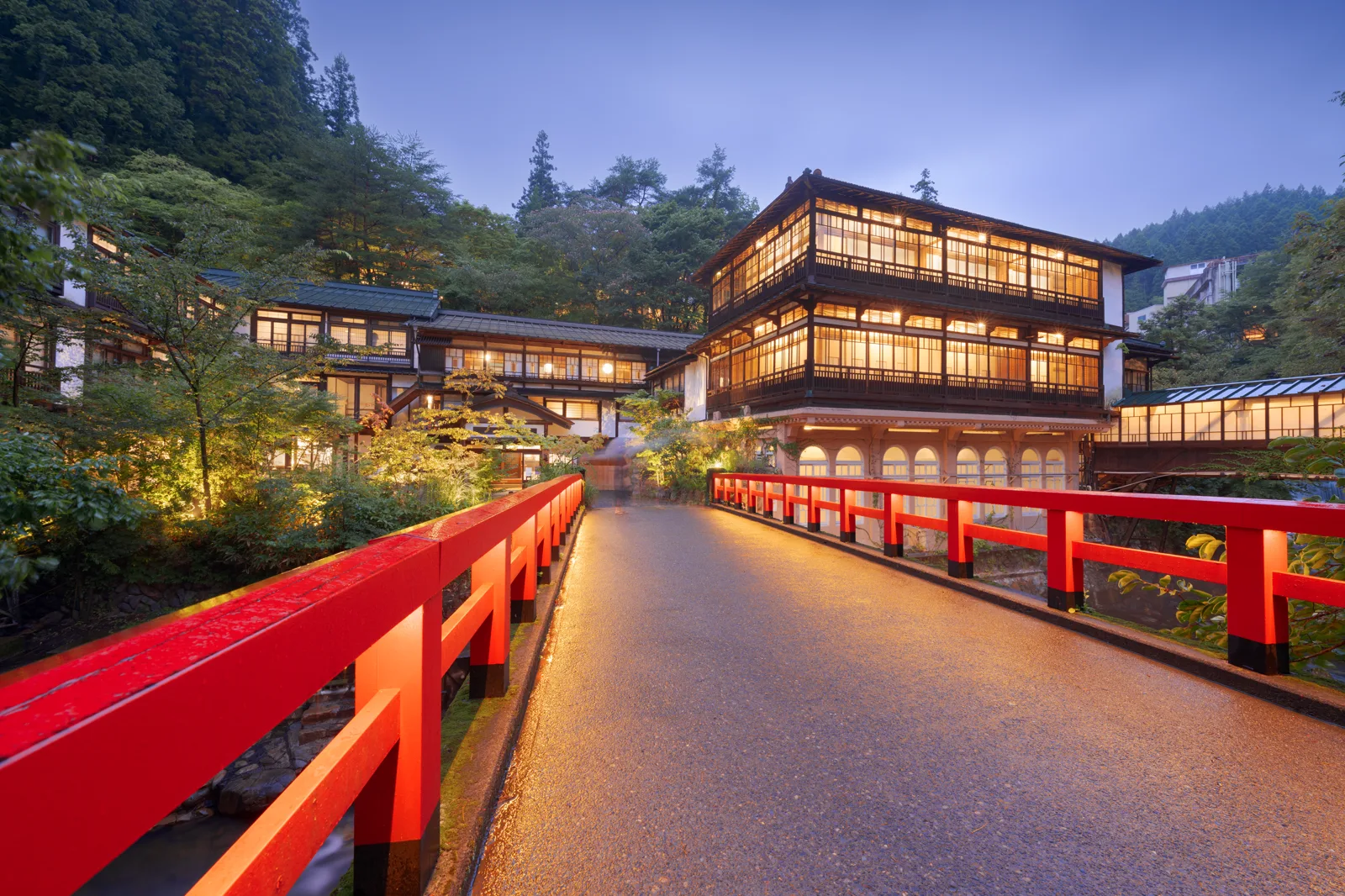
Kyoto's autumn is at its richest once the sun has dropped behind the western hills. The colours deepen without disappearing. Red leaves near a lantern take on the density of lacquer, wet stone reflects gold, and a lane that looked ordinary at noon becomes a passage of shadow and glow.
The city has always known how to handle darkness, with a paper screen, a lamp under the eaves, a corridor that shows a garden only in part, and autumn leaves need exactly this handling. Under flat midday light even a fine maple can lose its force; at the edge of evening it turns inward and glows. Rain changes the city again: the timber darkens, the roof tiles shine, fallen leaves stick to the stone, and the smell of damp earth and old wood comes forward in the narrow streets.
Autumn has its sounds here too: leaves being swept from a temple path, water running in the small channels beside the lanes, the softer tread of people in coats, a temple bell from beyond a wall.
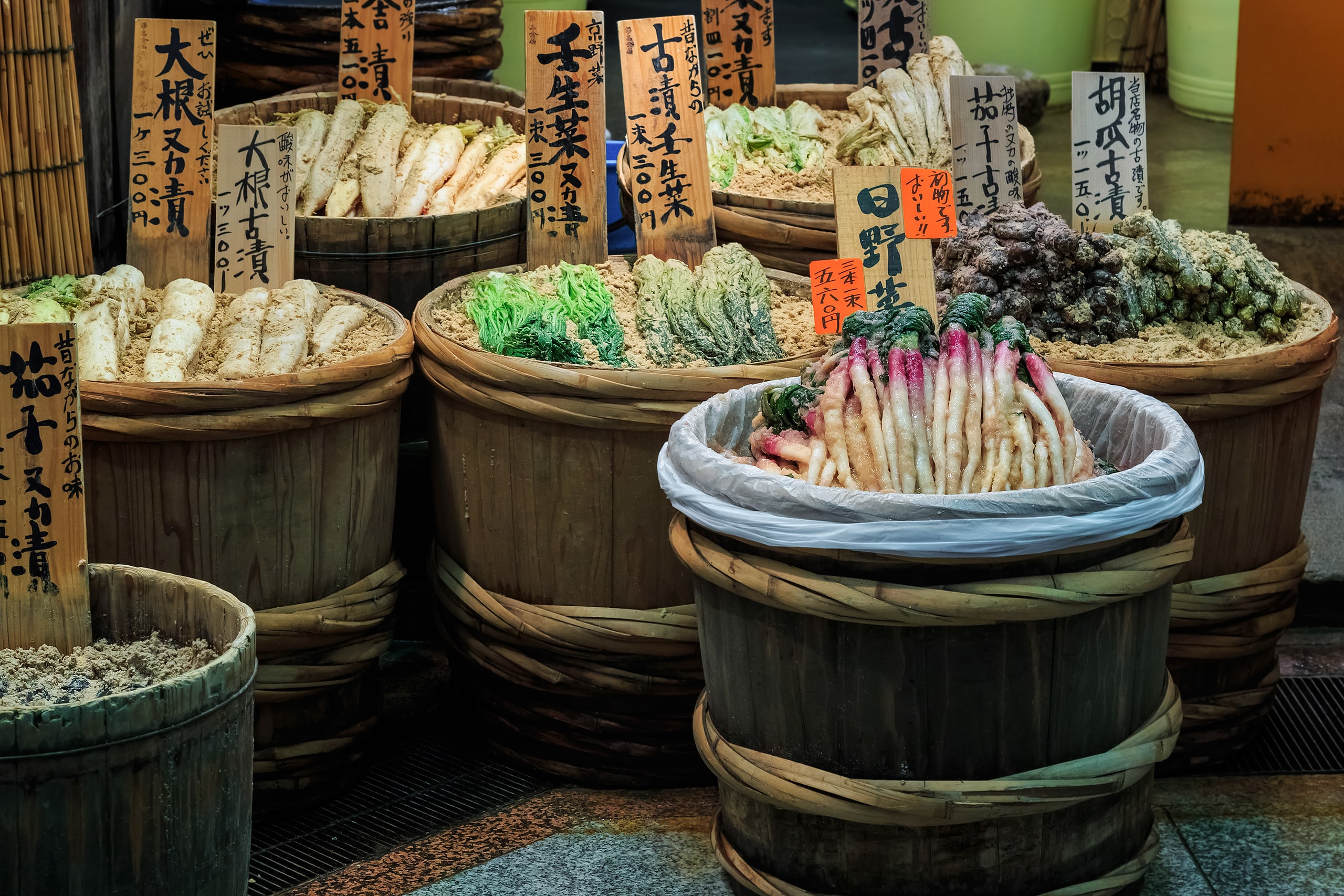
Nishiki Market's covered arcade sells pickles, dried fish and the produce of the season whatever the weather outside, and its side lanes open onto plaster walls where a single maple still finds the light. Teramachi and Shinkyōgoku, quieter once the dinner hour has emptied them, carry the season in doorway plants and in the cooler draught that reaches the street after dark.
The best of Kyoto's autumn lies between the famous precincts: a canal carrying yellow leaves, a shop curtain moving in cold air, a red branch above a side gate, the Kamo River under a lowering sky. It rewards a city walked one quarter at a time, with the hours to linger in each.
the journey
A private journey to Kyoto in autumn
The Custom Tour of Japan brings a private journey to Kyoto in its maples on the dates a party chooses, from five nights to as long as they like. A Tour Director is with the guests every day and a private car and driver wait in each city, so a day can run from the gardens of Higashiyama to the river at Arashiyama and back to Gion for the evening without a thought for the route between.
In Kamishichiken, a teahouse that receives guests only by introduction can lay a room for the party alone, where geiko and maiko dance, pour and then sit and talk, the Tour Director interpreting. With the lanes lit outside and the first cold of November in the air, it is Kyoto in autumn at its most private.
questions
Questions
When is the fall foliage in Kyoto?
In late November the maples reach the city. The colour begins high in the eastern hills of Higashiyama and comes down into the basin: the slopes first, then the old temple approaches and the gardens behind their walls, and last the ginkgo avenues of the lower city. The forest of Tadasu no Mori at Shimogamo turns among the last of all.
Where are the best places to see autumn leaves in Kyoto?
Higashiyama, the eastern hills, and the Philosopher's Path along their northern stretch; Arashiyama in the west, where the Ōi River bends beneath wooded slopes; the ginkgo of Kyoto Gyoen around the Imperial Palace; and the moat of Nijō Castle. After dark, Gion and the Shirakawa canal carry the season by lantern light.
Is Kyoto worth visiting in autumn?
Autumn is the old capital at its most composed. The cold air of late November sharpens every line of the city, and the maples burn red against dark timber, stone and water. Kyoto in autumn is best walked one quarter at a time, with the hours to linger in each, which is how a private journey with a Tour Director runs.