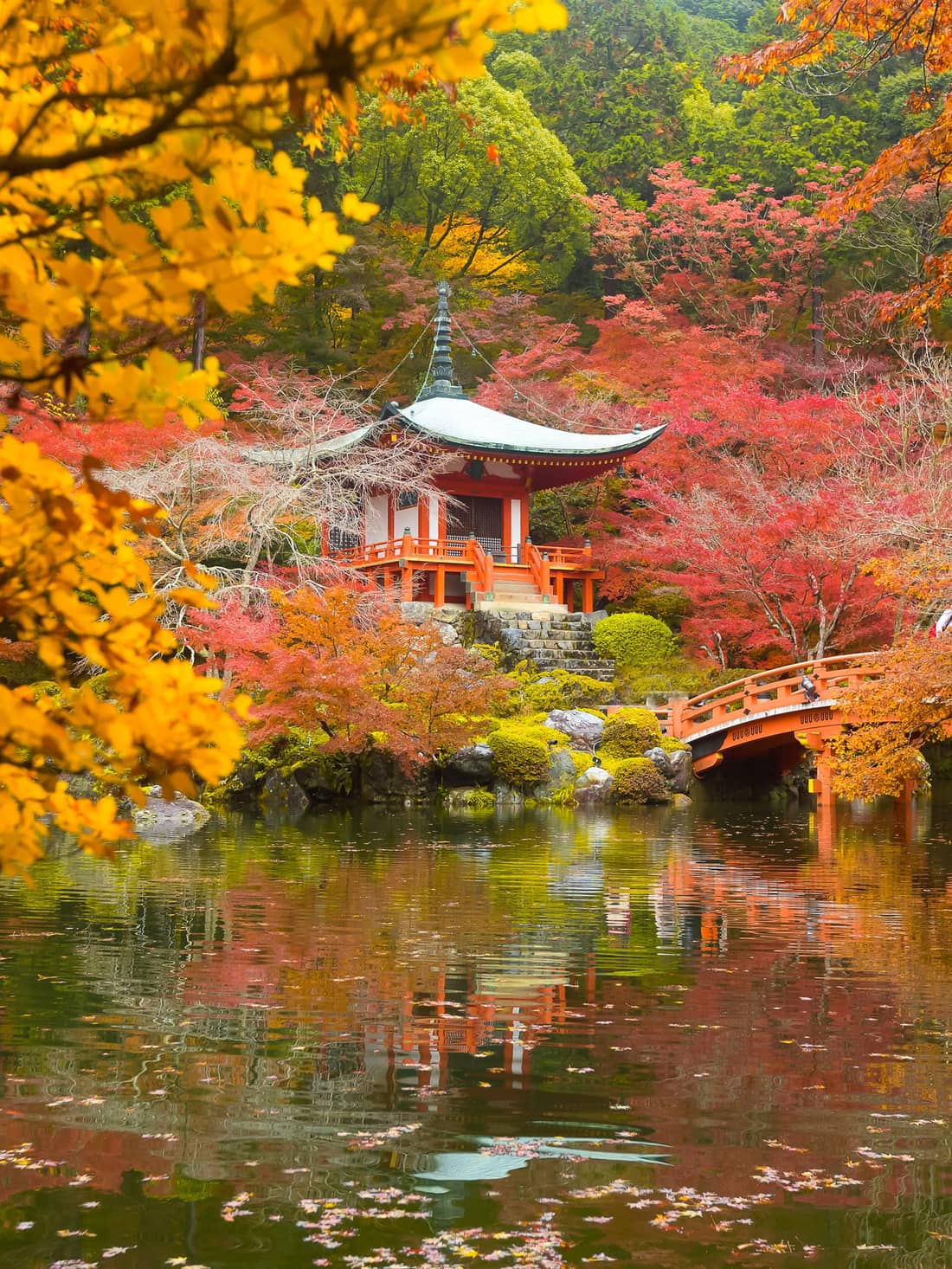

A luxury onsen ryokan room is a room in a Japanese inn with an onsen of its own, filled from a genuine hot spring, and the first thing to ask of it is where the water comes from. The tub is cypress, round, and already full when the room goes dark. Steam fogs the lower pane of glass, and beyond it a stone wall holds back a slope of maple and bamboo, the colour going out of it from green to grey. A kettle ticks in the next room, and the only other sound is the water running over the rim of the tub.
In Japan the word onsen has a legal meaning, tied to a hot spring source, its mineral content and the temperature of the water as it leaves the ground. A cypress tub filled with heated tap water is a fine thing to sit in, and a stone bath on a private veranda empties an evening of its noise, but neither is an onsen unless the water itself comes from a spring.
Kyoto makes the question harder, because the old capital is not an onsen town in the way Hakone, Kinosaki or Beppu are. Its basin sits on granite and river gravel, away from the volcanic ground that feeds Japan's great hot spring regions, and natural springs within the city are scarce. The private onsen room exists in Kyoto, but a guest has to know where to find it.
the water itself
The water itself
Some Kyoto properties bring hot spring water in, drawn from a licensed source in the surrounding hills and delivered by tanker to a private tub. Disclosed plainly, this is still onsen under Japanese law, no different in principle from a spring piped some distance to its own bathhouse, and a good property says so.
A few have drilled for it. Beside Nijo Castle, on the site of the Kyoto residence of a great merchant family, one hotel draws a sodium and calcium chloride spring from some thousand metres beneath the building, and two of its suites have an onsen of their own on it. In the forest garden at Takagamine, in the north of the city, a resort feeds its indoor and outdoor onsen from mineral water that rises nearby.
The Japanese standard is exact. Under the country's Hot Springs Act, water counts as onsen if it emerges from the ground at twenty-five degrees Celsius or warmer, or if it is cooler but carries one of nineteen designated substances, among them sulphur, iron and sodium chloride, at a set concentration. A spring at fifteen degrees is an onsen if the minerals are there, and no guest can judge that by looking at the water.
The tub matters too. Hinoki cypress gives fragrance and a softness under the hand, and it darkens slowly with use. Stone keeps its heat longer and looks darker at night, which suits a room made for the evening. A rotenburo, open to the air, or a han-rotenburo, half open, lets the water meet the cold directly, and in winter the steam rises off the shoulders into the garden. Several of the most admired suites in Gion have deep tubs of fragrant hinoki and no spring at all: beautiful baths, honestly described, and not onsen.
The best of these rooms in Kyoto are spare: the surface of the water, a garden wall, a branch moving past the glass, and one low lamp.
beyond the basin
Onsen in the hills around Kyoto: Kurama and Kameoka
The springs that the city lacks are found in the hills around it. Kurama, in the mountains north of the centre, about half an hour from Demachiyanagi on the Eizan line, has a stone rotenburo a short walk from the station along the river road. Its spring rises naturally from seven metres below the ground at only fifteen degrees, and it counts as onsen for its sulphur. In winter snow settles on the stones around the pool while the cedar on the slopes fades into cloud.

West of the city, in the hills behind Kameoka, Yunohana Onsen has a longer memory. Local tradition holds that the soldiers of Akechi Mitsuhide bathed their sword wounds here during the wars of the sixteenth century, and the radium spring is still drawn from the same ground. The valley is called Kyoto's oku-zashiki, its inner parlour, the room at the back of a traditional Japanese home where the most honoured guests are received.
Both are close enough to Kyoto that a night at either fits inside a stay in the city.
a night away
A night away: private onsen rooms within reach of Kyoto
For the full version of the room, the great onsen towns are close. Arima Onsen, in the hills behind Kobe, is about an hour by car and one of the oldest onsen towns in Japan. Its Kinsen, the gold water, rises clear from the ground and turns rust-red with iron and salt as it meets the air; its Ginsen, the silver water, is clear and carbonated.
Kinosaki Onsen, near the Sea of Japan coast, is two and a half hours north of Kyoto by limited express, and its most celebrated ryokan keeps its own onsen there, with the seven public bathhouses of the town a walk away along the willow canal in yukata. At Yamashiro Onsen in Kaga, about two hours from Kyoto by train, a ryokan has been kept by one family since 1639, and its garden rooms each have an open-air onsen of their own on the ryokan's spring.
A ryokan kept by one family since 1639, Yamashiro Onsen →
what changes
What a private onsen changes
Shared onsen are one of Japan's great pleasures, but they keep a shared clock. A room of one's own lets a guest go back to the water at whatever hour the day calls for it: before dinner, after rain, or late at night. That freedom matters most in Kyoto, where a day of temples and gardens, much of it on foot and on stone steps, tires the legs more than the distance would suggest.
Weather becomes part of the evening. Rain darkens the stone, sharpens the green of the moss and patters on the water, and cold air over a hot bath is a pleasure in itself, the steam filling the room while the garden outside goes still. In spring an open pane lets a few petals drift as far as the water. In summer a short soak at dusk, just before dinner, does more for a guest than a long one at midday.
The morning is the room's other hour. With the garden pale beyond the glass and a kettle sounding close by, the water is as hot as it was the night before, and a guest can start the day in it before leaving the room at all.
Dinner in a ryokan built around this kind of room follows the month as the bath follows the weather, a sequence of small dishes that changes with the season. A guest who wants an onsen should ask a plain question about the water, and expect a plain answer.
Read How to Use an Onsen, for the etiquette that still applies →
The room with its own onsen, near Mount Fuji →
Where to stay in Kyoto, through the year →
More of the Japan Edition on ryokan and onsen →
Luxury Kyoto tours: in blossom, in maple, and in private →
A room with its own spring is easier to find a night beyond Kyoto than inside it, and the Custom Tour of Japan, created from a blank page for one party, can set a hot-spring town beside the city in the same journey. Kinosaki at dusk is willows along a canal and lanterns coming on along the stone bridges, the guests in yukata as the light goes, then the onsen of their own suite and dinner brought to the room one course at a time. On Ise-Shima there is a resort where every suite has its own onsen, above a bay that changes colour all day.
questions
Questions
What is a luxury onsen ryokan?
A Japanese inn with an onsen drawing on a genuine hot spring source, either on site or piped and tankered in from a licensed spring nearby. Around Kyoto, where natural sources are scarce within the city itself, the honest room says plainly where its water comes from.
Are there real onsen in Kyoto?
Yes, though fewer than in the volcanic regions. Kurama in the northern mountains and Yunohana near Kameoka draw on their own springs, and within the city a hotel beside Nijo Castle draws its onsen from a natural spring a thousand metres beneath it.
Can a hotel room in Kyoto have its own onsen?
A few rooms in and around Kyoto carry a private tub filled from a licensed spring, by pipe or by tanker, which counts as onsen under Japanese law. The question to ask is where the water comes from; for a room with its own spring-fed onsen and no compromise, a night at Yamashiro, Kinosaki or Arima is within two and a half hours.
What is a kashikiri onsen?
An onsen reserved for one party at a time, usually for forty minutes to an hour, marked 貸切 at the door. It gives the privacy of a room's own onsen inside a ryokan whose rooms do not have one.
What is the difference between a private onsen and a hinoki bath?
The water. A hinoki bath is a tub of fragrant cypress, and it is an onsen only when it is filled from a hot spring that meets the legal threshold for temperature or minerals; filled from the tap, it is a fine bath and nothing more.
Is a room with a private onsen worth it?
Yes, above all in Kyoto, where a day of walking ends best in hot water at an hour of the guest's choosing, with no shared clock to keep.