
chubuishikawa
Kanazawa
Kanazawa is the old castle town of the Maeda lords in Ishikawa Prefecture, in the Chubu region, on the Sea of Japan coast about two and a half hours from Tokyo by Shinkansen, with one of the three great gardens of Japan at its centre.
Nagamachi, the samurai quarter, Kanazawa
- Prefecture
- Ishikawa
- Region
- Chubu
- Journeys
- One of our journeys
overview
A castle town that spent its fortune on gardens, tea and craft, and still lives by them.
For almost three centuries, from 1583 until the domains were abolished in 1871, Kanazawa was the seat of the Maeda family, lords of Kaga and the richest house in Japan after the Tokugawa shoguns themselves. Their wealth was measured at a million koku of rice, and with the shogunate wary of any lord who spent on soldiers, the Maeda spent instead on culture: Noh, tea, gardens, and the crafts that served them. The city they built is still there. Like Kyoto, Kanazawa was spared the air raids of the Second World War, and its teahouse districts, samurai lanes and temple quarters survive whole.
The legend behind the name is of a farmer who washed gold dust from potatoes he dug, and Kanazawa means marsh of gold. Almost all the gold leaf made in Japan is beaten in the city, and gold appears everywhere here, on lacquer, on screens, on the walls of a tea room and in the sweets. Kaga Yuzen silk dyeing, Kutani porcelain, Ohi ware for tea and lacquer of many kinds are still made in and around the city, and Kanazawa ranks with Kyoto and Matsue among the great cities of Japanese confectionery.
The modern city sits easily beside the old one. The 21st Century Museum of Contemporary Art, a low glass circle opened in 2004, stands a few minutes from the castle, and the D.T. Suzuki Museum gives Zen a building of water and concrete. Since the Hokuriku Shinkansen reached Kanazawa in 2015, it has become one of the great pleasures of a journey through Japan: a city of manageable size, walked in a day and understood in three, where the cooking of the Sea of Japan is some of the best in the country.
Our tours stay overnightOur tours visit for the dayOn a Custom Tour of Japan
see and do
What to see in Kanazawa
Kenrokuen
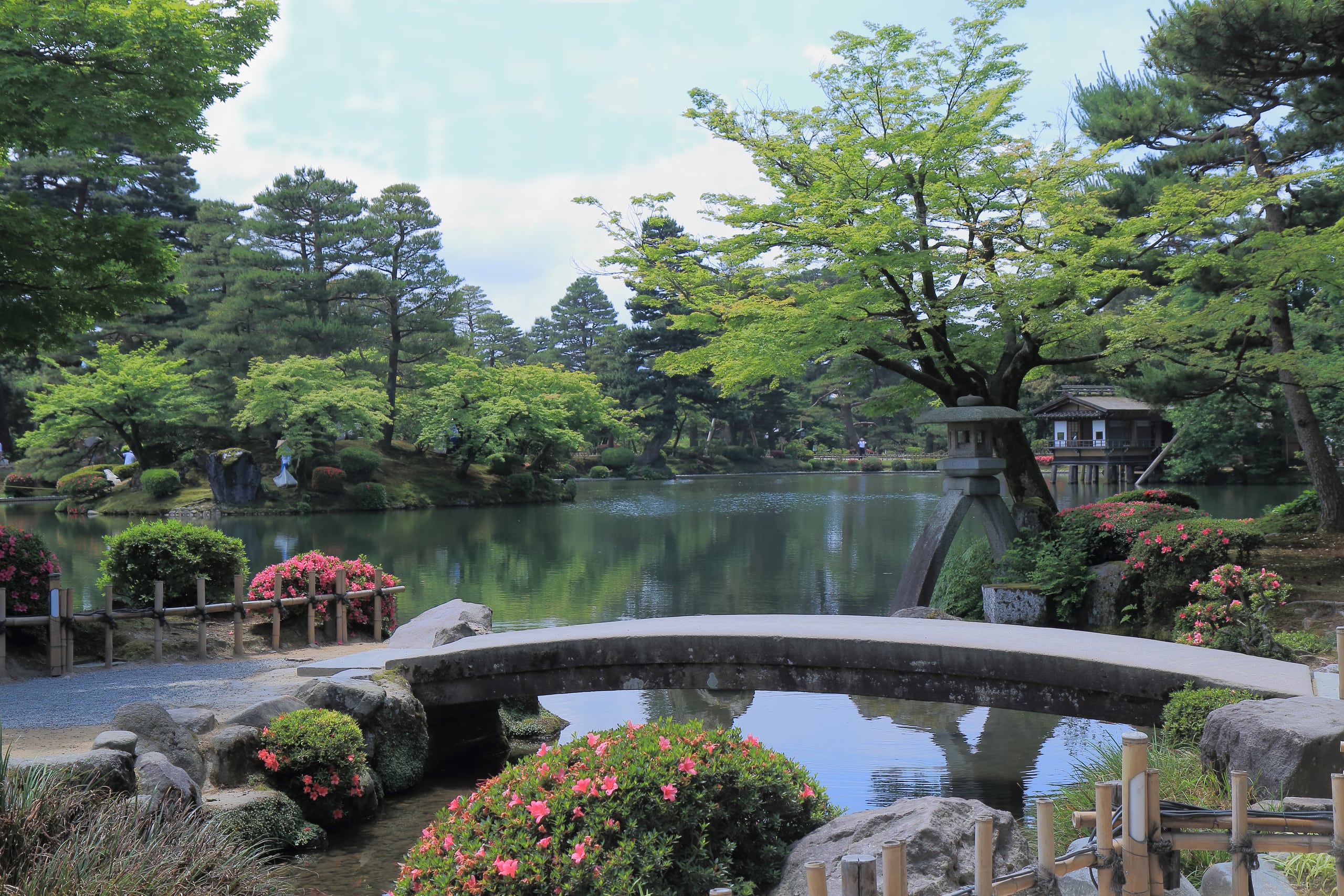
One of the three great gardens of Japan, with Kairakuen in Mito and Korakuen in Okayama, laid out by the Maeda lords from 1676 over eleven hectares beside the castle. Its name means the garden of six qualities, and its emblem is the Kotoji lantern, standing on two legs of unequal length at the edge of Kasumiga-ike pond.
Kanazawa Castle Park
The castle grounds across the road from Kenrokuen, entered through the Ishikawa-mon gate of 1788. The long white Gojikken Nagaya storehouse was rebuilt in wood by traditional methods in 2001, and the roofs are tiled in lead, which weathers to the pale grey that gives the castle its colour.
Gyokusen-inmaru Garden
A garden of the castle restored and reopened in 2015, built down a slope of stone walls around a pond, with a tea house where a bowl of matcha and a sweet are served looking over it.
Kenrokuen Higashi Chaya
The teahouse district laid out in 1820 on the east bank of the Asano River, two streets of wooden fronts with fine kimusuko lattices, where geiko still entertain. The Shima teahouse, built that year, is preserved as an Important Cultural Property with its upstairs rooms for the evening's guests.
Kazuemachi and Nishi Chaya
The city's two other teahouse districts: Kazuemachi, a single quiet row along the Asano River, lovely in the evening, and Nishi Chaya, south of the Sai River, smaller and less visited.
Nagamachi
The samurai quarter below the castle, a few lanes of earthen walls capped with straw matting and narrow canals. The Nomura family house keeps a small garden of stone, water and carp that is among the most admired private gardens in Japan.
21st Century Museum of Contemporary Art
A circular glass building by the architects Kazuyo Sejima and Ryue Nishizawa of SANAA, its galleries set like boxes within the round. Leandro Erlich's Swimming Pool, where visitors appear to stand beneath the water, is its best-loved work.
D.T. Suzuki Museum
A small museum by Yoshio Taniguchi to the Kanazawa-born writer who carried Zen to the West, built around a shallow Water Mirror Garden where a single ripple crosses the surface every few minutes.
Omicho Market
The market of the city since the eighteenth century, with some 170 stalls under one roof: snow crab, sweet shrimp, nodoguro, oysters and the vegetables of Kaga, and counters serving rice bowls of the morning's fish.
Myoryu-ji
A temple of the Nichiren sect in the Teramachi quarter, built for the Maeda with hidden stairways, trapdoors and concealed rooms, so that it is known as the ninja temple. It is seen by guided visit.
Oyama Shrine
The shrine of Maeda Toshiie, the first lord of Kaga, entered through a gate of 1875 that mixes Japanese, Chinese and European design, with coloured glass in the windows of its upper storey.
Seisonkaku
A villa built in 1863 by the thirteenth Maeda lord for his mother, on the edge of Kenrokuen, its rooms decorated with painted ceilings, lacquer and glass imported from Holland.

experiences
The best of Kanazawa
An evening in a teahouse
Dinner in an ochaya of Higashi Chaya, with the dances, the shamisen and the drinking games of the geiko, in the upstairs rooms built for exactly this. It is opened by introduction, and we arrange it.
Gold, lacquer and porcelain in the making
Time in the workshops of the city's crafts: the beating of gold leaf to a ten-thousandth of a millimetre, the painting of Kutani porcelain, the dyeing of Kaga Yuzen silk. Laying a sheet of gold leaf yourself, on a box or a tray, is a small and lovely thing to bring home.
The cooking of the Sea of Japan
Kanazawa eats as well as any city in Japan: snow crab, nodoguro grilled over charcoal, jibuni, the Kanazawa dish of duck simmered with wheat gluten and vegetables, and kaiseki served on Kutani porcelain and Wajima lacquer at a Michelin-starred counter in the teahouse district.
Tea and sweets
A tea ceremony in a tea room of the old city, with wagashi made by a confectioner whose family has supplied the tea masters of Kanazawa for generations, and the time to understand why this city keeps tea so close.
Kenrokuen with a gardener's eye
A walk through Kenrokuen with a guide who knows its making: the pines braced with ropes, the stream drawn from the Sai River by an aqueduct of 1632, and the views composed for a lord who walked the same paths.
plan your visit
Kanazawa on a journey through Japan
- How long to stay
- One night shows Kanazawa's great garden and its teahouse quarter, as on The Autumn Leaves Tour of Japan, and two or three let the gardens, the teahouse districts and the workshops unfold without hurry, with an evening in Higashi Chaya.
- Getting there
- By the Hokuriku Shinkansen from Tokyo in about two and a half hours on the fastest trains. From Kyoto or Osaka, the Thunderbird express to Tsuruga connects with the Shinkansen, a little over two hours from Kyoto. Komatsu Airport is about forty minutes by car.
- Pairs well with
- Kanazawa leads to the onsen ryokan of Kaga, half an hour south, to the thatched village of Shirakawa-go and on to Takayama, and to Kyoto or Tokyo by fast train.Kaga, Yamashiro OnsenShirakawa-goTakayamaKyotoTateyama Kurobe Alpine RouteTokyo
where to stay
Luxury hotels and ryokan in Kanazawa
The best places to stay in Kanazawa are in the old centre, between the castle park and the Higashi Chaya district, where the gardens, the teahouses and Omicho Market are all a walk away. The hotel we choose here is of that kind, in the old centre of the city itself.
Many guests pair a night or two in Kanazawa with a stay in the onsen ryokan of Kaga, half an hour to the south, where the ryokan are more distinguished than any hotel in the city and the cooking is of the same tradition.
journeys
Tours of Japan that include Kanazawa
Open a journey below for its route, its dates and its price. On dates of your own, a Custom Tour of Japan can bring you here and anywhere else in Japan you would like to go.
questions
Kanazawa: questions answered
How many days do you need in Kanazawa?
Two to three nights. Two covers Kenrokuen, the castle, the teahouse districts and the samurai quarter; three adds the museums, the craft workshops and an evening with geiko.
How do you get from Tokyo to Kanazawa?
By the Hokuriku Shinkansen from Tokyo or Ueno station, about two and a half hours on the fastest Kagayaki trains. On our journeys a private car meets you at Kanazawa Station.
How do you get from Kyoto to Kanazawa?
By the Thunderbird express to Tsuruga and the Hokuriku Shinkansen from there, a little over two hours in all, or about three hours by car.
What is Kanazawa famous for?
Kenrokuen, one of the three great gardens of Japan, its preserved teahouse and samurai districts, and its crafts, above all gold leaf, of which it makes almost all of Japan's supply. It is also known for the seafood of the Sea of Japan.
Is Kanazawa worth visiting?
Yes. It is one of the best-preserved historic cities in Japan, spared in the war like Kyoto, and smaller and calmer, with a garden, a castle, teahouse districts and craft traditions that reward two or three days.
Can you see geisha in Kanazawa?
Yes. Geiko still work in the Higashi Chaya, Kazuemachi and Nishi Chaya districts, and a dinner in a teahouse, arranged by introduction, is the way to spend an evening in their company.
Where should you stay in Kanazawa?
In the old centre, between the castle park and Higashi Chaya, so that the gardens, the teahouses and the market are on foot. For an onsen ryokan, the villages of Kaga are half an hour away.
Which Luxury Japan Travel journeys include Kanazawa?
The Autumn Leaves Tour of Japan spends nights in Kanazawa. On dates of your own, a Custom Tour of Japan can include Kanazawa too.
Can Kanazawa be part of a private tour of Japan?
Yes. The Custom Tour of Japan is created around your party alone, on your dates, with your own Tour Director, and it can go anywhere in the country, Kanazawa included. If you would rather travel independently, the Expert Japan Itinerary plans every day for you.
chubu
More in Chubu
Every place in Chubu
Kanazawa, planned for you.
Tell us when you would like to travel and what draws you to Kanazawa, and we will answer with the journey that suits you best: one of our published tours, a journey of The Private Collection, or a Custom Tour of Japan created around your party alone.