
chubugifu
Shirakawa-go
Shirakawa-go is a farming village in the Shogawa River valley of northern Gifu, in the Chubu region, whose steep-roofed thatched farmhouses are part of a UNESCO World Heritage Site.
Ogimachi from Shiroyama at blue hour, Shirakawa-go
- Prefecture
- Gifu
- Region
- Chubu
- Journeys
- The Custom Tour of Japan
overview
Farmhouses roofed like hands joined in prayer, in a valley of rice fields and cedar.
The farmhouses of Shirakawa-go are built in the gassho-zukuri style, gassho meaning hands joined in prayer, after the shape of their roofs. The thatch is pitched at about sixty degrees to shed the heavy snow of the valley, and the great timber frames beneath it are lashed together with rope and straw rather than nails. Under the roofs, three and four storeys of attic once housed the silkworms that were the families' income, warmed and dried by the smoke of the hearth below.
In 1995 the village of Ogimachi in Shirakawa-go, together with Ainokura and Suganuma in Gokayama, across the border in Toyama, was inscribed as the Historic Villages of Shirakawa-go and Gokayama. For centuries the valley was all but cut off in winter, and its families lived by silk, by washi paper and by saltpetre, made beneath the floors of the gassho houses for the gunpowder of the Kaga domain.
What keeps the village alive is the people who still live in it. A roof is rethatched every few decades by yui, the custom of neighbours giving their labour to one another, and Ogimachi remains a working village of rice fields, vegetable plots and water channels running beside the lanes. Seen from the hillside above, its dozens of roofs sit among the fields like a village drawn from memory.
Our tours stay overnightOur tours visit for the dayOn a Custom Tour of Japan
see and do
What to see in Shirakawa-go
Ogimachi
The largest of the gassho villages and the centre of Shirakawa-go, its thatched farmhouses spread along the east bank of the Shogawa among rice paddies and water channels.
Wada House
The largest farmhouse in Ogimachi and an Important Cultural Property, home of the Wada family, who were village headmen and dealt in saltpetre. The family still lives in the house; the attics show how the roof is built.
Kanda House
A gassho house of the nineteenth century whose upper floors are open, from the hearth room to the old silkworm attics under the ridge, with the great roof timbers close overhead.
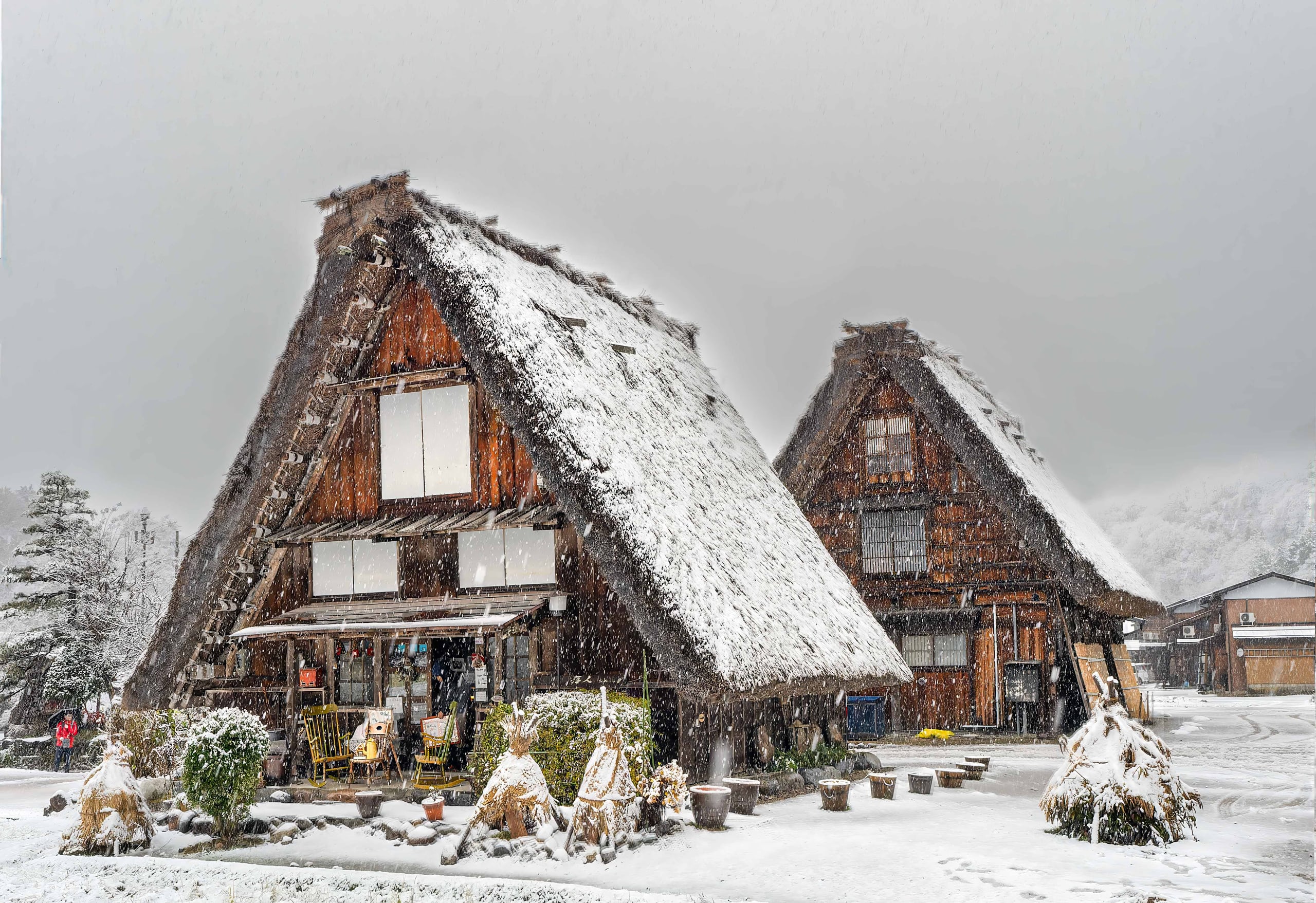
Gassho-zukuri farmhouses in the snow Nagase House
A five-storey gassho house built in 1890 for a family of physicians to the Kanamori lords, with the family's Buddhist altar and medical instruments still kept inside.
Myozen-ji
A temple whose living quarters, bell tower and main hall are all thatched in the gassho style, a rare sight in a temple, with a small museum of village life in the attics.
Shiroyama viewpoint
The site of the old Ogimachi castle, on the hillside north of the village, from which the whole valley of thatched roofs can be seen at once.
Shirakawa Hachiman Shrine
The village shrine, whose festival honours doburoku, the cloudy unfiltered sake brewed for it, with a small hall telling the story of the festival.
Gassho-zukuri Minkaen
An open-air museum across the river of farmhouses gathered from around the valley, some saved from villages lost to dams, and open to see the looms, hearths and tools of the valley.
Ainokura and Suganuma
The two gassho villages of Gokayama in Toyama, about half an hour to the north: Ainokura, with some twenty thatched houses on a terrace above the river, and Suganuma, with nine in a bend of the Shogawa.

experiences
The best of Shirakawa-go
The village after the day visitors leave
Ogimachi changes in the late afternoon, when the coaches have gone: smoke from the hearths, the sound of water in the channels, and the roofs going dark against the mountains.
Inside a working farmhouse
Time in one of the gassho houses with someone who can explain how the frame is lashed, how the thatch is laid and how a family lived beneath it, with tea by the irori hearth.
Washi in Gokayama
An hour at a papermaker's workshop in Gokayama, where washi has been made from mulberry bark for centuries, and where you can make a sheet of your own.
plan your visit
Shirakawa-go on a journey through Japan
- How long to stay
- Half a day is enough for Ogimachi itself, usually on the way between Takayama and Kanazawa; a full day allows Gokayama as well.
- Getting there
- By private car from Kanazawa in about an hour and a quarter, or from Takayama in under an hour, on the Tokai Hokuriku Expressway. From Toyama on the Hokuriku Shinkansen it is about an hour and a quarter by car.
- Pairs well with
- Shirakawa-go is the natural stop on the road between Takayama and Kanazawa, and the Tateyama Kurobe Alpine Route begins in Toyama, not far to the north.TakayamaKanazawaKaga, Yamashiro OnsenTateyama Kurobe Alpine RouteNagoya
journeys
Shirakawa-go on a private journey
We bring guests to Shirakawa-go on the Custom Tour of Japan, created around your party alone, on your dates, with your own Tour Director.
questions
Shirakawa-go: questions answered
How long do you need in Shirakawa-go?
Three to four hours is enough for Ogimachi, its farmhouses and the viewpoint above it. A full day lets you add the quieter villages of Gokayama.
How do you get to Shirakawa-go?
By private car or bus from Kanazawa, about an hour and a quarter, or from Takayama, under an hour. There is no railway to the village.
Can you stay overnight in Shirakawa-go?
Yes, in a few farmhouses run as simple family inns. For comfort, most travellers see the village by day and stay in Takayama, Kanazawa or an onsen ryokan nearby.
Why are the roofs of Shirakawa-go so steep?
To shed the heavy snow of the valley. The steep thatch also made room for several floors of attic, where families raised silkworms.
What does gassho-zukuri mean?
Gassho-zukuri means built like hands joined in prayer, after the steep, triangular thatched roofs of the farmhouses. The frames are lashed with rope and straw rather than nailed, so that they flex under the weight of the snow.
Is Shirakawa-go a World Heritage Site?
Yes. It was inscribed in 1995 with Ainokura and Suganuma in Gokayama as the Historic Villages of Shirakawa-go and Gokayama.
Is Shirakawa-go or Gokayama better?
Shirakawa-go has the larger village and the largest farmhouses to visit; Gokayama is smaller and quieter. With a private car, both fit in a day.
Can Shirakawa-go be part of a private tour of Japan?
Yes. The Custom Tour of Japan is created around your party alone, on your dates, with your own Tour Director, and it can go anywhere in the country, Shirakawa-go included. If you would rather travel independently, the Expert Japan Itinerary plans every day for you.
chubu
More in Chubu
Every place in Chubu
Shirakawa-go, planned for you.
Tell us when you would like to travel and what draws you to Shirakawa-go, and we will answer with a Custom Tour of Japan created around your party alone, or, if you would rather travel independently, an Expert Japan Itinerary that plans every day for you.