
chubugifu
Takayama
Takayama is an old merchant and castle town in the Hida mountains of northern Gifu, in the Chubu region of central Honshu, about two and a half hours by train from Nagoya.
The Miya River, Takayama
- Prefecture
- Gifu
- Region
- Chubu
- Journeys
- The Custom Tour of Japan
overview
A town of dark cedar and carpenters' joinery, with the Japan Alps on its eastern horizon.
Takayama grew up as the castle town of the Kanamori lords in the sixteenth century, and in 1692 the Tokugawa shogunate took Hida under its direct rule for the sake of its timber, its silver and its copper. For nearly two centuries the province was governed from a single office by the river, and the merchants of the town grew rich supplying it. The merchant houses still stand along the lanes of Sanmachi, the old quarter east of the Miyagawa River: two storeys of dark, weathered timber, latticed fronts, low eaves and gutters of running water.
Hida's real wealth was its carpenters. From the eighth century the province paid part of its tax not in rice but in labour, sending its craftsmen to build the temples and palaces of Nara and Kyoto, and the reputation of the Hida no takumi, the craftsmen of Hida, has never left. It shows in the joinery of the merchant houses, in the carved and lacquered festival floats kept in tall storehouses about the town, and in the workshops that still carve yew, lay translucent Shunkei lacquer and build bentwood furniture.
The town is small enough to know on foot and old enough to reward the time. Its sake breweries hang balls of fresh cedar over their doors when the new sake is pressed, two morning markets set out pickles, miso and mountain vegetables by the river and in front of the old government office, and in the evening Hida beef, the wagyu of these mountains, comes to the table grilled over charcoal or simmered with miso on a magnolia leaf.
Takayama is also the gateway to the northern Japan Alps. Shirakawa-go lies under an hour to the north, and to the east the road climbs to the onsen villages of Okuhida, beneath peaks of three thousand metres, and on to the upland valley of Kamikochi. To the south, under an hour by train, lies Gero Onsen, counted since the Edo period among the three famous onsen of Japan.
Our tours stay overnightOur tours visit for the dayOn a Custom Tour of Japan
see and do
What to see in Takayama
Sanmachi Suji
Three parallel lanes of Edo-period merchant houses, now the heart of the old town and a Preservation District for Groups of Traditional Buildings, with sake breweries, miso makers and craft shops behind the lattices.
Takayama Jinya
The government office of the shogunate's deputies in Hida, used from 1692 to the end of the Edo period and the only one of its kind to survive in Japan: tatami halls, a rice storehouse of the seventeenth century and the white-sand courtyard where cases were heard.
The morning markets
Two markets open every morning of the year, one along the east bank of the Miyagawa River and one in front of the Jinya, where farmers' families sell pickles, miso, mountain vegetables, flowers and fruit.
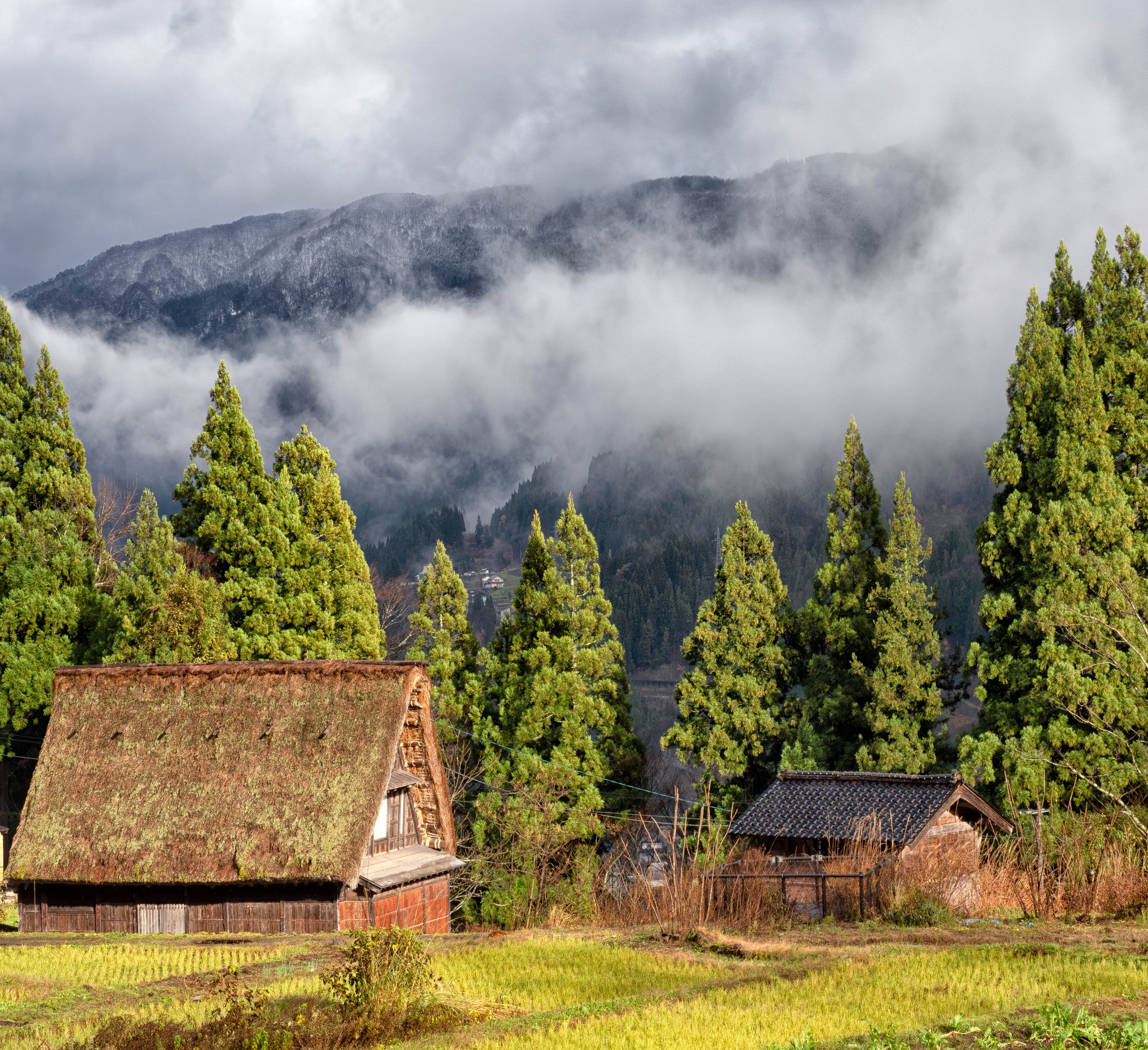
A gassho-zukuri farmhouse beneath cedars Kusakabe and Yoshijima merchant houses
Two merchant residences side by side, rebuilt after fires in 1879 and 1907 and both Important Cultural Properties: soaring interiors of polished cypress beams lit by high windows, the clearest demonstration of Hida carpentry in the town.
Takayama Festival Floats Exhibition Hall
In the grounds of Sakurayama Hachiman-gu, a hall where floats from the Takayama Festival are shown: towering, gilded, lacquered and hung with embroidery, some carrying karakuri puppets worked by strings.
Hida no Sato
An open-air museum on the hillside west of the town, where some thirty farmhouses of the Hida region, among them steep-roofed gassho houses brought from the mountain valleys, stand around a pond.
Hida Kokubun-ji
A temple founded in the eighth century by imperial order, close to the station, with a three-storey pagoda and a ginkgo tree said to be more than a thousand years old.
Higashiyama Teramachi
A line of temples and shrines on the wooded hill east of the old town, joined by a walking path of an hour or so through cedar groves and quiet precincts to the castle park.
Shiroyama Park
The site of Takayama Castle, dismantled in 1695, now a wooded hill of paths and stone walls above the town.
Nakabashi
The vermilion bridge over the Miyagawa River at the edge of the old town, its reflection the classic view of Takayama.
Okuhida Onsen villages
Five onsen villages about an hour east of the town, among them Shinhotaka and Fukuji, where open-air onsen are set beside mountain rivers beneath the northern Alps.
Shinhotaka Ropeway
A two-stage ropeway from the Okuhida valley, its upper stage with double-decker gondolas, rising to an observation deck at about 2,150 metres facing the Hotaka range.

experiences
The best of Takayama
A morning among the breweries
A walk through Sanmachi with a guide who knows the breweries, tasting the new sake from each, from the dry and clean to the rich and cloudy, and learning why Hida's cold water and winters make it.
Hida beef, properly
A dinner of Hida beef in Takayama, grilled over charcoal or served as sushi or on a magnolia leaf with miso, where the marbling of the wagyu explains in one mouthful why the mountains are proud of it.
The carpenters' craft
An hour in a workshop of Ichii Ittobori yew carving or Shunkei lacquer, watching a craftsman work a block of wood with chisels or lay a finish so clear that the grain shows through.
An evening in Okuhida
A night at an onsen ryokan in the valleys of Okuhida, with an open-air onsen of your own beside the river and a kaiseki dinner of mountain vegetables, river fish and Hida beef.
plan your visit
Takayama on a journey through Japan
- How long to stay
- Two nights in Takayama gives the old town and its markets an easy pace, and a third in an onsen ryokan in Okuhida or a day at Shirakawa-go makes the most of the mountains.
- Getting there
- From Nagoya by the Hida limited express, about two and a half hours along the gorges of the Hida River; from Tokyo, the Shinkansen to Nagoya and the Hida beyond take about four and a half hours in all. From Kanazawa a private car takes about two hours, by way of Shirakawa-go, and from Matsumoto about two hours through Okuhida.
- Pairs well with
- Takayama sits on the classic route across the mountains: Shirakawa-go and Kanazawa to the north, Kamikochi and Matsumoto to the east, and the post towns of the Kiso Valley to the south.Shirakawa-goKanazawaKamikochiMatsumotoKiso ValleyNagoya
journeys
Takayama on a private journey
We bring guests to Takayama on the Custom Tour of Japan, created around your party alone, on your dates, with your own Tour Director.
questions
Takayama: questions answered
How many days do you need in Takayama?
Two nights is right for most journeys: a day for Sanmachi, the Jinya and the morning markets, and a day for Hida no Sato and the temples of Higashiyama. Add a night in Okuhida or a day at Shirakawa-go for the mountains.
How do you get from Tokyo to Takayama?
By the Tokaido Shinkansen to Nagoya and the Hida limited express on to Takayama, about four and a half hours in all. A route through Toyama on the Hokuriku Shinkansen takes a similar time.
Is Takayama worth visiting?
Yes. Its old merchant quarter is among the best preserved in Japan, and the town, its breweries, its markets and its food make a natural stop between Kyoto or Tokyo and Kanazawa.
What is Takayama famous for?
For the Edo-period merchant houses of Sanmachi, the Takayama Jinya, its sake breweries and morning markets, the carved floats of the Takayama Festival, and Hida beef.
Can you visit Shirakawa-go from Takayama?
Yes. Shirakawa-go is under an hour by car, and a private car can continue on to Kanazawa the same day, or bring you back to Takayama for the evening.
What is Hida beef?
Hida beef is the wagyu of Gifu prefecture, from Japanese Black cattle raised in the prefecture and graded for its fine marbling. In Takayama it is grilled, served as sushi, or cooked with miso on a dried magnolia leaf.
Can you see the Takayama Festival floats outside the festival?
Yes. The Festival Floats Exhibition Hall in the grounds of Sakurayama Hachiman-gu shows several of the floats through the year, and the tall white storehouses that keep the others can be seen in the lanes of the old town.
Where should you stay near Takayama?
In a ryokan in the old town for the markets and the streets, or in the onsen villages of Okuhida, an hour east, for an evening in an open-air onsen beneath the Alps.
Can Takayama be part of a private tour of Japan?
Yes. The Custom Tour of Japan is created around your party alone, on your dates, with your own Tour Director, and it can go anywhere in the country, Takayama included. If you would rather travel independently, the Expert Japan Itinerary plans every day for you.
chubu
More in Chubu
Every place in Chubu
Takayama, planned for you.
Tell us when you would like to travel and what draws you to Takayama, and we will answer with a Custom Tour of Japan created around your party alone, or, if you would rather travel independently, an Expert Japan Itinerary that plans every day for you.