
kansaihyogo
Himeji
Himeji is a city in Hyogo Prefecture, in the Kansai region, about thirty minutes from Osaka by Shinkansen, whose castle, called the White Heron for its white plaster walls, is a National Treasure, a World Heritage Site and the largest original castle in Japan.
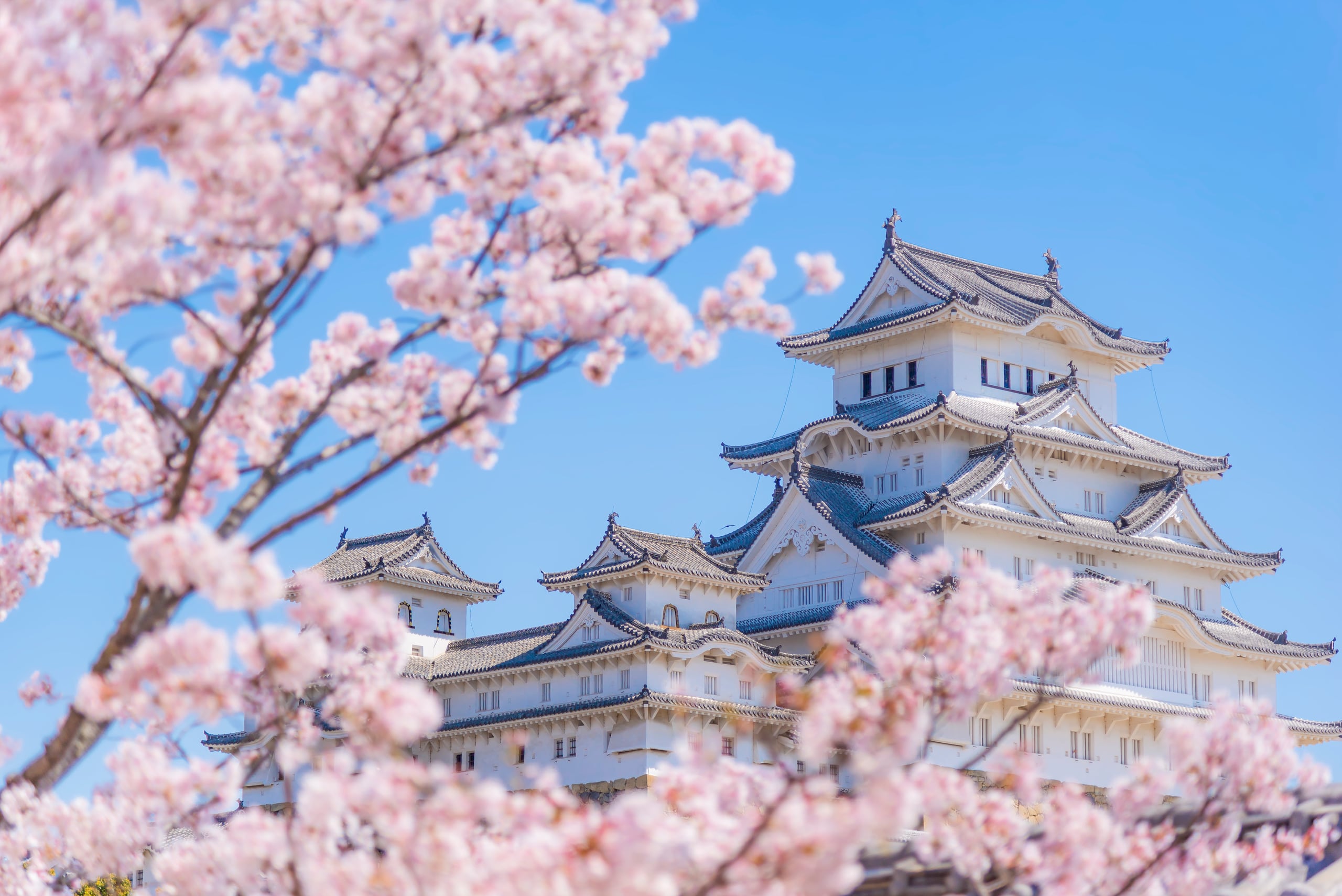
Himeji Castle above the blossom
- Prefecture
- Hyogo
- Region
- Kansai
- Journeys
- The Custom Tour of Japan
overview
The White Heron, standing over its walls since 1609.
A fort stood on Himeyama hill from the fourteenth century, and Toyotomi Hideyoshi built a three-storey keep here in 1581. The castle that survives was the work of Ikeda Terumasa, son-in-law of Tokugawa Ieyasu, who rebuilt it between 1601 and 1609 as a great complex of keeps, turrets, gates and walls. It was never besieged, came through the abolition of the castles in the Meiji era and the bombing of the city in 1945, and stands today largely as it was completed four centuries ago.
Japan has only twelve castle keeps that survive from before the modern age, and Himeji is the largest and most complete of them. Its main keep, five roofs on the outside and six floors and a basement within, is joined to three smaller keeps by covered corridors, and its walls of plaster are white to the tips of the roofs, which is how it earned its name. It was inscribed in 1993 among the first World Heritage Sites in Japan, and its great restoration, finished in 2015, returned the plaster to its full brilliance.
The castle is as clever as it is beautiful. The approach to the keep winds through a maze of gates, each named for a letter of the old syllabary, and turns back on itself so that an attacker would lose sight of the keep and be exposed from above at every corner. Below the walls, Koko-en is a set of nine gardens on the site of the old samurai residences, and the city has fine museums by Kenzo Tange and Tadao Ando. Himeji lies on the Shinkansen between Kyoto and Hiroshima, and it is one of the great days of any journey through western Japan.
Our tours stay overnightOur tours visit for the dayOn a Custom Tour of Japan
see and do
What to see in Himeji
The main keep
Six floors and a basement within five roofs, built around two great pillars of cypress and fir that run its full height. From the top floor the city, the plain and the mountains of Harima are spread out on every side.
The approach and its gates
A winding route through more than a dozen gates and walls, named I, Ro, Ha and Ni for the letters of the old syllabary, with loopholes for guns and arrows and stone drops built into the walls above.
The Nishi-no-maru and the Long Corridor
The western bailey, built for Princess Sen, granddaughter of Tokugawa Ieyasu, with a long corridor of rooms along its walls that ends at the turret where she is said to have readied herself on her way to pray at a shrine on the hill opposite.
The keep, Himeji Castle Okiku's Well
A well within the castle grounds tied to the ghost story of Okiku, a servant thrown into it, whose voice is said to be heard counting plates at night: the source of one of the best-known tales of the kabuki stage.
Koko-en
Nine walled gardens laid out in 1992 on the site of the old samurai residences below the western walls, each in a different style, with a teahouse where matcha is served looking out over a pond.
Engyo-ji on Mount Shosha
A temple founded in 966 in the forest on Mount Shosha, reached by ropeway, with a great hall raised on wooden pillars over the slope and a group of three great halls around an open courtyard.
Hyogo Prefectural Museum of History
A museum by Kenzo Tange, opened in 1983 just north of the castle, with a fine account of the castle and the history of Himeji and its region.
Himeji City Museum of Literature
A building by Tadao Ando, opened in 1991 on the slope west of the castle, devoted to the writers of the region, with views back to the keep across its terraces.

experiences
The best of Himeji
The castle with a historian
Himeji Castle in the company of a guide who knows its architecture and its defences, so that every turning gate, loophole and stone drop on the way to the keep can be read as it was meant.
Tea in Koko-en
A bowl of matcha and a seasonal sweet in the teahouse of Koko-en, the pond and the garden spread before you and the keep above the trees.
A craft of white leather
Himeji has made white leather for a thousand years, tanned with salt and rapeseed oil rather than chemicals. A visit to a workshop shows the craft and the small things made from it.
The castle on the way west
Himeji as a day on the journey from Kyoto or Osaka towards Okayama, Kurashiki or Hiroshima, with the luggage sent on ahead and a private car waiting at the station.
plan your visit
Himeji on a journey through Japan
- How long to stay
- Half a day for the castle and Koko-en, or a full day with Engyo-ji on Mount Shosha and the museums; most guests see Himeji on the way between Kyoto or Osaka and Hiroshima.
- Getting there
- By the Shinkansen from Shin-Osaka in about thirty minutes, from Kyoto in about forty-five and from Hiroshima in about an hour; from Tokyo the journey takes a little over three hours. The castle is a walk of about fifteen minutes straight up the avenue from the station.
journeys
Himeji on a private journey
We bring guests to Himeji on the Custom Tour of Japan, created around your party alone, on your dates, with your own Tour Director.
questions
Himeji: questions answered
How long do you need at Himeji Castle?
About two to three hours for the castle itself, and half a day with Koko-en. A full day allows Engyo-ji on Mount Shosha as well.
How do you get from Kyoto to Himeji?
By the Sanyo Shinkansen from Kyoto in about forty-five minutes, or from Shin-Osaka in about thirty. The castle is a fifteen-minute walk from Himeji Station.
Why is Himeji Castle called the White Heron?
Because of its brilliant white plaster walls and roofs, which seen from below suggest a white heron taking flight. In Japanese it is called Shirasagi-jo.
Is Himeji Castle original?
Yes. Its main keep, completed in 1609, is one of only twelve original castle keeps in Japan and the largest of them, and the castle has never been destroyed by war or fire.
Can you visit Himeji on the way to Hiroshima?
Yes. Himeji lies on the Shinkansen between Kyoto and Hiroshima, so it is easy to spend half a day at the castle with the luggage sent ahead and continue the same day.
What is Koko-en?
Koko-en is a set of nine Japanese gardens beside Himeji Castle, laid out in 1992 on the site of the old samurai residences, with a teahouse where matcha is served.
Can Himeji be part of a private tour of Japan?
Yes. The Custom Tour of Japan is created around your party alone, on your dates, with your own Tour Director, and it can go anywhere in the country, Himeji included. If you would rather travel independently, the Expert Japan Itinerary plans every day for you.
kansai
More in Kansai
Himeji, planned for you.
Tell us when you would like to travel and what draws you to Himeji, and we will answer with a Custom Tour of Japan created around your party alone, or, if you would rather travel independently, an Expert Japan Itinerary that plans every day for you.