
The Sapporo Snow Festival takes place every February in the capital of Hokkaido, and the 77th festival runs from 4 to 11 February 2027 at three sites: Odori Park, where the great snow sculptures stand along more than a kilometre of the city's central park; Susukino, where the sculptures are of clear ice; and Tsudome, a domed sports ground given over to slides of snow.
Seen at nine in the evening from the deck of the Sapporo TV Tower, ninety metres above the east end of Odori Park, the festival is a single line of light running west through the dark city. Each block of the park presents its sculpture, and the largest are as tall as a building of four or five storeys: a castle, a university hall, a clay figure from Japan's Neolithic past, all of them packed and carved from snow brought in by the truckload. Below, the paths between them are trodden hard and the snow squeaks underfoot at minus six.
It is one of the great winter spectacles of Japan, and for anyone in Hokkaido in February it is worth two evenings.
the dates
When is the Sapporo Snow Festival in 2027?
The festival's own organising committee has published the dates for 2027: the 77th Sapporo Snow Festival runs for eight days, from Thursday 4 February to Thursday 11 February 2027, at all three sites. The 2026 festival, the 76th, ran on the same dates, 4 to 11 February. The pattern repeats from year to year: eight days in the first half of February, closing on 11 February, National Foundation Day, a public holiday in Japan.
The festival publishes each year's programme, its sculptures and its events from mid-December, so the subjects of the 2027 great sculptures are not yet known. Those of 2026 give the measure of what to expect.
the history
A festival begun by schoolchildren in 1950
In 1950 the junior and senior high school students of Sapporo set six snow statues in Odori Park, alongside a snowball fight and a carnival. About fifty thousand people came in a single day, and the city made it an annual event. The first great sculpture followed in 1953, a figure fifteen metres tall titled Ascension, built by the students of Fushimi High School.
In 1955 the Self-Defense Forces joined the work with a ten-metre statue of the Virgin Mary, and soldiers have carried the snow and carved many of the largest sculptures every year since. The Winter Olympics of 1972 brought Sapporo and its festival to an audience around the world. In 1974 the oil crisis left the snow trucks short of fuel, and the great sculptures were built around oil drums to make the snow go further. The International Snow Sculpture Contest began the same year; Susukino and its ice joined in 1983, and Tsudome in 2009. The record year was 2019, with 2,737,000 visitors.
On the last night the lights along Odori go out at ten. The next morning the machines arrive to bring the sculptures down, and by spring Odori Park is a lawn again.
the sites
The three sites: Odori, Susukino and Tsudome
Odori Park: the great snow sculptures
Odori Park is the heart of the festival.The site runs from the first to the eleventh block west of the TV Tower, about 1.1 kilometres, and in 2026 it carried 136 of the festival's 210 or so sculptures. Odori is a public park, open at every hour of the festival week, and it is lit until ten each night.
The great sculptures stand on their own blocks, each sponsored by a Sapporo newspaper or broadcaster and built by the Ground Self-Defense Force or the festival's own sculpture committee. The 2026 set shows their range. On the eighth block stood Tsurugajo, the castle of Aizu-Wakamatsu, built by soldiers over thirty days and a combined 3,800 working days, its roofs and walls made with what the builders call the ice-block method, small parts carved separately in snow and set in place one by one. On the seventh block stood Furukawa Hall of Hokkaido University, its Meiji-era timber and gables reproduced for the university's 150th year. On the fourth, the Jomon clay figure Kakkuu, a National Treasure of Hokkaido, rose thirteen metres above the park. On the fifth, a thoroughbred ran between snow poplars, and after dark the sculpture became a screen for projection mapping, colour and pattern moving across the snow in time with music.
At the western end, on the eleventh block, the International Snow Sculpture Contest gives each team a block of snow and a few days to carve it. In 2026 the contest took place for the fiftieth time, with ten teams from as many countries and cities, and the carving itself, in the days before the judging, is as good to watch as the finished work. Between the great sculptures stand smaller ones made by the people of Sapporo, a few metres high: animals, temples, cartoon characters, the year's sporting heroes.
Susukino: the ice sculptures
Susukino is the entertainment district south of Odori, and its part of the festival lines Ekimae-dori, the main avenue, from the fourth to the sixth block south. In 2026 it showed about sixty ice sculptures, among them the entries to an ice-carving competition and the blocks of clear ice with fish frozen inside them, carved by some two hundred chefs and ice carvers working through three nights before the opening. The ice is lit until eleven, an hour later than Odori (until ten on the final night), with the neon of Susukino behind it, and it is the place to end an evening, a few minutes' walk south of the park.
Tsudome: the snow slides
Tsudome is a domed community sports ground in Higashi Ward, a shuttle bus ride from Sakaemachi station on the Toho subway line. Its festival is for families: long slides and tube runs of packed snow outside, snow rafts, and warm food and games under the dome. It opens from ten until four.
seeing it
What to do at the Sapporo Snow Festival, and how to see it well
See Odori twice. By day, in the flat white light of a Hokkaido afternoon, the sculptures show their carving: the joints of the castle roof, the faces on the clay figure, the texture the carvers leave on purpose so that the light catches it. After dark they are lit from below, the projection mapping runs on its block, and the whole park glows between the office towers. The walk from the TV Tower to the eleventh block and back takes an hour at a festival pace, longer with a stop at each sculpture.
The view from above is worth having once. The observation deck of the Sapporo TV Tower, about ninety metres up at the eastern end of the park, opens until ten in the evening and looks straight down the line of sculptures to the mountains west of the city.
Between the sites and the hotels, Sapporo's underground walkways keep the walk warm. Chi-Ka-Ho, a concourse of about 520 metres under Ekimae-dori, runs from Sapporo Station to Odori, and the arcades beyond it continue south towards Susukino, so an evening can move from the hotel to the park to the ice with only the sculptures themselves in the open air.
Sapporo in February is also a city of snow crab and hairy crab, of scallops and sea urchin from the cold coasts, of miso ramen and the grilled lamb the city calls jingisukan, eaten at a small counter with the windows steamed against the snow outside.
the cold
What to wear in Sapporo in February
Sapporo in February is cold and snowy, and with the right clothes the cold is no hardship. The Japan Meteorological Agency's normals give a February mean of minus 2.7°C, a daily high of 0.4°C and a low of minus 6.2°C, with 116 centimetres of snow falling over the month and about 95 centimetres lying at its deepest. The festival falls in the coldest weeks of the Sapporo year.
Layers beneath a proper down coat, a warm hat that covers the ears, gloves, and above all shoes with a grooved winter sole: the paths of Odori and the pavements of the city are packed snow and ice for the whole week. The festival's own shops, the convenience stores and the station kiosks sell slip-on ice grips that fit over ordinary shoes, and they make the evening walk an easy one. Every hotel, restaurant and taxi is warm, so the cold is felt only on the walk between them.
the verdict
Is the Sapporo Snow Festival worth it?
Yes, as two evenings within a journey through Hokkaido in winter. The great sculptures stand as tall as a five-storey building and are carved down to the joints of a snow roof, and Odori at night under falling snow is one of the loveliest sights of the Japanese winter. It is also a large public festival in the middle of a city, and a week in Sapporo for the festival alone would leave the rest of a Hokkaido February unseen. The better plan pairs the festival with what Hokkaido does best in February: an onsen ryokan in deep snow, the candlelit canal at Otaru, and, for skiers, Niseko.
where to stay
The best hotels for the Sapporo Snow Festival
For the festival, the best address in Sapporo is a short walk from Odori Park.
The hotel for the festival stands at North 1 West 4, a block north of the fourth block of Odori Park. It opened in 1934 as the first European-style hotel in Hokkaido and remains the city's classic address, its executive rooms and suites in soft greys and creams sharing a lounge of their own for breakfast and a quiet hour after the cold. From its door the festival is a few minutes away on foot, and the old red-brick government hall of Hokkaido and the clock tower are a few streets further. It is the Sapporo hotel of the Cherry Blossom Tour of Hokkaido and the Summer Tour of Hokkaido, and of Pure Hokkaido, a journey of The Private Collection.
Sapporo's first European-style hotel, by Odori Park →
The alternative is to stay outside the city and come in for the evenings. Jozankei Onsen lies in a forested gorge at the head of the Toyohira River, still within the city of Sapporo and about forty minutes by car from the centre, and its most appealing resort is a village of cottages in the trees, each with a mezzanine and an open-air onsen on its own wooden deck, around a broad onsen of clear, faintly salt spring water with tall windows on the snow. After an evening in the park, a morning in that water takes the cold away.
the onsen
Pairing the festival with onsen: Jozankei and Noboribetsu

The onsen (hot-spring bath) is the natural partner to a Hokkaido February, and two of the island's great onsen towns lie within an easy drive of Sapporo.
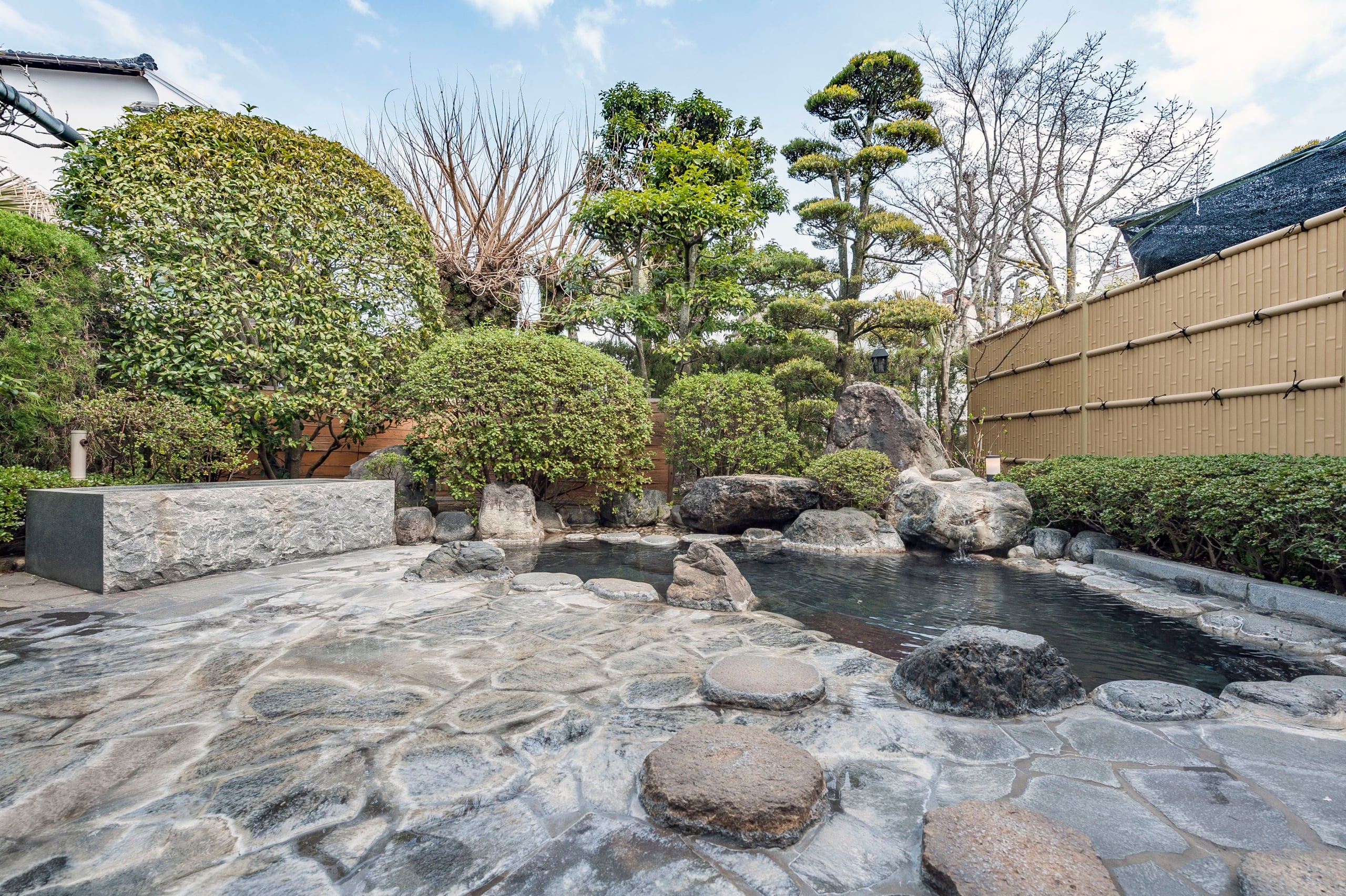
Jozankei, in the gorge south-west of the city, is the closer: a riverside of onsen and the red Futami Suspension Bridge over the water, snow heavy on the forest above it. Noboribetsu, further south towards the Pacific coast, sits in a wooded valley below Jigokudani, the steaming crater that feeds its springs. There a ryokan of thirty rooms, reached by its own footbridge over a river of warm water, draws four kinds of spring water, sulphur, iron, salt and radium, and gives twelve of its rooms an open-air onsen fed straight from the source. Dinner is kaiseki in a private room over a Japanese garden that in February lies under snow.
A ryokan of thirty rooms on four springs, Noboribetsu Onsen →
otaru
Otaru's Snow Light Path, half an hour away
About half an hour from Sapporo by train, the old port of Otaru stages a quieter festival in the same weeks. For the Snow Light Path, Yuki Akari no Michi, first staged in 1999 and returning every February, the stone warehouses of the Otaru canal and the disused Temiya railway line through the town are lined with small lanterns of snow, each carrying a candle, and glass floating candles drift on the dark water of the canal. In 2026 it ran from 7 to 14 February, lit from five until nine in the evening, and Hokkaido's tourism organisation lists the 2027 edition for 6 to 13 February, overlapping the Snow Festival. A small ryokan in the hills of Asari above Otaru, its rooms furnished with antiques and each with an onsen of its own, turns the evening on the canal into a night away.
hokkaido
Beyond Sapporo: Niseko's snow and the drift ice
For skiers, Niseko lies west of Sapporo across the mountains, under its deepest powder in February, and a festival week combines easily with a few days there.
Luxury ski journeys in Japan: Niseko, Hakuba and Myoko →
In the east, February is the month of the drift ice on the Sea of Okhotsk and the cranes dancing on the snow at Kushiro.
the journey
A private winter journey to the Snow Festival
A February journey through Hokkaido turns on a few fixed evenings, the sculptures in Odori Park and the candles on the canal at Otaru, with the onsen of Jozankei and Noboribetsu, and Niseko for skiers, arranged around them. Luxury Japan Travel builds these winter journeys as a Custom Tour of Japan: private, from five nights, on the dates the party chooses, with a private car and driver every day and a Tour Director travelling with the guests. The festival evenings are set first, and the onsen, the canal and the snow of the island are planned around them.
questions
Questions
When is the Sapporo Snow Festival in 2027?
The 77th Sapporo Snow Festival runs from 4 to 11 February 2027 at all three sites, Odori, Susukino and Tsudome, as published by the festival. The 2026 festival ran on the same dates.
Is the Sapporo Snow Festival worth it?
Yes. The great snow sculptures in Odori Park stand as tall as a building of four or five storeys and are lit until ten each night. Two evenings, paired with an onsen ryokan and Otaru's Snow Light Path, make the best of it.
What are the three sites of the Sapporo Snow Festival?
Odori Park shows the great snow sculptures and the International Snow Sculpture Contest; Susukino shows about sixty ice sculptures along Ekimae-dori, lit until eleven; and Tsudome offers snow slides for families, open from ten until four.
How cold is Sapporo during the Snow Festival?
February in Sapporo averages minus 2.7°C, with a daily high of 0.4°C and a low of minus 6.2°C, by the Japan Meteorological Agency's normals. A down coat, hat, gloves and shoes with a grooved winter sole are the right clothes.
What is the best hotel for the Sapporo Snow Festival?
Close to Odori Park. The city's classic hotel, opened in 1934, stands a block north of the park, a few minutes on foot from the great sculptures. For an onsen instead, a village of cottages in the forest at Jozankei Onsen, each with an open-air onsen on its own deck, lies about forty minutes from the city centre.
How many days does the Sapporo Snow Festival need?
Two evenings and an afternoon: Odori by day and again after dark, and an evening that ends among the ice of Susukino. Everything else in a February journey belongs to the onsen, Otaru and the snow of Hokkaido.