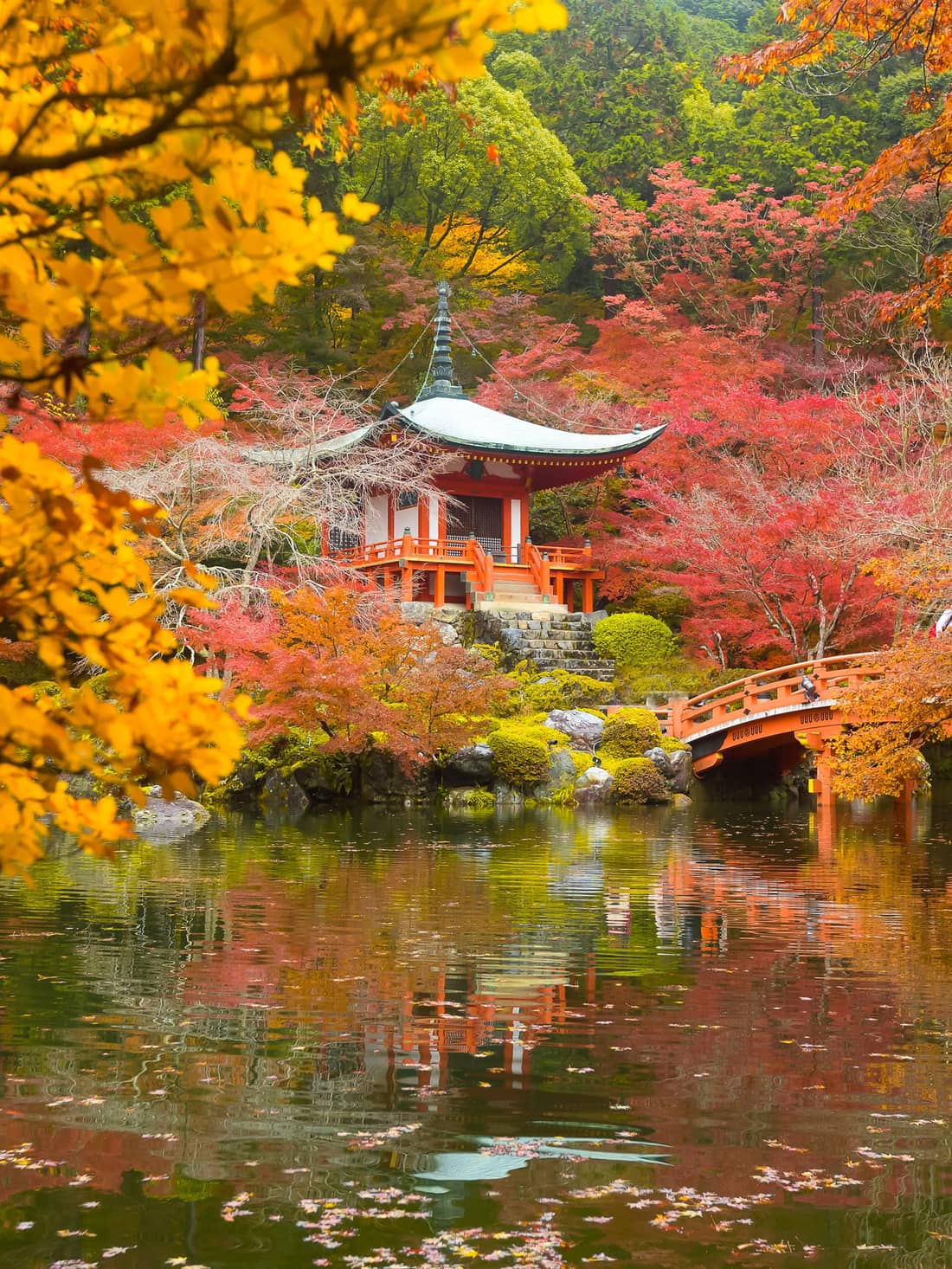

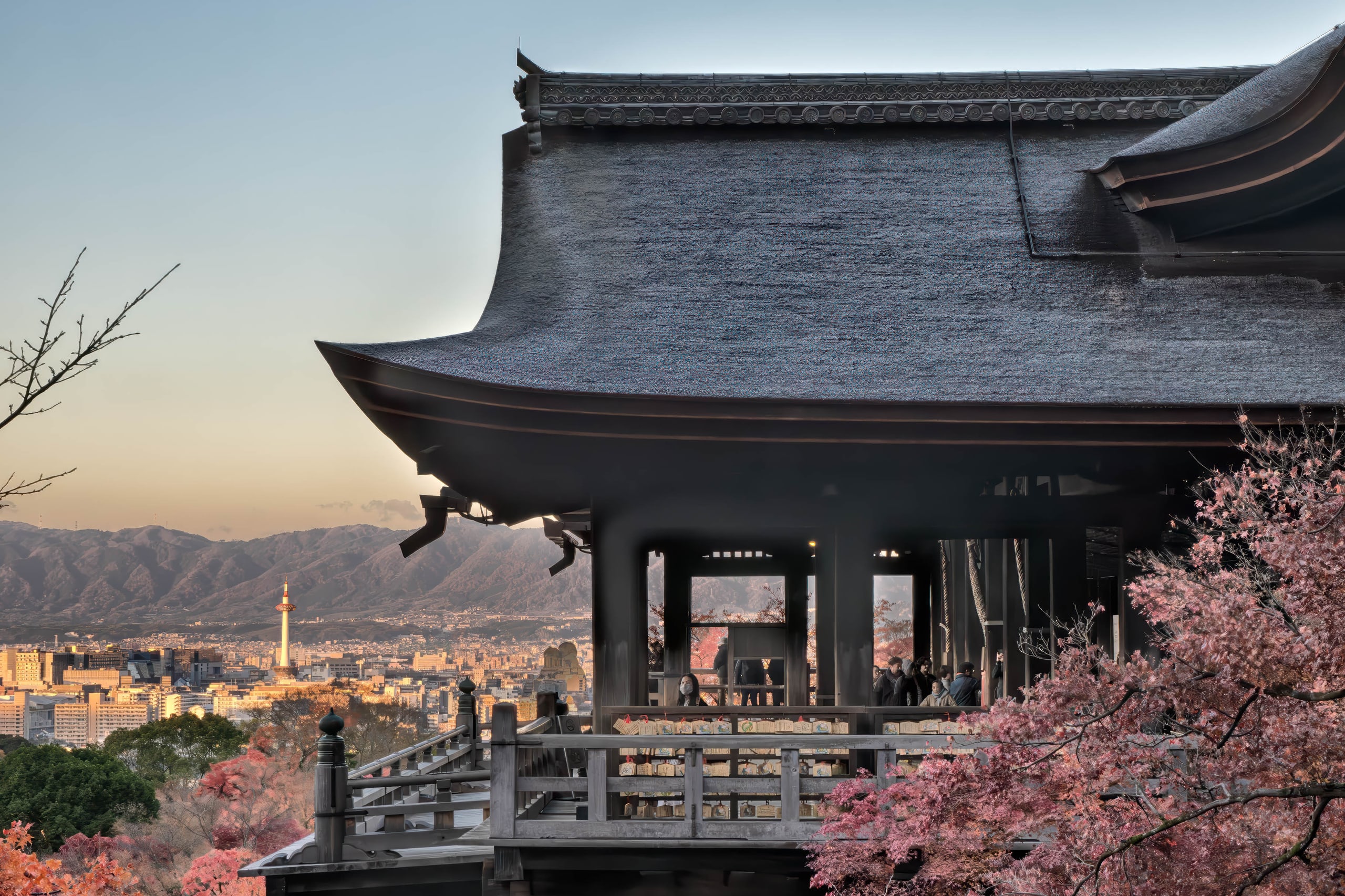
The great Japanese gardens of Kyoto number fourteen, and the first among them is Katsura Imperial Villa, with Saiho-ji, the moss garden, close behind. Around them stand the dry gardens of Ryoan-ji and Daisen-in, the pond gardens of Tenryu-ji and Byodo-in, the borrowed mountains of Murin-an and Entsu-ji, and the modern geometry of Tofuku-ji. No other city in Japan has so many.
At Ryoan-ji the veranda boards are cool through the cloth, even in summer. Fifteen stones sit in a rectangle of white gravel twenty-five metres by ten, raked in lines that close around each stone like water. A visitor counts them, moves a few places along the veranda, counts again, and arrives at fourteen. From no point on the veranda can all fifteen be seen at once. No one knows who made the garden, or when, and the temple offers no reading of what it means.
Every great garden in Kyoto is made on the same principle: to be looked at slowly, from a fixed place, by someone prepared to stay.
the fourteen
The best gardens in Kyoto, in order
The order below is a judgement of quality, and each entry carries the fact that matters most for the visit.
1. Katsura Imperial Villa
If only one garden in Japan is to be seen, it is this one. Katsura was made in the seventeenth century by Prince Toshihito of the Hachijo-no-miya and finished by his son, Prince Toshitada, on the west bank of the Katsura River. It is a stroll garden around a pond, and its teahouses stand around the shore, each placed for a different view across the water. The path is composed as a sequence: a formal stepping-stone walk, a boat landing, a stone lantern placed exactly where the eye needs a pause, a spit of pebbles and pines that miniaturises Amanohashidate, the sandbar on the Sea of Japan coast that is counted among the three great views of Japan. The architecture and the garden are a single work, which is why Katsura teaches more in an hour than a week of reading.
Katsura is seen only on a guided tour run by the Imperial Household Agency, by application to the Agency, with tours in English at set hours.
2. Saiho-ji, the moss garden
Muso Soseki, the Zen priest who was the great garden maker of his age, laid out Saiho-ji in 1339: a pond garden below, around the Golden Pond, and a dry garden of stone above, reached by a steep path that recalls the mountain climb of a monk in training. The moss came later. More than 120 kinds now cover the ground, grown in the centuries when the temple fell into neglect, which is why Kyoto calls it Kokedera, the moss temple. After rain the whole floor of the garden turns the green of wet velvet.
Saiho-ji cannot be visited on impulse. Visits are made by reservation at least a day ahead, online or by return postcard, and each begins in the main hall with shakyo, the copying of a sutra by brush, before the garden opens to the visitor. The quiet of the writing is part of the design: nobody reaches the moss in a hurry.

3. Ryoan-ji
Ryoan-ji is a hiraniwa, a flat garden with no hill and no pond, enclosed on two sides by an earthen wall. The temple was founded in 1450 by Hosokawa Katsumoto; the garden's date and maker are unknown.
4. Daisen-in
A sub-temple of Daitoku-ji, built between 1509 and 1513 under the priest Kogaku Soko. Its garden beside the shoin, the study, tells a river's whole life in a strip of ground: upright stones and clipped shrubs for the mountains and cliffs, a dry waterfall, then white sand that runs as a stream, widens into a river and reaches the sea. It is a Special Place of Scenic Beauty, the highest garden designation the state gives, and it is the clearest lesson in Kyoto in how stone and sand can carry narrative.
5. Tenryu-ji
Muso Soseki again, between 1339 and 1345. The pond called Sogenchi was dug with the hills of Arashiyama and Kameyama as its background, and its focus is the dry waterfall of stones on the far shore, set so precisely that water seems to fall where none runs. The garden is a Special Place of Scenic Beauty and part of the World Heritage listing of ancient Kyoto.
6. Ginkaku-ji
Ashikaga Yoshimasa began his mountain villa here in 1482, and the Silver Pavilion still stands where he placed it. The garden's two great forms in sand were made later, in the mid-Edo period or after: Ginshadan, the sea of silver sand, a raised bed raked in broad waves, and Kogetsudai, a flat-topped cone about 1.8 metres high whose name means the platform facing the moon. They are sculpture as much as garden, and the gardeners reshape them by hand.
7. Shugakuin Imperial Villa
Made for the retired Emperor Go-Mizunoo in the 1650s on the slopes below Mount Hiei, in three parts, the Lower, Middle and Upper Villas, joined by tree-lined paths through rice fields that are farmed to this day. From the Upper Villa the garden takes in the city below and the mountains beyond. Like Katsura, it is seen on a tour run by the Imperial Household Agency, by application before the visit.
8. Murin-an
The villa of Yamagata Aritomo, the Meiji statesman, made between 1894 and 1896 by Ogawa Jihei VII. It broke with the Kyoto garden before it: a bright lawn, a shallow stream fed by the Lake Biwa Canal, and the Higashiyama hills drawn in as borrowed scenery. Yamagata named the five things he loved in it: the rain, the moss, the distant mountains, the wildflowers and the water.
9. Heian Jingu
Ogawa Jihei's other masterpiece, behind the vermilion shrine, made from 1894 and enlarged later. The Garyukyo, the sleeping dragon bridge, is a line of round stepping stones across the pond, cut from the piers that once carried the Sanjo and Gojo bridges over the Kamo River.
10. Nanzen-ji and Konchi-in
The Hojo garden of Nanzen-ji, attributed to Kobori Enshu, is known as the tiger cubs crossing the water; its stones and shrubs grow lower and sparser to the right, so the gravel seems to run away into distance. A few minutes' walk away, the sub-temple Konchi-in has a garden that Enshu certainly designed, a worship stone between a crane island and a turtle island, the old emblems of long life, under a wall of clipped green. It is a Special Place of Scenic Beauty, and among the gardens of Kyoto it is the one most underrated.
11. Tofuku-ji
Shigemori Mirei made the four gardens around the Hojo in 1939, and they are the proof that the Japanese garden did not stop in the Edo period. The north garden sets squares of moss and paving stone in a checkerboard that dissolves into green; the east garden arranges stone cylinders as the Big Dipper. They were designated a Place of Scenic Beauty in 2014. The temple's valley of maples is a sight of the autumn, and the Hojo gardens repay a visit in any month.
12. Shisen-do
The hermitage of Ishikawa Jozan, the samurai turned scholar of Chinese poetry, founded in 1641. Clipped azaleas roll over white sand below the study, and somewhere below them a sozu, a bamboo pipe that fills with water and tips, strikes a stone with a hollow knock at intervals. Late in the afternoon the sun comes in low across the sand and the azaleas throw long shadows towards the study.
13. Entsu-ji
A small dry garden in the north of the city, laid out by the veranda and enclosed inside a clipped hedge, with Mount Hiei standing beyond it. It is the purest example of shakkei in Kyoto: the mountain is the garden's principal stone. Kyoto City protects the view from new building.
14. Byodo-in, Uji
South of the city, in Uji, the Phoenix Hall of 1053 stands over the Aji-ike pond in a garden made to picture the Pure Land of the Amida Buddha. It is the oldest kind of garden in this account, a Heian vision of paradise in water and vermilion timber, and the hall on the pond is the one on every ten yen coin in Japan.
the kinds
What are the different types of Japanese gardens?
Five kinds cover almost every garden in Kyoto, and most great gardens combine two.
Karesansui, the dry landscape
Stone and raked gravel or sand, with moss and clipped shrubs at most, and no water at all. The gravel is the water, the stones are mountains, islands or animals, and the whole is made to be seen from the temple veranda. The form grew in the Zen temples, and Ryoan-ji, Daisen-in, the Hojo of Nanzen-ji and Tofuku-ji are its masterpieces.
The pond-and-stroll garden
Kaiyu-shiki teien, the circuit garden: a path around a pond that reveals a sequence of views, each hidden from the last by a hill, a planting or a bend in the shore. Katsura is the supreme example; Heian Jingu and Murin-an are its Meiji descendants. The great daimyo gardens outside Kyoto are all of this kind.
The tea garden, or roji
The dewy path to the teahouse: stepping stones set just far enough apart to slow the step, a stone lantern, and the tsukubai, a low basin where guests rinse their hands before entering. The roji is a passage to be walked, and everything in it prepares the guest to leave the world outside.
Shakkei, borrowed scenery
Strictly a technique: a distant mountain drawn into the composition, with a hedge or a wall placed to cut away everything between. Entsu-ji borrows Mount Hiei, Murin-an the Higashiyama hills, Tenryu-ji Arashiyama.
Tsuboniwa, the courtyard garden
The garden of a Kyoto machiya, the narrow wooden townhouse: a court a few metres square open to the sky, bringing light and air to rooms built wall to wall with the neighbours. A lantern, a water basin, a single maple, a stone, seen from the rooms on every side.
the reading
How to read a Japanese garden
Sit. A dry garden is composed for the person seated on the veranda, and from standing height its proportions are wrong. The eye level of someone kneeling on the boards is the eye level the garden was made for.
Read the stones before the plants. The stones are the garden's bones and were set first, and in a great garden every one leans, faces or turns away from its neighbour on purpose; the Sakuteiki, the eleventh-century manual that is the oldest Japanese text on garden making, uses the phrase for setting stones to mean making a garden at all. Look for the principal stone and the groups that answer it: three together, five together, seven. Then look at the gravel, at where the raking turns around each stone and where it runs straight, because the lines say whether the water is still or moving. Only then the plants, which are clipped to the shape of hills, clouds and waves. And last, the edge: the wall, the hedge, the frame of the veranda posts, which decide what the garden includes and what it leaves out.
The seasons change what is there to be read. Moss is at its deepest green after rain, and the rainy season of June is when Saiho-ji and the moss of Tofuku-ji's north garden glow. The maples turn in late autumn. Snow on a dry garden reverses it, the gravel vanishing and the stones standing dark. The melancholy that attends these changes has its own word in Japanese, and its own article.
beyond kyoto
Japan's three great gardens, and the gardens beyond Kyoto
The three great gardens of Japan are Kenroku-en in Kanazawa, Koraku-en in Okayama and Kairaku-en in Mito, all of them daimyo stroll gardens, larger and more open than anything inside Kyoto. Kenroku-en was named in 1822 for the six attributes that a classical Chinese text said no garden could bring together, spaciousness and seclusion, artifice and antiquity, water and panorama, and it achieves them. Koraku-en was begun in 1687 for Ikeda Tsunamasa, lord of Okayama, and completed in 1700, its lawns laid out beneath Okayama Castle. Kairaku-en was made in 1842 by Tokugawa Nariaki, lord of Mito, around a grove of about 3,000 plum trees, and alone of the three it was meant from the start to be shared.
Ritsurin, in Takamatsu on Shikoku, belongs in their company and is larger than any of them: 75 hectares, completed in 1745 for the lords of the domain, with six ponds and thirteen hills, its pines shaped by hand over generations and Mount Shiun drawn in behind. It is a Special Place of Scenic Beauty, and outside Kyoto it is the one stroll garden not to miss.
And in Yasugi, east of Matsue in Shimane, the Adachi Museum of Art keeps a garden that is not walked at all. It is seen through the museum's windows, framed like a painting, with the mountains of Shimane borrowed behind it, and the Journal of Japanese Gardening has ranked it first in Japan for twenty-three consecutive years.
the days
How many days the gardens of Kyoto need
Four days, arranged by district. A day in the north-west for Ryoan-ji, Daisen-in at Daitoku-ji and, across the river, Katsura. A day in the east for Ginkaku-ji, Murin-an, Heian Jingu, Nanzen-ji and Konchi-in, all within a short drive of each other below the Higashiyama hills. A day in the west for Saiho-ji and Tenryu-ji. A day in the north for Shugakuin, Shisen-do and Entsu-ji, with Tofuku-ji and Byodo-in in Uji to the south on the way in or out. Two gardens of the first rank in a day is the right measure; three, and the third is wasted.
the journey
A private garden tour of Kyoto and Japan
The Custom Tour of Japan is designed for one party, on its own dates and from five nights, and a garden journey on it is built around the gardens that party most wants to see: the moss of Saiho-ji, the stones of Daisen-in and Konchi-in, and, if the journey runs further, Kenroku-en in Kanazawa or the pines of Ritsurin in Takamatsu. A private car carries the party between the districts, so the day is spent in the gardens themselves, and a Tour Director who knows which veranda catches the afternoon light is with them every day.
It also gives what the ordinary visit cannot: the right garden at the right hour of the day, and a Tour Director beside the party who reads it for them, stone by stone.
questions
Questions
What is the most famous garden in Kyoto?
Ryoan-ji, the dry garden of fifteen stones in raked white gravel, of which no more than fourteen can be seen from any point on the veranda. The garden most worth the journey is Katsura Imperial Villa, seen by permit from the Imperial Household Agency.
What are the different types of Japanese gardens?
Five kinds cover almost every garden: karesansui, the dry landscape of stone and raked gravel; the pond-and-stroll garden; the tea garden or roji; shakkei, borrowed scenery; and tsuboniwa, the small courtyard garden of a townhouse.
How do you visit Saiho-ji, the moss temple?
By reservation at least a day ahead, made online or by return postcard. Each visit begins with sutra copying in the main hall, and the moss garden follows; the whole visit takes about an hour.
Can you visit Katsura Imperial Villa?
Yes, on a guided tour run by the Imperial Household Agency, by application before the visit. Tours in English are given at set hours, and Shugakuin Imperial Villa is visited the same way.
What are Japan's three great gardens?
Kenroku-en in Kanazawa, Koraku-en in Okayama and Kairaku-en in Mito, all stroll gardens made for feudal lords. Ritsurin in Takamatsu, at 75 hectares, is larger than any of them.
How many days do the gardens of Kyoto need?
Four days, arranged by district: the north-west, the east below Higashiyama, the west with Saiho-ji and Tenryu-ji, and the north with Shugakuin and Entsu-ji. Two great gardens a day is the right measure.