
The phrase 物の哀れ, mono no aware, is usually translated as a gentle sadness at the passing of things, which is flatter than the Japanese. Aware began as a cry, something close to an English "ah", the sound a person makes when something touches them, and mono no aware is the capacity to be touched in that way by the world: by a blossom, a change in the light, a line of a poem, precisely because none of them stays.
Said aloud it is six even syllables, mo-no no a-wa-re, with no stress on any of them. The nearest English attempts are "the pathos of things" and, more literally, "the ah-ness of things", and the second is closer, because the word names the moment of response. Melancholy turns away from the world and nostalgia prefers the past; mono no aware looks harder at the present precisely because the present is moving.
the scholar
What Norinaga meant by it
The term entered criticism through Motoori Norinaga, who lived from 1730 to 1801 and practised as a physician in the merchant town of Matsusaka in Ise, giving his evenings to the oldest Japanese texts and to what they said before Chinese learning came to explain them. He set out the idea in a short treatise on The Tale of Genji in 1763, and returned to it at length in his great commentary on the novel at the end of the century.
His argument was a quarrel with the moralists. The scholars of his day read Genji as a Buddhist lesson on impermanence, or as a warning against the prince's many loves. Norinaga argued that it was neither. A sensitive reader of Genji, he wrote, comes away more attached to the world, and more tender towards it, for knowing that it passes. To know mono no aware, in his account, was to know what it is to be human, and the novel existed to teach it.
the poets
A feeling already a thousand years old
Norinaga did not invent the feeling; he named what the court poets had been writing about for eight centuries. The Kokinshu, the imperial anthology of around 905, opens with a preface in which the poet Ki no Tsurayuki says that Japanese poetry has the human heart as its seed and grows into ten thousand leaves of words. In the same anthology Ariwara no Narihira wrote that if the world had no cherry blossoms, the heart in spring would be at peace. Japanese readers have always taken it as praise for the blossom that unsettles him.
The monk Saigyo wrote that he hoped to die beneath the blossoms in spring, at the full moon of the second month, and in 1190 he died at almost exactly that season, which Japan has never forgotten. A century and a half later Yoshida Kenko opened the 137th section of his essays, Tsurezuregusa, with a question, and answered it himself: the branch about to open, and the garden strewn with fallen petals, move the heart as much as the full flower.
Are blossoms to be looked at only in full flower, and the moon only when the sky is clear?
Yoshida Kenko, Tsurezuregusa, section 137, about 1330
the neighbours
Mono no aware and wabi-sabi: the neighbouring words
English readers usually meet mono no aware in the company of four other Japanese words, and blur the five together. Each has its own origin and its own object.
Behind all of them stands mujo, the Buddhist teaching of impermanence. The Tale of the Heike, the great war chronicle of the thirteenth century, opens with the sound of a temple bell that tells of the impermanence of all things, and with the observation that the proud do not last, like a dream on a spring night. Mujo is a teaching, learnt from sutras and sermons; mono no aware is the response of a person standing under a cherry tree as its petals come down, when the teaching is in front of the eyes.
Wabi-sabi belongs to the tea room, and it moves the same feeling from the season to the object. Wabi is the beauty of the plain and the quiet, a rough tea bowl preferred to a perfect one; sabi is the beauty that time leaves on things, such as the moss on a stone lantern in a temple garden. Where mono no aware is moved by the blossom falling, wabi-sabi is moved by the bowl that has been used for two hundred years, and by the gold seam of kintsugi where it was once broken and mended.
Yugen, the word of the noh stage, is the beauty of what is only half shown, the moon behind thin cloud or a mountain path going into mist. Ichigo ichie, a phrase of the tea ceremony, holds that each meeting happens once, so a host prepares an ordinary afternoon's tea as though it would never come again, which in truth it will not.
the calendar
A concept the country built around
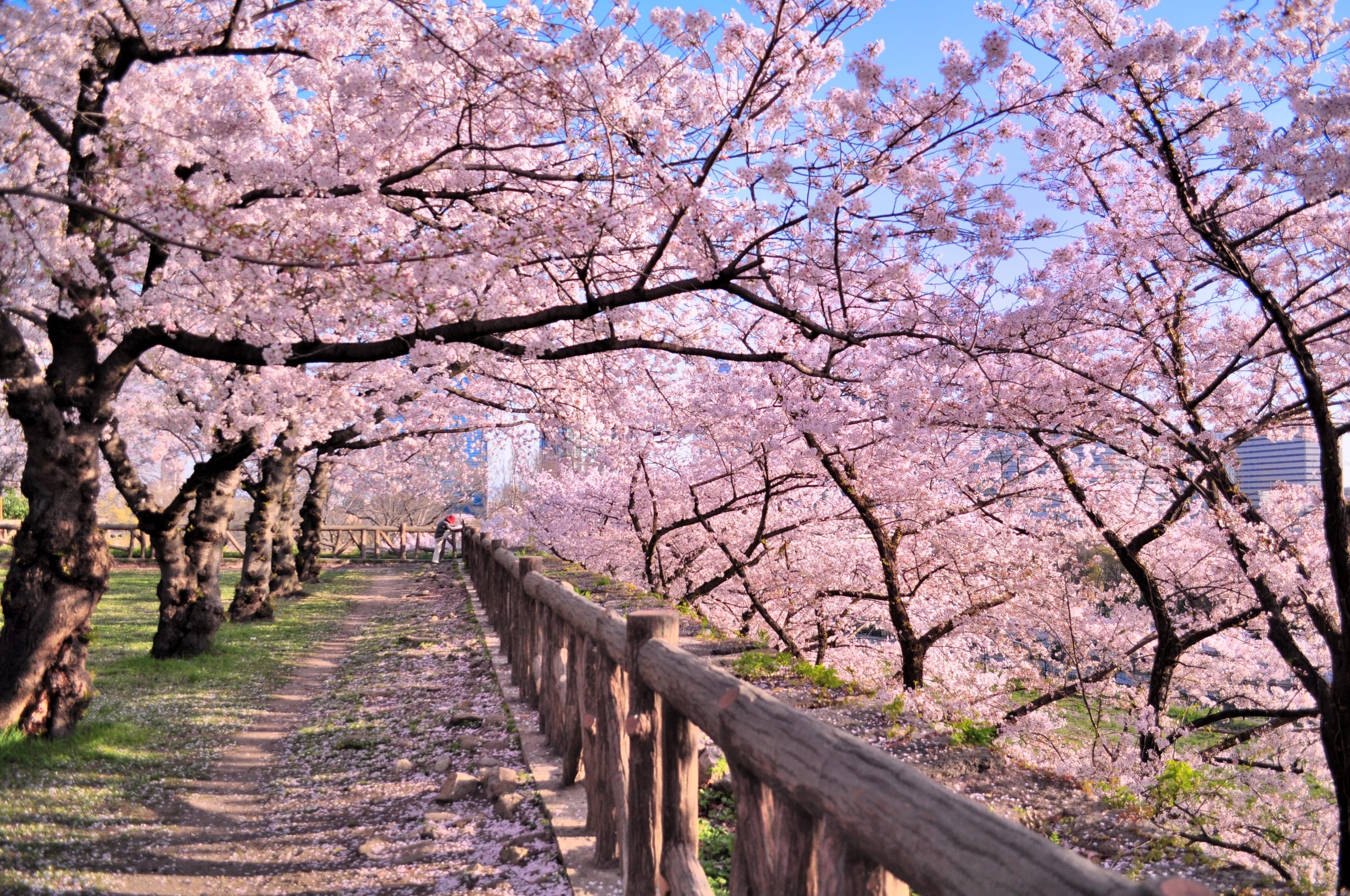
Japan arranged its year around the feeling long before Norinaga gave it a name, and the cherry blossom is the plainest case. Families and colleagues spread their mats under the branches and eat there, and when the petals fall the country has words ready: hanafubuki, a blizzard of blossom, and hanaikada, the raft of petals floating on a moat. The falling is part of the event, looked forward to as much as the flowering.
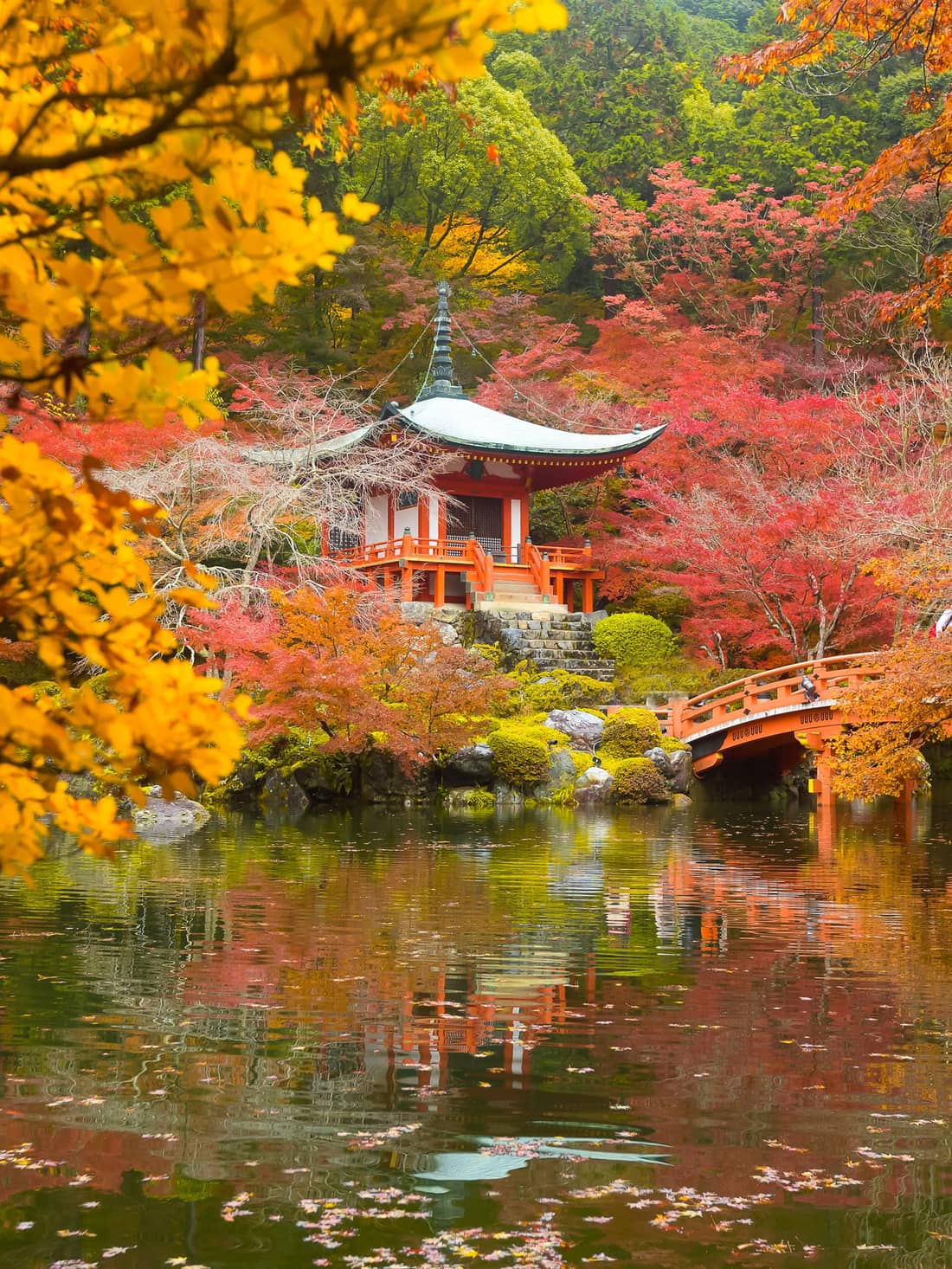
The maple season is the same event in other colours, and it has its own word, chiri-momiji, the scattered maple on the moss. And the kaiseki kitchen has made the feeling into a working vocabulary. Every ingredient has three moments: hashiri, the first of it, served in small amounts as a herald; shun, when it is at its best and most plentiful; and nagori, the last of it, served as a farewell. A September menu may set the last of the summer's hamo beside the first matsutake of the autumn, and a guest who knows the words can read the season in a single tray.
The cherry and the maple are only the best known of these moments. The plum opens in February in the cold, a month ahead of the cherry. In June the fireflies come out over the streams of the northern hills of Kyoto, an evening's walk in the dark among small moving lights. On the fifteenth night of the eighth month of the old calendar, in September or early October, the full moon is viewed over a pond or from a temple veranda, tsukimi, with pampas grass in a vase and white rice dumplings stacked on a stand. The first snow has its own word, hatsuyuki, and at midnight on the last day of the year the great temple bells are struck one hundred and eight times, one stroke at a time, while the year goes out.
Hanami: how Japan watches the blossom →
why it travels
Why it travels
Every culture knows the late-summer evening whose pleasure is bound up with the summer ending. Japan is unusual in having built a calendar, a cuisine and a body of poetry on that feeling, so that a visitor learns it from the arrangement of a tray or the timing of a festival without anyone explaining it.
Visitors who have seen Kyoto in blossom for the first time often say afterwards that the trees were more beautiful because the petals were already coming down. In saying so they have given a fair English definition of a term that has stood in Japanese criticism since 1763.
where to feel it
Where a guest feels it most
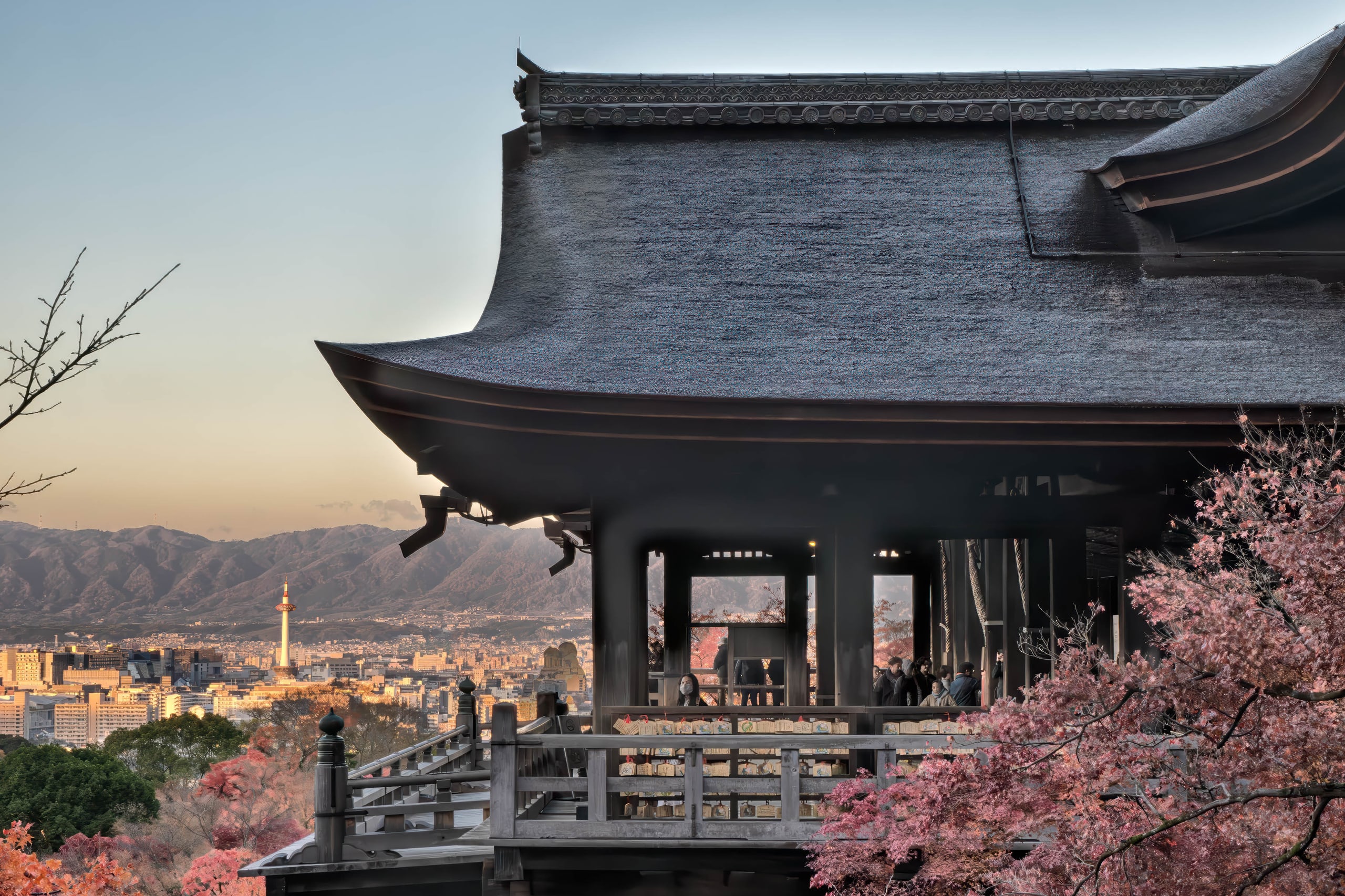
No single place owns the feeling, though some make it easier to meet: the moss garden of Saiho-ji in Kyoto under autumn rain, or a ryokan room in Kinosaki with the last matsuba crab of the winter on the table. At a dry-landscape garden late in the afternoon the sun drops low enough that the raked gravel is the only thing in the enclosure still catching the light.
Kyoto: the city and its places →
Japan cherry blossom tours, 2027 →
The tea ceremony in Kyoto: what happens and what it means →
Hanami, the custom of sitting down beneath the blossom for a whole afternoon, has kept that attention alive since the Heian court, and it is the form of it a visitor can most easily share. The Classic Cherry Blossom Tour of Japan follows the blossom for twelve days from the palace moat in Tokyo to the castle park in Osaka, and twice it stops beneath the trees, with a picnic from a Michelin-starred kitchen laid on rugs in Yoyogi Park and again in the park of the Kyoto Imperial Palace. In Kyoto there is also kaiseki at a two-Michelin-star restaurant, where the spring is set out course by course on the tray.
questions
Questions
What does mono no aware mean?
Mono no aware is the heart moved by things as they pass: a sharpened, tender attention to a blossom, a change of light or a line of a poem, because none of them stays. The usual translation, "the pathos of things", is gentler than the Japanese, in which aware began as a cry, close to "ah".
Who named mono no aware?
Motoori Norinaga, the eighteenth-century scholar of Matsusaka, set out the idea in a treatise on The Tale of Genji in 1763. The feeling itself runs through Japanese poetry from the Kokinshu of around 905.
What is the difference between mono no aware and wabi-sabi?
Mono no aware is a response to the passing of things, most of all the seasons. Wabi-sabi, from the tea room, is the beauty of the plain and of what time leaves on an object: the rough bowl, the patina, the mended crack.
How is mono no aware pronounced?
Mo-no no a-wa-re: six even syllables, with no stress on any of them, and the final e said as in "bed".
What is an example of mono no aware?
The falling of the cherry blossom, which Japan treats as part of the flowering rather than its end, with its own words for it: hanafubuki, a blizzard of petals, and hanaikada, the raft of petals on a moat. The kaiseki kitchen's nagori, the last of an ingredient served as a farewell, is another.
Is mono no aware a sad feeling?
Sadness is only part of it. It carries an awareness that things pass, but it turns towards the world: the heart is moved, and the thing is loved more for it.