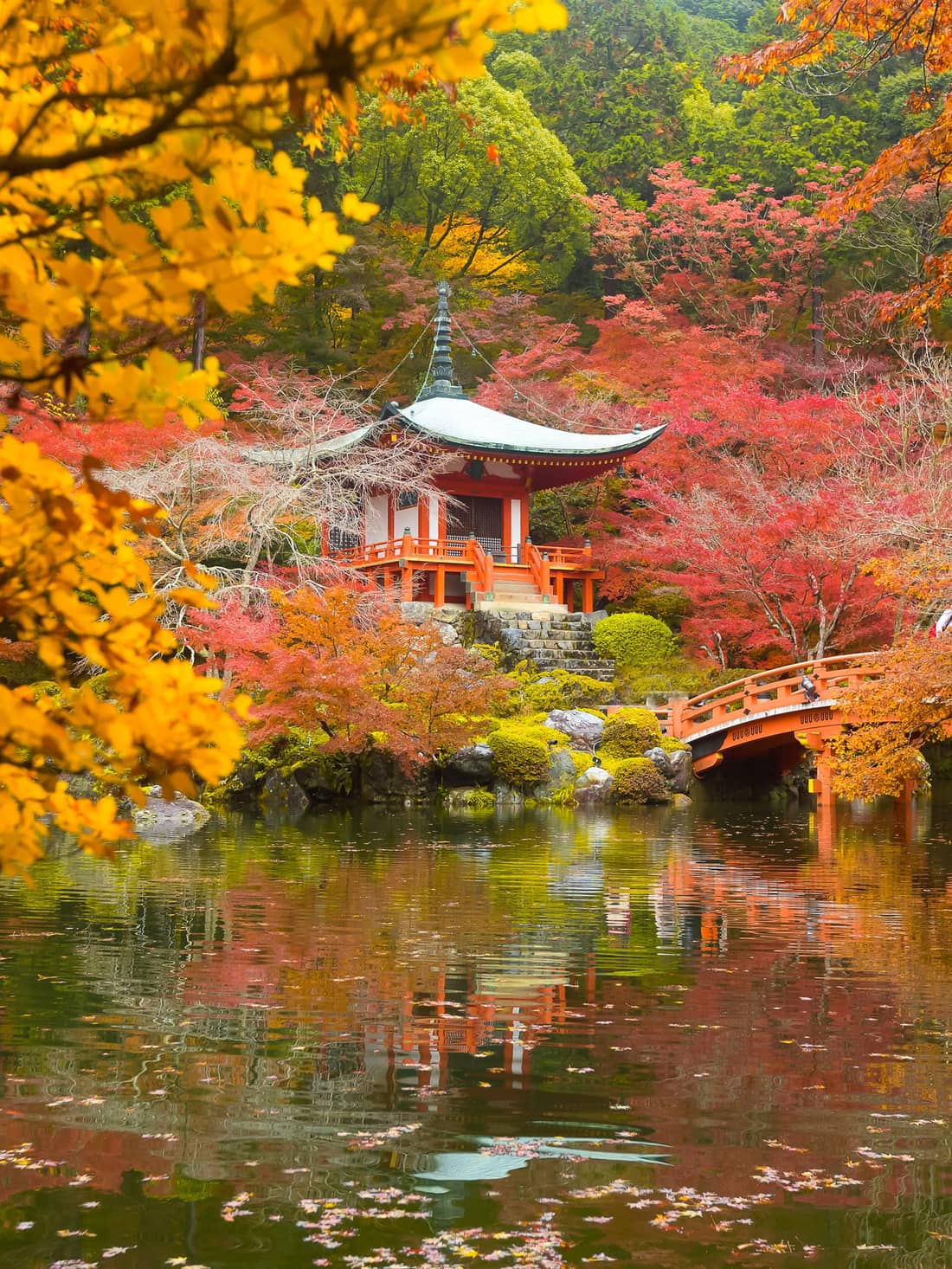

At Tōfukuji the maples fill the valley below the bridge so densely that the trees seem to have become a single red cloud. The covered timber bridge lifts the visitor above the colour, and the roofs and dark beams cut across the view, so that the abundance below is seen inside a frame. That is the gift of Kyoto's temples in autumn: the colour arrives already composed.
The precincts were built for looking long before the first maple was planted in them, and they show the leaves across a pond, beyond a veranda, under a gate, against moss and white gravel, or reflected in a polished floor. Each temple frames the season its own way, which is the reason to see more than one.
the frame
Tōfukuji and its valley of maples
Seen from the Tsūtenkyō bridge, Tōfukuji's valley of maples is one of the strongest autumn scenes in Kyoto. The bridge spans the ravine at the height of the canopy, so the colour is met from above and between dark beams and rooflines, a mass of red understood almost as architecture.
The temple was founded in 1236, in the Kamakura period, as one of Kyoto's great Zen institutions, and that discipline still governs the visit. Long corridors, heavy timber, broad gates, gravel and moss, and abrupt changes of height make the precinct a sequence of frames.
The approach deserves as much attention as the bridge: the walk through the gates, the first red above a wall, the sudden drop of the valley. Around the hōjō, the abbot's quarters, the gardens laid out by Shigemori Mirei in 1939 work in the opposite direction, all stone, moss and clipped forms, with a chequerboard of square stones and moss on the northern side. After the excess of the valley, they clear the eye.
the eastern climb
Eikan-dō, Nanzenji and the eastern hills
Eikan-dō sits on the slope of Higashiyama, and its maples take the late afternoon light from the west. The colour gathers vertically, from the pond through the roofs of the halls and up the hillside to the pagoda, and the eye keeps travelling up and back down again. No single viewpoint takes it all in: a maple leans over the water, a roof shows through the leaves, a covered stairway climbs towards the pagoda.
At its centre is the Mikaeri Amida, the Amida Buddha who looks back over his left shoulder, said to have turned to call a monk who had fallen behind in his devotions. The statue gives the temple a stillness that its seasonal fame never quite overwhelms.
Nanzenji, a few minutes' walk away, is broader and sterner. Its Sanmon gate is monumental, its grounds open, its sub-temples set with gardens of water, stone and maple. The brick aqueduct, completed in 1890 as part of the Lake Biwa Canal works, runs straight through the precinct on Roman-style arches, red brick beside red maple. The colour here is less saturated than at Eikan-dō and has more air around it, appearing in intervals along the long approach and the open gravel.
height and evening
Kiyomizu-dera, Kōdaiji and the temples at night
Kiyomizu-dera shows autumn from height. From the wooden stage, the city drops away below the temple and the slopes around it gather red, orange and dark evergreen, with Kyoto spread out as a basin beyond. Then the visitor moves back into corridors, stairs and smaller halls, and a single branch at eye level after the broad view from the stage can strike harder than the panorama.
When the grounds are lit after dark in the autumn season, the timber, the slope and the leaves become more dramatic, the shadows deepen beneath the stage, and the city beyond recedes into points of light.
Kōdaiji, below it on the hillside, brings the season into the evening with more intimacy, its ponds, bamboo grove and stone paths lit for night viewing. The temple was founded by Nene, the widow of Toyotomi Hideyoshi, in his memory, and the rooms and lacquered darkness of the precinct carry that history beneath the seasonal polish. What stays from a night there is small: a maple reflected in black water, a stone path carrying fallen leaves, a branch over a pond where the tree and its reflection almost meet. Kyoto's night maples are at their most moving when the light is used sparingly and the water keeps some of its darkness.
the quiet precincts
Quieter temples for autumn colour in Kyoto
Ninnaji is known for spring, when its late-blooming Omuro cherries flower at about head height. In autumn its pagoda, gates and broad grounds let the colour appear slowly: a red branch beside an old building, a yellow tree beyond the gravel, leaves gathering along a path.
Shinnyodō, in the hills north of the main Higashiyama temples, gives its colour room, the maples spaced along its approach and around its pagoda and open grounds so that each tree stands whole in the view. Enkōji, in the north-east of the city, is closer and more enclosed, its autumn read across moss, water and stones and through framed views from the rooms. Jōjakkōji, on the slopes of Ogurayama in Arashiyama, climbs: its paths rise among roofs and trees, and the city and river country show through the leaves in glimpses.
Rurikōin, open only in certain seasons, is known for the maples reflected in the polished surface of a lacquered table on its upper floor. The fame is recent; the principle is old. Kyoto has long understood that a garden reflected in wood, lacquer or water slows the eye more than the garden seen directly.
The last stage of the season is chirimomiji, the fallen leaves. Around a stone lantern, across a rain-darkened garden, along the edge of a veranda or gathered at the margin of a pond, the scattered maples carry a quieter beauty than the colour overhead, and at the best temples the season goes on for days after the branches have thinned.
the journey
Kyoto's temples in autumn, on a private journey
The Custom Tour of Japan designs a private journey around Kyoto's temples in autumn, on the party's own dates and from five nights. A Tour Director walks every precinct with the guests and a private car waits at the foot of each approach, so Tōfukuji's valley and Eikan-dō's lit pond sit easily in a single day. And one afternoon can end in a quieter sub-temple garden, the raked gravel catching the last light, with the Tour Director beside the party to say what they are looking at.
questions
Questions
Which temples in Kyoto are best for autumn leaves?
Tōfukuji, whose valley of maples is seen from above on the Tsūtenkyō bridge; Eikan-dō on the slope of Higashiyama, its colour climbing from the pond to the pagoda; Nanzenji, broader and sterner, with its brick aqueduct beside the maples; and Kiyomizu-dera, which shows the season from its wooden stage. Shinnyodō, Enkōji, Jōjakkōji and Rurikōin are quieter.
Are Kyoto's temples lit up at night in autumn?
Yes. In the autumn season Kiyomizu-dera lights its grounds after dark, the shadows deepening beneath the stage and the city receding into points of light, and Kōdaiji lights its ponds, bamboo grove and stone paths for night viewing.
What is chirimomiji?
Chirimomiji is the fallen maple leaves, the last stage of the autumn season. Around a stone lantern, across a rain-darkened garden or at the edge of a pond, the scattered leaves carry a quieter beauty than the colour overhead, and at the best temples the season goes on for days after the branches have thinned.