
kantotochigi
Nikko
Nikko is a mountain town of shrines and temples in Tochigi prefecture, in the Kanto region, about two hours north of Tokyo, where the first Tokugawa shogun lies in the most richly decorated mausoleum in Japan.
The Shinkyo bridge, Nikko
- Prefecture
- Tochigi
- Region
- Kanto
- Journeys
- The Custom Tour of Japan
overview
Gold and lacquer in a cedar forest, and a lake high in the mountains above.
Nikko was a sacred mountain long before the shoguns came. A Buddhist monk, Shodo Shonin, founded the first temple here in the eighth century, and the peaks above the town were places of pilgrimage for a thousand years. In 1617 the remains of Tokugawa Ieyasu, the shogun who unified Japan, were brought here, and his grandson Iemitsu rebuilt his shrine as the Toshogu, a complex of gilded, lacquered and carved halls finished in 1636 by thousands of craftsmen.
The shrines and temples of Nikko, with the cedar forest around them, were inscribed as a World Heritage Site in 1999. They make a striking contrast with the restraint of Kyoto: where Zen temples speak in moss and bare wood, the Toshogu speaks in gold leaf, painted dragons and carved peonies, a declaration of Tokugawa power meant to dazzle.
Above the town, a road of forty-eight hairpin bends climbs to Lake Chuzenji, more than 1,200 metres up beneath the volcanic cone of Mount Nantai. Here the diplomats of the Meiji era built summer villas along the shore, and today the lake, its waterfalls and the high marshland of Senjogahara make Nikko a place to stay for its scenery as much as its shrines.
Nikko rewards a night. The day visitors from Tokyo leave in the late afternoon, and the shrine precinct, with its stone lanterns and its avenue of cedars, falls quiet. In the morning, with mist lying in the forest, the gold of the Yomeimon glows in a softer light, and the drive up to the lake, through woods of maple and beech, takes less than an hour.
Our tours stay overnightOur tours visit for the dayOn a Custom Tour of Japan
see and do
What to see in Nikko
Nikko Toshogu
The mausoleum shrine of Tokugawa Ieyasu, its halls covered in gold leaf, lacquer and carving. Its Yomeimon gate alone carries more than five hundred carved figures, and it is called the gate one could look at until sunset. Beyond it, a stair of more than two hundred stone steps climbs through the cedars to the bronze tomb of Ieyasu himself, plain and quiet after the splendour below.
The three monkeys and the sleeping cat
Two of the most famous carvings in Japan, both in the Toshogu: the monkeys who see, hear and speak no evil on the sacred stable, and the small sleeping cat, attributed to the carver Hidari Jingoro, above the passage to Ieyasu's tomb.
Taiyuin
The mausoleum of the third shogun, Iemitsu, built on a smaller scale than his grandfather's so as not to rival it, and in its black and gold lacquer, many think, the more beautiful of the two.
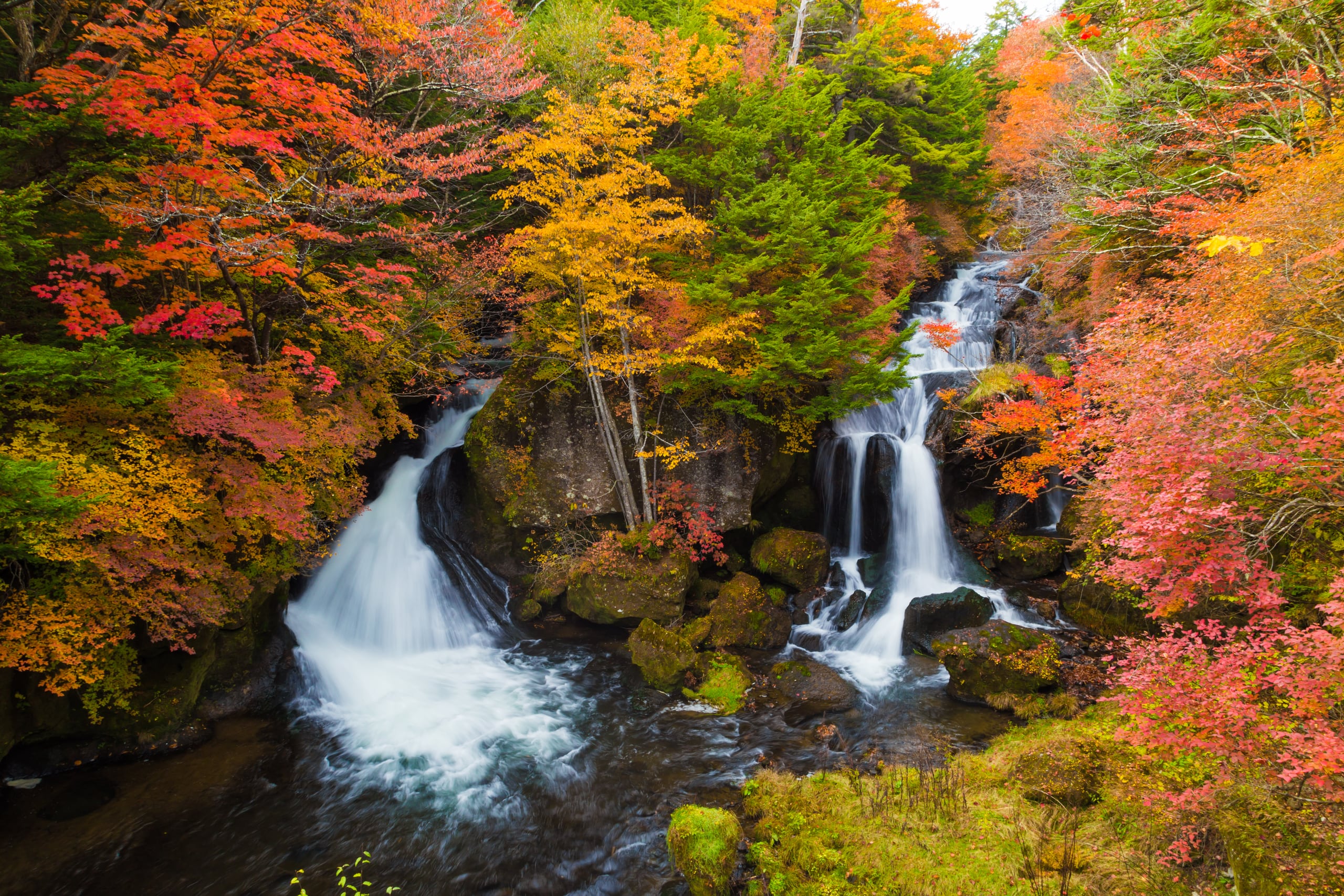
Ryuzu Falls, above Lake Chuzenji Rinno-ji
The principal Buddhist temple of Nikko, founded by Shodo Shonin, whose great hall, the Sanbutsudo, contains three gilded statues more than eight metres high.
Futarasan Shrine
The shrine to the three sacred mountains of Nikko, older than the Toshogu, with halls in the cedar forest and an inner shrine on the summit of Mount Nantai.
Shinkyo Bridge
The vermilion lacquered bridge that spans the Daiya River at the entrance to the shrine precinct, on the spot where, by legend, two serpents formed a bridge for Shodo Shonin to cross.
Kanmangafuchi
A gorge of dark volcanic rock on the Daiya River, with a riverside path lined by some seventy stone Jizo statues in red bibs, which are said never to number the same twice.
Lake Chuzenji
A deep mountain lake at 1,269 metres, cradled in its valley by the slopes of Mount Nantai, its shore lined with forest and the restored summer villas of the Italian and British embassies.
Kegon Falls
The great waterfall of Nikko, where Lake Chuzenji spills 97 metres down a cliff of volcanic rock, seen from a viewing platform at its foot reached by lift. Twelve smaller falls seep from the rock face beside it, and in winter the spray freezes into curtains of ice.
Senjogahara
A high marshland on a plateau above the lake, crossed by boardwalks among grasses and larch, with the peaks of Nikko on every side.
The Cedar Avenue of Nikko
Avenues of some twelve thousand Japanese cedars planted by a Tokugawa lord in the seventeenth century along the roads to the shrine, more than thirty kilometres in all.
Nikko Tamozawa Imperial Villa
A summer villa of more than a hundred rooms, built in 1899 for the crown prince who became Emperor Taisho, combining an Edo-period merchant house with Meiji-era additions.

experiences
The best of Nikko
The Toshogu with an expert
A morning in the shrine precinct with a guide who can read its carvings, its symbols and its politics, so that what can seem a blaze of gold becomes a story of the Tokugawa shoguns and their craftsmen.
A lakeside onsen
An evening by Lake Chuzenji, with the mountains darkening across the water and an open-air onsen beneath the trees, a world away from the shrine town below.
Yuba, the food of the temples
Nikko is famous for yuba, the delicate skin lifted from simmering soy milk, served in a dozen ways in the vegetarian cuisine of its temples.
The lake by boat
A cruise on Lake Chuzenji past the old embassy villas and the forested shore, with Mount Nantai rising above the water.
A level walk by the water
An hour along the Kanmangafuchi gorge, or on the boardwalks of Senjogahara, slow and quiet.
plan your visit
Nikko on a journey through Japan
- How long to stay
- One night lets you see the shrines in the afternoon and again in the quiet of the next morning; two nights adds Lake Chuzenji, Kegon Falls and Senjogahara at an easy pace.
- Getting there
- The Tobu limited express runs from Asakusa to Tobu-Nikko in about two hours. Alternatively, the Tohoku Shinkansen reaches Utsunomiya from Tokyo in about fifty minutes, with a car on to Nikko in about forty-five. Lake Chuzenji is a further thirty minutes by road from the shrines.
- Pairs well with
- Nikko is the natural journey north from Tokyo, and it continues easily west through the mountains to Kusatsu Onsen and Karuizawa, or north by Shinkansen from Utsunomiya into Tohoku, to Fukushima and Sendai.TokyoKusatsu OnsenKaruizawaFukushimaSendai
where to stay
Luxury hotels and ryokan in Nikko
There are two places to stay in Nikko, and they suit different journeys. In the town, near the shrines, a ryokan of spacious suites gives each its own onsen, so the Toshogu can be seen in the quiet of the late afternoon and again the next morning.
Up the mountain, on the shore of Lake Chuzenji, a hotel is built in wood and stone in the manner of the old embassy villas, its rooms turned to the lake and Mount Nantai, with open-air onsen beneath the trees. Okunikko Yumoto, at the head of the valley beyond Senjogahara, and Kinugawa, on its river gorge to the east, have their own onsen ryokan for longer stays, and the choice between the town and the lake comes down to whether the shrines or the mountains are the heart of the visit.
journeys
Nikko on a private journey
We bring guests to Nikko on the Custom Tour of Japan, created around your party alone, on your dates, with your own Tour Director.
questions
Nikko: questions answered
Is Nikko worth visiting from Tokyo?
Yes. The Toshogu and its temples are among the great sights of Japan, and Lake Chuzenji above them is mountain scenery within two hours of the capital.
How do you get from Tokyo to Nikko?
By the Tobu limited express from Asakusa to Tobu-Nikko in about two hours, or by Tohoku Shinkansen to Utsunomiya in about fifty minutes and a car on from there. On our journeys a private car makes the journey door to door in a little over two hours.
Can you do Nikko as a day trip from Tokyo?
Yes, by private car or the Tobu limited express from Asakusa, about two hours each way, but a day allows only the shrines; a night lets you add Lake Chuzenji and Kegon Falls.
How many days do you need in Nikko?
One night for the shrines, and two nights to include Lake Chuzenji, Kegon Falls and Senjogahara at an easy pace.
What is Nikko famous for?
The Toshogu, the gilded mausoleum shrine of the shogun Tokugawa Ieyasu, with its carvings of the three wise monkeys, and the scenery of Lake Chuzenji and Kegon Falls.
Is Nikko a World Heritage Site?
Yes. The Shrines and Temples of Nikko, including the Toshogu, Futarasan Shrine and Rinno-ji, were inscribed together in 1999.
How high is Kegon Falls?
Kegon Falls drops 97 metres from Lake Chuzenji down a cliff of volcanic rock, and is seen from a viewing platform at its foot, reached by lift.
Where should you stay in Nikko?
In the town, near the shrines, for an easy visit to the Toshogu, or on the shore of Lake Chuzenji for the mountains, the lake and the onsen.
Can Nikko be part of a private tour of Japan?
Yes. The Custom Tour of Japan is created around your party alone, on your dates, with your own Tour Director, and it can go anywhere in the country, Nikko included. If you would rather travel independently, the Expert Japan Itinerary plans every day for you.
kanto
More in Kanto
Nikko, planned for you.
Tell us when you would like to travel and what draws you to Nikko, and we will answer with a Custom Tour of Japan created around your party alone, or, if you would rather travel independently, an Expert Japan Itinerary that plans every day for you.