
The first dish is smaller than expected. A single bite, set with a leaf, a line of sauce, a seed, a sliver of citrus that belongs to the month. The room is quiet enough for the lacquer lid of the next bowl to sound when it lifts. Kaiseki is Japan's most considered form of seasonal dining, and its first course exists only to wake the appetite.
Kaiseki is a sequence of small seasonal courses, eight or more, served one at a time, each in a vessel chosen for the month. At its best it is a chain of decisions about time: what the month permits, what the region offers, how the meal moves from lightness towards depth, when heat arrives, when a lid is lifted, and when rice closes the savoury courses before a single sweet and a cup of tea.
two words, one name
Two words, one name
In English there is one word for it, but in Japanese there are two, and they explain most of what confuses a first-time guest. Chakaiseki, written with the characters for bosom and stone, takes its name from a habit of ascetic monks, who kept a warmed stone inside the robe to quiet hunger through long fasts. The tea master Sen no Rikyu is credited with carrying that idea into the tea room in the late sixteenth century: a deliberately modest meal, a handful of simple courses, served before the thick tea itself and meant only to settle the guest.
The kaiseki found on a modern menu, written with the characters for gathering and seat, descends from a different occasion. It grew out of the banquet, the meal shared at a gathering, and it runs to eight courses or more, built to accompany sake and served in a restaurant or a ryokan dining room. Chakaiseki is hospitality built around tea. Kaiseki, in this second sense, is hospitality built around the table itself, and the sake poured at it. Both share the same root idea, restraint measured against the season. A guest who expects the austerity of the tea room from a ryokan dinner, or the abundance of the dinner from a tea gathering, has confused two related forms.
the shape of the meal
The shape of the meal
A banquet kaiseki has no single fixed menu, though certain courses recur: an opening taste, a small seasonal plate, a clear soup, sashimi, a grilled dish, a simmered dish, a steamed dish, rice with miso soup and pickles, and a sweet to close. The order and the weight of each shift with the kitchen, the region, the occasion and the month. A great kaiseki is judged on one test: whether every course belongs where it falls.
The hassun course carries the clearest evidence of the form's own logic. Its name means eight sun, an old unit of measurement equal to a little over three centimetres, so eight sun comes to roughly twenty four, the edge length of the small cedar tray on which the course is traditionally served. Hassun grew out of the last stage of a tea gathering, when a host would bring out sake and a plate to accompany the more relaxed conversation that followed the ceremony itself; the classical version pairs two things from the sea with two things from the mountain, a discipline that turns a handful of ingredients into a compressed map of a single place and season.
In a full banquet kaiseki the courses carry names, and the names are worth knowing because they say what each dish is for.
- Sakizuke: the opening bite, small and pointed, there to wake the palate and announce the month.
- Hassun: the seasonal plate of sea and mountain, set out with the first cup of sake.
- Mukozuke: sashimi, named for the far side of the tray, where it once sat beyond the rice and soup.
- Wanmono: the clear soup in its lidded lacquer bowl, the course by which a kitchen is judged.
- Yakimono: the grilled course, a fish in most months, over charcoal.
- Takiawase: vegetables, fish or tofu simmered separately in dashi and brought together in one bowl.
- Gohan, tome-wan and ko no mono: rice, a closing miso soup and pickles, which end the savoury meal.
- Mizugashi: fruit, or a small sweet, and tea.
Clear soup arrives early and carries more weight than its size suggests. Kombu and shaved bonito steeped in water give a broth that looks simple only to a guest who has never tasted a poor one. When the lid comes off the bowl, the scent of yuzu or kinome reaches the table first, and in that half second the seriousness of the kitchen is plain. The sashimi is a matter of temperature, knife work and the fat the fish carries in that season, and a fish handled well in winter is cut quite differently from the same fish in early summer.
vessels and material
Vessels and the intelligence of materials
Every kaiseki course sits in a vessel chosen for the season, the temperature of the food and the meaning of the month, and the vessel is half the course. A summer dish arrives in glass or pale porcelain, cool to the eye before the first bite. Autumn brings deeper ceramics and lacquer. Winter favours lidded bowls that keep the heat a little longer. Spring lightens the table with soft colour and open shapes, a dish cut in the outline of a cherry petal, a bowl painted with young bamboo.
Lacquer in particular does specific work: a lidded bowl seals in aroma until the moment it is opened at the table; a black tray deepens an autumn colour laid across it; gold lacquer catches candle or lamp light in a way flat white porcelain cannot. Empty space on the plate is a material of its own. A small piece of fish on a wide plate is a matter of proportion: the plate supplies scale and silence, and a garnish set slightly off centre draws the eye across it.

The ingredients follow the same calendar. Spring brings bamboo shoot, the bitter mountain greens and sea bream; summer, ayu from the rivers, hamo eel in Kyoto and a lighter dashi; autumn, matsutake and chestnut; winter, crab, root vegetables and the warming bowls of the cold months.
Every kaiseki course arrives in a vessel chosen to say what month it is.
the counter
Kaiseki, kappo and omakase
Three words are often used as if they meant the same meal, and they do not. Kaiseki is the structured sequence, served in a private room, each course carried in and the kitchen out of sight. Kappo is kaiseki brought to the counter: the same seasonal ingredients and much of the same order, but cooked in front of the guest, the chef cutting, simmering and grilling at arm's length, and the name says as much, from the words for cutting and cooking. Osaka made the form, and Kyoto took to it. Omakase simply means leaving it to the chef, a way of ordering in any cuisine; at a sushi counter it is the whole meal, and at a kappo counter it means the chef decides the sequence that night.
Kaiseki also borrows from the temple. Shojin ryori, the vegetarian cooking of Zen and Shingon monasteries, gave the meal its respect for vegetables, its sesame tofu and its habit of building flavour from kombu and shiitake alone. A night at a temple lodging on Koyasan serves that older cooking in its own right.
where it is eaten
Where to eat kaiseki: the ryotei and the ryokan
Kyoto keeps the great ryotei, the restaurants of private rooms and gardens, in Higashiyama, in Gion and on the road to Arashiyama, some of them in the same families for generations. An evening there runs to two and a half or three hours, the room facing a small garden lit after dark, and the courses arriving at a pace the guest never has to ask for.
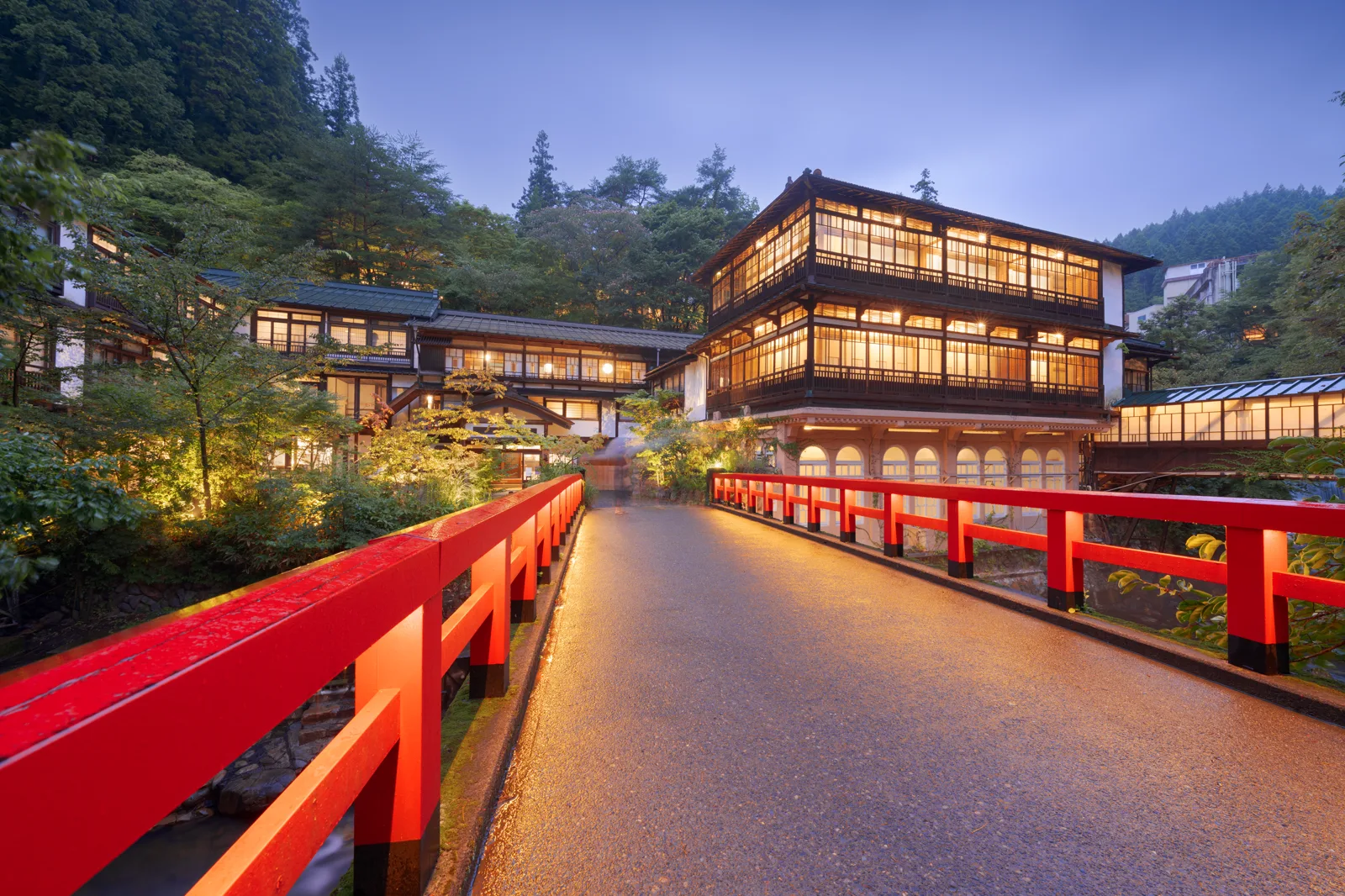
The other great kaiseki of Japan is eaten at the ryokan, and here the meal belongs to its region. At the most celebrated ryokan of Kinosaki Onsen, on the Sea of Japan, the kaiseki follows the month through the Tajima country: Tajima beef in one season, and in winter the Matsuba crab landed on the coast a few kilometres away. In the mountains the same structure fills with river fish, wild greens and preserved foods. A first kaiseki is best eaten in Kyoto and a second at a ryokan, so that the difference between the two becomes the lesson.
Kinosaki's most celebrated ryokan →
Classic Japan: kaiseki in Kyoto, then two nights at Kinosaki Onsen →
the manners
Kaiseki etiquette: how to read the meal
Kaiseki asks two things of a guest, attention and pace. Attention means noticing the vessel, the scent released when a lid lifts, the garnish beside the ingredient it answers. Pace means eating each dish soon after it is set down, while its temperature and texture are as the kitchen meant them.
Region shapes the meal as firmly as the season. Kyoto's kaiseki carries the imprint of the court, the temples, the tea room and the vegetables of the city's own farms, and it leans harder on dashi and quiet vegetable cookery than any kitchen on the coast.
The manners are few and sensible. A lidded bowl is opened by steadying its base and lifting the lid towards the guest, letting the condensation run back inside, and the lid is replaced the right way up when the bowl is finished. Small bowls are lifted to the mouth; chopsticks lie on their stand, never across a bowl and never upright in rice. Strong perfume stays at the hotel, because the aroma of a dashi is part of the meal for everyone at the table, and the counter is no place for a long session with a camera.
the journey
Kaiseki in Kyoto and at the ryokan, on a private tour of Japan
The Custom Tour of Japan sets its kaiseki where the form is strongest: a private room in a Kyoto ryotei with the garden lit beyond the screen, then a ryokan dinner served course by course from the food of its own region. It is a private journey for one party, on the dates they choose, from five nights, and its table is planned before anything else: a table with three stars or the whole counter, a chef brought to the ryokan for a dinner of the guests' own, a tea master in Uji to show where the meal began. A private car and driver wait every day, and a Tour Director travels with the party from the first dinner to the last.
questions
Questions
What is kaiseki?
Kaiseki is Japan's formal seasonal meal: a sequence of small courses, each in a vessel chosen for the month, moving from a single opening bite through soup, sashimi, grilled and simmered dishes to rice, pickles and a sweet. It grew from the meal served before tea and from the banquet, and the two histories share one name.
How many courses are in a kaiseki meal?
Usually eight to twelve, though the number is not fixed. A great kaiseki is judged by whether every course belongs to the season.
How long does a kaiseki dinner take?
Two and a half to three hours at a ryotei or a ryokan. The pace is set by the kitchen, one course at a time, and is part of the meal.
What is the difference between kaiseki and omakase?
Kaiseki is a structured seasonal sequence of courses, usually served in a private room. Omakase means leaving the choice to the chef, a way of ordering used above all at the sushi counter; kappo is the counter form of kaiseki, cooked in front of the guest.
Where is the best place to have kaiseki in Japan?
Kyoto, at a ryotei of private rooms and gardens, for the classical form; and a ryokan in the country, where the same structure is filled with the food of its own region, from Sea of Japan crab to mountain river fish.
What should guests wear to a kaiseki dinner?
Smart clothes that sit easily on a cushion, and no strong perfume, because the aroma of the soup is part of the meal. At a ryotei with tatami rooms, shoes come off at the door, so socks matter; at a ryokan, the yukata is correct for dinner.