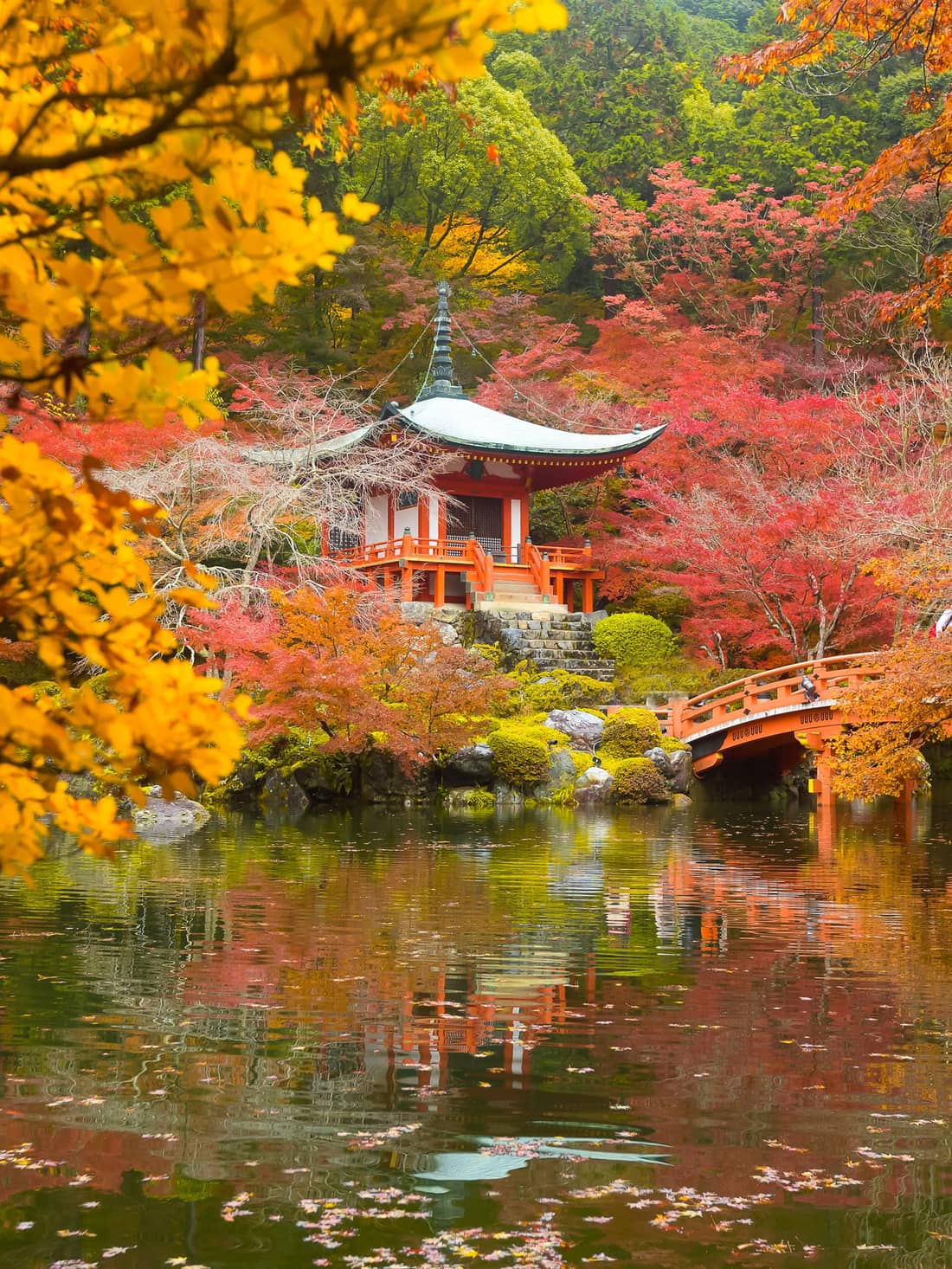

Shirakawa carries the whole of Kyoto's spring in a channel scarcely wider than a lane. Willow leans from one bank and cherry from the other, and the water between them moves just slowly enough to carry both reflections. A single petal turns on the current, catches against a stone, and is carried on. Kyoto in cherry blossom season is a sequence of views like this one, told through water, timber and a light that shifts through the day across a city closed in by hills on three sides.
The blossom here is domestic before it is public. It appears above garden walls, between two roof tiles, at the end of an alley too narrow for a car, long before it gathers into anything as large as a park. For a fortnight the colour of the water changes, the air smells faintly of the petals, and certain streets become the streets everyone remembers Kyoto by.
the dates
When the cherry blossom reaches Kyoto
Kyoto's cherry trees flower around 26 March and reach full bloom around 4 April in an average year, on the Japan Meteorological Agency's 1991 to 2020 normals. In 2026 the season ran early: first flowers on 23 March, full bloom on 30 March. The dated forecast for 2027 arrives between December and February, and is carried on the forecast page as each forecaster releases it.
The city does not bloom all at once. The weeping cherries, Maruyama's among them, open a few days ahead of the Somei Yoshino along the canals; the mountain cherries and the late double-flowered varieties follow into mid-April. In the park of the Kyoto Imperial Palace, where weeping, mountain and double cherries are planted together, the Ministry of the Environment counts the cherry season from late March into early May. Along the Philosopher's Path, some two kilometres of canal beneath the eastern hills, about four hundred Somei Yoshino and Oshima cherries come together in the first days of April.
the water
Cherry blossom along Kyoto's canals and rivers
The blossom in Kyoto follows the water. The Kamo River opens the centre of the city into a long corridor of sky, its stepping stones and sandbanks giving way at the edges to lines of cherry that lean out over the current. Herons stand in the shallows. Students cross on the turtle-shaped stepping stones at Demachiyanagi, and by afternoon the banks are Kyoto at its most public, families settled on the grass and the northern mountains visible beyond the last of the roofs.
The Takasegawa is a canal, dug between 1611 and 1614 by the Kyoto merchant Suminokura Ryōi after the rebuilding of the great Buddha hall at Hōkō-ji had shown how hard it was to bring timber and stone up the Kamo. Flat boats worked it from the port of Fushimi for some three hundred years. Kiyamachi, the street that runs beside it, grew rich on that traffic, and in spring the cherry trees above the canal draw the city down to the water as the barges once did.
Shirakawa, narrower and older in feeling, has stone bridges, a low willow and blackened timber teahouse fronts, and a single line of cherry above the water carries the whole street.
At Okazaki the water opens outward again. The Lake Biwa Canal broadens beside the vermilion torii of Heian Jingu, twenty-four metres tall, and in the blossom season flat-bottomed jikkoku-bune, the old working boats of Kyoto's waterways, carry passengers beneath branches that meet over the water from both banks. Museums and parkland stand back from the canal, and the great red gate gives the flower a frame no lane in the old quarters could match.
Above Okazaki, the Keage Incline climbs thirty-six metres between the canal and the city. Built in 1891 to haul cargo boats up and down the slope on wheeled cradles, it ran for 582 metres and was the longest of its kind in the world when it opened. It closed in 1948. Some ninety Somei Yoshino now grow along it, and their branches meet overhead in a long tunnel of pink and white, the stone of the old slope underfoot.
the quarters
Gion, Higashiyama and Kyoto's quieter quarters
Where the water opens the city, the old quarters close it back down to human scale. Gion's lanes are narrow enough that a single branch above a tiled wall carries the street. Along Hanamikoji and its side streets the blossom shows itself in fragments: through a lattice screen, above a gate, at the far end of a lane.
Higashiyama rises behind the district in stone steps and close rooflines. Ninenzaka and Sannenzaka, the two sloping lanes on the old pilgrim route up to Kiyomizu-dera, have kept their wooden shopfronts since the Edo period. Legend says a stumble on Sannenzaka's stones brings three years of misfortune, and small shops at its foot still sell gourd charms to ward it off.
Maruyama Park, Kyoto's oldest park, opened in 1886 and has been the city's gathering place in spring ever since. At its centre stands the Gion shidarezakura, a weeping cherry whose branches fall almost to the ground. The present tree is a second planting, set in 1949 after the original, close to two hundred years old, failed in 1947. Lit after dark, its whole descending shape stands clear against the hill behind, and people gather at every distance from it, some close enough to trace the branches, some far enough back to take in the whole fall of blossom at once.
Northwest of Gion and Maruyama, Nishijin and Kamishichiken show a different Kyoto. Nishijin keeps its weaving history in narrow streets and old workshop fronts. Kamishichiken, the oldest of Kyoto's geisha districts, is smaller and more reserved than Gion, its spring arriving in single branches over a wall, and a bicycle bell on the stone carries the length of the street.
Kyoto keeps its spring the way a machiya keeps its light, leaving the visitor to find it room by room.
the hour
Kyoto's cherry blossom by day, in rain and at night
Kyoto's blossom changes with the light. Along the canals in the morning it is pale, closer to white than pink, and the water carries the reflection whole until wind or current breaks it. By midday the same trees turn warmer, and the parks and riverbanks fill with a city out in its own spring.
Rain gives the city another season altogether. Petals cling to wet paving stones and darken them further. The smell of turned earth rises from the small gardens between the machiya, and a branch above a damp stone wall turns brighter than it was an hour before, because everything around it has deepened.
After dark, lanterns along Pontochō, the narrow alley beside the Kamo given over to bars and small dining rooms, throw warm light against black water. Along Kiyamachi, cherry branches hang over the canal beside the glow of signs and the lights of passing taxis. Yozakura, night blossom, suits Kyoto, a city that has always known how to use low light: a lamp beside a canal, a lit branch over dark water, wet stone catching a single reflected line.
Luxury Kyoto tours: in blossom, in maple, and in private →
Cherry blossom tours of Japan, 2027, side by side →
Kyoto's spring dances and Japan's cherry blossom festivals, 2027 →
the journey
A cherry blossom tour that includes Kyoto
The Classic Cherry Blossom Tour of Japan, from 30 March to 10 April 2027, gives Kyoto three nights in Gion, with the old lanes of Higashiyama at the door. Its days in the city take in the cherry canopy of the Keage Incline, the thousand torii of Fushimi Inari and the Golden Pavilion at Kinkaku-ji, and it lays a hanami picnic in the park of the Kyoto Imperial Palace, a meal from a Michelin-starred kitchen and cold sake on rugs beneath the trees.
On the eighth evening a private teahouse room in Gion belongs to the guests, and geiko and maiko dance, pour and lead the old games of the ozashiki; dinner in Kyoto is kaiseki at a restaurant with two Michelin stars. The tour is limited to 8 guests, and its Tour Directors travel every mile of it beside them.
questions
Questions
When is cherry blossom season in Kyoto?
Late March to mid-April. Kyoto's first bloom falls around 26 March and full bloom around 4 April on the Japan Meteorological Agency's 1991 to 2020 normals; in 2026 full bloom came on 30 March.
When is cherry blossom in Kyoto in 2027?
By the long-run average, first bloom around 26 March and full bloom around 4 April 2027. The dated 2027 forecasts are released between December 2026 and February 2027.
Where is the best place to see cherry blossom in Kyoto?
The canals: the Shirakawa in Gion, the Takase along Kiyamachi, the Okazaki canal beneath Heian Jingu's torii and the Keage Incline above it. Maruyama Park's weeping cherry is the single tree the city gathers around.
Is Kyoto busy in cherry blossom season?
Yes. Kyoto's hotels ran at 85.1 per cent occupancy in April 2026. The crowds gather at the famous sites; the canals and the old quarters are at their loveliest in the late afternoon and the evening, when the lanterns come on.