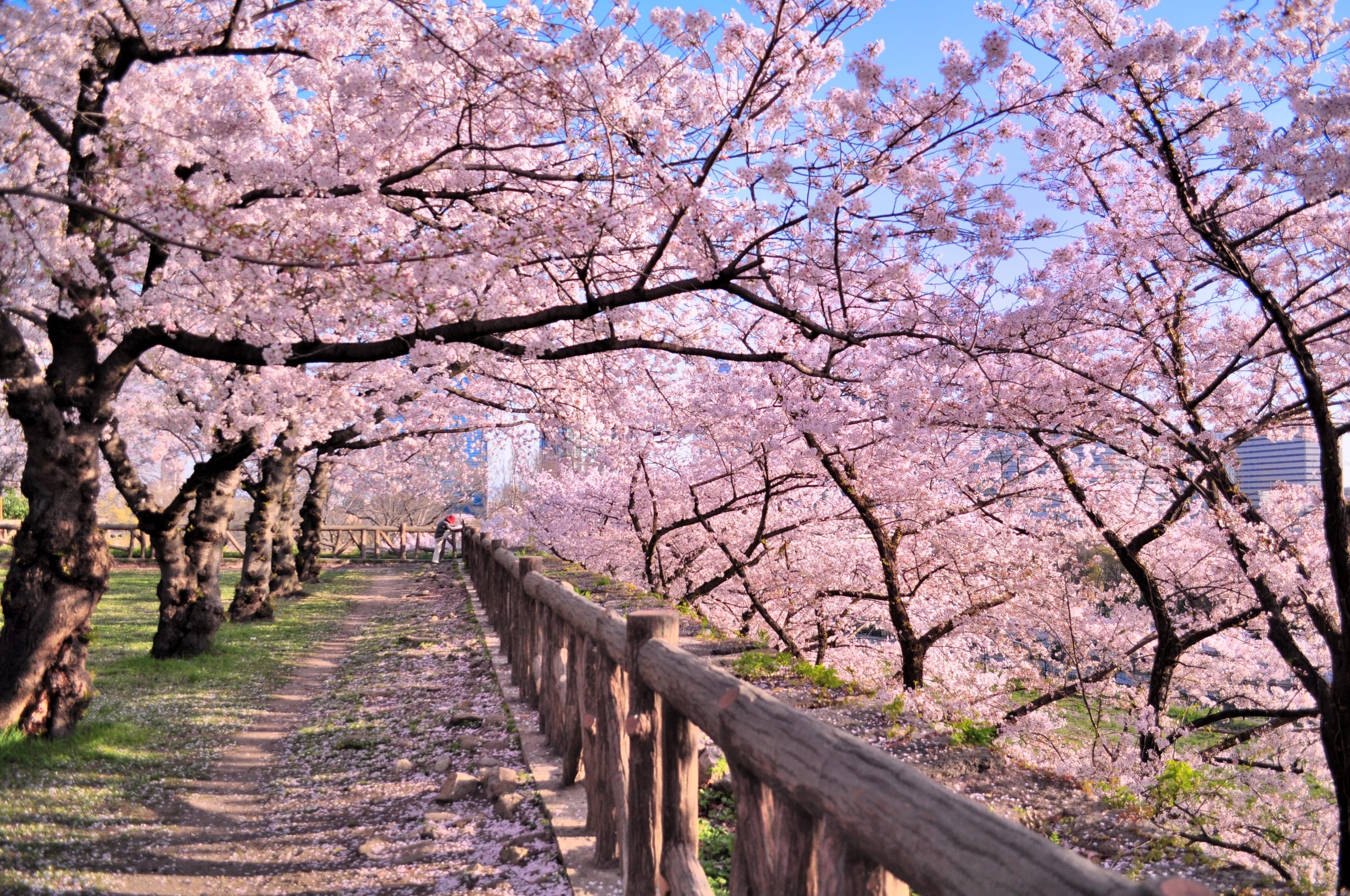

Snow still covers the upper third of Mount Fuji when the cherry trees around Kawaguchiko, the lowest of the five lakes at its northern foot, come into flower. On a clear day in the second week of April the mountain stands white across the water against a sky already warming toward summer, while the branches on the near shore carry blossom that opened only days before. In Tokyo, a hundred kilometres to the east, the same variety of tree has already dropped its petals. That delay is what joins the mountain to the blossom: at the lakes the flowers arrive late enough to meet the last of the winter snow.
The cause is altitude. Tokyo's Somei Yoshino reach full bloom around the turn of March into April. The lakes at Fuji's northern foot lie between 830 and 980 metres above the sea and keep the cold of winter well into spring, so their own bloom comes roughly between the tenth and the twentieth of April, one to two weeks behind the capital.
By then the cherry trees of Tokyo are in fresh leaf, and the upper slopes of the mountain are still white.
the five lakes
The five lakes
Five lakes ring Fuji's northern base, and each shows the mountain differently. Yamanakako, the largest and the highest at close to 980 metres, is broad and open, and the mountain stands over it at its full width. Kawaguchiko, the lowest at close to 830 metres, is smaller and more settled, with towns, ryokan and a long shoreline turned toward the peak. Saiko, Shōjiko and Motosuko lie further west at around 900 metres, with forest running down to the water and few buildings on their shores.
The group's Japanese name, Fujigoko, means simply the five Fuji lakes. When UNESCO inscribed Mount Fuji on the World Heritage list in 2013, it did so as a cultural site, a sacred place and a source of artistic inspiration, and the lakes are part of the inscription.
Saiko and Shōjiko share a history the other lakes do not. Both are what remains of a single larger lake, Senoumi, which was cut in two in 864, when the mountain sent a broad flow of stone down its north-western flank. That flow laid down the porous rock on which the Aokigahara forest now grows, between Saiko and the mountain.
Kawaguchiko is the best base for the mountain and the blossom together. On its eastern shore the small headland of Ubuyagasaki looks across the water toward the Ohashi bridge and the mountain beyond it, and on a still day the whole scene doubles in the lake, a reflection known as Sakasa Fuji, the upside-down Fuji. The northern shore is plainer and, in April, finer: a lakeside path lined with some two hundred cherry trees, with Fuji directly across the water and nothing between the blossom and the peak.
Away from those two shores the views are smaller and closer: the mountain in pieces between roof tiles in the lanes above the northern shore, or a cherry branch hanging over the shallows of Saiko with its reflection lying a few feet from the mountain's.
the pagoda
The Chureito Pagoda above Fujiyoshida
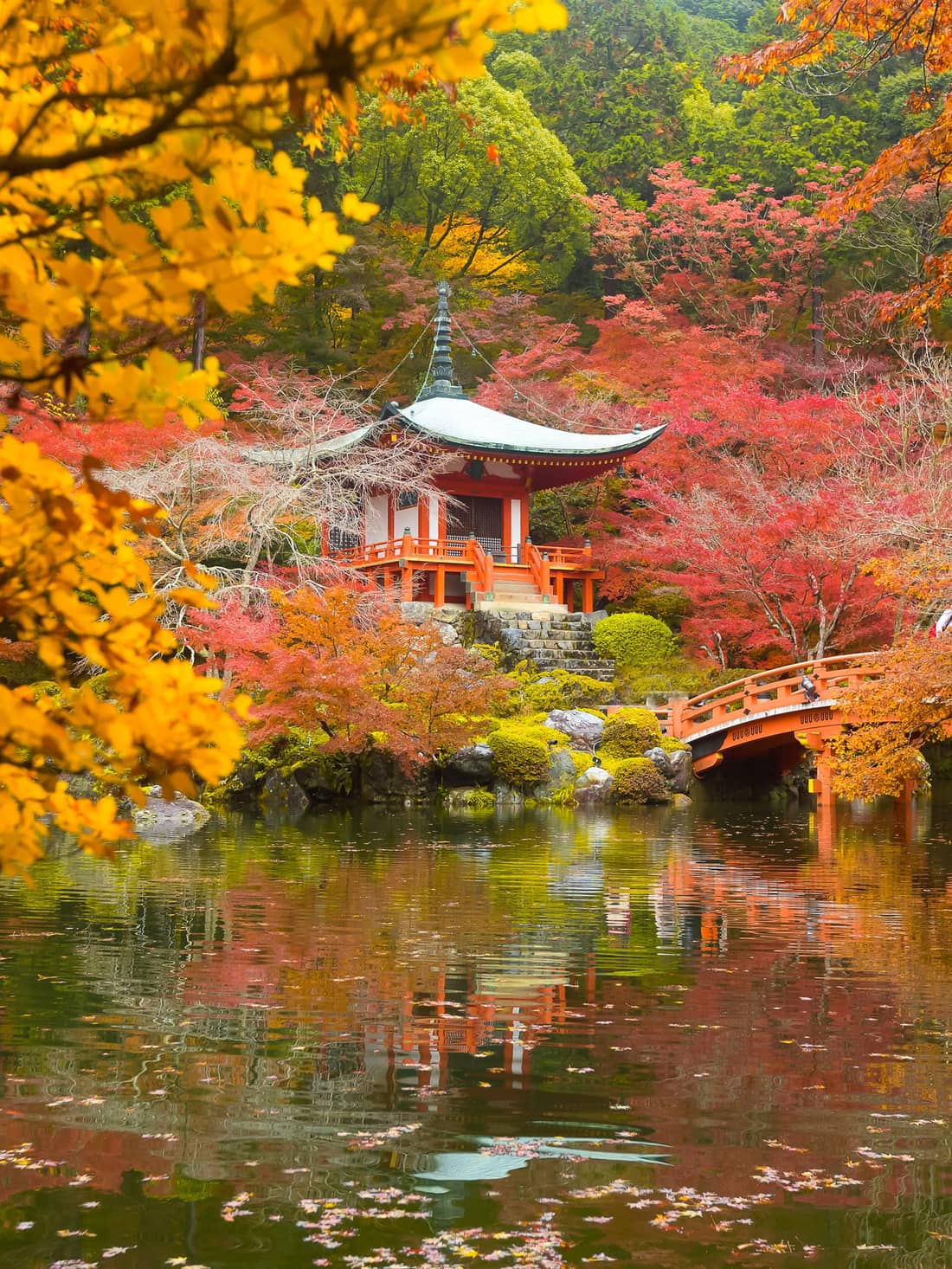
The most reproduced view of Mount Fuji was not made beside a lake at all. Arakurayama Sengen Park, on a hillside above the town of Fujiyoshida, is the setting of the Chureito Pagoda, a five-storeyed memorial pagoda completed in 1963 within the grounds of Arakura Sengen Shrine. A stairway of 398 steps climbs the hill to reach it. From the terrace above, the view is composed vertically: the pagoda's dark tiered roofs, the rooftops of Fujiyoshida below them, and majestic Mount Fuji rising beyond all of it, a scene painted and photographed so often that it is easy to forget it is a real hillside, climbed one step at a time.
The shrine's name carries an older story. The Sengen shrines of Japan, some thirteen hundred of them, enshrine Konohanasakuya-hime, the goddess now worshipped as the spirit of Mount Fuji, whose name is written with the character for flower and means the blossom of the trees. The Kojiki, compiled in 712, tells how the heavenly prince Ninigi married her and sent away her elder sister, the goddess of rock. Because he chose the blossom, the lives of his descendants became as brief as flowers; had he kept the rock as well, they would have lasted like stone.
Fuji's summit is clearest in the cold, dry air of winter. In spring, cloud gathers around the peak as the day warms and clears again toward evening, so the mountain comes and goes over the course of a single day.

The pairing is far older than the pagoda. Katsushika Hokusai's Thirty-six Views of Mount Fuji, printed between about 1830 and 1832, shows the mountain in blue calm and in red morning light, beyond the curl of a wave about to break over three fishing boats, and, in the mountains of Tōtomi province, behind a pair of sawyers cutting a great timber beam, a pale triangle at the back of an ordinary working day. One print in the series, Goten-yama at Shinagawa on the Tōkaidō, sets it behind cherry trees in flower: townspeople picnic under the branches on the hill above the bay, and Fuji stands small and white in the distance. Utagawa Hiroshige gave the mountain its grandest moment in his Fifty-three Stations of the Tōkaidō at the post town of Hara, where the peak rises clean out of the top of the frame above travellers walking toward it.
the evening shore
Evening on the shore of the lake
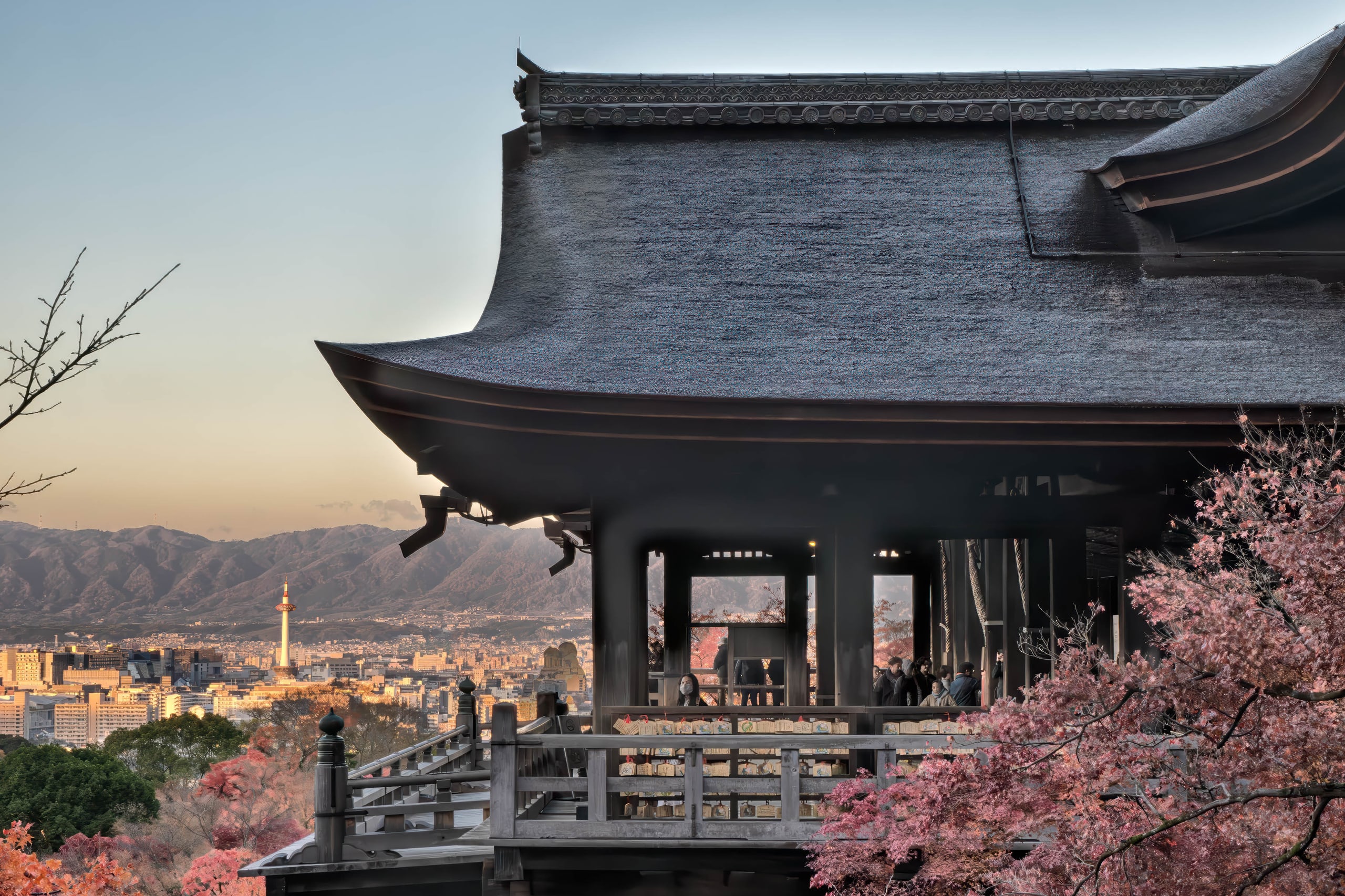
By late afternoon the shore changes. The day visitors begin to leave, the light goes out of the water first, and the cherry branches along the shore turn from colour to silhouette while the snow on the summit is still pink with the last of the sun.
A room facing the water turns the mountain from a single view into a whole day of them: clear at four, wrapped in cloud at five, back again by six, all of it seen from the same chair.
The lakes keep their cold longer than the plain below. Even with the cherry trees in full flower the shore air has a mineral chill, and in mid-April a fire in a ryokan hearth or a heated floor underfoot is still welcome here, weeks after Tokyo has put such things away.
Yamanashi's table is built for that cold. Hōtō, thick hand-cut wheat noodles simmered in miso broth with pumpkin and root vegetables, is the prefecture's own dish. The vineyards of the Kōfu basin, an hour to the north, grow more of Japan's Koshu grape than anywhere else, and its pale, dry wine comes to the table beside the trout the lake country has always eaten.
Cherry blossom in Hokkaido, the later spring of the north →
The Classic Cherry Blossom Tour of Japan, Luxury Japan Travel's twelve-day spring journey from Tokyo to Osaka, spends two nights beneath Mount Fuji. You stay in the finest luxury hotels and ryokan in Japan, each one chosen personally by us for its luxury, its comfort and its setting. Each room has its own open-air bath with Fuji in view, the place to watch the summit come and go through an afternoon. One morning the tour walks up to the Chureito Pagoda, with majestic Mount Fuji behind its five roofs, and lunch is grilled over charcoal at the hearth of an old thatched farmhouse.
Japan cherry blossom tours, 2027: both tours side by side →