
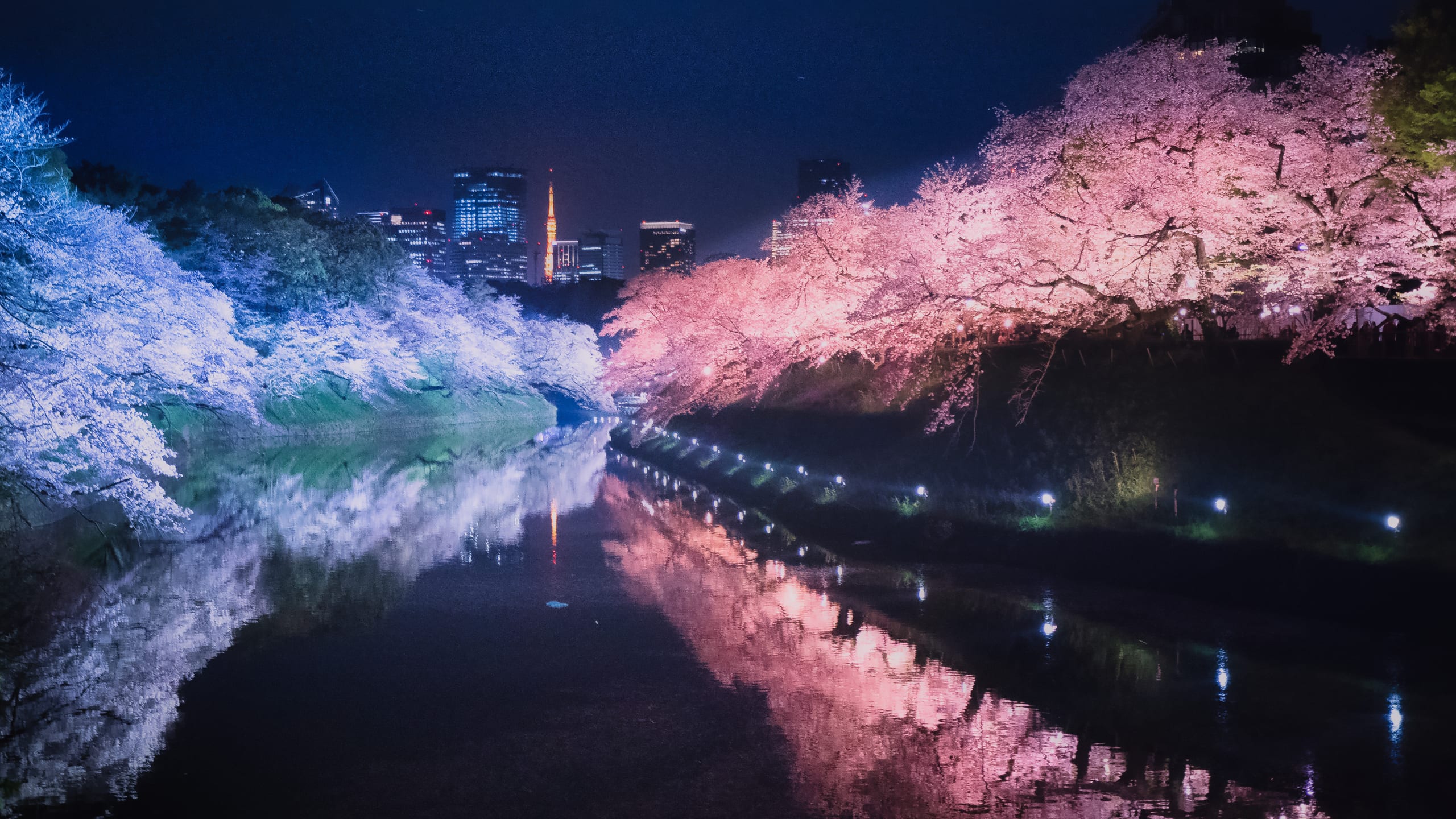
At Chidorigafuchi, the Imperial Palace moat lies still beneath cherry trees that lean out from both banks until their branches nearly meet above the middle of the water. Small boats cross beneath them, threading between reflections that break and re-form with every stroke of an oar. Beyond the trees, the towers of Marunouchi rise into the same pale sky. The trees along this moat were planted within living memory, on water laid out four centuries ago to defend a shogun's castle, and the city of glass behind them carries on as usual through the whole season.
In Tokyo the blossom grows along the lines of old Edo: the castle moats, the Sumida and its embankments, the temple grounds of Ueno, and the cemetery avenues laid out in the 1870s. For two or three weeks in spring, a walker who follows the trees is following the map of the shogun's capital.
By the Meteorological Agency's thirty-year average, the benchmark tree at Yasukuni Shrine opens around 24 March and the city reaches full bloom around 31 March; in 2026 the two dates fell on 19 and 28 March. The Somei Yoshino along the moats and rivers carry the city into April, and the later double-flowered varieties of the great gardens carry it on through the month.
Japan cherry blossom forecast 2027 →
the moats
The palace moats and their old walls
Chidorigafuchi takes its name from the shape of the walls that enclose it: chidori, the plover, a bird the fortifications are said to trace when the moat is seen from above. It was made in the early seventeenth century as part of the defences of Edo Castle, and the cherry trees came only once the castle's original purpose had passed. The British diplomat Ernest Satow, minister to Japan at the end of the nineteenth century, gave the first of them, planted along the stretch that faced the British legation, and the great mass of trees now crowding both banks was set out in the years of reconstruction after the Second World War. A path of 700 metres runs along the moat's public side beneath them.

Kitanomaru Park continues the same palace ground to the north, its older trees and open lawns giving the visitors around the moat room to spread out. Yasukuni Shrine stands just beyond it, and within the shrine's precincts grows the tree the Japan Meteorological Agency uses as Tokyo's official benchmark: when five or six of its flowers open, the whole city is declared to be in bloom.
At Kudanzaka, where the shrine's approach meets the moat road, the trees follow the old stone walls down to the water.
the rivers
The rivers that still carry Edo
The Sumida River has the longer civic memory. Tokugawa Ietsuna, the fourth shogun, first ordered cherry trees planted along its banks, giving the townspeople of Edo somewhere to gather in spring. His successor Tokugawa Yoshimune, the eighth shogun, added roughly a hundred more during his rule, from 1716 to 1745, and the row that lines the river today, close to a kilometre between Azumabashi and Sakurabashi, stands on the line of that eighteenth-century planting. Tokyo Skytree now rises from the eastern bank, close enough to old Asakusa that the tower shows above the blossom of Sumida Park as plainly as it shows above the shopping streets beneath it.
The Meguro River is narrower and more modern. Close to eight hundred Somei Yoshino line about four kilometres of its banks through Nakameguro, their branches meeting overhead above water edged by cafes and small shops. For roughly two weeks from the day the local blossom opens, usually the last weekend of March, paper lanterns called bonbori hang the length of the river, each one paid for by a nearby shop or resident, who chooses the message written on it.

the wider frame
Parks, cemeteries and gardens
Ueno Park has the oldest cherry blossom history of any ground in the city. Its site was once the precinct of Kan'ei-ji, and the priest Tenkai, who founded the temple, had cherry trees brought there from Yoshino in the early seventeenth century, carrying that mountain's bloom into the shogun's own capital. The temple's fortunes fell with the Boshin War of 1868, and in 1873 its old ground opened to the public as one of the first parks in Japan. More than a thousand cherry trees grow there now, above Shinobazu Pond and the museum lawns that have replaced most of the temple buildings, and it is still the city's most public spring, open to whoever walks in.
Two cemeteries carry the flower in a different key. Aoyama opened as Japan's first public cemetery in 1874, and the central avenue running almost 800 metres through it is lined by more than 230 cherry trees, chiefly Somei Yoshino, with yaezakura and shidarezakura among them. Office workers cut through at lunchtime, and photographers set up as the light turns gold. No one treats the setting as sombre.
Yanaka, in the old north-east of the city, is smaller and older in feeling.
Yanaka's cemetery was cut from the grounds of the temple of Tennō-ji in the early 1870s, around the same time as Aoyama's, and its central avenue, Sakura-dori, runs about 300 metres beneath a lower, denser canopy. Cats live along its paths in numbers a visitor soon stops counting. Old temple stones and small Jizō statues stand among the graves, and the streets around it keep a wooden, low-roofed Tokyo that the boulevards further south have long replaced.
Shinjuku Gyoen is the place to see how long the season lasts. Some nine hundred cherry trees of about sixty-five varieties are planted so that the bloom moves through the garden in relay. Kanzakura opens as early as February. The Somei Yoshino at the centre of the garden flower through late March and into April. Ichiyō and Kanzan follow into mid-April, and the pale Baigoji juzukakezakura can still be in flower in the last week of the month, long after the rivers have turned green.
Rikugien is a garden of a different kind. Built between 1695 and 1702 by Yanagisawa Yoshiyasu, a close aide to the fifth shogun, it is counted with Koishikawa Kōrakuen as one of the two great strolling gardens of Edo, its ponds and hills arranged to recall scenes from classical waka poetry. Near its entrance grows a single great shidarezakura, a weeping cherry whose branches fall in a curtain from a height of some fifteen metres, and after dark it is lit against the garden's hill.
the picnic
Hanami in Tokyo: the picnic under the trees
Tokyo's great lawns are where the city sits down. Ueno fills with company groups on blue tarpaulins, a junior colleague sent ahead to claim the ground for the evening. Yoyogi Park, beside the forest of Meiji Jingu, has some six hundred cherry trees over lawns wide enough for the gatherings to spread out, and the Somei Yoshino canopy turns the light itself pale pink.
Shinjuku Gyoen keeps a stricter order: a garden with an entrance fee and closing hours, and no alcohol on its lawns, which makes it the calmest of the great hanami grounds and the best for a long walk among varieties seen together nowhere else in the city.
the water
The Sumida by boat, and the city from the water
Edo watched its cherry blossom from the river, and the yakatabune, the roofed pleasure boat with paper lanterns along its eaves, still carries that habit into the present. A boat taken for a party alone leaves from the landing stages near Asakusa or Ryogoku as the light goes, and dinner is served on tatami as it drifts past the lit banks of Sumida Park and under the bridges, Skytree standing over the blossom on one side and the lamps of the city on the other.
after dark
Where to see cherry blossom at night in Tokyo
After dark the city lights its trees. At Chidorigafuchi, floodlights angled up into the branches throw a second, brighter canopy onto the black water of the moat, and the office towers behind settle into a skyline. At Nakameguro, the bonbori along the Meguro River turn the whole tunnel of blossom the colour of their paper, a corridor of pink and gold repeated in the water beneath it.
In Ueno the evening is for talk. Once the museums close, the benches under the canopy fill with colleagues finishing the working day together and older residents watching the light go, beneath cherry trees that drew crowds in the Edo period and draw them still.
where to stay
Where to stay in Tokyo for the cherry blossom
The best address for the season is on the palace moat. One hotel stands where the moat bends past Wadakura, its rooms turned to the old stone walls and the trees of the palace grounds, and the path at its door leads round the walls to the East Gardens and on to Chidorigafuchi. Another looks down on the same palace from the top of a tower in Otemachi. In Toranomon, a third keeps its gardens around a museum of art, a few minutes by car from the moats and from the avenue in Aoyama.
For a party that wants to travel privately, on dates of its own, Essential Japan in The Private Collection gives Tokyo three nights at Nihonbashi before first class to Kyoto.
The hotel on the palace moat at Wadakura →
A garden hotel around a museum of art, Toranomon →
Essential Japan: Tokyo, Kyoto and Osaka, privately →
Japan cherry blossom tours, 2027 →
Tokyo's cherry blossom festivals, with their dates →
A twelve-day cherry blossom itinerary, Tokyo to Osaka →
The Classic Cherry Blossom Tour of Japan opens with three nights in the centre of Tokyo. Its days in the city take in the seven-hundred-metre tunnel of cherry trees along the Chidorigafuchi moat and the Meguro river at Nakameguro, and a hanami picnic from a Michelin-starred kitchen is laid on rugs beneath the canopy in Yoyogi Park, with cold sake poured beside it.
questions
Questions
When is cherry blossom season in Tokyo?
By the Meteorological Agency's thirty-year average, Tokyo's benchmark tree opens around 24 March and the city reaches full bloom around 31 March. In 2026 the dates were 19 and 28 March, and the later varieties of the great gardens carry flowers on through April.
Where are the best places to see cherry blossoms in Tokyo?
Chidorigafuchi on the Imperial Palace moat, the Meguro River through Nakameguro, the Sumida River below Skytree, Ueno Park, the avenue of Aoyama Cemetery, Shinjuku Gyoen for its many varieties, and the weeping cherry at Rikugien.
Where to see cherry blossoms at night in Tokyo?
Chidorigafuchi, where the moat's trees are floodlit over black water; the Meguro River, hung with paper bonbori lanterns through Nakameguro; and Rikugien, where the great weeping cherry is lit against the garden's hill.
Can visitors have a hanami picnic in Tokyo?
Yes. Ueno Park and Yoyogi Park are the great picnic lawns under the trees; Shinjuku Gyoen welcomes picnics but allows no alcohol. The Classic Cherry Blossom Tour of Japan hosts its Tokyo picnic in Yoyogi Park.
Where to see the Imperial Palace cherry blossoms in Tokyo?
From the moats. Chidorigafuchi, on the palace's north-western side, is the great stretch, with a 700-metre path beneath the trees, and Kitanomaru Park continues the same ground to the north.
Where to stay in Tokyo for cherry blossom season?
Beside the palace moat: one hotel faces the palace gardens across the water at Wadakura, and another looks down on them from a tower in Otemachi. Both put the moat walks at the door.