
kyushuoita
Beppu
Beppu is a hot-spring city on Beppu Bay in Oita Prefecture, on the east coast of the Kyushu region, with more hot-spring sources and more spring water than anywhere else in Japan.
The steam of Kannawa at dusk, Beppu
- Prefecture
- Oita
- Region
- Kyushu
- Journeys
- The Custom Tour of Japan
overview
A city built over its springs, where the steam rises from the hillsides into the streets.
Beppu climbs from the bay up the slopes of Mount Tsurumi, and from almost anywhere in the city you can see the white pillars of steam that rise from vents among the rooftops. The water that feeds them falls as rain on the volcanoes behind the city and returns, heated far below, through thousands of sources. Together they give Beppu a volume of hot water that no other place in Japan approaches, and the steam of the old quarter of Kannawa is now protected as a cultural landscape.
The city is made of eight onsen districts, the Beppu Hatto, each with water of its own character: the salt springs by the sea, the sulphur of Myoban in the hills, the steam of Kannawa, the mud and the sand. Some were known in the eighth century, and tradition credits the monk Ippen, who came here in the thirteenth century, with taming the scalding ground of Kannawa so that people could use it. By the Meiji era Beppu had a port and a steamer service from Osaka, and it grew into the onsen resort of western Japan.
Beppu is a working city, and that is its charm. Neighbourhood bathhouses still serve the people of each street for a few coins, steam kitchens cook vegetables and seafood over the vents, and the jigoku, the hells, are springs too hot to bathe in, shown for their colours. Behind the city lie the shrines of Usa and the Kunisaki Peninsula, and Yufuin is half an hour inland, so Beppu makes a natural centre for eastern Kyushu.
The food is reason enough to come. The Bungo Channel off Oita gives seki-aji and seki-saba, line-caught horse mackerel and mackerel landed at Saganoseki and prized across Japan as sashimi. Toriten, chicken fried in tempura batter, dango-jiru, a miso soup of flat wheat noodles, and kabosu, the sharp green citrus of Oita squeezed over everything, belong to the region, and Bungo beef is served in the best ryokan.
Our tours stay overnightOur tours visit for the dayOn a Custom Tour of Japan
see and do
What to see in Beppu
Umi Jigoku
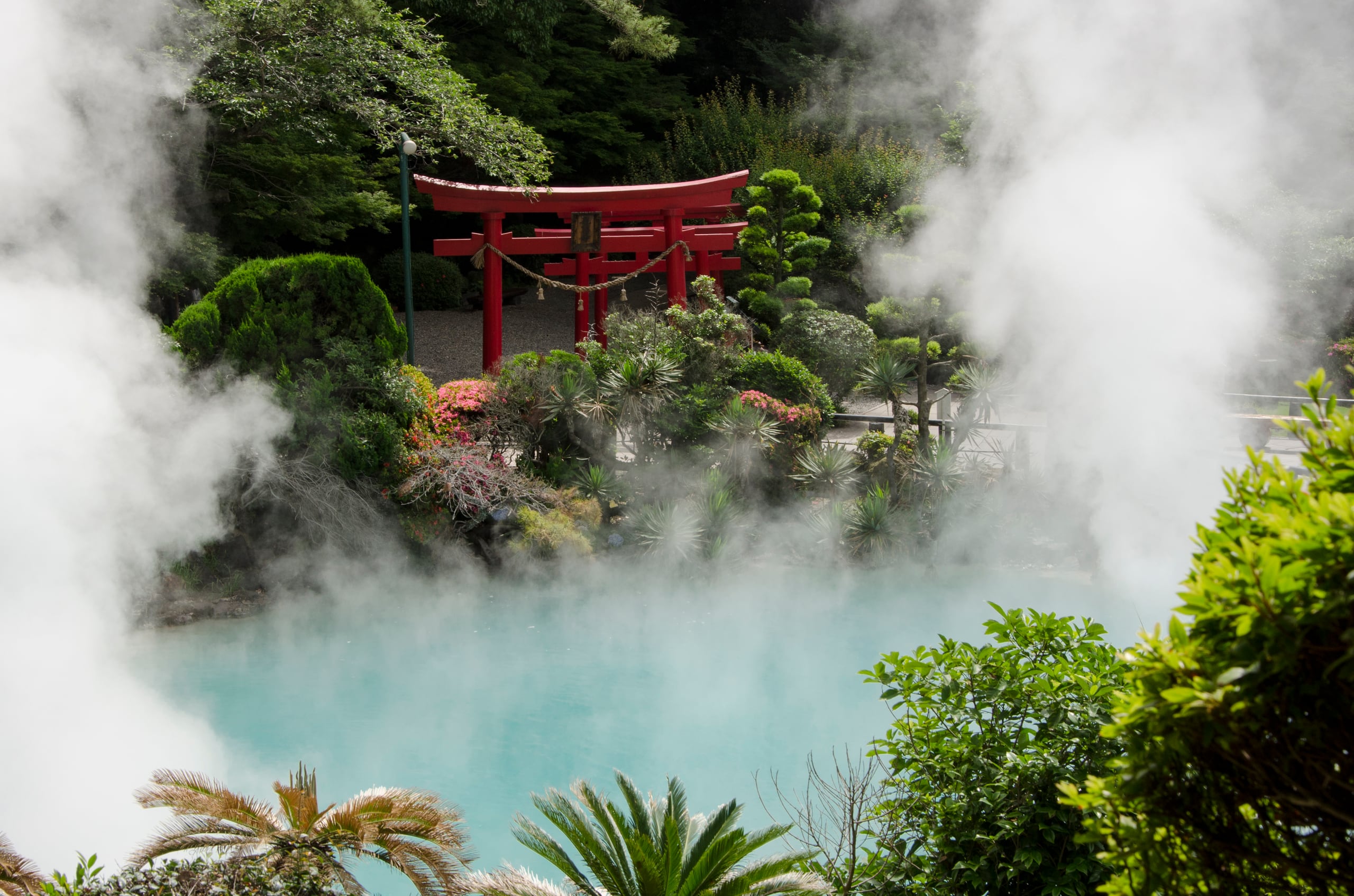
The sea hell: a pool of cobalt-blue water near boiling point, formed some twelve centuries ago, its steam drifting over a garden of lotus ponds and greenhouse water lilies.
Chinoike Jigoku
The blood pond hell, a pool of red clay-coloured water in the Shibaseki district, one of the oldest recorded springs in Beppu, together with Umi Jigoku and two others protected as a national Place of Scenic Beauty.
Tatsumaki Jigoku
A geyser beside Chinoike that sends a column of boiling water into the air every thirty to forty minutes, kept down by a stone roof so that it spreads into a curtain of spray.
Umi Jigoku, Beppu Oniishibozu Jigoku and Shiraike Jigoku
Two of the gentler hells of Kannawa: the first a field of grey mud that rises in round bubbles likened to the shaven heads of monks, the second a milky white pond in a Japanese garden.
Kannawa
The old onsen quarter on the hillside, its lanes of stone and timber inns wrapped in steam. The Yukemuri viewpoint above it looks over the plumes rising from the roofs to the bay, and the Kannawa Mushiyu is a steam room laid with fragrant ishokusa leaves, a custom said to go back to the monk Ippen.
Takegawara Onsen
A public bathhouse founded in 1879 near the old port, its present wooden building with a great curved roof dating from 1938. Inside are an onsen of the plain old style and a sand onsen, where attendants cover you in sand warmed by the spring.
Oniishibozu Jigoku, Beppu Myoban Onsen and its yunohana huts
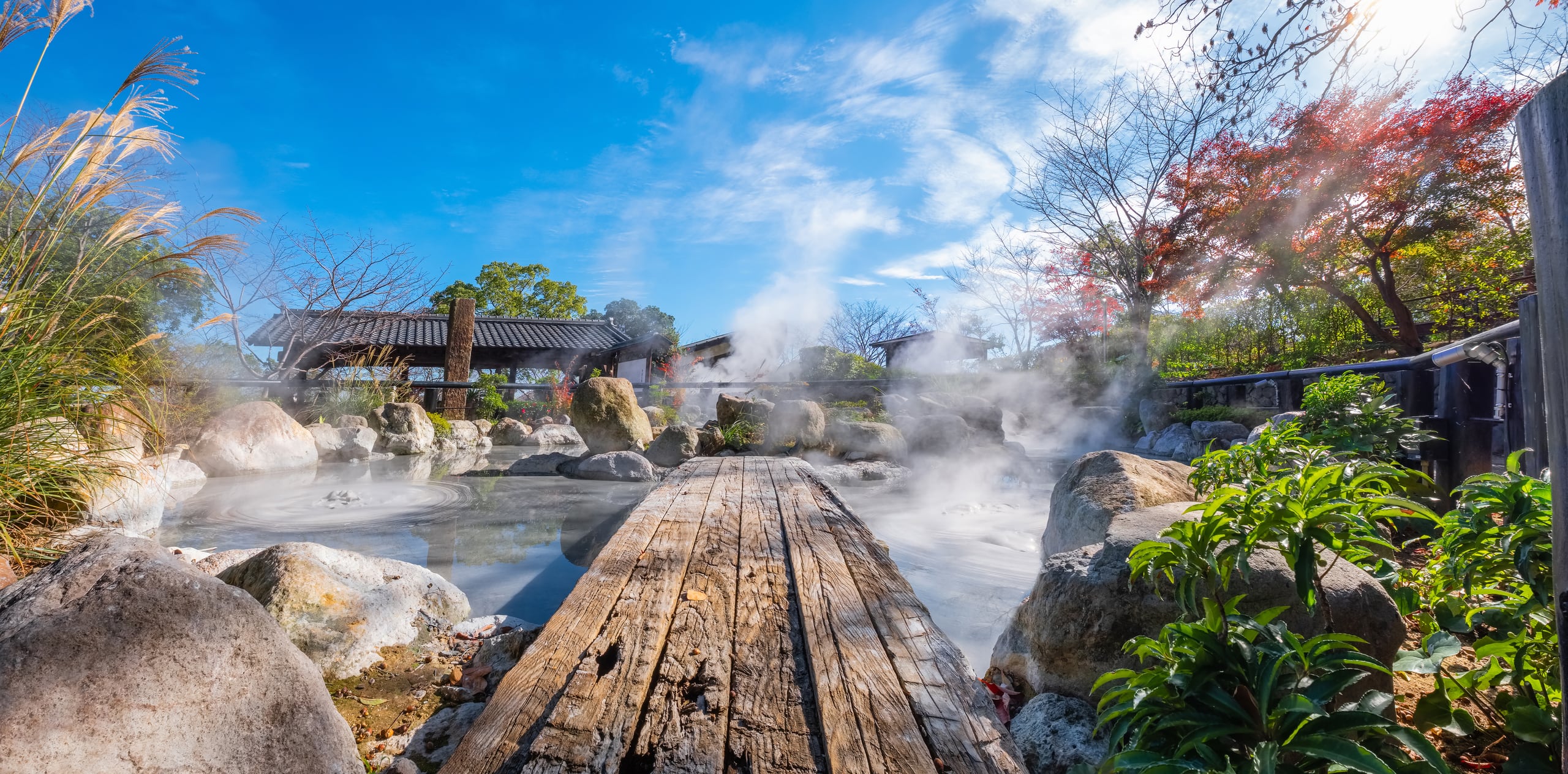
The sulphur springs of the hills, where low thatched huts are built over the vents so that crystals of yunohana, the flowers of the hot spring, form on clay beds to be gathered for bath salts, a craft practised here since the Edo period.
Jigoku-mushi Kobo Kannawa
A steam kitchen in Kannawa where baskets of vegetables, eggs, seafood and pork are lowered into stone ovens heated by the vents and lifted out minutes later, tasting faintly of the minerals of the spring.
Hyotan Onsen
A bathhouse of Kannawa opened in 1922, with open-air onsen, steam rooms, a cascade of hot water falling from bamboo pipes and its own sand onsen.
Mount Tsurumi
The volcano behind the city, 1,375 metres, reached by a ropeway of about ten minutes to near the summit, with a view across Beppu Bay and, on clear days, as far as Shikoku.
Beppu bamboo craft
Beppu is the centre of bamboo weaving in Japan, a nationally designated traditional craft, and the city's Traditional Bamboo Crafts Centre shows baskets and vessels from simple market work to pieces of museum quality.
Usa Jingu
The head shrine of the Hachiman shrines of Japan, set in a forest about fifty minutes north of Beppu, its vermilion main halls a National Treasure.
The Kunisaki Peninsula
A round peninsula north of Beppu where a distinctive mountain Buddhism grew among the valleys. Fuki-ji, its Amida hall of the twelfth century the oldest wooden building in Kyushu, and the Buddhas carved into the cliff at Kumano are the places to see.


experiences
The best of Beppu
An onsen ryokan above the bay
Nights at a ryokan on the hillside, in a suite with an onsen of its own and the bay laid out below, with seki-aji from the Bungo Channel at dinner.
The sand onsen
Lying in a light yukata while attendants cover you to the shoulders in sand heated by the spring beneath, for ten or fifteen minutes of deep warmth, followed by an onsen to rinse it away.
A day of the hells
The jigoku of Kannawa and Shibaseki with a guide who knows their history and geology, and a lunch of food steamed over the vents in the old quarter.
A bamboo master's workshop
An hour with one of Beppu's bamboo craftsmen, from splitting the cane to weaving it, and the chance to commission a piece of your own.
The shrines of Kunisaki
A day by private car into the valleys of the Kunisaki Peninsula and to Usa Jingu, among temples and stone Buddhas that few visitors to Japan ever see.
plan your visit
Beppu on a journey through Japan
- How long to stay
- Two nights for Beppu itself, and three if you would like a day for Usa Jingu and the Kunisaki Peninsula, or a night in Yufuin as well.
- Getting there
- By air from Tokyo Haneda to Oita Airport in about an hour and a half, then about forty minutes by private car. From Fukuoka, the Sonic limited express from Hakata takes about two hours, and a private car about the same.
journeys
Beppu on a private journey
We bring guests to Beppu on the Custom Tour of Japan, created around your party alone, on your dates, with your own Tour Director.
questions
Beppu: questions answered
What is Beppu famous for?
Its hot springs. Beppu has more hot-spring sources and more spring water than anywhere else in Japan, and it is known for the jigoku, the colourful hells of Kannawa, for sand onsen and for food steamed over the vents.
What are the hells of Beppu?
The jigoku are hot springs too hot to bathe in, shown for their colours and character: the cobalt blue Umi Jigoku, the red Chinoike Jigoku, the geyser of Tatsumaki Jigoku and the bubbling mud of Oniishibozu. Seven are usually visited together.
How do you get from Fukuoka to Beppu?
By the Sonic limited express from Hakata Station in about two hours, or by private car in about the same time.
How many days do you need in Beppu?
Two nights covers the hells, the onsen districts and a ryokan evening; three allows a day for Usa Jingu and the Kunisaki Peninsula.
What is a sand onsen?
An onsen in which you lie covered in sand heated by the spring flowing beneath it. In Beppu it is offered at Takegawara Onsen, at Hyotan Onsen and on the shore at Shoningahama.
Should you stay in Beppu or Yufuin?
Both, if you can: Beppu for the sea, the steam and the variety of its waters, Yufuin for a quiet valley of ryokan beneath Mount Yufu. They are half an hour apart by car.
What food is Beppu known for?
Jigoku-mushi, food steamed over the hot-spring vents, along with the seki-aji and seki-saba of the Bungo Channel, toriten, dango-jiru and Bungo beef.
Can Beppu be part of a private tour of Japan?
Yes. The Custom Tour of Japan is created around your party alone, on your dates, with your own Tour Director, and it can go anywhere in the country, Beppu included. If you would rather travel independently, the Expert Japan Itinerary plans every day for you.
kyushu
More in Kyushu
Beppu, planned for you.
Tell us when you would like to travel and what draws you to Beppu, and we will answer with a Custom Tour of Japan created around your party alone, or, if you would rather travel independently, an Expert Japan Itinerary that plans every day for you.