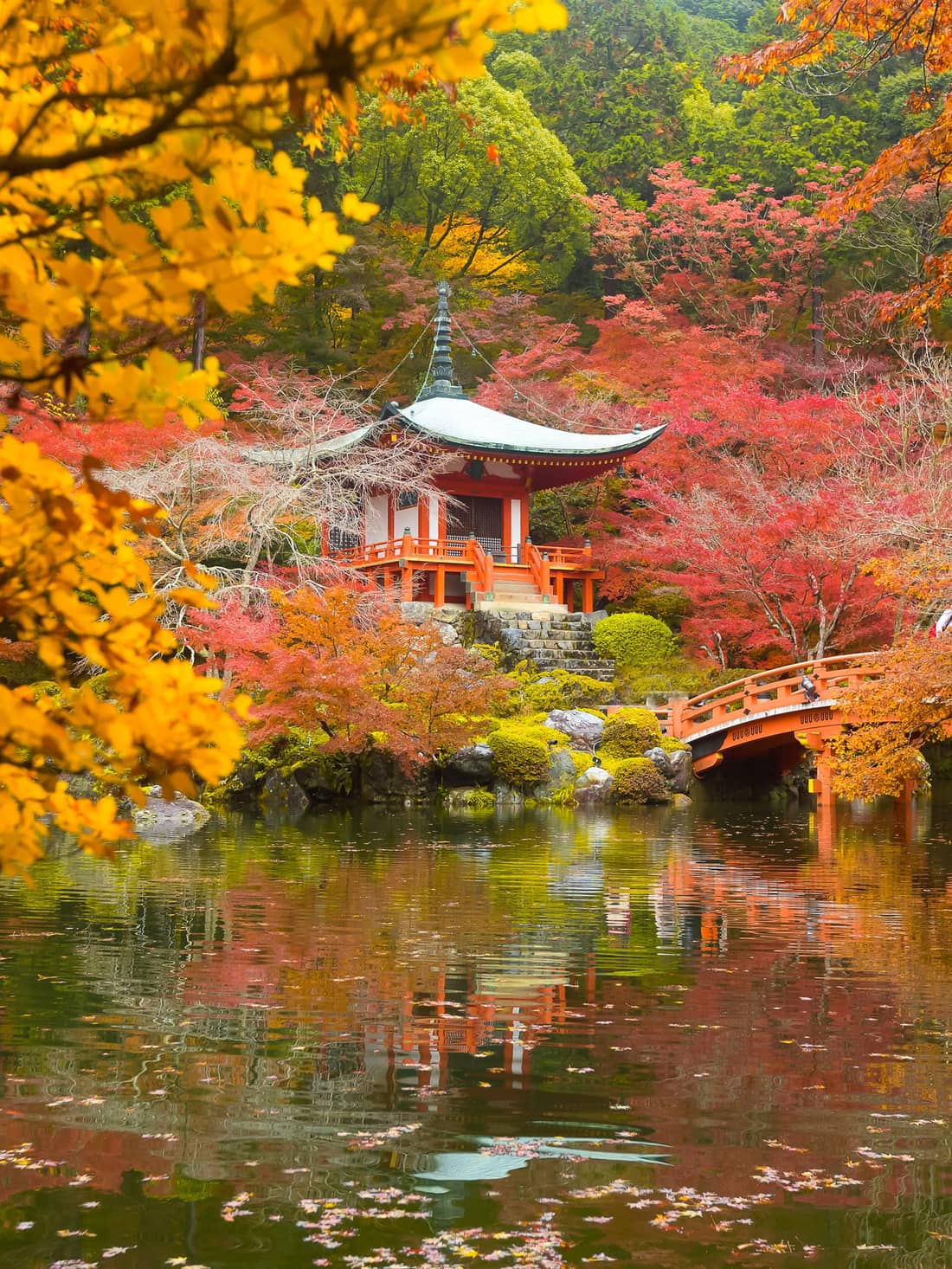

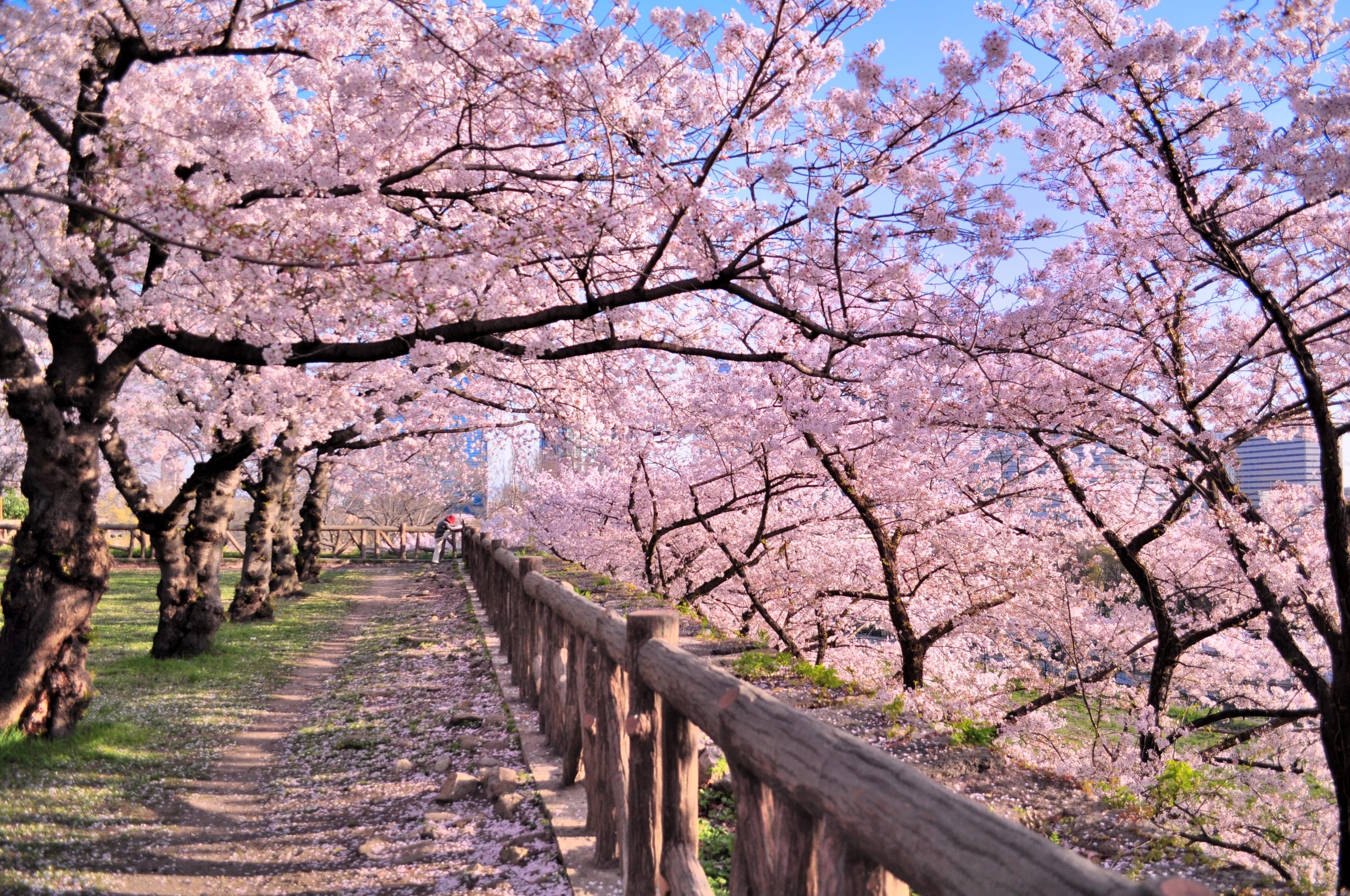
A blue tarpaulin is staked into damp grass, its corners weighted with shoes, a canvas bag and a thermos of tea. An older man opens a lacquered box of food with something close to ceremony. Above the group a cherry tree fills the whole sky, white running to pink, the branches so full that blue shows through only in patches. This is hanami. The literal translation is flower viewing, and the custom asks for more than a look: to view the flower is to sit beneath it, eat with it overhead, and mark, however lightly, that it will soon be gone.
The custom reaches back through court poetry and city planning to a garden banquet given twelve hundred years ago, and it survives today in a form anyone would recognise: a sheet on the ground, food passed round, a tree overhead. A woman walking alone beneath a branch on her way to work takes part in it, and so does a company of office workers with cans of beer, or two old friends sharing tea from a flask.
the shift from plum
Where hanami began
Japan's court began with plum. Through the Nara period ume claimed the aristocracy's attention, imported from the continent along with poetry, calligraphy and the prestige of everything that came from China. The Man'yōshū, the country's oldest surviving poetry anthology, compiled by the late eighth century, carries more than a hundred poems to the plum against some forty to the cherry. Ume opened in the cold, scented the air and read as scholarship; sakura was a flower of the hillside, admired and seldom written about.
By the Heian period the court's attention had moved. The Kokin Wakashū, a tenth-century anthology of more than a thousand poems, gives cherry blossom the central place plum once had. Heian-kyō, the capital that is now Kyoto, had built a whole social grammar around noticing the season: a robe chosen for its shade, a poem folded around a fallen petal, a fan closed at exactly the right line of a verse. A courtier answered the flower with a poem of his own.
The clearest single date belongs to the emperor Saga. In 812 he gave a cherry blossom banquet at Shinsen-en, the garden beside the imperial palace in Heian-kyō, and the court chronicle Nihon Kōki recorded it: sake poured, verse composed in Chinese, music played beneath the trees. From 831 the banquet became a fixture of the court, given nearly every spring.
The Tale of Genji kept the custom at the centre of court life. In the novel's eighth chapter, Hana no En, the festival of the cherry blossoms, a banquet beneath the cherry of the Shishinden hall becomes the setting for one of the story's pivotal encounters, two centuries after Saga's afternoon at Shinsen-en.
A court banquet needed guests and a poem needed readers, but the solitary form ran alongside it from the start: a single figure at a garden's edge, looking at one tree. Both forms have lasted, the shared occasion and the private one.
the picnic spreads
How the hanami picnic spread from the court
For centuries the flower belonged to the court and, by degrees, to the temples and samurai households that copied its taste. The wider public came later, and it came by design.
The eighth Tokugawa shogun, Yoshimune, spent the early eighteenth century turning cherry blossom into a public amenity for Edo. Building on trees the fourth shogun, Ietsuna, had planted at Mukōjima decades before, he extended the planting along the bank of the Sumida River, and in 1720 set out more than twelve hundred cherry trees on Asukayama, a hill in what is now Kita ward, so that the city's ordinary residents had somewhere open to spend a day of leisure in spring. Sakuramochi in its Tokyo form is said to have been first sold in 1717 at the gate of Chōmeiji temple, on the same Mukōjima bank.
Commoners and samurai began arriving at the same riverbank, spreading the same food on the same kind of mat, and the picnic became the centre of the custom. A person seated beneath a tree for an hour sees far more of it than one who passes with a camera raised: the light shifting through the afternoon, petals loosening one at a time, conversation slowing to the pace of the branch overhead.
Evening carried the custom on after dark. Paper lanterns strung along the branches or set beside the path turned the same trees into a second spectacle, which Japanese names on its own: yozakura, night cherry. Under lantern light the pale flower turns warmer, closer to gold than white, and the gathering beneath it moves from food to drink and to conversation that runs late into the night.
Two sweets carry the season into taste. Sakuramochi wraps a pink rice cake in a single salted leaf of Ōshima-zakura, the wild cherry of the Izu islands, and the salt and the leaf's faint almond scent cut the sweetness. Hanami dango sets three colours on one skewer, pink for the bud, white for the flower and green for the leaf that follows it.
The manners are old and simple. Branches are never pulled down for a photograph, and roots are not stood on. A sheet on the ground marks an afternoon's use of the grass, and the party that spreads it leaves the ground exactly as it found it, every scrap of rubbish carried home.
the flower's bargain
Why the falling petals matter in Japan
Mono no aware, usually rendered as the pathos of things, is the phrase Japan reaches for to explain why a flower that lasts barely a week became the country's central emotional symbol. The term describes a heightened kind of noticing: the sense that a thing moves the heart more because it is about to end. Cherry blossom carries the idea more cleanly than any other subject, because its ending is never in doubt.
Full bloom is the public climax. The custom's real subject is the fall.
A breeze crosses the branch, the petals let go, and for a moment even a crowded park goes almost quiet. The Japanese call the moment a gust strips a tree hanafubuki, the flower blizzard, and the petals that gather on a river or a moat afterwards hanaikada, the flower raft. Both words are spoken with pleasure.
The bloom also falls at the hinge of the Japanese year. The school year and the business year both begin in April, so a country starting something new does it beneath a flower known for ending. Graduation photographs, first days at a new company and farewells all fall within the same fortnight as the bloom, and the Japanese see no contradiction in that at all.
A commuter eating a rice ball under a park cherry is taking part in the same custom as the courtier who composed a verse at Shinsen-en. By the time the sheet is folded and the last box packed, the tree overhead has gone a shade greener than it was that morning, and everyone beneath it knew it would.
the journey
Hanami on a cherry blossom tour of Japan
The Classic Cherry Blossom Tour of Japan, from 30 March to 10 April 2027, sits down for hanami twice, in the manner this custom has kept since the court. In Tokyo it is Yoyogi Park, where some six hundred cherry trees stand over open lawns; in Kyoto, the city where Emperor Saga gave his banquet, it is the park of the Kyoto Imperial Palace, where the city's own families come each spring. Each time a meal from a Michelin-starred kitchen is laid on rugs beneath the canopy at the water's edge, cold sake is poured, and the afternoon belongs to the trees.
In Gion, one evening is spent in a private teahouse room with geiko and maiko, who dance, pour and lead the old games of the ozashiki. The tour is limited to 8 guests, and its Tour Directors travel every mile of it beside them.
Japan cherry blossom tours for 2027, each with two hanami picnics →