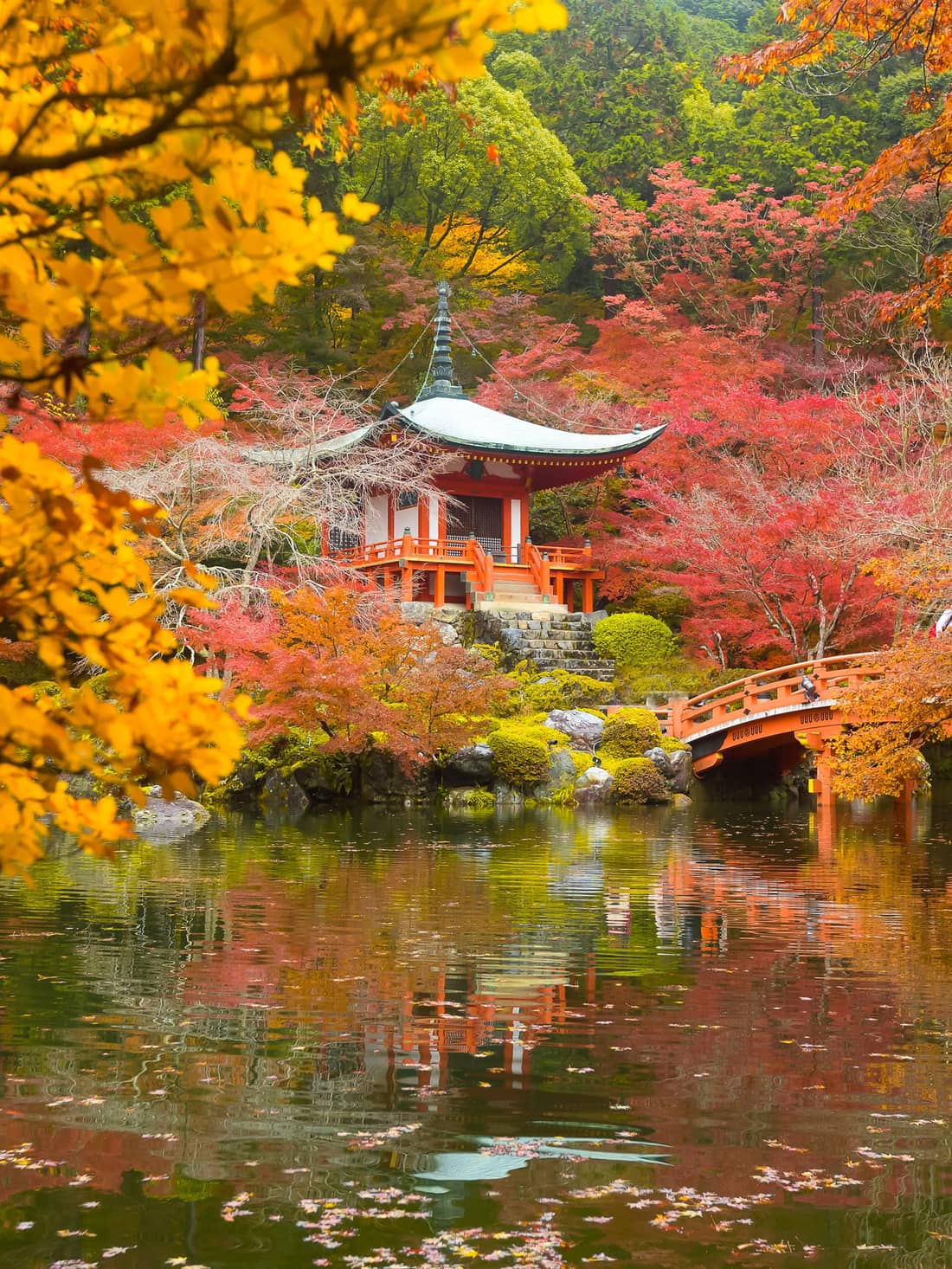

A group pauses beneath a maple and, for a few seconds, no one in it speaks at all. The path is narrow and uneven underfoot, the leaves overhead are red at the edges and still green near the stem, and a few have already fallen onto the moss and stone below. One person raises a camera, studies the framing, then lowers it without taking the shot. Another bends down to look at the ground. Both are practising momijigari, the Japanese custom of going out to see the autumn leaves, which counts the leaf on the moss as part of the season as surely as the leaf still on the branch.
The word joins momiji, the maple in its autumn colour, to gari, hunting, and it is usually translated as autumn leaf viewing or maple hunting. The hunting is the older sense of going out into the hills in search of something seasonal, and the quarry is the view. Cherry blossom opens almost at once and is celebrated in crowds beneath the trees. The maples turn over weeks, from the mountain tops down to the valley floors, and momijigari is the custom of going out to meet them.
the courtly root
Where momijigari comes from
The custom begins at the Heian court, which between the ninth and twelfth centuries made seasonal attention into an art. Courtiers wore layered robes in colour combinations named for the time of year, one of them called momiji, and a poem sent to the right person at the right moment was a social act. In the seventh chapter of The Tale of Genji, written early in the eleventh century, Genji dances the Seigaiha beneath the autumn leaves at an imperial celebration, and the chapter takes its title, Momiji no Ga, from the occasion.
In court poetry the maple stood for parting, and for the sadness of beauty that begins to pass at the moment it is at its height.
The custom reached a wider public slowly, along temple roads and pilgrimage routes, and it reached the stage as well. In the Noh play Momijigari, attributed to Kanze Nobumitsu and written in the late Muromachi period, the warrior Taira no Koremochi comes upon a party of noblewomen viewing the maples on Mount Togakushi and is invited to drink with them, and their leader turns out to be a demon in disguise. Kabuki took up the story, and a performance of it filmed in 1899 is the oldest Japanese film that survives. By the Edo period, printed guidebooks were sending townspeople out to the famous maples much as they went out for cherry blossom, for the moon and for the hot springs. The word hunting still fits, because the colour moves: it reaches the high beech forests weeks before the garden maples of the valleys, and it runs faster after a run of cold nights.
the trained eye
What momijigari teaches the eye
The Kokinshū, the first imperial anthology of Japanese poetry, compiled around 905, gives two of its twenty books to autumn, and the maple runs through both. A poem in it turns on a single image, leaves carried on the Tatsuta River, a deer calling in the mountains, a path lost under fallen colour, and the reader is expected to feel the whole season in that one line.
Deep in the mountains, treading through the fallen maple leaves, a deer cries out: to hear its voice is to know the sadness of autumn.
Sarumaru Dayū, poem 5 of the Hyakunin Isshu
Leaf viewing calls for a different kind of looking from blossom viewing. A cherry tree in flower is taken in at once, a pale canopy overhead. A maple is read in gradations: red at the tips, orange and gold behind, green still showing under the outer leaves, and the fallen leaves darkening once they touch the ground. A practised eye spends as much time on the path, the moss and the water in a stone basin as on the branch, because the colour depends on what stands behind it. Red is at its strongest against dark cedar, and gold against grey stone.
The custom has names for the stages of the tree. Aomomiji is the maple in its green summer leaf, a season word for summer in haiku. Chirimomiji, the leaves scattered on moss, gravel and water, is a season word of its own, and it is the reason the custom does not end when the first leaves come down.

Strictly, momiji is the maple in its autumn colour, though the same two characters, crimson and leaf, are also read kōyō and cover every tree that turns: ginkgo, beech, larch, oak and the lacquer tree. Kōyō is the colour in general, momiji narrows it to the maple, momijigari is the act of going out to see it, and chirimomiji is the leaf on the ground. The maple took the central place because a single leaf is enough to carry the season, in a poem, on a lacquer box, on a folding screen or on a kimono. A maple leaf laid beside the food on a dish in November places the meal in the year.
the etiquette
The etiquette of the leaf hunt
Modern momijigari keeps most of this inheritance. A family under a temple maple, a couple photographing a single branch and a walker stopping at a bend in the path would not name the Heian court as their source, yet the habit they share, stopping to look at a leaf instead of walking past it, comes from the same root.
The etiquette begins with not taking the hunt literally. Nobody pulls a branch down for a photograph, strips a leaf or steps onto the moss for a better angle, and the fallen leaves stay where they fell. A moss garden is slow to recover once it has been trodden, and a crowd that stops in a narrow corridor blocks the view the garden was laid out to frame.
Pace matters as much. A visitor who moves from one famous view to the next misses the stages in between: the half-turned tree, a leaf on the surface of a pond, a wall darkened by rain, a branch lit from beneath by the low afternoon sun.
Momijigari has an indoor counterpart. A branch of maple cut for a vase in the alcove of a tatami room, a persimmon leaf laid under a sweet, a maple motif woven into a kimono for the season: each brings a single leaf indoors. The outing goes to find the colour, and the arrangement brings one branch of it home.
For many Japanese the outing is as much a relief as a lament. It comes as the summer heat finally breaks and the air clears over the mountains, and the maple, for a week or two, is the brightest thing in the landscape before its leaves come down.
Japan fall foliage tours, 2027 →
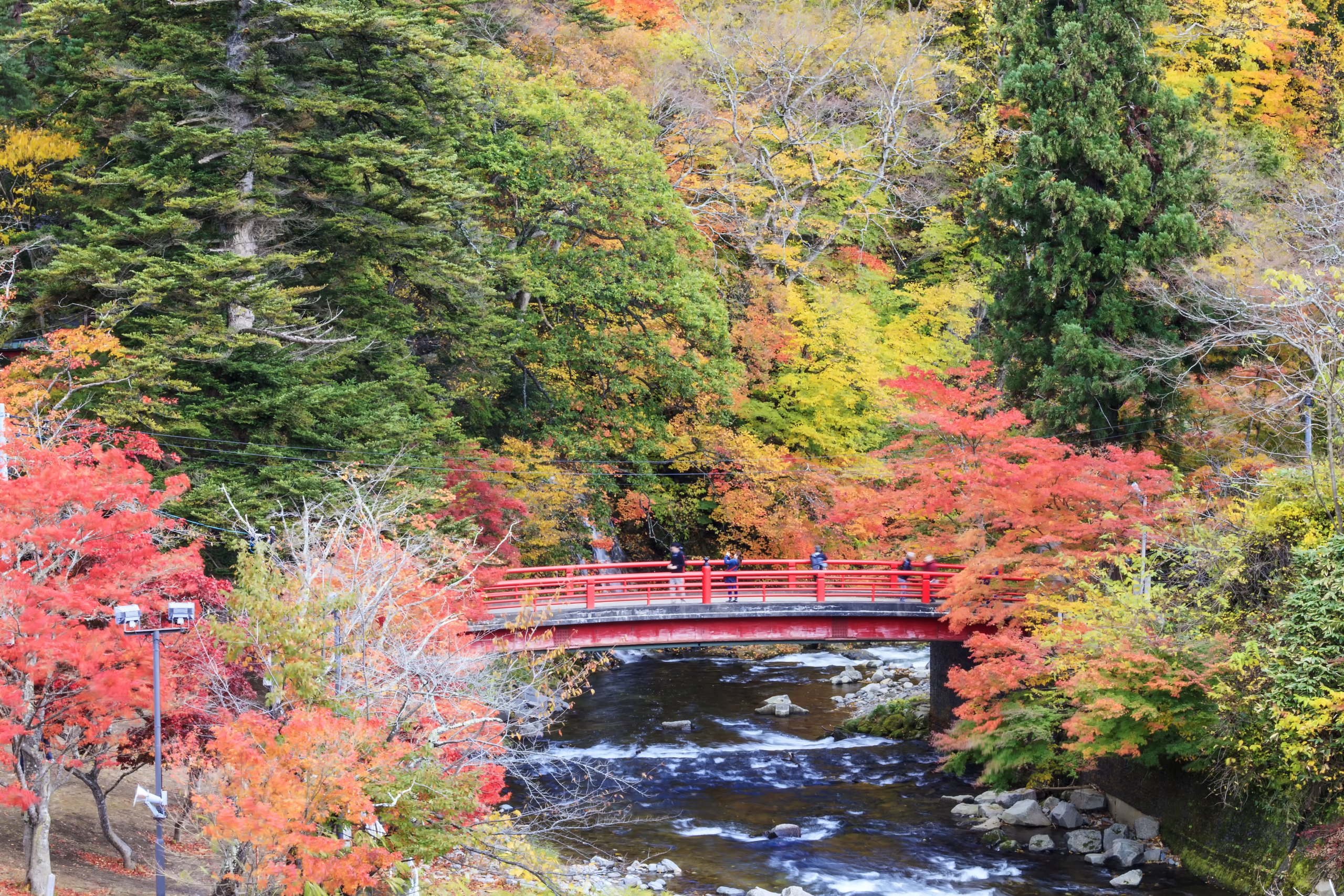
The oldest form of the custom, the journey out to wherever the leaves are turning, is the shape of Luxury Japan Travel's Autumn Leaves Tour of Northern Japan. It follows the colour from Hokkaido south through Tohoku, from the last of the northern colour in the gorge at Jozankei to the fourteen kilometres of the Oirase Stream, taken stretch by stretch with the car waiting at each waterfall. In its final days a private wooden boat carries the group down the Mogami River, through the canyon Basho came down in 1689.
questions
Questions
What does momijigari mean?
Momijigari joins momiji, the maple in its autumn colour, to gari, hunting, and it is usually translated as autumn leaf viewing or maple hunting. The hunting is the older sense of going out into the hills in search of something seasonal, and the quarry is the view. The custom begins at the Heian court, which made seasonal attention into an art.
What is the difference between momiji and koyo?
Momiji is the maple in its autumn colour. The same two characters are also read kōyō and cover every tree that turns: ginkgo, beech, larch, oak and the lacquer tree. Kōyō is the colour in general, momiji narrows it to the maple, momijigari is the act of going out to see it, and chirimomiji is the leaf on the ground.
What is the etiquette for viewing autumn leaves in Japan?
Nobody pulls a branch down for a photograph, strips a leaf or steps onto the moss for a better angle, and the fallen leaves stay where they fell. Pace matters as much: a visitor who moves from one famous view to the next misses the stages in between, the half-turned tree, a leaf on the surface of a pond, a wall darkened by rain.