
A luxury ski holiday in Japan for a couple is three or four great days on Niseko, Hakuba or Myoko, a private onsen and a long dinner after each, then Tokyo and Kyoto by shinkansen or a short flight.
The last lift at Niseko Hanazono has stopped, the light on Mount Yotei has gone from gold to blue, and two people are sitting to their shoulders in hot spring water on a cedar deck while snow settles on the rail. This is the shape of the great ski holiday in Japan for a couple: three or four great days on one of the country's international mountains, Niseko, Hakuba or Myoko, with a private onsen (hot-spring bath) and a long dinner at the end of each, then a shinkansen or a short flight to Tokyo and Kyoto, which in January and February are at their quietest of the year.
Enquire about a private ski journey for two →
A couple seldom wants a fortnight on the slopes. A few superb days on the mountain carry half the pleasure of the journey. The other half is the Japanese winter evening, and Tokyo and Kyoto in the months between the autumn leaves and the blossom.
the mountains
Which ski resort a couple chooses, and why it shapes the journey
The mountain is chosen for the week around it as much as for the snow. Niseko, Hakuba and Myoko all run in English, on the mountain and at the front desk.
Why the international resorts suit beginners and families →
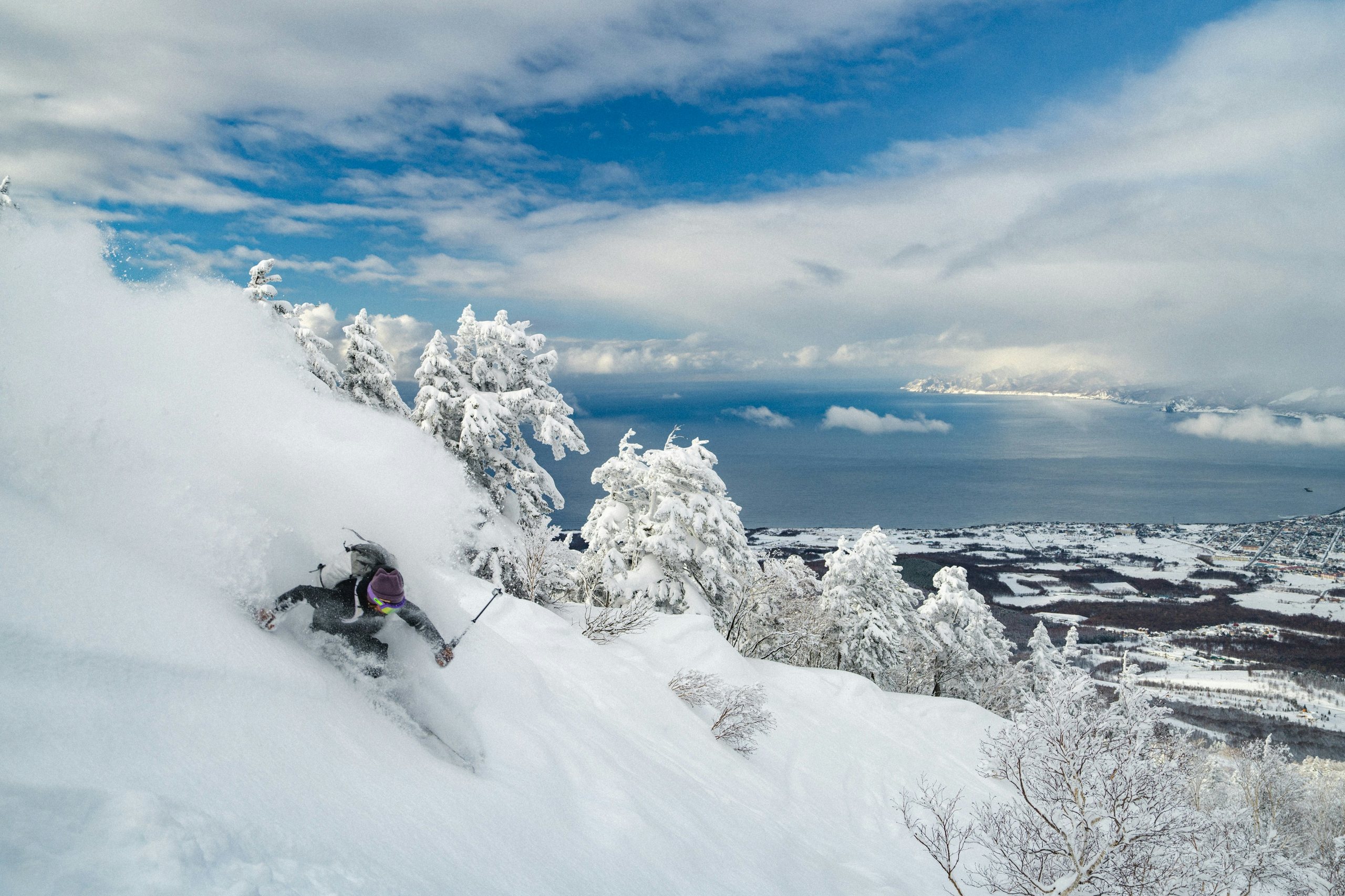
For a couple the choice comes down to what else the week holds. Niseko, on Hokkaido, gives the lightest powder and the easiest evenings, with Mount Yotei across the valley from almost every run, and it means a flight each way. Hakuba, in the Northern Alps of Nagano, is the mountain for two people who ski hard and want long, steep runs. Myoko, and Lotte Arai Resort above it, is the one that sits on the railway to Kanazawa and Kyoto, and that makes it the most graceful choice of all.
the evening
The private onsen and the ryokan dinner after the last run
What the mountain gives a couple that a city cannot is the evening. At a ryokan of fifteen villas in the Hanazono hills of Niseko, each villa's own outdoor onsen stands open to the birch forest, and the snow falls on the water and vanishes. There is no one else in it.
Dinner follows in yukata: kita kaiseki, the northern kaiseki, the Kyoto form of the seasonal meal cooked with Hokkaido's winter larder, course after course in a private room. After a day at altitude there is nothing left to decide, and the onsen is there again at midnight. The hotels and ryokan of the ski country are described one by one in Luxury Ski Hotels in Japan.
the cities
Tokyo and Kyoto in winter, the other half of the journey
Winter is the quiet season in Japan's cities. Kyoto's major hotels are far less full in January than in April, the month of the blossom, and across the country January is one of the quietest months of the hotel year. The streets still have their people. But the lanes that move at the pace of a queue in spring move at the pace of a walk.
Kyoto in winter opens doors that stay shut in other seasons. Each year from early January into March the Kyoto Winter Special Openings admit visitors to temple halls, gardens and paintings that are otherwise closed; in 2026 they ran from 9 January to 18 March and included the Hatto, the Dharma Hall, of Daitoku-ji, in the year of that temple's seven hundredth anniversary. The long hall of Sanjusangen-do, with its thousand and one statues of Kannon, is walked end to end without waiting for anyone. On the few mornings each winter that follow a night of snow, the gold pavilion of Kinkaku-ji stands over a white garden.
February brings Kyoto two of its best days. On the eve of Setsubun, 2 February, Yoshida Shrine on its hill above Kyoto University performs the tsuina, the old rite of driving out demons, at six in the evening by torchlight, and the next day hundreds of stalls line the approach. Across the city the plum garden of Kitano Tenmangu, more than 1,500 trees in some fifty varieties, flowers through February, and on 25 February the shrine keeps its Baikasai, when the geiko and maiko of Kamishichiken, Kyoto's oldest geisha district, serve tea outdoors beneath the first of the blossom.
Tokyo in January has its clearest skies of the year, with rain on only four or five days in the month, and on a clear morning Fuji stands white on the western horizon from the upper floors of the city's hotels. On 2 January the inner grounds of the Imperial Palace open for the New Year Greeting. After the holiday Tokyo is simply itself: the counters of Ginza, the galleries of Roppongi, the long, lamplit evenings, with a little more room in all of them. In February the plum comes to Tokyo too: the Bunkyo Plum Festival at Yushima Tenjin, the shrine of scholars, runs from early February into March, and the white and red blossom stands over the wooden ema plaques of students praying for their examinations.
The order matters. Tokyo comes first, while the body adjusts to the hour, then the mountain, and Kyoto last, when the legs have done their work and the days belong to gardens, temples and the table.
the route
How to combine skiing with Tokyo and Kyoto by shinkansen and air
Each of the three mountains joins the cities differently, and the choice of mountain is also a choice of route.
Myoko is the most elegant. The Hokuriku Shinkansen reaches Joetsumyoko from Tokyo in about two hours, and Lotte Arai Resort is around half an hour on by road. After the skiing, the same line runs on to Kanazawa in about an hour and five minutes, a city worth a night of its own in winter, and from Kanazawa the shinkansen to Tsuruga and the Thunderbird express bring Kyoto in about two hours with one change. Tokyo, snow, Kanazawa, Kyoto: a single line across the country, and not one flight.
Kanazawa is the stop that makes the route. Of Japan's three great gardens, Kenroku-en is the one known for snow, and from 1 November its gardeners rig the yukitsuri, starting with the Karasaki pine: some 800 ropes run from five poles to its spreading branches, a great tent of rope that keeps the limbs from breaking under the weight. The ropes stay until March. In winter the Sea of Japan also sends Kanazawa its snow crab, kano-gani, whose season opens on 6 November, and a couple who arrive from the mountain eat it the same evening.
Hakuba follows the same railway. The Hokuriku Shinkansen reaches Nagano from Tokyo in about ninety minutes, and the valley is about seventy minutes on by road. From Hakuba a couple returns to Tokyo, or goes on west by the Hokuriku line towards Kanazawa and Kyoto.
Niseko is a flight. Haneda to New Chitose takes about an hour and thirty-five minutes, and the road to Niseko is about 110 kilometres, two to two and a half hours in winter by private car. Kyoto is then reached by flying from New Chitose to Itami or Kansai, or back through Tokyo and down the Tokaido Shinkansen, a little over two hours by Nozomi.
Ten nights carries it well: three in Tokyo, four on the mountain, three in Kyoto.
Luxury ski journeys in Japan, from the mountain to the onsen →
A Japan ski itinerary for two, written for you to travel independently →
Winter and the New Year in Japan →
In Kyoto, on a still January morning, there is the sound of a temple broom on gravel and a thin frost on the moss, and Yotei at sunset is only a few days behind.
The Custom Tour of Japan creates that journey for two and runs it: a private journey on the couple's own dates, from five nights, with a chauffeur at the airport and a Tour Director beside them from the first evening to the last. On the mountain there is a private mountain guide who knows where the snow lies deepest, and at the end of each day a villa in the forest with snow building on the rim of its own open-air onsen and kaiseki brought course by course to a private room.
In Kyoto the same journey opens a temple garden after its gates have closed for the day, and gives an evening in Kamishichiken to a teahouse that receives guests only by introduction, where geiko and maiko dance for the two of them and then sit and talk.
questions
Questions
Which ski resort in Japan suits a couple?
Niseko for the lightest powder and the easiest evenings, Hakuba for two people who ski hard and want long, steep runs, and Myoko, with Lotte Arai Resort, for the couple going on to Kanazawa and Kyoto by rail. All three run in English.
Can a couple have a private onsen at a Japanese ski resort?
Yes. At a ryokan of fifteen villas in the forest at Niseko, every villa has an outdoor onsen of its own, open to the birch forest, so a couple ends each ski day in hot water with no one else in it.
How does a ski holiday in Japan combine with Tokyo and Kyoto?
By rail from Myoko or Hakuba, and by air from Niseko. The Hokuriku Shinkansen joins Tokyo, Myoko, Kanazawa and Kyoto in a single line without a flight, while Niseko is a flight from Haneda to New Chitose and two to two and a half hours by road.
How many nights does a couple's ski journey in Japan need?
Ten nights carries it well: three in Tokyo, four on the mountain and three in Kyoto.
In what order should a couple take the cities and the snow?
Tokyo first, while the body adjusts to the hour, then the mountain, then Kyoto last, slow and quiet.