
Naha
Naha is the capital of Okinawa Prefecture, on the south-west coast of Okinawa Island in the Okinawa region, and the hill of Shuri above it was the royal seat of the Ryukyu Kingdom from the fifteenth century until 1879.
The Kinjo-cho stone lane, Shuri
- Region
- Okinawa
- Journeys
- The Custom Tour of Japan
overview
A harbour city below the hill of the Ryukyu kings, their stone lanes still winding down to the sea.
Naha grew as the port of the Ryukyu Kingdom, the harbour where ships from China, Korea, Japan and South-East Asia unloaded silk, porcelain and spices, while the court lived on the hill of Shuri a few kilometres inland. Chinese scholars and interpreters settled in the Kume district by the harbour in the fourteenth century, and for five hundred years the city faced outward, to the sea and the trade it carried. Shuri and Naha were joined as one city in 1954, and today Naha has some 300,000 people and is the arrival point for almost every journey to the islands.
Most of old Naha was destroyed in 1945, and the city rebuilt itself quickly, but the kingdom's sites have been restored with great care. Shuri Castle, the royal mausoleum of Tamaudun, the stone gate of Sonohyan-utaki and the garden villa of Shikinaen are all part of the World Heritage Site of the Ryukyu kingdom, and the old royal road still descends the hill of Shuri between coral walls and banyan trees.
Naha is also where Okinawa's crafts and food are easiest to understand. The potters of Tsuboya have worked in the same quarter since 1682, dyers of bingata and weavers of Shuri textiles keep their workshops in the old town, and the markets off Kokusai-dori sell everything an Okinawan kitchen needs. Two nights here is the right beginning, before the coast or the islands.
Our tours stay overnightOur tours visit for the dayOn a Custom Tour of Japan

see and do
What to see in Naha
Shuri Castle
The palace of the Ryukyu kings, its ramparts of curving limestone climbing the hill in tiers to the courtyard of the main hall. The hall itself, lost to fire in 2019, is being rebuilt to its eighteenth-century design, with its carpenters and lacquerers at work in view of visitors.
Shureimon
The ceremonial gate on the road up to the castle, its red lacquered frame under two roofs of red tile, with a tablet naming Ryukyu a land of propriety. It appears on Japan's 2,000 yen note.
Sonohyan-utaki Ishimon
A stone gate beside the castle, carved in 1519, where the king prayed for a safe journey before leaving Shuri. It stands for the sacred grove behind it, which no one entered.
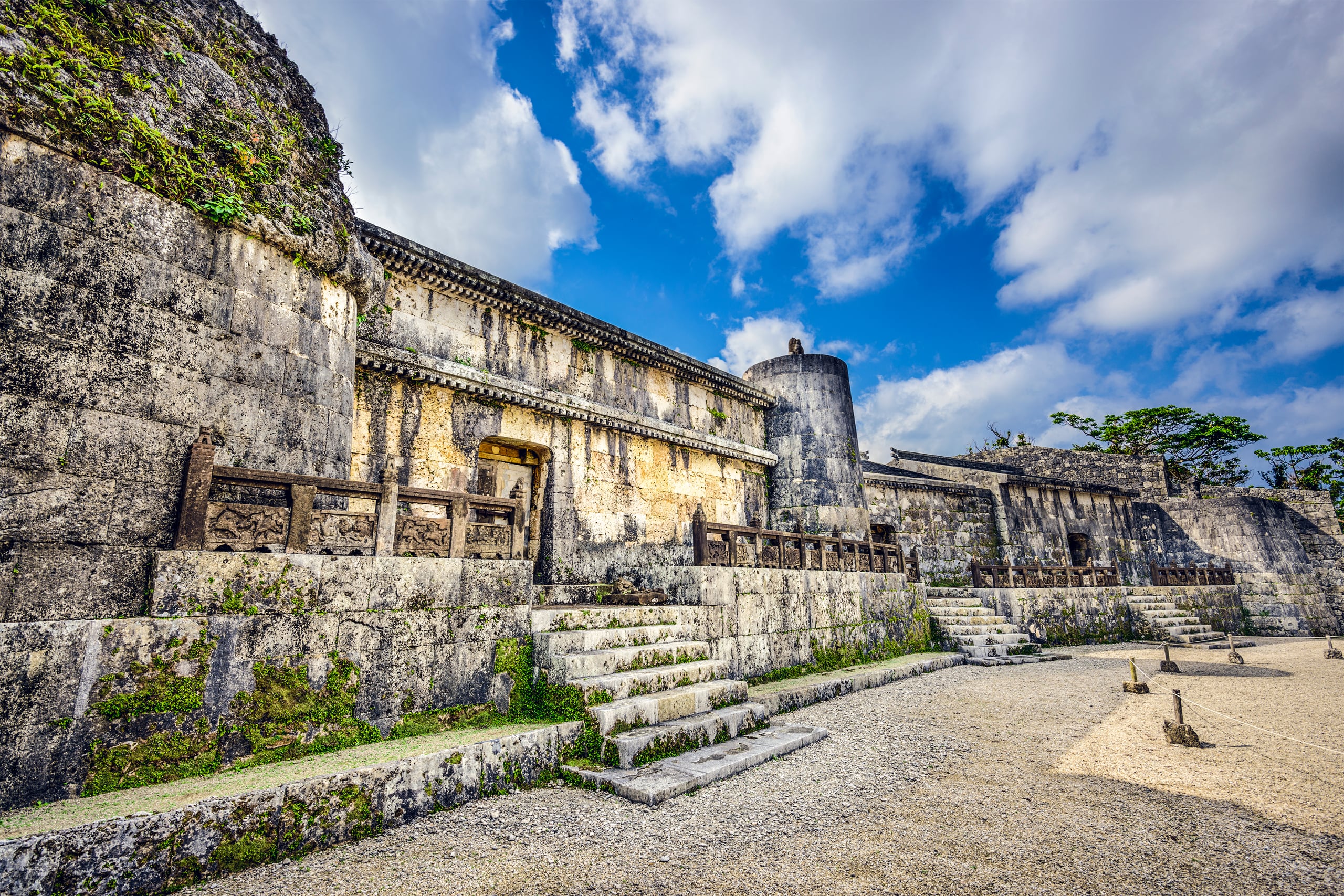
Tamaudun, the royal mausoleum Tamaudun
The mausoleum of the Ryukyu kings, built in 1501 by King Sho Shin: three vaults of cut stone with roofs shaped like houses, guarded by stone lions, behind two quiet walled courts.
The Kinjo-cho stone road
Some three hundred metres of the sixteenth-century royal road from Shuri towards the port, paved in limestone and descending between old walls and red-tiled houses, with a grove of great akagi trees, revered in the neighbourhood, beside it.
Shikinaen
The royal garden villa south of Shuri, built in 1799 around a pond in the Chinese manner, with stone bridges, a hexagonal pavilion and a residence of red tile where the kings received envoys of the Chinese emperor.
Tsuboya
The potters' quarter since 1682, when the kingdom gathered its kilns in one place. Workshops line the stone-paved Tsuboya Yachimun-dori, and the Tsuboya Pottery Museum tells the story of the craft beside an old climbing kiln.
Makishi Public Market
The market off Kokusai-dori, rebuilt and reopened in 2023, with stalls of parrotfish and lobster, Agu pork and sea grapes on the ground floor, and cooks upstairs who will prepare what you have chosen.
Naminoue-gu
The first in rank of the eight shrines of the old kingdom, on a coral cliff above the sea, where sailors once gave thanks for a safe return to the harbour.
Okinawa Prefectural Museum and Art Museum
A building in the new district of Omoromachi shaped like the walls of a gusuku, telling the islands' story through the kingdom to the present, with the prefecture's collection of modern art beside it.
Fukushuen
A Chinese garden of pavilions, a waterfall and a pond in the Kume district, made in 1992 to mark Naha's friendship with Fuzhou, the port through which the kingdom traded with China.

experiences
The best of Naha
Shuri with a historian
A morning on the hill of Shuri with a guide who knows the kingdom, walking down from the castle and Tamaudun by the stone road of Kinjo-cho, past the old red-tiled houses and the akagi grove, with the city and the sea opening below.
Royal cuisine
A dinner of Ryukyu court dishes, rafute pork braised in awamori and soy, delicate soups and sweets once served to Chinese envoys, set out in red lacquer, with the sanshin played softly and a glass of old awamori to close.
Awamori in Shuri
The old royal town was one of the few places permitted to distil awamori in the kingdom's day, and distilleries still work there. A tasting shows the spirit young and fiery, and aged for years in clay pots until it turns mellow.
A bingata workshop
An hour with a bingata dyer in Shuri, watching the stencils cut, the paste laid and the colours brushed in by hand, the same process that once dressed the royal court.
Kumiodori
An evening of kumiodori, the musical drama created in 1719 to entertain Chinese envoys, now recognised by UNESCO, at the National Theatre Okinawa in Urasoe, a short drive north of the city.
plan your visit
Naha on a journey through Japan
- How long to stay
- Two nights in Naha allow a day for Shuri and the royal sites, and a day for Tsuboya, the markets and a museum. From Naha the journey moves north to the west coast or out to the islands.
- Getting there
- By air: Naha Airport is about two and a half hours from Tokyo and a little over two from Osaka. The airport is about fifteen minutes by car from the centre, and the Yui Rail monorail runs from the airport across the city to Shuri.
- Pairs well with
- Naha is the hub of the islands: the west coast of Okinawa Island is an hour north by car, the Kerama Islands under an hour by boat, and Kumejima, Miyakojima and Ishigakijima short flights from the same airport.Okinawa IslandKerama IslandsKumejimaMiyakojimaIshigakijimaTokyo
journeys
Naha on a private journey
We bring guests to Naha on the Custom Tour of Japan, created around your party alone, on your dates, with your own Tour Director.
questions
Naha: questions answered
How many days do you need in Naha?
Two nights is enough for most journeys: a day for Shuri Castle and the royal sites, and a day for the potters of Tsuboya, the markets and the prefectural museum.
Can you visit Shuri Castle?
Yes. The gates, walls and grounds are open, and the main hall, lost to fire in 2019, is being rebuilt to its eighteenth-century design.
How do you get from Naha Airport to the city?
By car in about fifteen minutes, or by the Yui Rail monorail, which runs from the airport through the centre to Shuri in under half an hour.
Is Naha a good base for Okinawa?
Yes, for Shuri, the south and the boats to the Kerama Islands. For beaches and the north, most travellers move on to a resort on the west coast, about an hour away.
Can you visit the Kerama Islands from Naha?
Yes. High-speed boats from Tomari Port reach Tokashiki in about thirty-five minutes and Zamami in about fifty, so the islands make an easy day from the city.
What is yachimun?
Yachimun is the Okinawan word for pottery: heavy, generously glazed stoneware, often painted with fish or arabesques, made in Naha's Tsuboya quarter since 1682 and at the potters' village of Yomitan.
Can Naha be part of a private tour of Japan?
Yes. The Custom Tour of Japan is created around your party alone, on your dates, with your own Tour Director, and it can go anywhere in the country, Naha included. If you would rather travel independently, the Expert Japan Itinerary plans every day for you.
okinawa
More in Okinawa
Naha, planned for you.
Tell us when you would like to travel and what draws you to Naha, and we will answer with a Custom Tour of Japan created around your party alone, or, if you would rather travel independently, an Expert Japan Itinerary that plans every day for you.