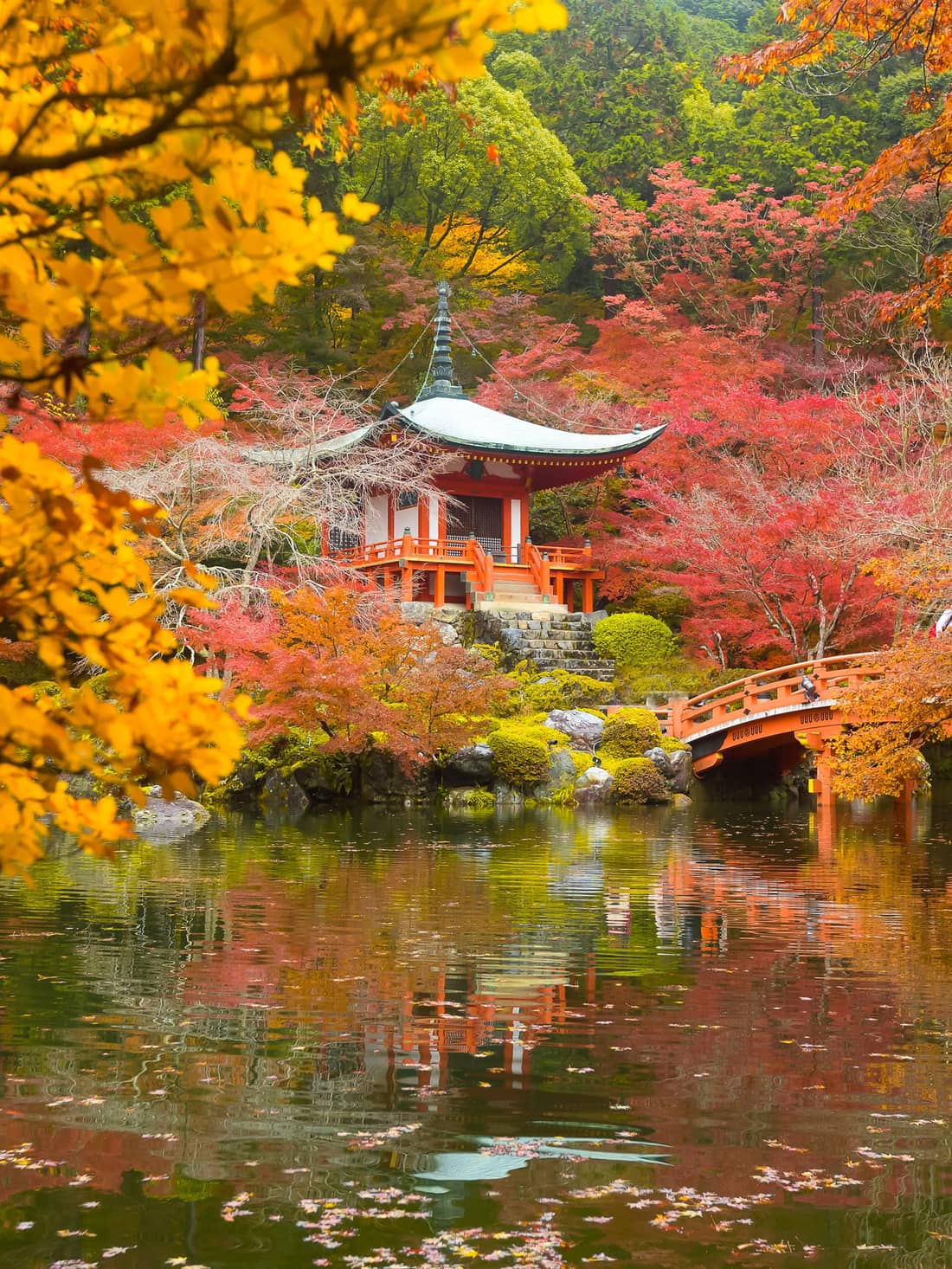

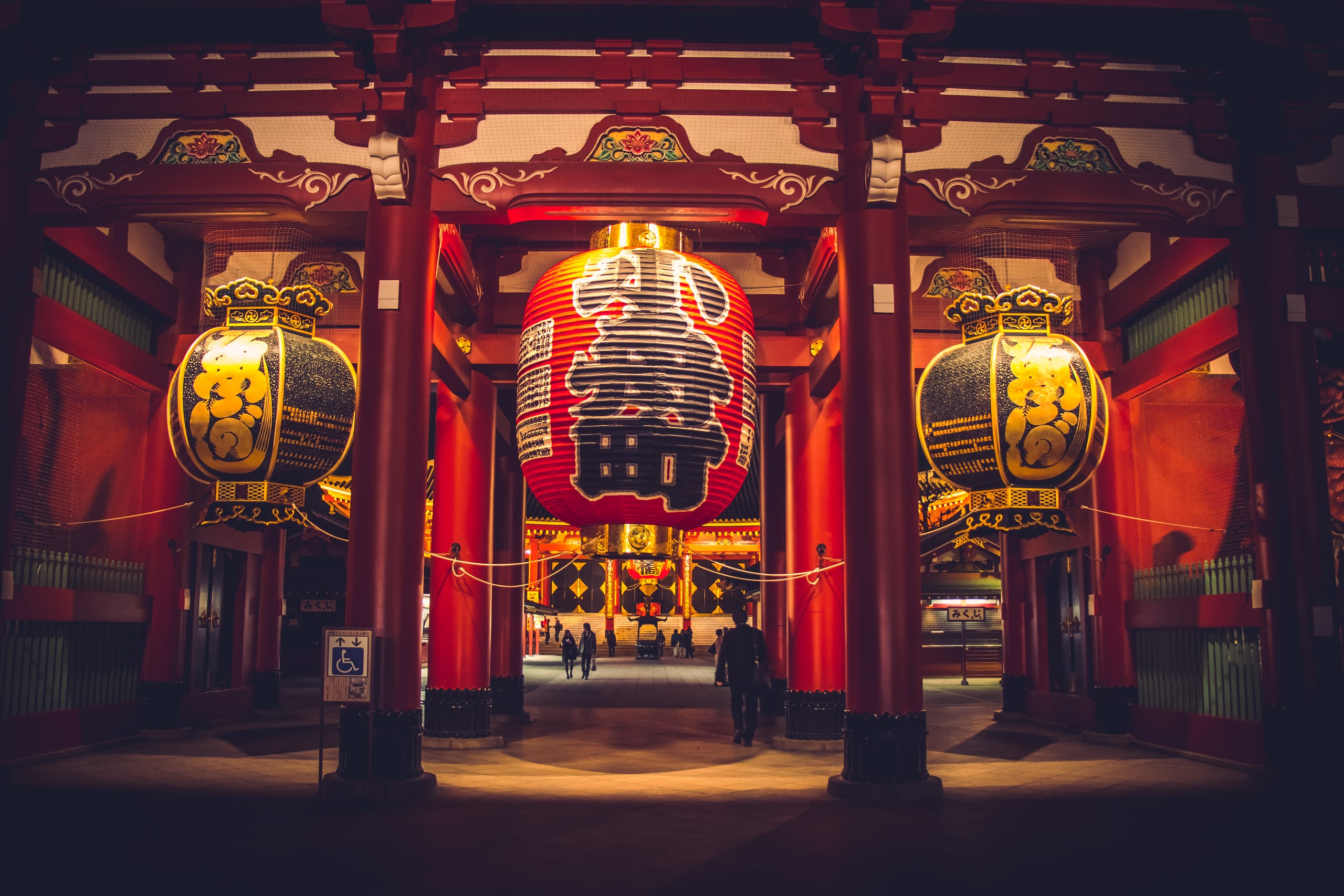
The road climbs through cedar and cloud before the town appears. Some eight hundred metres above the plains, roofs gather in a mountain hollow, temple gates stand in the cool air, and fallen maple leaves collect along stone edges that the monks sweep clean between one hour of chanting and the next. In autumn the mountain is quieter still.
Koyasan, or Mount Koya, is the centre of Shingon Buddhism in Japan, founded by Kūkai, also known as Kōbō Daishi, in 816. Its autumn stands apart from Kyoto's late, urban blaze. The mountain sits higher, so the season turns earlier and with a colder edge, and by late November the leaves are coming down: underfoot on the stone, cedar dark overhead, breath visible in the morning air, and a sacred town making ready for winter.
the colour
When the colour comes to Koyasan
The plateau stands some eight hundred metres higher than Kyoto, and its maples turn ahead of the city, from late October into the first weeks of November, two or three weeks before Tōfukuji and Eikan-dō have begun. The Danjo Garan and the garden of Kongōbuji carry the brightest of it, and the approach to Okunoin the most sparing. By late November the trees are thinning and the colour lies on the stone more than on the branch. The first fortnight of November is for the colour; the last weeks of the month are for the mountain itself, cold, clear and still.
the mountain town
The mountain temple town
The approach is part of the experience. A cable car climbs the last and steepest stretch from Gokurakubashi, rising through cedar so dense that the valley floor disappears within a few minutes. The forest along the line is cedar and cypress, green in every season, so the mountain's own colour arrives as a surprise once the plateau opens out and the temple roofs appear among the last of the turning trees.
At the top is a whole town: one hundred and seventeen temples set across a high plateau within a ring of forested peaks, with monastic lodgings, gates, halls, cemeteries, workshops, small shops and temple kitchens along its lanes. More than fifty of the temples take guests for the night. The air is thinner up here, the nights colder, the mist quick to arrive.
Kūkai chose the mountain because its basin, ringed by eight peaks, could stand for a mandala laid out in the landscape, and the town that grew there still has that sense of enclosure. The Danjo Garan is its ceremonial centre. Its Konpon Daitō pagoda, painted a deep vermilion, stands out sharply in the autumn air, its colour answering the leaves around it and outlasting them. Around it, halls, gates, stone paths and old trees show the season through contrast: bright maple against dark cedar, vermilion against a grey sky, fallen leaves on gravel.
At the western edge of the plateau stands the Daimon, the great gate, some twenty-five metres high, facing out over the ranges of the Kii peninsula towards the sea. It was the traditional entrance for pilgrims who walked up.
Kongōbuji, the head temple of Koyasan Shingon Buddhism, has formal rooms, painted screens and long corridors, and Banryūtei, the largest rock garden in Japan. In autumn the cold outside gives the interiors a sharper clarity: paper screens look brighter, corridors more austere. Out in the town, kitchens prepare shōjin ryōri, small buses run along the main road, pilgrims pass in white, and priests walk quickly in the cold.
the temple night
A temple stay at Koyasan in autumn
A night in a shukubō, a temple lodging, is the heart of an autumn visit to Koyasan, and the only way to see the mountain once the day visitors have gone down. Shoes come off at the step. The corridors are cool, and the rooms are plain in the best sense: tatami, sliding screens, futon, a garden or courtyard beyond the paper, and the knowledge that the mountain night will be dark.
Dinner is shōjin ryōri, the vegetarian cooking of Buddhist temples, made without meat or fish: goma dōfu, a sesame tofu with a dense, yielding texture, mountain vegetables, miso, pickles, rice and simmered dishes. Autumn suits it, because the season's own ingredients are earth, root, mushroom and nut.
Cold settles quickly once the sun has left the plateau, and the evening in the lodging is warm and quiet. The morning service is the centre of the stay. In a hall heavy with incense the monks' voices rise in chant, and the religious life of the mountain is suddenly present. Outside afterwards, the same maples, cedars and stone lanes no longer look like scenery.
the practice
The temple day: fire, breath and the brush
Several temples perform the goma fire ritual each morning, and it is the most physical thing on the mountain. A priest feeds wooden prayer sticks into a fire on the altar one by one, the flames rising almost to the beams, the drum and the chanting quickening with them, while the hall fills with smoke and the smell of cedar oil.
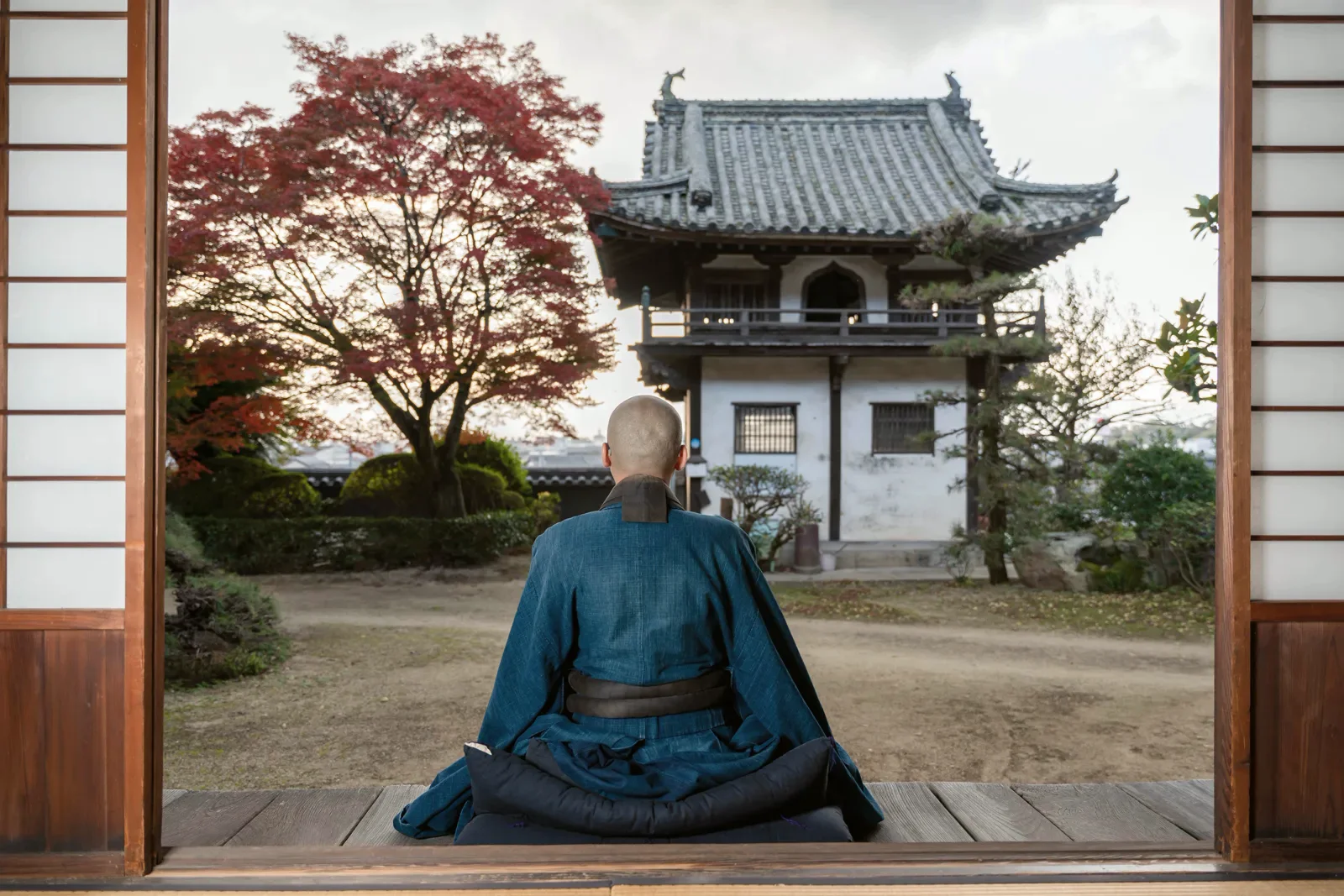
The quieter practices are open to guests too. Ajikan is the meditation of Shingon, the eyes resting on a painted moon disc and the Sanskrit letter A, the breath slowed to the sound of it. Shakyo is the copying of a sutra by hand, with a brush, an ink stone and a sheet printed faintly with the characters to trace, an hour given wholly to the next stroke. A temple lodging arranges either in a room overlooking its garden, and in late autumn the paper screens are bright with the cold light of the plateau.
the cedar path
Okunoin and the path through cedar
Okunoin is Koyasan's deepest autumn experience. The path to Kūkai's mausoleum runs for some two kilometres from the Ichinohashi bridge through one of the great sacred landscapes of Japan, past more than two hundred thousand memorials beneath towering cedars: stone lanterns, moss-covered graves, small Jizō figures in red bibs. Autumn here is a matter of a few red leaves on moss, a yellow branch above a stone figure, mist between the trunks, the dry sound of leaves underfoot and the smell of incense near the inner precinct.
At first the visitor notices individual monuments, the carved names, the lanterns, the height of the cedars. Then the repetition takes over, stone after stone and trunk after trunk, and ordinary time falls away.
The memorials take in far more than religious history. Feudal lords of the Edo period lie here, and a few paces from a moss-blackened daimyo's grave stand memorials raised by modern companies, one carved as a rocket, another as a coffee cup. The same yellow leaf settles on a seventeenth-century stone and on one cut last year.
Beyond the Gobyōbashi bridge the atmosphere tightens: photography stops, voices drop, and the path leads to the mausoleum of Kūkai, who is believed within the tradition not to have died but to remain in eternal meditation. Before it stands the Tōrōdō, the hall of lanterns, where thousands of lamps hang from the ceiling in rows and two of them are said to have burned without going out since the eleventh century. Twice each day monks carry a meal across the last bridge to Kūkai, in a wooden box on a pole, as they have for nearly twelve hundred years.
At night Okunoin grows more severe. Lanterns burn in the dark, the cedars become columns, and the autumn leaves, almost invisible now, are still underfoot, damp on the stone, caught in the moss, gathered at the bases of the statues. The only sounds are a bell, a crow, gravel and the wind in the cedars.
the way up
Getting to Koyasan, and the pilgrim's path
From Namba in Osaka the Nankai limited express climbs to Gokurakubashi in about an hour and a half, the last of it switchbacking through cedar along a river valley, and the cable car carries passengers the final steep stretch to the plateau. From Kyoto the mountain is about two and a half hours by car, which is how a private journey arrives, at the temple gate.
The old way is on foot. The Choishi-michi climbs some twenty-four kilometres from Jison-in in the valley town of Kudoyama to the Daimon, marked every hundred and nine metres by one of one hundred and eighty tall stone posts carved with Sanskrit letters, set up in the thirteenth century to replace the wooden markers of Kūkai's time. In 2004 the trail and the mountain were inscribed together in the UNESCO World Heritage listing of the Sacred Sites and Pilgrimage Routes in the Kii Mountain Range, with the Kumano Kodo to the south. In autumn the last stretch below the Daimon walks through falling maple into the town.
the journey
Koyasan and Kyoto in autumn, on a private journey
The Custom Tour of Japan gives the mountain its night. Designed for one party on its own dates, from five nights, it brings the guests up from Kyoto by private car to the temple gate, settles them into a shukubō for the evening and its shōjin ryōri, the vegetarian cooking of the temple kitchens. After dinner their Tour Director walks the lantern-lit cedar path to Okunoin with them, and Kyoto's temple gardens in their maples can open or close the same journey.
questions
Questions
When do the autumn leaves turn at Koyasan?
From late October into the first weeks of November, two or three weeks ahead of Kyoto, because the plateau stands some eight hundred metres higher. By late November the leaves are on the ground and the mountain turns towards winter.
Is it worth staying overnight at Koyasan?
Yes. The mountain is at its most itself after the day visitors have gone: a shōjin ryōri dinner, Okunoin by lantern light, and the morning service in the temple hall. One night is the right length; two allow the Choishi-michi or a slower day among the halls.
What is a shukubo?
A temple lodging. More than fifty of Koyasan's one hundred and seventeen temples take guests, with tatami rooms, a vegetarian shōjin ryōri dinner and breakfast, and the morning service in the hall.
How is Koyasan reached from Osaka or Kyoto?
From Namba in Osaka, the Nankai limited express to Gokurakubashi takes about an hour and a half, then the cable car climbs to the plateau. From Kyoto it is about two and a half hours by car.
How cold is Koyasan in autumn?
Markedly colder than Kyoto or Osaka. By late November the mornings on the plateau are near freezing, and a warm coat, gloves and shoes that slip on and off easily suit the temple day.
What is Okunoin?
The inner sanctuary of Koyasan and the mausoleum of Kūkai, reached by a path of some two kilometres through ancient cedars and more than two hundred thousand memorials, ending at the Tōrōdō, the hall of lanterns.