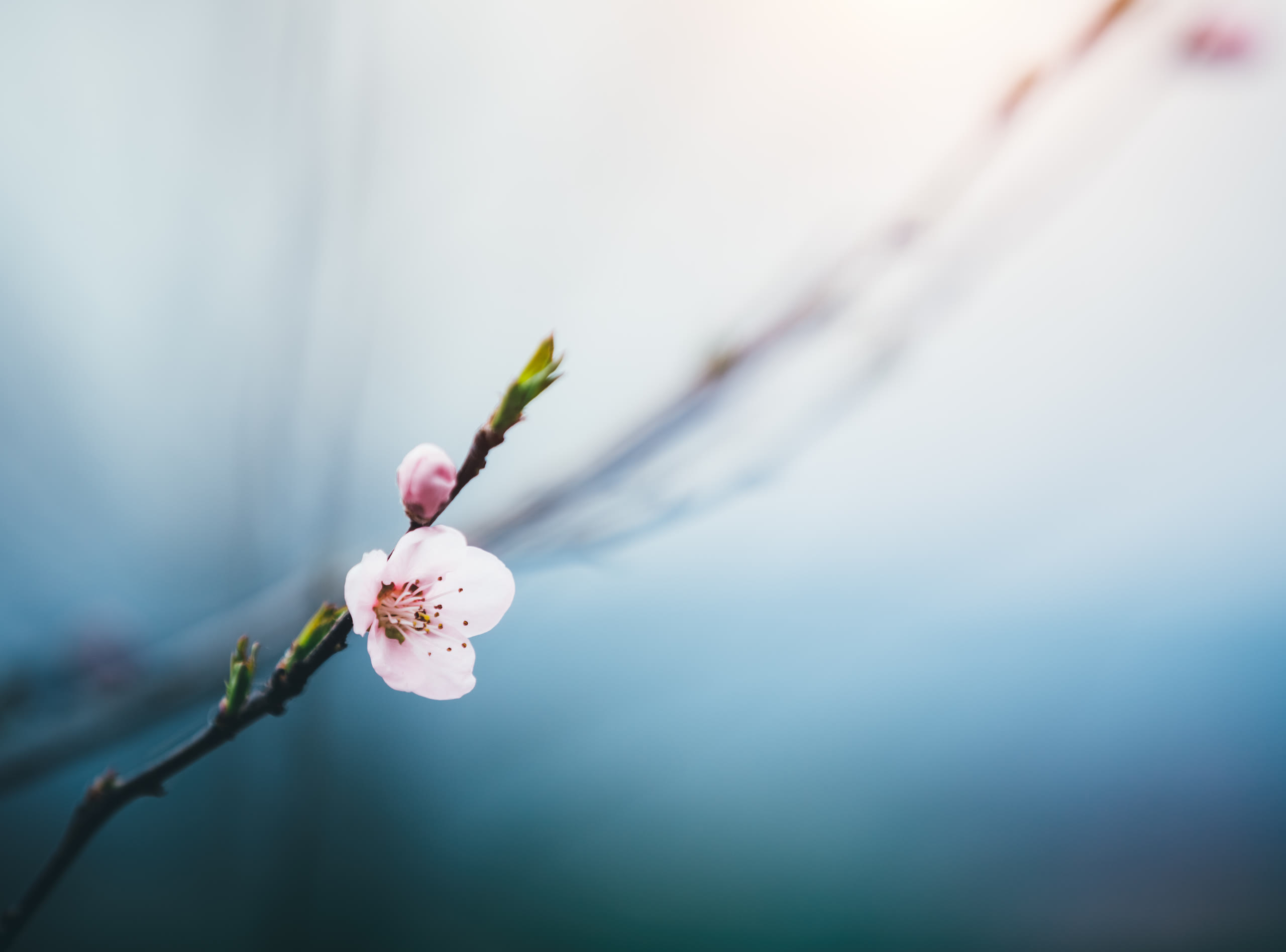

In Sapporo's Maruyama Park, cherry blossom and plum blossom open in the same week, on the same paths. Elsewhere in Japan the two flowers keep their distance: plum comes in February, cold and solitary, and cherry follows six or seven weeks later, at the end of March. In Hokkaidō the sequence collapses. Both arrive together around the turn of May, while the grass beneath the trees is still the pale colour of a winter that has only recently let go, and the petals that fell in Kyoto and Tokyo a month before are now filling the air above Sapporo's parks and the port streets of Hakodate.
This is Hokkaidō's second spring, with its own cherry, its own light and its own reasons for arriving so late. A traveller who has stood beneath the trees of Kyoto has seen half of what the Japanese season can do.
why the north waits
Why Hokkaidō's cherry blossom arrives so late
Every cherry tree in Japan works on the same principle. Winter cold sets the bud into dormancy, and a running total of spring warmth releases it, city by city, as the front moves north through the archipelago. In Tokyo and Kyoto that threshold is usually crossed in the last week of March. Sapporo's long-term average for first bloom, kept by the Japan Meteorological Agency, is the first of May, with full bloom five days later; Hakodate, on the island's southern coast, opens a few days ahead of it.
Distance accounts for only part of the gap. Winter runs long in Hokkaidō, spring comes late, and even midsummer stays mild by the standards of Kyoto's basin. Snow still lies on the higher ground when the first flowers open in the parks below, and the warmth that Kyūshū and central Honshū gather by March takes the island another month to collect. The front that has been moving north since January finally runs out of land.
Two kinds of cherry share this late spring. Somei Yoshino, the cloned variety that lines the moats of Tokyo and the canals of Kyoto, grows in the milder pockets: the parks of Sapporo, and the star-shaped moat of Goryōkaku in Hakodate. Beside it stands a tree made for colder ground. Ezo-yamazakura, botanically Prunus sargentii, is a wild mountain cherry with larger, deeper pink flowers than the Somei Yoshino, and bronze young leaves that open at the same moment as the petals. It grows taller and hardier, at home on forest edges and open parkland, and it gives Hokkaidō's bloom a heavier colour than the pale cloud that settles over Kyoto in early April. Botanists also call it Ōyama-zakura, the great mountain cherry, and south of Hokkaidō it grows wild only in the mountains, where the cold suits it.
the compressed season
Plum and cherry in flower together in Sapporo
Further south, spring unfolds over two months: plum first, then the earliest cherries, then the Somei Yoshino, then the late double-flowered kinds, each stage a small season with its own name. Hokkaidō has no room for that sequence. Flowers spaced a month apart in Kyoto open within days of each other here.
At Hokkaidō Shrine, in the woods of Maruyama Park, some fourteen hundred cherry trees and two hundred and fifty plum trees grow through the same grounds and reach bloom together. The plum's small, round flower and the cherry's looser one fall on the same gravel, and the shrine's long approach between the second torii and the main hall runs beneath both.

The land still shows winter while this happens. Distant slopes keep their snow into May, and a bare tree stands beside a blooming one. The grass in Sapporo's parks is pale gold at the edges before the deep green of early summer comes in, and once the season starts it moves fast: bud, blossom and leaf within days.
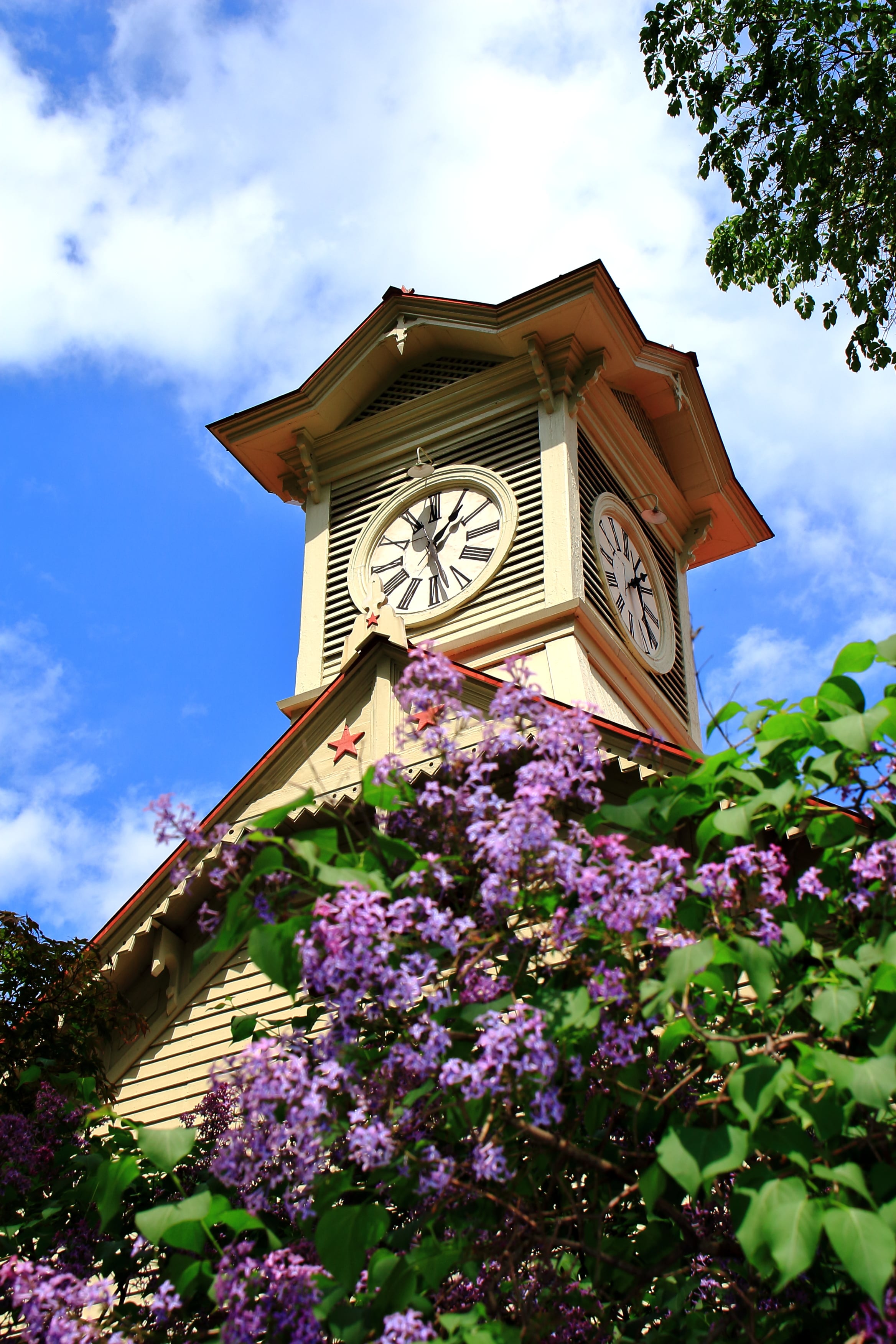
A cherry tree in Kyoto is read against a stone wall, a canal, a temple gate. In Sapporo it stands against open lawn, a line of poplars, a wide grid of streets, or the red brick of the former Hokkaidō Government Office, and the flower has far more sky around it. Wind passes freely through the branches, and birdsong carries across the open parkland.
That grid was a decision. Sapporo was founded in 1869 as the capital of the new Hokkaidō, laid out on the flat Ishikari Plain by the Kaitakushi, the Meiji government's colonisation office, which brought in American advisers led by Horace Capron. Ōdōri, the broad green strip that runs east to west through the centre, was cut as a firebreak between the government quarter and the town. The city is barely a hundred and fifty years old, and its blossom fills open avenues and parks laid out for it.
Hokkaidō opens a colder, wider spring of its own, with the last of winter still visible at the edges.
after honshū moves on
Seeing cherry blossom in Hokkaidō after Honshū
By the time the blossom reaches the north, the bloom forecasts and the crowds beneath the famous trees of Honshū belong to a season that finished weeks before. The change in Sapporo registers in small, physical ways. Benches unused since autumn come back into service. Bicycles reappear on streets that a month earlier were banked with cleared snow, and people stay out of doors after work for the first time since October. All of it happens within a fortnight.
The light is different too. Northern air carries less humidity than the air over Kyoto in early April, and the colour shows it: the pink stands sharper against a clean blue sky, against dark conifers, against the last snow on a distant slope. Along the coast, at Matsumae and around Goryōkaku, the same bloom meets castle walls, sea wind and the Tsugaru Strait.
More of the Japan Edition on Hokkaido →
Japan cherry blossom tours for 2027, Honshu and Hokkaido side by side →
The Classic Cherry Blossom Tour of Japan, from Tokyo to Osaka →
the journey
A Hokkaidō cherry blossom tour
The Cherry Blossom Tour of Hokkaido, from 28 April to 10 May 2027, crosses the island in the direction its spring travels, from the far south to Sapporo. It opens at Matsumae, a castle park of some ten thousand cherry trees in two hundred and fifty varieties, with a hanami picnic laid on rugs beneath the castle wall and the Tsugaru Strait behind. On the sixth day it reaches Noboribetsu Onsen along an avenue of Ezo-yamazakura eight kilometres long, driven slowly from end to end, and in Sapporo a last hanami picnic is laid in Moerenuma Park, the landscape Isamu Noguchi designed for the city.
Between them come Japan's clearest lake, seen from an open-air onsen of the guests' own at Lake Shikotsu, and the culture of the Ainu, followed from the national museum at Upopoy to an indigo-dyeing workshop by the water. The tour is limited to 8 guests, and its Tour Directors travel every mile of it beside them.