







chugokuyamaguchi
Hagi
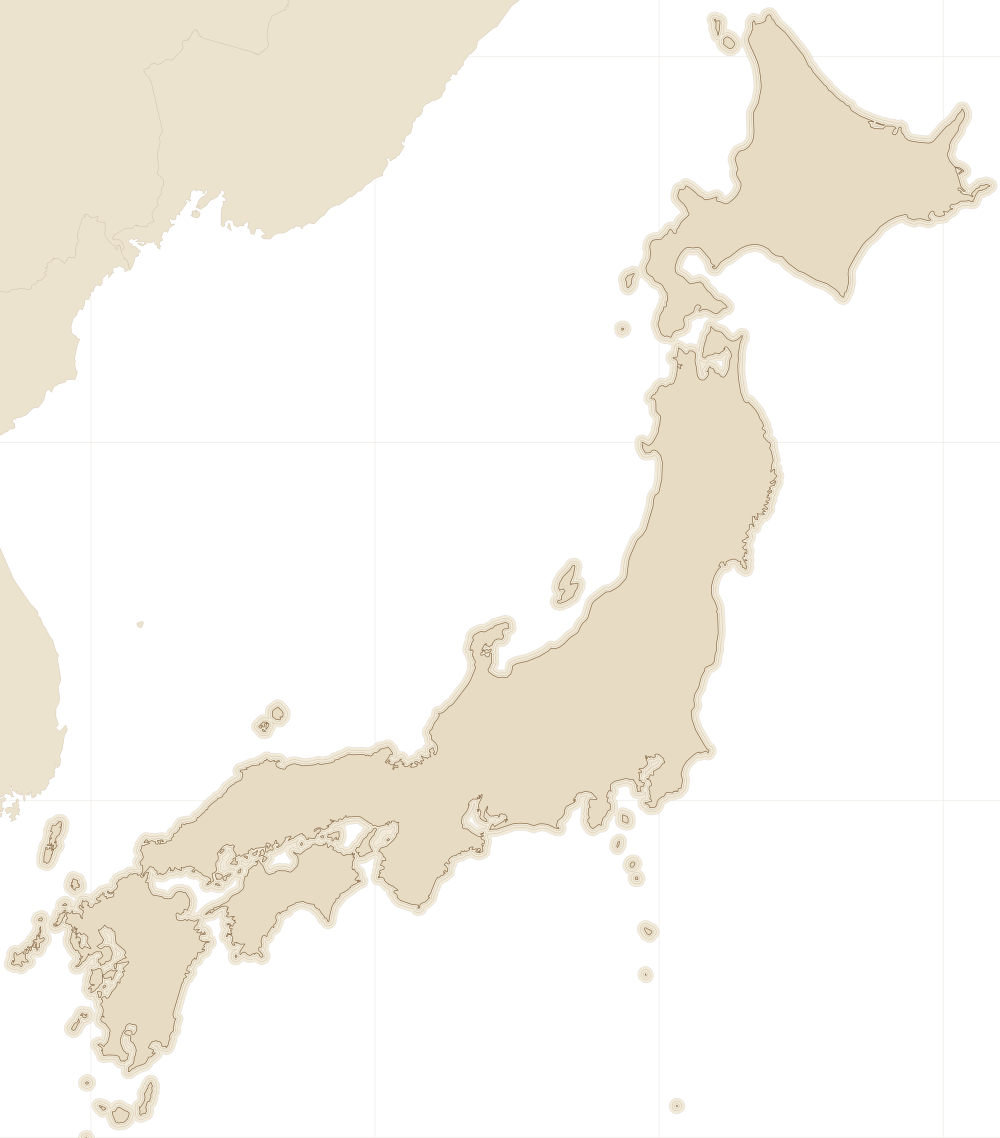
Hagi is an old castle town on the Sea of Japan coast of Yamaguchi Prefecture, in the Chugoku region, about an hour from the Shinkansen at Shin-Yamaguchi, known for its samurai streets, its pottery and its part in the Meiji Restoration.
- Prefecture
- Yamaguchi
- Region
- Chugoku
- Journeys
- The Custom Tour of Japan
overview
A castle town between two rivers and the sea, where the tea bowls change colour with the years.
Hagi became a castle town in 1604, when the Mori clan, having lost much of their lands after the battle of Sekigahara, were sent to this far corner of Honshu and built their castle on the delta between the Hashimoto and Matsumoto rivers. For two and a half centuries it was the seat of the Choshu domain, and its grid of samurai houses, earthen walls and merchant streets survives so well that old maps of the Edo period can still be used to find your way.
In the 1850s a young teacher, Yoshida Shoin, taught at a small private school here, the Shoka Sonjuku. Among his pupils were men who went on to overthrow the shogunate and build modern Japan, Ito Hirobumi, the first prime minister, among them. Five places in Hagi, the school, the castle town, an iron works, a reverberatory furnace and a shipyard, are part of the World Heritage Site of the Sites of Japan's Meiji Industrial Revolution, inscribed in 2015.
Hagi is also one of the great names in Japanese pottery. Potters from Korea, brought to Japan after Hideyoshi's invasions at the end of the sixteenth century, founded the kilns that make Hagi ware, soft and pale in glaze, beloved of tea masters. The tea world's old saying ranks it second only to Raku. A Hagi tea bowl is said to have seven transformations, as tea seeps through its fine crackle and slowly changes its colour over years of use.
see and do
What to see in Hagi
The Horiuchi samurai district
The streets of the higher samurai families inside the old outer moat, lined with earthen walls, gateways and summer orange trees planted in the gardens when the samurai lost their stipends after 1868.
Hagi Castle ruins and Shizuki Park
The castle of the Mori lords, dismantled in 1874, survives as stone walls and a moat at the foot of Mount Shizuki, beside the sea, with a teahouse and the Mori family's old shrine in its park.
The Kikuya House
The house of a merchant family who served the Mori lords, its oldest parts from the seventeenth century, with storehouses, a garden and the household goods of a wealthy merchant.
Shoka Sonjuku
The small wooden school where Yoshida Shoin taught, a room of eight mats and an extension of ten and a half, where many of the leaders of the Meiji Restoration studied. It stands in the grounds of Shoin Shrine.
The Hagi reverberatory furnace
A brick chimney of about eleven metres, built in 1856 as an experimental furnace for casting iron cannon, one of only two such survivals in Japan.
Tokoji
A Zen temple of the Obaku school, family temple of the Mori lords, where some five hundred stone lanterns stand in rows before the tombs of five generations of the clan.
Daishoin
The other family temple of the Mori, keeping the tombs of the first lords and their retainers, with more than six hundred stone lanterns in its grounds.
The Hagi Uragami Museum
A museum designed by Kurokawa Kisho with a collection of ukiyo-e prints, among them Hokusai and Hiroshige, and Asian ceramics, with exhibitions of Hagi ware.
The Hagi ware kilns
Kilns in the Matsumoto and Fukawa districts that have been worked by the same families since the seventeenth century, with galleries where you can see and buy the pottery.
experiences
The best of Hagi
A potter's studio
An hour in the workshop of a Hagi potter, whose family has worked the same kiln for generations, followed by tea served in Hagi bowls old and new, to see how they change.
The castle town on foot
A walk through the old streets of Hagi with a guide, from the samurai district to the merchant houses, the summer oranges hanging over the earthen walls.
The school of the Restoration
A visit to the Shoka Sonjuku with someone who can tell the story of the teacher and the pupils who built modern Japan.
An onsen beside the sea
A night at an onsen ryokan in Hagi or at Nagato Yumoto, an onsen town in a river valley forty minutes away, with a kaiseki dinner of fish from the Sea of Japan.
plan your visit
Hagi on a journey through Japan
- How long to stay
- Two nights are right for Hagi, with a day for the castle town and its kilns and a second for the coast or the karst of Akiyoshidai.
- Getting there
- From Shin-Yamaguchi on the San'yo Shinkansen by car or bus in about an hour; Shin-Yamaguchi is about thirty-five minutes from Hiroshima and about four and a half hours from Tokyo. Hagi-Iwami Airport, with flights from Tokyo Haneda of about an hour and a half, is about an hour away.
journeys
Hagi on a private journey
We bring guests to Hagi on the Custom Tour of Japan, created around your party alone, on your dates, with your own Tour Director.
questions
Hagi: questions answered
Is Hagi worth visiting?
Yes. It is one of the best preserved castle towns in Japan, the home of Hagi ware pottery and a key place in the history of the Meiji Restoration, with five World Heritage sites.
How do you get to Hagi?
By Shinkansen to Shin-Yamaguchi, then about an hour by car or bus. From Hiroshima the whole journey takes about an hour and a half.
What is Hagi ware?
A pottery of soft clay and pale glazes, made in Hagi since the seventeenth century and prized for the tea ceremony. Its fine crackle absorbs tea and changes colour over years of use.
How many days do you need in Hagi?
One full day for the castle town, the kilns and the Shoka Sonjuku, and two to include the coast and the onsen of Nagato.
Why is Hagi a World Heritage site?
Five places in Hagi are part of the Sites of Japan's Meiji Industrial Revolution, inscribed in 2015: the castle town, the Shoka Sonjuku, the reverberatory furnace, the Ohitayama iron works and the Ebisugahana shipyard.
Can Hagi be part of a private tour of Japan?
Yes. The Custom Tour of Japan is created around your party alone, on your dates, with your own Tour Director, and it can go anywhere in the country, Hagi included. If you would rather travel independently, the Expert Japan Itinerary plans every day for you.
chugoku
More in Chugoku
Hagi, planned for you.
Tell us when you would like to travel and what draws you to Hagi, and we will answer with a Custom Tour of Japan created around your party alone, or, if you would rather travel independently, an Expert Japan Itinerary that plans every day for you.