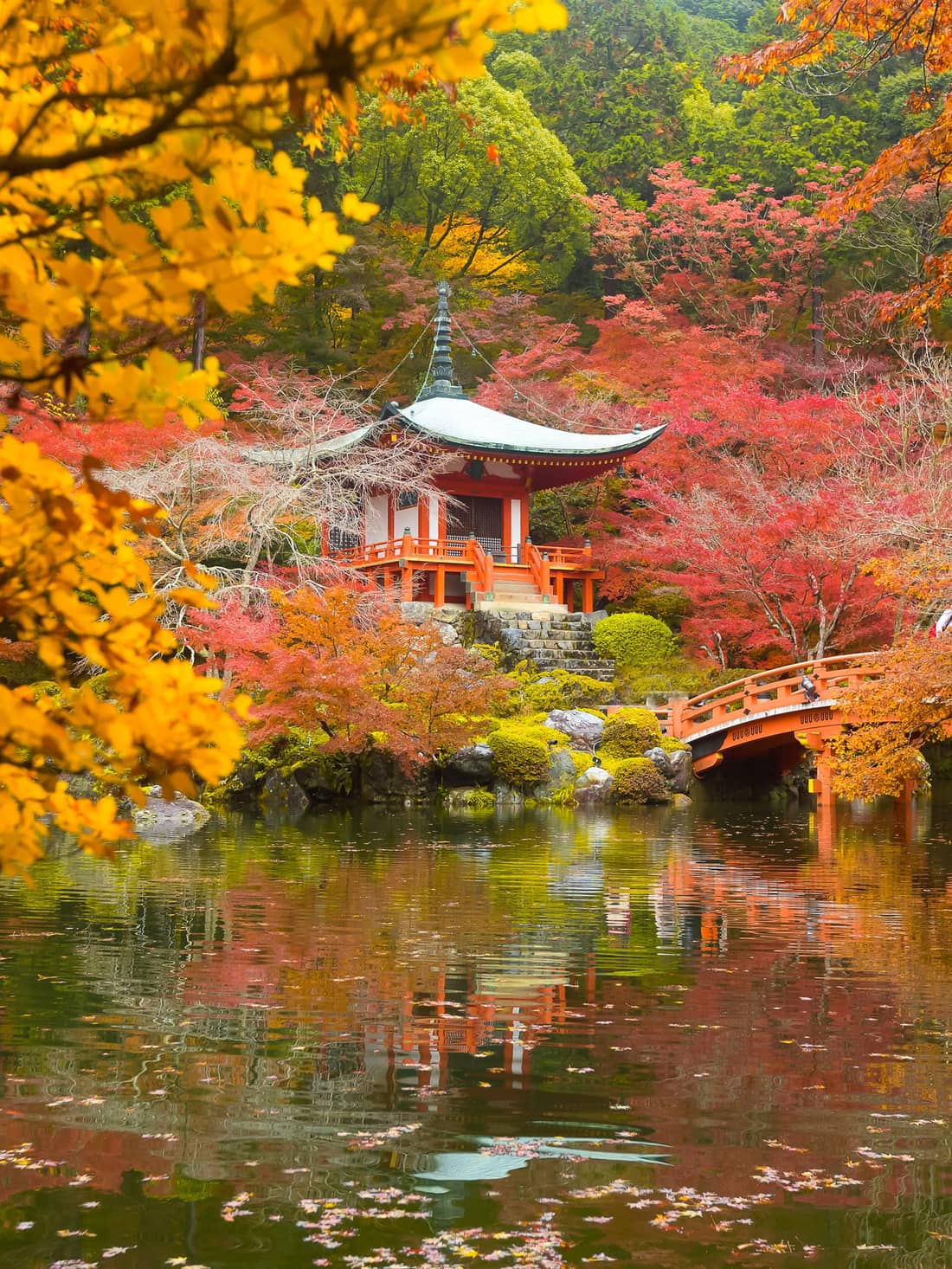

At a castle moat in western Honshū, the morning comes in layers: gold ginkgo by the stone wall, red maple near the bridge, dark pine as green as it is in every season, and the water carrying the whole composition upside down. A gardener sweeps the path with a bamboo broom and leaves the fallen leaves along its edges.
Each region of Japan shows its autumn differently. The mountain forests turn in broad sweeps, the castle towns give the colour a frame of stone and water, the old capitals set leaves against moss and tile, and the coast softens the season with sea light. The colour runs deepest where it suits the character of the place: in the Japan Alps and at Nikkō, in the post towns of the Kiso Valley, in Kanazawa and the castle towns of the west, and in Kyoto and Nara.
the high country
Mountain Japan
The mountains turn first, and on the largest scale. In mixed forest at altitude the colour climbs in tiers, from the ground plants through the shrubs and broadleaf trees to the dark green of the conifers above, and in the northern ranges it covers whole slopes, ridgelines and river valleys at once.
In the Japan Alps the colour is vertical. Around Kamikōchi, Hakuba, Tateyama, Norikura and the uplands of Nagano and Toyama, the larch turns gold in the high air, birch and beech bring yellow and copper, and the maples go red in the sheltered hollows and along the streams. Snow can lie on a far summit while the valley below is warm in the afternoon sun, so that a single mountain valley shows in one day a sequence the lowlands take weeks to complete. Tateyama turns earliest: at Murodō, 2,450 metres up on the Tateyama Kurobe Alpine Route, the colour comes in late September, among the first on Honshū.
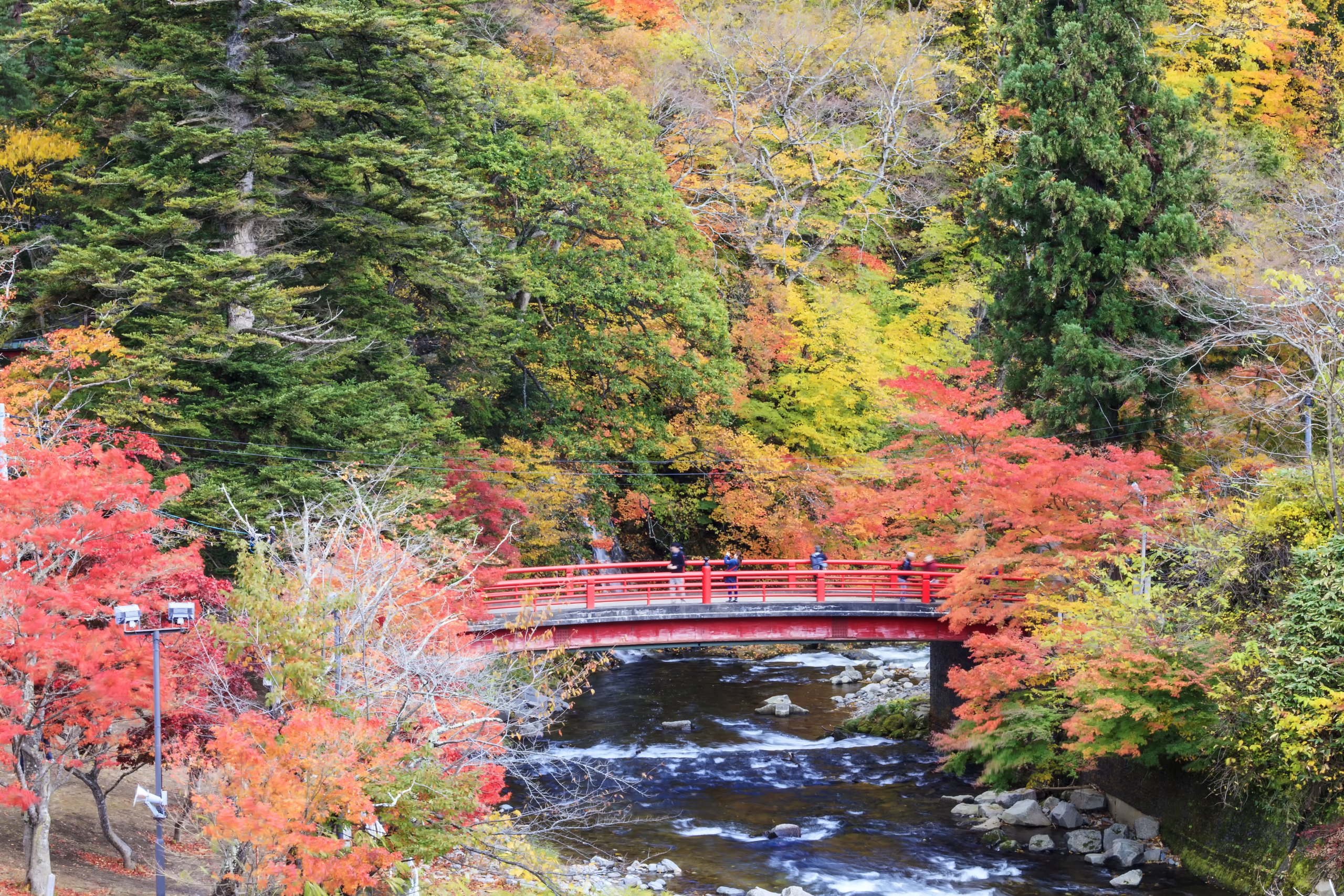
Nikkō sets the mountain autumn beside its shrines. The cedar avenue that leads to the town, the vermilion Shinkyō bridge and the gilded halls of Tōshō-gū sit below a plateau where Lake Chūzenji and the ninety-seven-metre fall of Kegon carry the season higher, the water dark with cold and the slopes around it copper and rust by late October.
The Kiso Valley and the old Nakasendō post towns bring the mountains down to a human scale: a red branch over a roof, yellow leaves in a stone gutter, mist between the slopes. Tsumago and Magome, the best kept of the post towns, keep their timber facades against a valley turning gold, and the old road between them runs about eight kilometres through the forest.
stone and water
Castle towns, gardens, and western Honshū
Castle towns give autumn a frame. Stone walls, moats, bridges, white plaster and clipped pines turn the colour into a composition, and a maple beside a moat, doubled in still water against dressed stone, looks placed in a way a maple on a hillside never does.
Kanazawa, on the Sea of Japan coast, has the polish of a garden city: black tiles, the old teahouse district of Higashi Chaya, water channels running beside the samurai streets of Nagamachi, and the gold leaf for which the city is known, beaten in Kanazawa for almost all of Japan. Kenroku-en, counted among the three great gardens of Japan, colours in the second half of November, and the damp of the coast makes its red leaves heavier and turns its ginkgo, against dark timber, the colour of lacquer.
In Okayama the broad lawns of Kōraku-en make the colour legible at a distance, with the black keep of Okayama Castle borrowed into the view. At Matsue, one of the twelve castles in Japan whose original keep still stands, the moat doubles its maples. At Himeji the white keep rises above Kōko-en, a garden of nine walled sections laid out beside the castle in 1992, whose maples colour in the second half of November. Matsumoto's black keep stands against the Northern Alps, which often carry their first snow while the castle grounds are still turning.
The Inland Sea softens the season. Around Onomichi, Kurashiki, Takamatsu, Matsuyama and the islands between Honshū and Shikoku, the light comes off the water onto stone steps, old warehouses, small harbours and hillsides of citrus. Kurashiki's merchant quarter has willows along its canal and barely a maple in sight, and its autumn is the low light on white plaster and black tile. On the islands the mikan ripen orange on the terraces above the sea.
the old capitals
The old capitals and the cultural centre
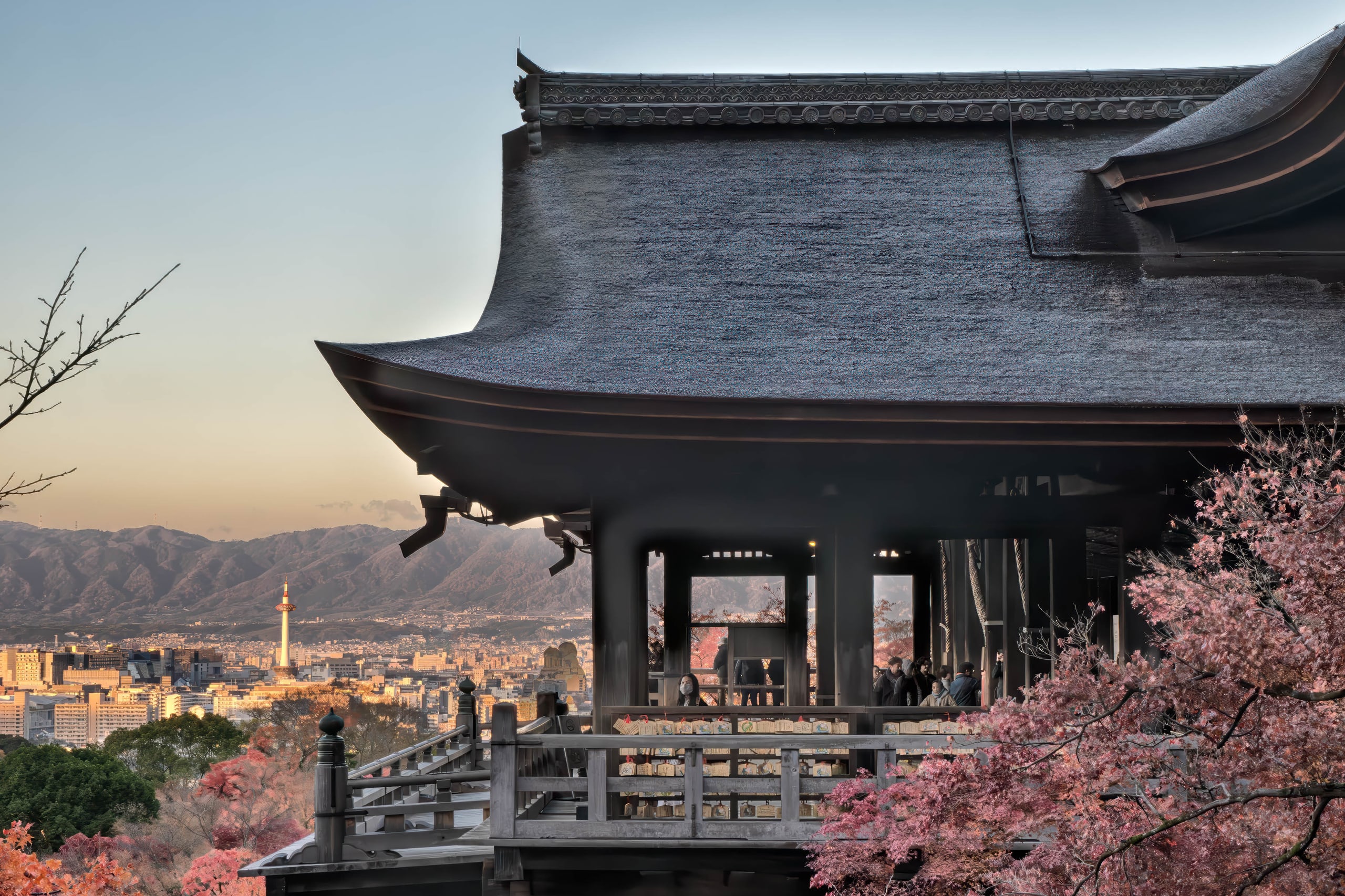
Kansai gives the autumn its most refined cities. Kyoto, enclosed by the mountains of its basin, sets its maples and ginkgo against tile, moss, gravel, water and dark timber, in temple gardens composed over centuries to be seen in this season.
Nara's autumn is broader and older: parkland, wooded slopes and shrine approaches, with deer moving through the grass under gold and red leaves. The approach to Kasuga Taisha is lined with some three thousand stone and bronze lanterns, mossed dark green, and its colour comes from single maples instead of a solid canopy.
Osaka's colour is urban, read through the castle grounds and along the rivers. Kobe sets its autumn between the Rokkō slopes and the harbour, and above the city the onsen town of Arima, one of the oldest in Japan, has its own small valley of maples at Zuihō-ji Park.
the long approach
Central valleys, Fuji, and the mild south
Yamanashi, Gifu, Nagano and the foothills of Mount Fuji sit between the high mountains and the plains, and the colour there moves through vineyards, orchards, rivers, post towns and lake shores. In autumn Mount Fuji rises above grasses, maples and larch, with the first lasting snow returning to the summit. The Fuji Five Lakes divide the view between them: the most visited for the classic reflection of the mountain, Yamanakako for open water, and Saiko and Shōjiko for a quieter shore.
The Izu coast and the Pacific shore have a milder autumn, the colour arriving later among sea cliffs, fishing towns and onsen valleys. Kyūshū and Shikoku close the map with warmth still in the air. Kurokawa Onsen in its wooded river valley and the volcanic grasslands of Aso turn in November, and the lowland gardens of the south carry the colour towards December, long after Tōhoku has gone bare.
Japan fall foliage tours, 2027 →
The far north is the region this survey touches only at its edges, and it is where Luxury Japan Travel's Autumn Leaves Tour of Northern Japan goes deepest. Over twelve days it moves from Hokkaidō into Tōhoku, through the fourteen kilometres of the Oirase Gorge, the samurai town of Kakunodate with its avenues turning gold and amber, and the beech-forest springs of Nyūtō, where one onsen has received travellers for more than three centuries.
questions
Questions
Where are the best places to see fall foliage in Japan?
In the mountains first: the Japan Alps around Kamikōchi, Hakuba and Tateyama, and the northern ranges of Tōhoku and Hokkaidō, where the colour descends from larch and birch to beech and maple. Then the castle towns and gardens of western Honshū, the temple grounds of Kyoto and Nara, and the valleys around Mount Fuji.
Where can you see autumn colour in the Japan Alps?
Around Kamikōchi, Hakuba, Tateyama, Norikura and the uplands of Nagano and Toyama, the larch turns gold in the high air, birch and beech bring yellow and copper, and the maples go red in the sheltered hollows and along the streams. Tateyama turns earliest: at Murodō, 2,450 metres up on the Tateyama Kurobe Alpine Route, the colour comes in late September.
When are the autumn leaves at their best in Kanazawa?
Kenroku-en, counted among the three great gardens of Japan, colours in the second half of November. The damp of the coast makes its red leaves heavier and turns its ginkgo, against dark timber, the colour of lacquer. Kanazawa has the polish of a garden city: black tiles, the old teahouse district of Higashi Chaya and water channels beside the samurai streets of Nagamachi.