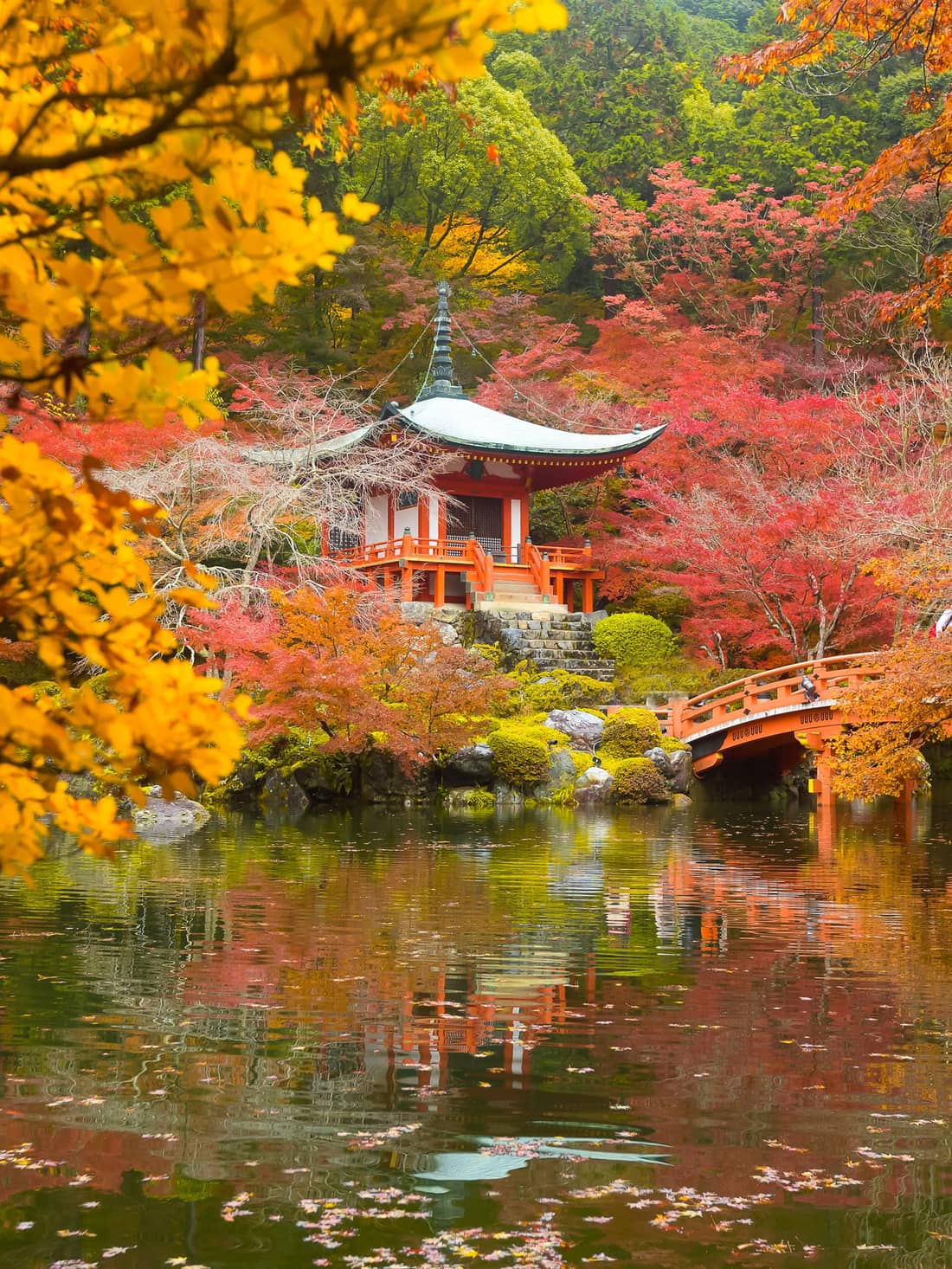


A maple leaf lands on the veranda before dinner is served, and no one moves to clear it away. Beyond the glass the garden has passed from red into shadow, and the pond no longer shows the trees above it. Inside, the room smells of cedar, tea and warm tatami while the cold gathers outside. The day is over, and the autumn is still in the room.
In autumn the choice of where to stay decides how much of the season a traveller keeps. The light goes early, before five o'clock in Kyoto in late November and earlier still in the north, and a room with nothing to look at leaves the colour to the daytime. A good one carries it through the evening: the garden lit after dark, rain turning fallen leaves into colour on the stones, the onsen steaming in the cold. Three kinds of stay do this best.
- Garden ryokan: the room framed by a single maple, a pond and a stone lantern covered in moss
- Mountain onsen inn: steam rising into cold air at the head of a forest valley
- City hotel or machiya with a garden or river view: the season brought into the middle of town
the garden inn
Garden ryokan and the autumn evening
The ryokan is the most complete autumn stay, because the evening moves indoors without losing sight of the landscape. The garden stays close, the kaiseki brings the harvest into the room, and the onsen, where the ryokan has one, is a few steps down the corridor. A garden ryokan in autumn needs a framed view more than a grand one: a single maple beyond a paper screen, a pond catching yellow leaves, a stone lantern half covered in moss.
The room itself matters. Tatami brings everyone down to the floor and slows the evening, and the tokonoma, the alcove for a hanging scroll and a flower arrangement, gives the season a formal place indoors: a branch of maple, a stem of pampas grass, a chrysanthemum, a ceramic the colour of persimmon. In the late afternoon the colours outside deepen and then withdraw, and a room facing a garden at that hour shows a part of the season that no daytime sightseeing reaches.
The onsen is the other half of an autumn evening. An indoor bath of hinoki cypress, an open-air onsen of stone, or an onsen on a room's own terrace makes the cold air a pleasure, the steam rising into a dark garden. Good service lets the evening end without friction: tea arriving at the right moment, the futon laid out while dinner is served, the room changed for the night on the guest's return.
the mountain lodge
Mountain onsen inns and cold air
Breakfast shows which kind of stay a traveller has chosen. In a garden ryokan it arrives with the same care as dinner: rice, grilled fish, pickles, miso soup, a small seasonal dish and tea, in a room still cool from the night. In a mountain inn it is heartier, with warmer broths and rice cooked in its own small pot over a flame at the table.
Autumn begins in the mountains, and a mountain ryokan puts the traveller inside the cold that turns the leaves. At altitude the evening comes with a sharper edge: the windows mist, the steam lingers over the onsen, a quilt becomes part of the pleasure, and the dark slopes keep the last colour of beech, larch and maple.
Onsen valleys suit the autumn because they join colour and heat. Steam rises from vents and channels while a cold stream runs beside the hot springs, and the pleasure lies in the contrast: mineral heat against night air, damp leaves on stone, water moving through the valley. The best mountain inns keep their materials close to the landscape, timber, stone, paper, straw and clay, and their kitchens cook the mountain: mushrooms, river fish, new rice, chestnut and root vegetables.
The north of Honshū is rich in them. In the beech forest above the Oirase Gorge stands a wooden inn whose main onsen is built directly over its own spring. At Nyūtō Onsen in Akita, a scatter of inns at the end of a forest road each draws on its own spring, and at one of them two waters meet, one cloudy gold and one clear. At Ginzan Onsen in Yamagata, wooden inns of three and four storeys face each other across the river under gas lamps, and behind one preserved Taishō facade the interior has been rebuilt in bamboo lattice and glass.
Getting there is part of the stay. A mountain ryokan should be close enough to reach in comfort and far enough to leave the city behind, and the drive up through turning slopes and darkening forest brings the season indoors before the shoes come off at the entrance.
the city stay
City hotels, townhouses, and old quarters
Kanazawa makes the case for a city stay in autumn. Its old districts and its garden culture sit so close together that a room near the canals or the Nagamachi samurai quarter puts both within walking distance, Kenroku-en among them. Nara offers a gentler version: a stay near the park puts the deer and the maples just outside the door.
In Kyoto and Tokyo the question is placement. The best city hotels in autumn give a view of trees, water, roofs or skyline in the low November light, a bar looking onto a garden, and corridors whose materials soften the sound of the street. In north-west Kyoto, near Kinkaku-ji, the city ends in hills, and a room there can look onto a forest garden of moss and stone. In Tokyo, the hotels at the edge of Marunouchi look across the moat to the gardens of the Imperial Palace, where the ginkgo and the late maples colour at the end of November.
Machiya, the old timber townhouses of Kyoto and Kanazawa, offer another kind of stay. Their scale is small: a narrow frontage, a deep interior, timber lattice and an inner garden. Privacy is the gain and service the trade, and in autumn the tsuboniwa, the small courtyard garden, does the work of a whole landscape with a little moss, one stone basin and a single maple branch.
what it should add
What the stay should add
A longer autumn journey moves through more than one kind of stay: a mountain night followed by a city stay, or a garden ryokan after a day among the temples. Each is chosen for what it adds to that stretch of the route.
A good autumn stay adds time to the day: the late afternoon return before the colour fades, an onsen that makes the cold air welcome, a room in which rain improves the day. Autumn colour lasts longer than the cherry blossom, and it changes constantly, from branch to ground and from red to brown, and a well-chosen room is a fixed point from which to watch it.
Rain at a garden ryokan is heard on the roof and seen on the pond. Wind at a mountain inn becomes sound and movement, leaves scattering across the path below the window. The rooms that do autumn best are built around shadow, warmth and view, and seldom around ornament: a window set at the height of a seated guest, an onsen open to the air, a meal that brings the season indoors without heaviness.
Japan autumn tours 2027, side by side →
Nights like these are the backbone of Luxury Japan Travel's Autumn Leaves Tour of Northern Japan. It opens with three nights above the Toyohira gorge in the mountains beyond Sapporo, stays a night inside the samurai district of Kakunodate, and gives two nights each to the beech-forest springs of Nyūtō and the gas-lit valley of Ginzan, with a full day of relaxation at Nyūtō to move between the village's seven springs.
questions
Questions
Where is the best place to stay in Japan in autumn?
Three kinds of stay do the season best: the garden ryokan, the room framed by a single maple, a pond and a stone lantern covered in moss; the mountain onsen inn, with steam rising into cold air at the head of a forest valley; and the city hotel or machiya with a garden or river view, which brings the season into the middle of town.
Why stay in a ryokan in autumn?
The ryokan is the most complete autumn stay, because the evening moves indoors without losing sight of the landscape. The garden stays close, the kaiseki brings the harvest into the room, and the onsen, where the ryokan has one, is a few steps down the corridor. The light goes early, before five o'clock in Kyoto in late November, and the room carries the colour through the evening.
Where should I stay in a city in autumn?
Kanazawa makes the case: a room near the canals or the Nagamachi samurai quarter puts Kenroku-en and the old districts within walking distance. Nara offers a gentler version near the park, with the deer and the maples just outside the door. In Tokyo, the hotels at the edge of Marunouchi look across the moat to the gardens of the Imperial Palace, where the ginkgo and the late maples colour at the end of November.