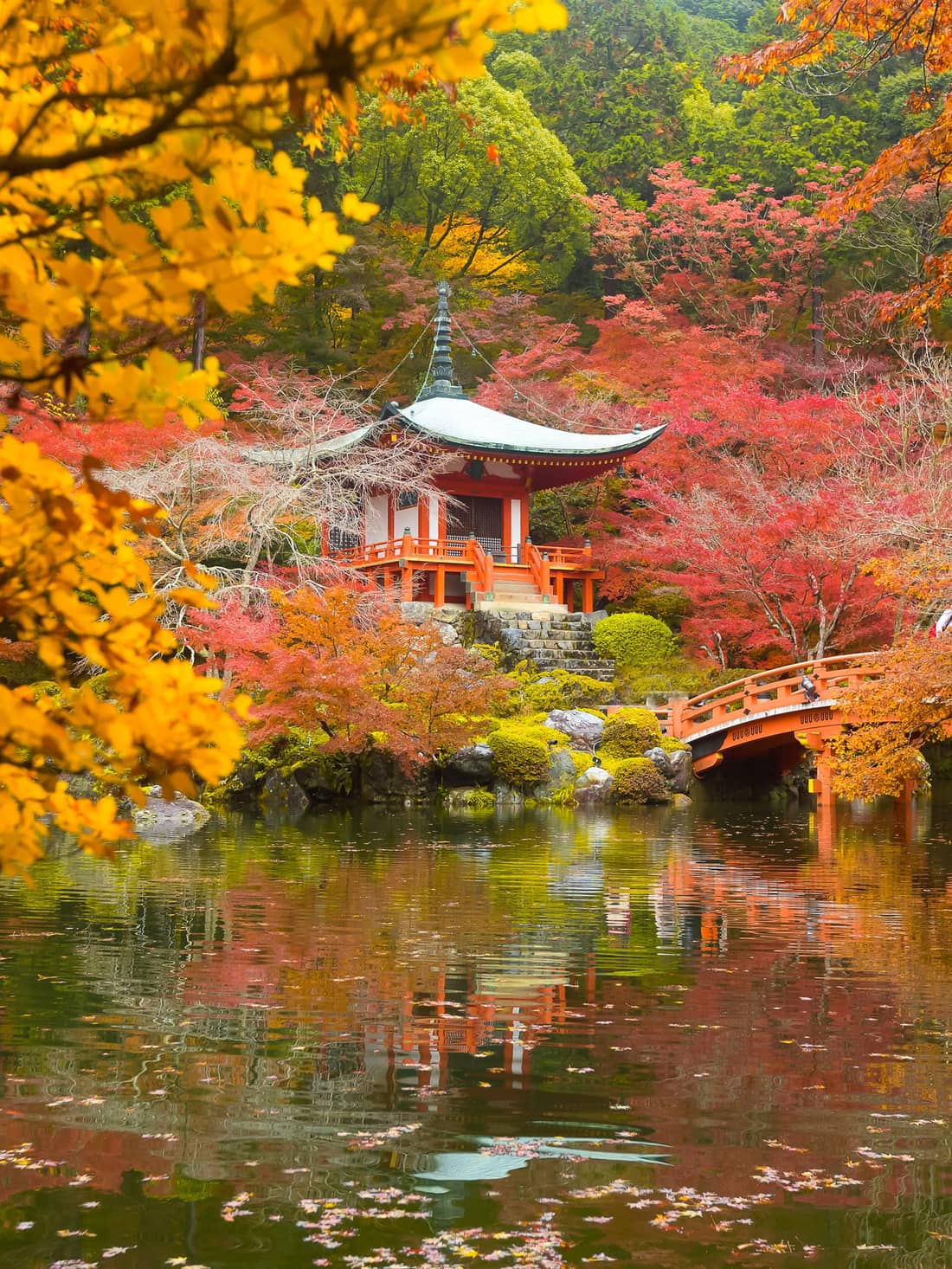

In mid-September, on the high ridges of Daisetsuzan in central Hokkaidō, the first leaves of the Japanese autumn turn: rowan, mountain birch and the low alpine shrubs on the slopes of Mount Asahi, red and gold against grey volcanic scree. From there the colour moves south and downhill, a front that takes about ten weeks to cross the country and reaches the temples of Kyoto in late November.
The movement is measured every year. The Japan Meteorological Corporation publishes forecasts for viewing spots across the country, and the long-run averages are steady: colour in the first half of October at Lake Akan in eastern Hokkaidō, from the middle of October in the Oirase Gorge in Aomori, in the second half of November at Tōfuku-ji in Kyoto, and into early December in the gardens of Tokyo. The national news follows it as closely as it follows the cherry blossom in spring.
the moving line
The line that moves south
What moves is a temperature. Maples begin to colour once the overnight minimum falls below about eight degrees Celsius, and the colour runs fastest when the nights reach five or six. The same cold turns the ginkgo gold and the wax tree scarlet, and it turns the katsura yellow, its fallen leaves smelling of burnt sugar. The front moves downhill as well as south, so in mid-October a single day's drive can climb from valley trees still green to mountain slopes fully turned.
Japan runs some 3,000 kilometres from north to south, with mountains down its spine, and in any one week of autumn the colour stands at a different stage in every region and at every height. The useful question is never simply when to go, but where to be in a given week.
The colours themselves come from two different processes. The yellows of ginkgo, birch and beech were in the leaf all summer, masked by chlorophyll, and they appear as the green breaks down. The reds of the maple are made fresh in autumn, as the leaf builds anthocyanin in bright sun and cold nights, which is why the deepest reds follow a run of clear days and cold nights, and why a ginkgo turns the same gold whatever the weather.
the north first
Where the line arrives first
Daisetsuzan is the largest national park in Japan, and its high slopes are the first in the country to turn, often with the first snow already on the ridges above them. Few travellers from outside Japan see it. Further south, the Shirakami mountains on the border of Aomori and Akita carry the largest virgin beech forest left in East Asia, inscribed as a World Heritage Site in 1993, and in October the whole range turns gold and copper. For anyone who wants the Japanese autumn from its beginning, it is the strongest argument for going north of Tokyo.
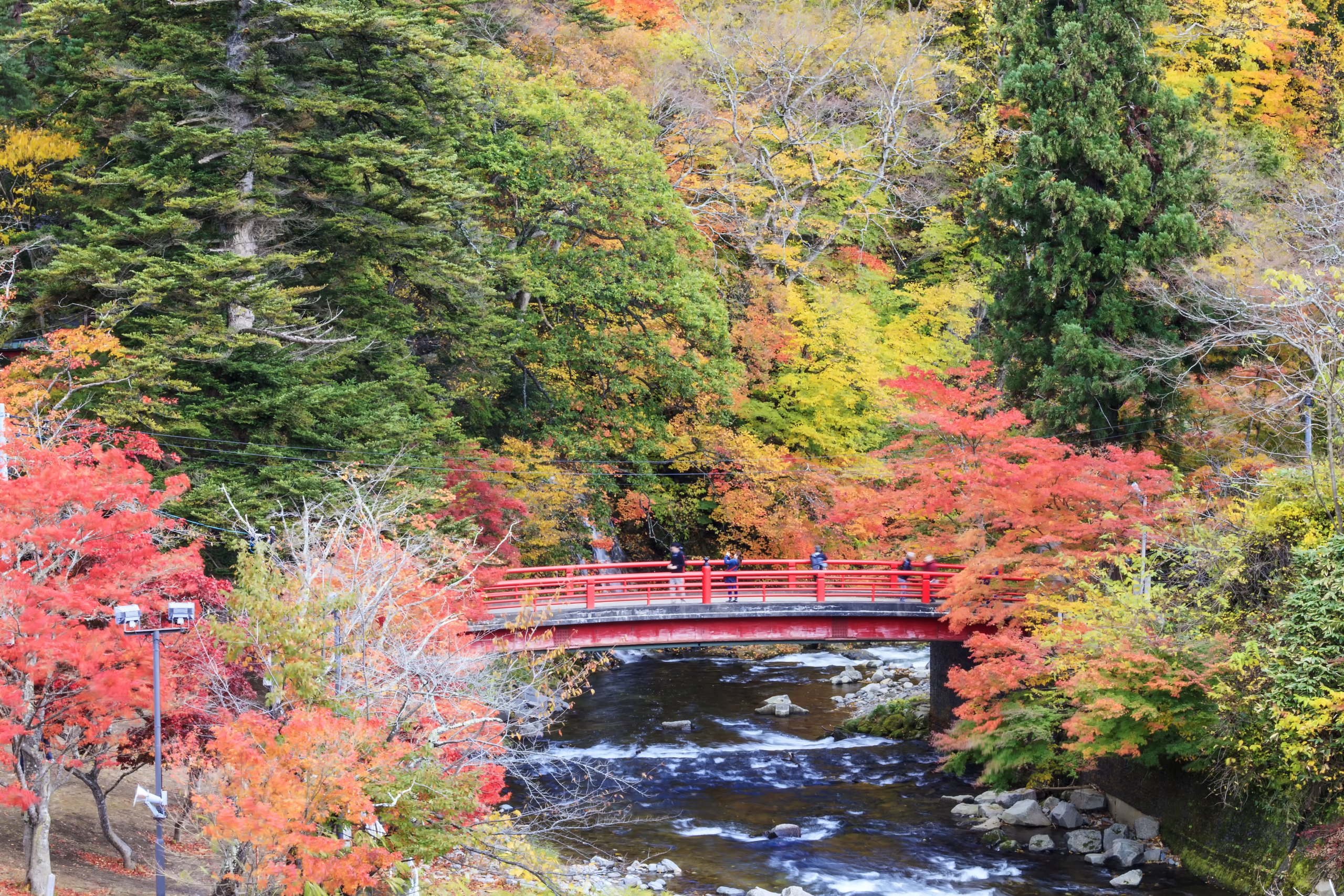
By late September the colour has reached the Hakkōda mountains in Aomori, and from the middle of October it comes down into the Oirase Gorge, where fourteen kilometres of stream run out of Lake Towada through beech and maple forest. Through October it fills the beech woods around the mountain onsen of Nyūtō in Akita, and Tsuta-numa, a small pond in the beech forest below the Hakkōda mountains, mirrors a crimson and amber canopy in water so still that the shoreline disappears.
the south last
Where it arrives last
The front reaches Kyoto and Nara some two months after the first colour in Hokkaidō. This is the Japanese autumn most people picture: the maples below the Tsūten-kyō bridge at Tōfuku-ji and around the halls of Eikan-dō in late November; the garden of Rurikō-in reflected in the polished black floor of its upstairs room; the slopes of Arashiyama turning red above the river.
two landscapes
Kanazawa and Kinosaki in November
Kanazawa, mid-November
The garden of Kenroku-en, counted among the three great gardens of Japan, begins its yukitsuri on 1 November each year: ropes run from tall poles down to the branches of the pines in the shape of a cone, so that the pines can bear the weight of the coming snow. They go up in the weeks before the garden's maples turn, and by mid-November the red of the maples, the gold of the ginkgo and the geometry of the ropes stand together against a grey Kanazawa sky.
Kinosaki Onsen, late November
The onsen town of Kinosaki, on the Japan Sea coast of northern Hyōgo, turns in the second half of November. The willow-lined Ōtani River runs the length of the town between its seven public onsen, and the colour coincides with the matsuba crab, the snow crab of the Japan Sea, whose season opens on 6 November. An evening spent walking between the onsen in yukata, then sitting down to the first crab of the year, is the autumn of western Japan at its most complete.
the planning
The planning reality
The first consequence for anyone planning from abroad is that autumn in Japan is several seasons, depending on latitude. A journey in early October looks nothing like one in late November. The north in October brings cold mountain air and the first snow on the peaks; Kyoto in late November brings mild days and clear light.
The second is that the best rooms of the season go first. A ryokan of four rooms in Kyoto, or an inn in Kinosaki with its own onsen and a single sitting for kaiseki, has only a handful of nights in the colour each year, and those nights are taken by travellers who plan their autumn a year ahead.
The third is the reward. The days are mild, the kitchens are cooking matsutake, chestnut and new rice, and the colour comes down the length of the country for ten weeks, from the ridges of Daisetsuzan to the temple gardens of Kyoto.
Japan fall foliage tours, 2027 →
The northern stretch of the front is the route of Luxury Japan Travel's Autumn Leaves Tour of Northern Japan, which travels north to south in the order the colour moves. It opens in Hokkaidō above the Toyohira gorge at Jozankei, among the last of the northern colour, then crosses beneath the Tsugaru Strait to the Oirase Gorge, Tsuta-numa and the beech forests of Nyūtō, and ends in the gas-lit valley of Ginzan Onsen in Yamagata.
questions
Questions
When is the best time to see autumn leaves in Japan?
It depends on where you are, because the colour moves south and downhill over about ten weeks. It begins in mid-September on the high ridges of Daisetsuzan in Hokkaidō, reaches Lake Akan in the first half of October and the Oirase Gorge from the middle of October, and comes to Tōfuku-ji in Kyoto in the second half of November and the gardens of Tokyo in early December.
What temperature do maple leaves turn red?
Maples begin to colour once the overnight minimum falls below about eight degrees Celsius, and the colour runs fastest when the nights reach five or six. The reds of the maple are made fresh in autumn, as the leaf builds anthocyanin in bright sun and cold nights, which is why the deepest reds follow a run of clear days and cold nights.
Why do the leaves change earlier in Hokkaido than in Kyoto?
What moves is a temperature, and the cold reaches the north and the high ground first. The front reaches Kyoto and Nara some two months after the first colour in Hokkaidō. It moves downhill as well as south, so in mid-October a single day's drive can climb from valley trees still green to mountain slopes fully turned.