
The sliding door to the garden is the first thing a guest notices on the first morning in a ryokan, because it was closed when they went to bed and it is open now. Someone has slid the shoji back along its wooden track without a sound, and the room is full of the light of the garden.
That someone is the nakai, the attendant who looks after a handful of rooms and the guests in them for the length of their stay. She served dinner in the room the night before, course by course, and while the guests were in the bath afterwards she laid out the futon. Guests rarely see her at work. They see what has changed while they were out of the room.
the room
A room that changes with the hour
The guest wakes in a tatami room that was turned from a dining room into a bedroom while they were out of it, and by the time breakfast is served it will have been turned back again. The futon is folded into a closet whose existence may not have registered the day before. The low lacquer table returns to the centre of the floor.
In the tokonoma, the alcove that is the one decorated wall of the room, a hanging scroll and a small arrangement of the season sit together: pampas grass in autumn, a branch of plum in February, a single camellia in winter. They are chosen to agree with each other, and in the best inns they are changed with the season, sometimes within it.
The room feels larger than it did on arrival, and the difference is real. A ryokan room has no fixed purpose. It is a reception room, a dining room and a bedroom by turns, depending on the hour, and the change is made with nothing more than a futon, a table and a few cushions.
the walk
The yukata, and the walk to the bath
The guest walks to the onsen in the yukata the inn has laid out, a cotton robe in the ryokan's own pattern, with a padded tanzen jacket over it when the weather is cold. It is closed left side over right; right over left is kept for funerals, and a nakai will quietly correct a guest who has it the wrong way round.
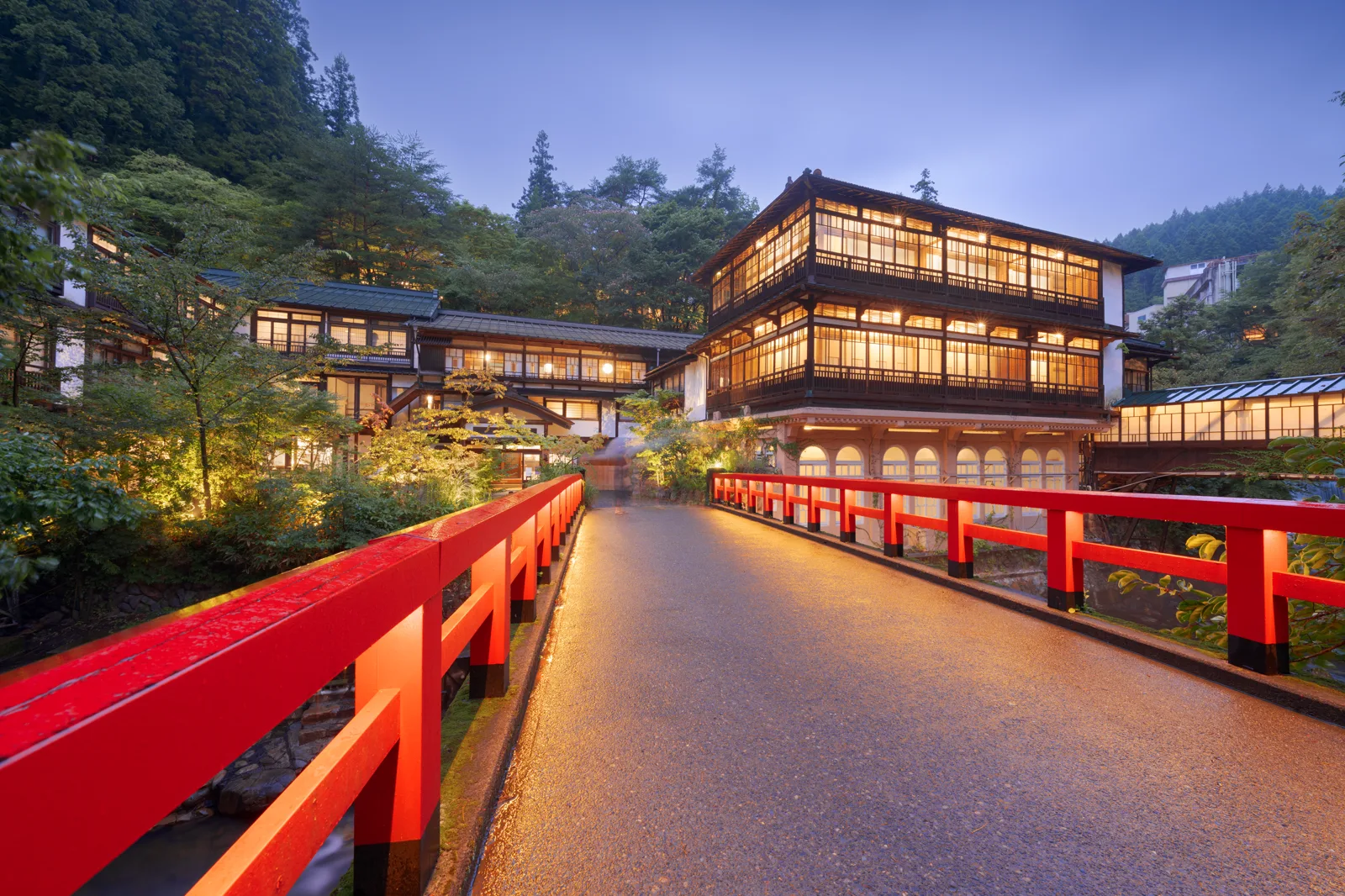
A well-planned ryokan places its onsen at a distance from the rooms, so that reaching it means a walk through the building, along a wooden corridor beside a garden or under the eaves of a wing whose shape can only be read from outside. In the morning, before breakfast, the corridor is empty and the only sound is the guest's own slippers.
Many inns have two onsen and exchange them overnight, so that a guest knows both: the cedar tub in the evening, and in the morning the stone pool open to the garden.
the water
What makes a bath an onsen
The word onsen has a legal meaning. Under the Hot Springs Act of 1948, water from the ground counts as a hot spring if it comes out at 25°C or warmer, or if it carries any one of a list of minerals in sufficient quantity, so a cool spring rich in iron is an onsen as much as a scalding one. The finer inns say proudly on the sign by the bath that the water is kakenagashi, flowing in from the source and over the edge of the tub without being filtered and returned, which is how the water of a spring town smells and feels of the ground it came from.
Outside the window of the bath is whatever the ryokan was built to look at: a mossed stone, a waterfall, snow on a pine, a maple, the line of the mountain against the morning sky.
the long breakfast
Breakfast, and why it is so long
Ryokan breakfast follows the same logic as the kaiseki of the evening before, in fewer and smaller dishes. There is a grilled fish, often a split and salted horse mackerel, aji no himono, and rice from a wooden tub with miso soup made that morning. Pickles and a sheet of toasted nori come beside them, with a small pot of tofu warming over a flame, and often an onsen tamago, an egg cooked slowly in water at around 65 to 70°C, so that the yolk sets while the white stays soft, the reverse of an ordinary boiled egg, served in a little cold dashi.
The breakfast changes with the region. In Kyoto it may be yudofu, squares of tofu simmered in kelp broth, a tradition of the temple kitchens around Nanzen-ji. On the Japan Sea coast the grilled fish is from the morning's catch, and in the mountains the pickles are the inn's own, made from vegetables of the valley.
The meal takes the best part of an hour. The dishes come in sequence, each one cooked or warmed as it is needed, and the nakai sets the pace from the doorway.
kinosaki
A town built for the yukata
In a few onsen towns the morning continues outside. At Kinosaki Onsen, on the Japan Sea coast of Hyogo, the town itself is the onsen: seven public bathhouses stand along a willow-lined canal, and guests of the town's ryokan walk between them in yukata and wooden geta, the clack of the soles carrying down the street, with a pass from the inn that opens every door.
Guests often finish their first ryokan morning and realise, as they change for the day, that they have not looked at a phone once.
The best luxury ryokan in Japan →
The Classic Cherry Blossom Tour of Japan gives a night to Kinosaki, at a ryokan kept by one family for seven generations on the willow-lined canal. Dinner there is of Tajima beef, raised in the hills of Tajima, the old province around the town, and the evening and the morning are spent crossing the town's seven bathhouses in yukata and geta, at the pace the town has kept for thirteen hundred years.