
A cherry branch in bud gives nothing away. The flower sits clenched inside scales of brown and green, no more expressive than any other bare winter twig. Then it opens, and the tree shows exactly what it is: five petals or thirty, white or a saturated pink, carried upright or falling in long arcs, in bloom in January or not until May. Sakura is a family of several hundred wild and cultivated forms, and because they open at different times, Japan's cherry season runs for close to five months, from the first flowers in Okinawa to the last in Hokkaido.
The word covers a mountainside that has flowered on its own since before Kyoto was the capital, and a single cloned tree bred in nineteenth-century Tokyo that now stands, genetically identical, on thousands of riverbanks. It covers a flower that hangs downward like a small bell and a flower stacked thirty petals deep. Most visitors picture one cherry. Japan grows dozens in common use, and each opens in its own weeks of the year.
A practised eye looks past colour to petal count, branch habit, and whether the leaves have already opened.
the clone
Somei Yoshino, the clone that set the calendar
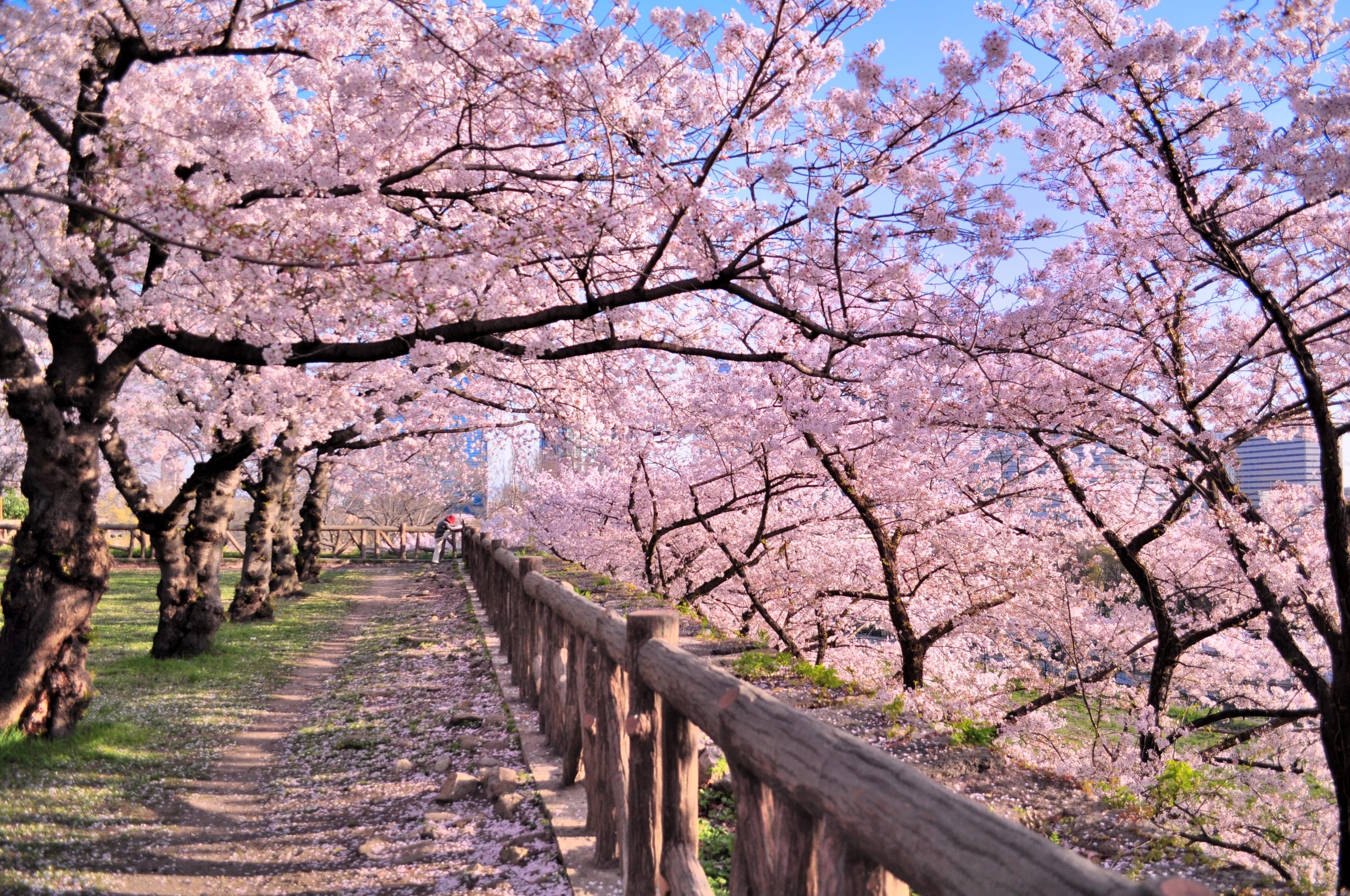
The Somei Yoshino is the tree most people picture: pale, almost white, five petals, a faint blush at the centre that deepens as the flower ages. It flowers on bare branches before the leaves appear, which gives full bloom its cloud-like whiteness. For a few days the tree appears to be made of nothing but flower.
Its origin is specific and recent by the standards of a wild species. It is a hybrid of the Edo higan, the tree botanists know as Prunus itosakura, and the Oshima cherry, Prunus speciosa, first raised in the nurseries of Somei village, in what is now Tokyo's Toshima ward. In 1900 the horticulturist Fujino Yorinaga gave it the name it carries today, drawn from that village and from Yoshino, the old byword for cherry blossom itself. In 2019 the Kazusa DNA Research Institute, working with Shimane University and Kyoto Prefectural University, sequenced its full genome and confirmed the parentage.
That hybrid origin left it unable to breed true from seed, so every Somei Yoshino alive is a cutting or a graft, a copy of the same original tree. When an old riverbank planting is replaced, the new trees are grafted from that same line, and the tree flowering over a modern moat is, cell for cell, the tree Tokyo planted in the nineteenth century. Because a whole district is planted with one genetic individual, every tree answers the spring warmth in the same way, which is why an entire riverbank of them opens, and lets its petals fall, within the same few days.

weeping and wild
The weeping cherry and the wild mountain cherry
Shidarezakura, the weeping cherry, has the same simple flower as its relatives and an entirely different posture. Its branches fall in long arcs, so the blossom hangs in curtains instead of spreading into a horizontal canopy. It is a weeping form of the Edo higan, the same species that gave Somei Yoshino one of its parents, though the two trees could hardly look less alike once grown, and botanists now name the whole species Prunus itosakura, after the weeping tree's old Japanese name, ito-zakura, the thread cherry. A mature shidarezakura in bloom shapes the space beneath it almost like architecture, a room with walls of flower.
Yamazakura, the mountain cherry, is older still in the Japanese imagination and needs no planting at all. It is the country's most widespread wild cherry, seeding itself across hillsides and forest edges, and it was the cherry of classical poetry centuries before Somei Yoshino was bred. The clearest way to know it is the leaf. Somei Yoshino flowers on bare wood and leafs out afterward; yamazakura opens its pale pink or white blossom together with its new leaves, which come out bronze or copper red. A hillside of yamazakura is a warm mix of soft pink and rust, each tree a slightly different shade from its neighbour.
If there were no cherry blossoms in the world, how much more at peace the heart would be in spring.
Ariwara no Narihira, Kokinshū, c. 905
the early ones
The early cherries: kanhizakura and Kawazu zakura
Kanhizakura opens before the rest of the country has finished with plum. Native to Taiwan and southern China and long grown in Okinawa, it carries a deep fuchsia flower shaped like a narrow bell that hangs downward and never opens flat into the star of Somei Yoshino. It flowers as early as January, first in the cooler hill country of the Motobu peninsula in northern Okinawa, then southward to Naha over the following one to two weeks. Its season is over before Honshū has left winter behind.
On the mainland, Kawazu zakura keeps the earliest calendar. Named for Kawazu, the town on the Izu peninsula in Shizuoka where it was first propagated, it opens from early February into March, a month or more ahead of the Somei Yoshino. Its petals are larger and a deeper pink than those of the pale national variety, and its bloom lasts close to a month, so a single tree can carry buds, open flowers and fading petals at the same time.
Ōshimazakura, the Oshima cherry, is paler than either. Its five white petals open together with fresh green leaves, and those leaves, once salted, take on the fragrance that wraps sakuramochi, the pink rice cake of spring. It is one of the two wild species, with the Edo higan, behind Somei Yoshino, and it appears again in the parentage of most of the double-flowered garden cherries that close the season.
the late fullness
Yaezakura, the double-flowered cherries of late April
Yaezakura, the double-flowered cherries, belong to the Sato-zakura group, garden forms descended largely from the Oshima cherry. They open one to two weeks after Somei Yoshino, carrying the season into mid and late April. A double flower is unmistakable once seen: many more than the plain five petals, gathered into a rounded cluster like folded silk.
Kanzan is the best known of them, its clusters built from twenty to fifty deep pink petals above coppery new leaves, dense enough that a mature branch reads almost solid with colour. Ichiyō, around twenty petals in a lighter pink that fades toward white, is named for the single leaf-like pistil at the centre of each bloom. Fugenzō, pale pink ageing to white, has two such pistils, said to recall the tusks of the white elephant ridden by the bodhisattva Fugen, whose name it carries. These late doubles arrive once the first pale wave has gone, among the fresh leaves of early summer.
In order, the year runs like this. Kanhizakura opens in Okinawa in January. Kawazu zakura follows on the mainland in February and keeps its bloom for close to a month. Somei Yoshino brings Tokyo and Kyoto into full flower at the turn of March into April, the weeping cherries and the wild yamazakura alongside it. The yaezakura come a fortnight or more later, heavy and deep pink, as the leaves fill in around them.
The Classic Cherry Blossom Tour of Japan travels with the Somei Yoshino, from the seven-hundred-metre tunnel of cherry trees along Tokyo's Chidorigafuchi moat to the more than six hundred around the moat of Osaka Castle. Guests who add its extension go on to Yoshinoyama, the great mountain of the wild cherry, where some thirty thousand trees rise in four bands up the slope.