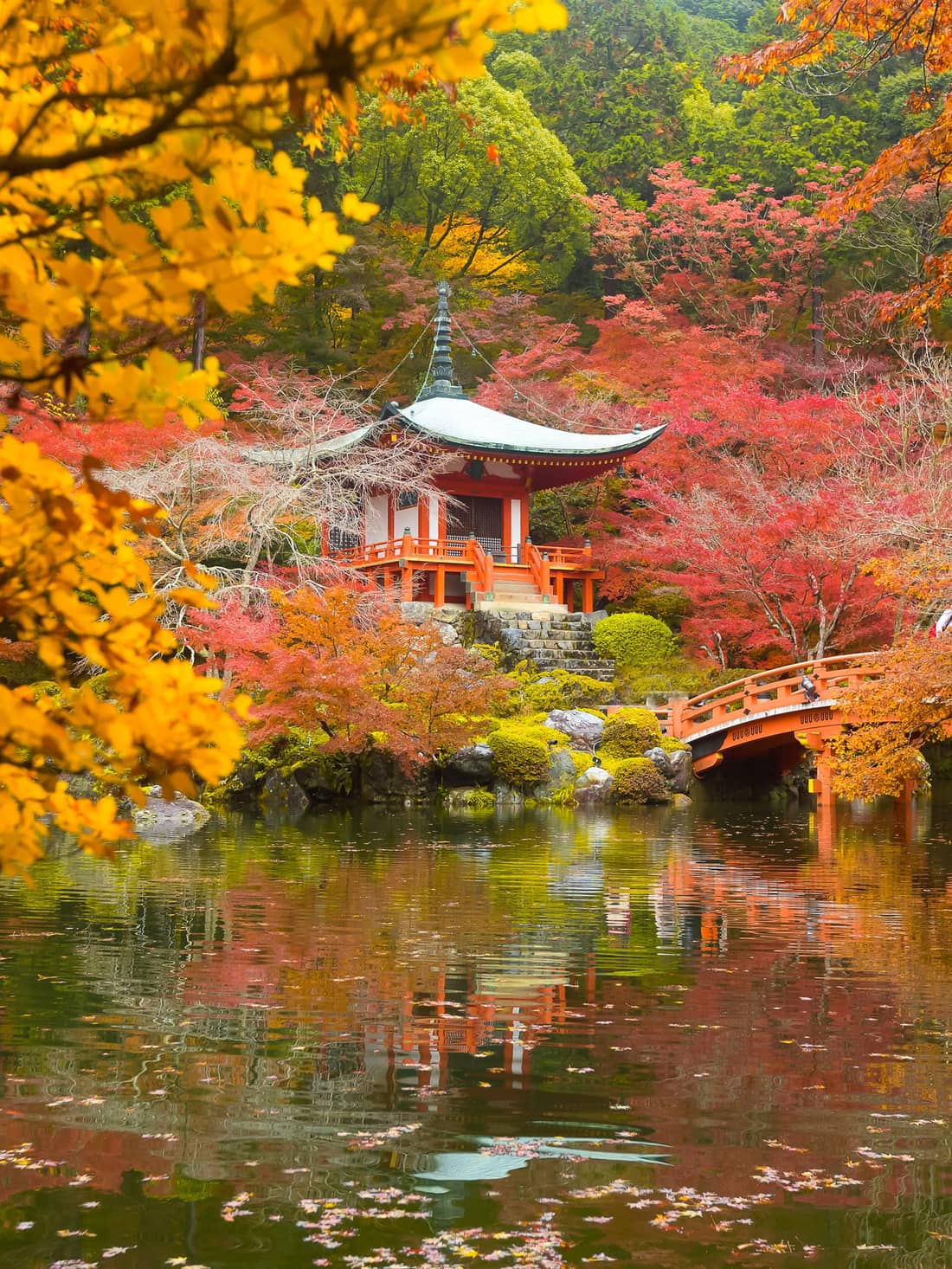

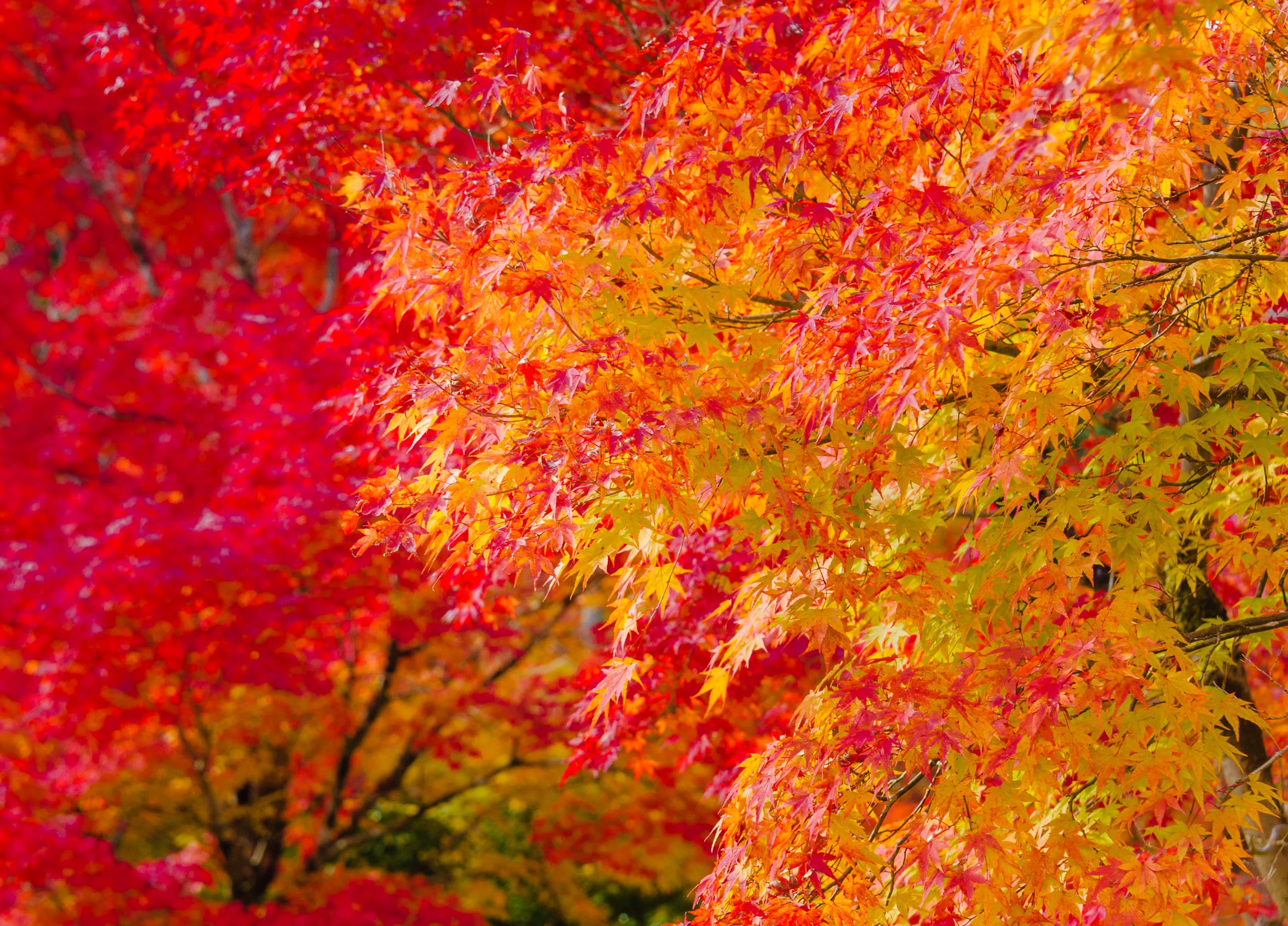
At Oirase the stream braids around boulders, slides beneath fallen beech leaves, turns white over the small drops and runs clear again under branches already losing their colour. The forest grows right down to the water. Red maple, yellow beech, wet rock and pale water sit almost on top of one another, and the colour a mountain shows from a distance is here within reach of the hand.
The high slopes of the north take the first colour, but it is the rivers and gorges that give it movement and sound. Water carries a fallen leaf downstream, doubles a maple branch in a still pool and darkens a cliff after rain, and in the north the season is best followed along a river.
beside the water
Oirase and the colour beside water
The Oirase Stream runs fourteen kilometres out of Lake Towada through the beech forest of Aomori, past named rapids and waterfalls, Ashura no Nagare and Kumoi Falls among them, to Chōshi Ōtaki at the lake itself. It is strong enough to fill the forest with sound and narrow enough to follow on foot, and it comes in intervals instead of one grand viewpoint: a rapid over stone, a small fall, a pool gathering leaves, a branch low over the water. Few visitors walk the whole length. The better way is to take it a stretch at a time and stop wherever the water does something worth watching.
The path stays so close to the stream that the sound changes every few steps, loud at the drops and almost silent where the stream widens and the leaves gather in eddies. Spray cools the air, wet leaves cover the path, and the moss on the boulders is the brightest green in the forest. At the head of the gorge the stream opens onto Lake Towada, a caldera lake ringed by slopes that colour through October. The lake and the stream together are a Special Place of Scenic Beauty and a Natural Monument, Japan's highest protection for a landscape, and the moss along the water alone runs to some three hundred species.
the ravines
Naruko, Dakigaeri, and the ravines of colour
Naruko Gorge in Miyagi turns autumn into depth. The Ōya River has cut a ravine about a hundred metres deep, crossed high above the water by the white arch of the Ōfukazawa Bridge, and in autumn its walls are banded in the reds, yellows and copper of maple, beech and oak. Summer green hides the shape of the ravine. Autumn draws it, each species turning at its own pace, so that the slope shows where the sun falls and where the cold settles. Naruko is onsen country as well, and the day in the gorge ends in the hot springs of Naruko Onsen, fed by the same volcanic ground the river has cut through.
Dakigaeri Gorge in Akita, near the samurai town of Kakunodate, is more enclosed: blue-green water between steep forested walls, a red suspension bridge at its entrance and a path along the river to Mikaeri Falls. The name is said to come from the old path, so narrow that travellers had to embrace one another to pass. In autumn the water takes on a mineral clarity, and the red leaves above it look brighter for it.
the island gorges
Sōunkyō and Jozankei: the gorges of Hokkaidō
Hokkaidō's rivers turn earlier than any in Tōhoku. At Sōunkyō, on the upper Ishikari River below Daisetsuzan, the river runs between columns of volcanic rock more than a hundred metres high, and two waterfalls, Ryūsei and Ginga, fall side by side down the cliff, the meteor and the Milky Way, among slopes of birch and maple.
Jozankei, an hour into the mountains from Sapporo, is the gentler gorge of the two. The Toyohira River runs through an onsen town under the red span of the Futami suspension bridge, and further upstream the reservoir behind Hōheikyō Dam sits in an amphitheatre of forest that turns red, orange and yellow in October.
the slow rivers
Geibikei, Tadami, Mogami, and the slow rivers
The slower rivers of the north spread the colour across kilometres instead of compressing it into one ravine. At Geibikei in Iwate, a flat-bottomed boat is poled by hand up a limestone gorge whose cliffs rise some fifty metres on either side, maples growing on ledges too steep for any path. On the return the boatman sings the Geibi Oiwake, the gorge's own folk song, and his voice comes back off the rock.
The Tadami River, running through Fukushima towards Niigata, is slower still: a chain of bends, dams and small villages, with forested slopes rising on both sides and mist lying on the water through the autumn. Its best-known image is a two-carriage train crossing the steel arch of the First Tadami River Bridge, a small line drawn through colour and water.
The Mogami River in Yamagata, counted among the three swiftest rivers in Japan, carries a longer history. It was the trade route of the province, taking rice and safflower down to the port of Sakata, and Bashō came down it by boat in the summer of 1689 and gave it one of the best-known haiku in the language.
Gathering the rains of early summer, how swift it runs, the Mogami River.
Matsuo Bashō, Oku no Hosomichi, 1689
Boats still run through the Mogami's canyon, and from the water the forest on its walls passes slowly, the river keeping the centre while the colour moves along both banks. The boatmen sing the Mogamigawa Funauta, the old boat song of the river, and the Shiraito Falls come down the wooded wall of the canyon in a single white thread.
Rain gives all of these rivers a darker voice: wet cliffs turn black, moss brightens and the water grows louder. Mist softens the far bank until the colour comes back as the air warms. And once the leaves fall heavily, the rivers carry the season in fragments, collecting behind stones, spinning in pools and sliding along the edge of the current, the colour leaving the tree and travelling downstream.
A single photograph from the standard lookout tells little about any of them. They are best followed for an hour or more, bank to bridge to bend, while the colour changes with the light and the current changes after rain.
Japan autumn tours 2027, side by side →
The northern autumn by water is where Luxury Japan Travel's Autumn Leaves Tour of Northern Japan spends its days. The fourteen kilometres of the Oirase Stream are taken stretch by stretch, the car waiting at each, and in the last days of the journey a wooden boat chartered for the group alone carries it down the Mogami River, the boatman telling the river's story through the canyon Bashō descended in 1689.
questions
Questions
How do you see the Oirase Gorge in autumn?
The Oirase Stream runs fourteen kilometres out of Lake Towada through the beech forest of Aomori, past named rapids and waterfalls, to Chōshi Ōtaki at the lake itself. It comes in intervals instead of one grand viewpoint, so the better way is to take it a stretch at a time and stop wherever the water does something worth watching.
What are the best gorges for autumn colour in Japan?
Naruko Gorge in Miyagi, a ravine about a hundred metres deep crossed by the white arch of the Ōfukazawa Bridge; Dakigaeri Gorge in Akita, enclosed and blue-green, near the samurai town of Kakunodate; Sōunkyō in Hokkaidō, between columns of volcanic rock more than a hundred metres high; and Jozankei, an hour into the mountains from Sapporo, the gentler gorge of the two.
Can you see autumn leaves from a boat in Japan?
Yes. At Geibikei in Iwate a flat-bottomed boat is poled by hand up a limestone gorge whose cliffs rise some fifty metres on either side. Boats still run through the canyon of the Mogami River in Yamagata, where the boatmen sing the old boat song of the river and the forest on the walls passes slowly, the colour moving along both banks.