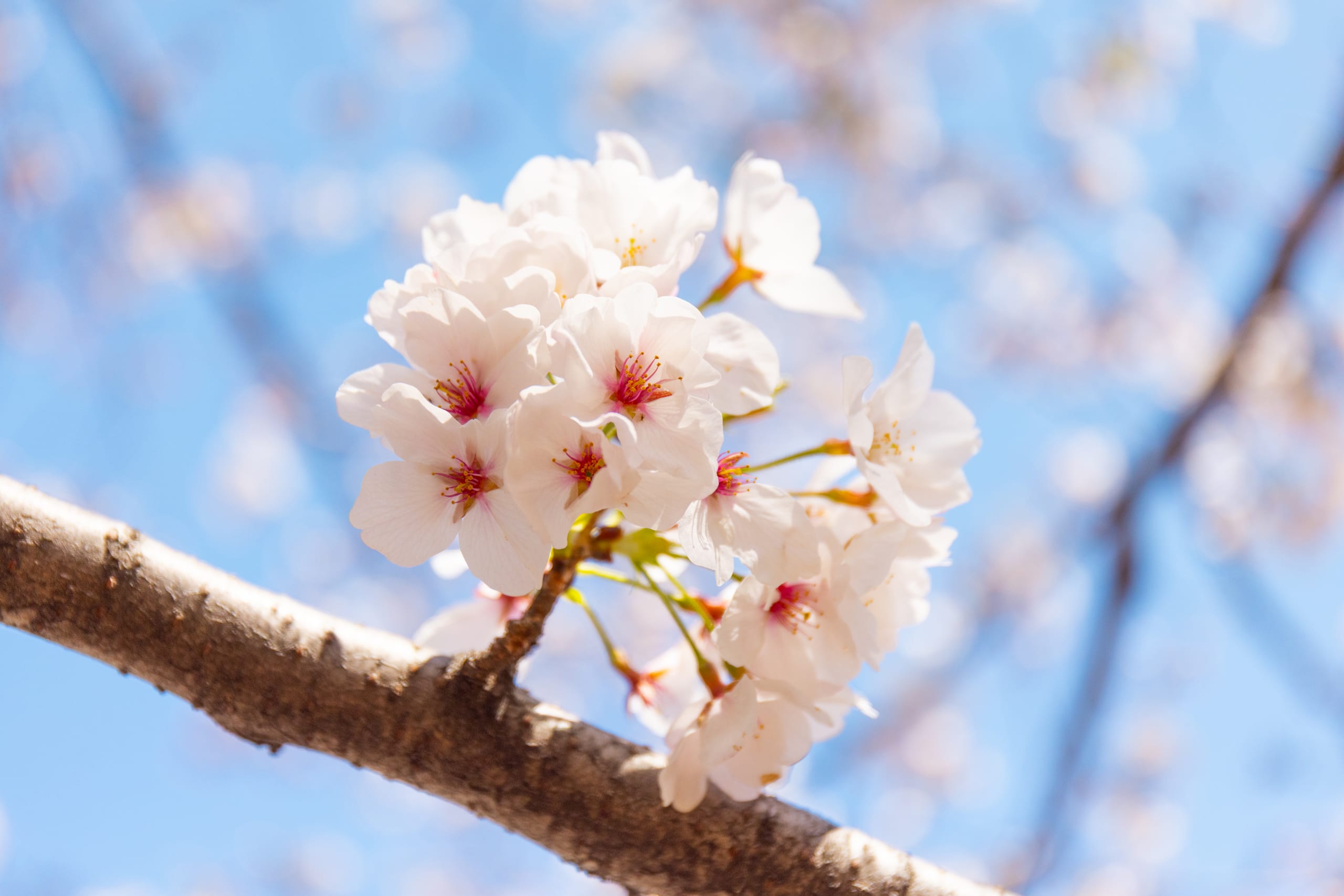

The wind off the Tsugaru Strait carries salt into Matsumae Park before the morning has properly warmed. It moves through the grounds of Matsumae Castle, officially Fukuyama Castle, lifting petals from the earliest of the park's ten thousand cherry trees while others, a few steps further on, still keep their buds shut against the cold. Some two hundred and fifty varieties grow in this one park, and because they open one after another, early, mid season and late, some part of it is in flower for about a month.
Matsumae, Goryōkaku and Hakodate are where Hokkaidō's late cherry season meets the island's history: a castle town at its southern tip, a star-shaped fort on the edge of Hakodate, and a port named in 1854 as one of the first two in Japan to receive foreign ships. The trees are a different mix from Kyoto's. Somei Yoshino fills the parks of Hakodate, but across Hokkaidō the deep-pink Ezo-yamazakura, the Sargent cherry, flowers with its leaves already out, in a stronger colour than the pale blossom of the south.
the relay
Matsumae and the long relay
Matsumae Castle was the last castle built in Japan in the traditional style, raised between 1850 and 1854 as a coastal defence against the foreign ships then appearing in the northern seas. In 1949 a fire that began in the neighbouring town hall destroyed the tower and part of the eastern wall at the main gate, and a reinforced concrete rebuilding in 1961 restored the three-tiered tower, white walls stepped beneath a dark roofline. It now houses the Matsumae Castle Museum.
The trees around it are the older story. Matsumae Park gathers around ten thousand cherry trees of some two hundred and fifty varieties, about a hundred of them raised by cross breeding in Matsumae itself. The first trees are said to have come north in the Edo period with people from Honshū, planted in memory of the blossom of the towns they had left. The Japan Cherry Blossom Association lists Matsumae Park among the hundred great cherry blossom sites of the country, further from Kyoto than almost any other name on that list.
Its most revered tree is the Kechimyaku-zakura in the grounds of Kōzen-ji, a temple in the town, thought to be about three hundred years old and the parent of many of the cherries that now grow around the castle.
The town's standing is older than its horticulture. For more than two centuries the Matsumae clan ruled the only feudal domain on Ezo, granted sole rights by the Tokugawa shogunate in 1604 to trade with the Ainu for furs, eagle feathers and marine goods, exchanged for rice, sake and ironware carried up from Honshū. The arrangement was hard on the Ainu: resentment at years of undervalued trade broke into open revolt in 1669, when the chieftain Shakushain led an uprising against the Matsumae outposts before it was put down. What remains is Hokkaidō's only castle town, the one place on the island where a keep, its park and its cherry trees stand together as they do in Hirosaki or Himeji, with the strait in place of a moat.
the star fort
Goryōkaku from above
Goryōkaku, in Hakodate, is a five-pointed star fort designed in 1855 by Takeda Ayasaburō, a scholar of Dutch military texts, and built between 1857 and 1866 to defend the newly opened port, for a shogunate that now understood what foreign gunships could do to an old hilltop keep. The star shape removed the blind spots a conventional wall left open to cannon fire. At ground level it reads as moat and embankment beneath more than sixteen hundred Somei Yoshino cherry trees, in grounds first opened to the public as a park in 1914. From the observation deck of Goryōkaku Tower the whole plan resolves into five points traced in blossom and water, a shape no one standing inside the fort can see.
The tower shows the shape of the fort; a walk along the moat gives it its size.
The fort also saw the end of the Tokugawa order. Goryōkaku was the last stronghold of the former shogunate's forces in the Boshin War and the scene of that war's final battle, in June 1869, when Enomoto Takeaki's short-lived Ezo Republic surrendered there. The Hakodate Magistrate's Office inside the grounds, completed in 1864 and demolished in 1871, was rebuilt in 2010 to about a third of its original size, using traditional joinery worked from the surviving plans. The site was designated a special historic site in 1952, and its cherry blossom now falls across ground where modern Japan began.
the port
Hakodate and its port light
Hakodate was one of the two ports named in the Convention of Kanagawa of 1854, and in 1859 it opened fully to foreign trade alongside Yokohama and Nagasaki. Motomachi, the district that climbs the slopes below Mount Hakodate, still carries that decade in its streets: the former British Consulate, opened in 1859 and rebuilt in 1913 as the building that stands today, and the white walls of the Hakodate Orthodox Church, whose first chapel, consecrated in 1860, was the first purpose-built Orthodox church in Japan. In spring the cherry trees on these slopes flower among consulates, churches and merchant houses built for the foreign trade that came to Hakodate after 1859.

The mountain above the port gives the city the rest of its reputation. Its summit view is counted, alongside Nagasaki's Mount Inasa and Kobe's Mount Rokko, among Japan's three great night views. The reason is geography: Hakodate sits on a narrow isthmus with the sea on both sides, so its lights gather into an hourglass between two dark bays.
the strait
The Tsugaru Strait, a line between two Japans
The strait is a border older than any building near it. Thomas Blakiston, a naturalist who lived mostly in Hakodate between 1861 and 1884, was the first to record that the animals of Hokkaidō belonged to the fauna of northern Asia while those of Honshū, twenty kilometres south across open water, belonged to a warmer, southern lineage. He published the finding in 1883, and biologists have called the line Blakiston's Line ever since. The Japanese macaque, familiar further south from the hot-spring troops of Nagano, has never established itself north of the strait. In 1883 Blakiston also collected, at Hakodate, the first specimen of a large fishing owl that now carries his name, a bird of Hokkaidō and the Russian Far East that is not found south of the line.
The Seikan Tunnel, opened in March 1988, runs 53.85 kilometres beneath the strait, about twenty-three of them under the seabed itself, and remains the longest tunnel in the world with an undersea section. Before it, the crossing between Aomori and Hakodate took a ferry nearly four hours.
Luxury Japan Travel's Cherry Blossom Tour of Hokkaido begins on this ground, with three nights by Lake Onuma beneath Mount Komagatake. A full day goes to Matsumae, with a hanami picnic laid on rugs beneath the castle wall and the strait behind, and another to old Hakodate: the morning market, the slopes of Motomachi, Goryōkaku and the night view from the mountain. From there the tour follows the blossom north across the island for thirteen days, to the gardens of Sapporo that flower last.
Japan cherry blossom tours for 2027, from Tokyo to Matsumae →
The Classic Cherry Blossom Tour of Japan, from Tokyo to Osaka →
The Hokkaido cherry blossom tour of 2027, which opens at Matsumae →