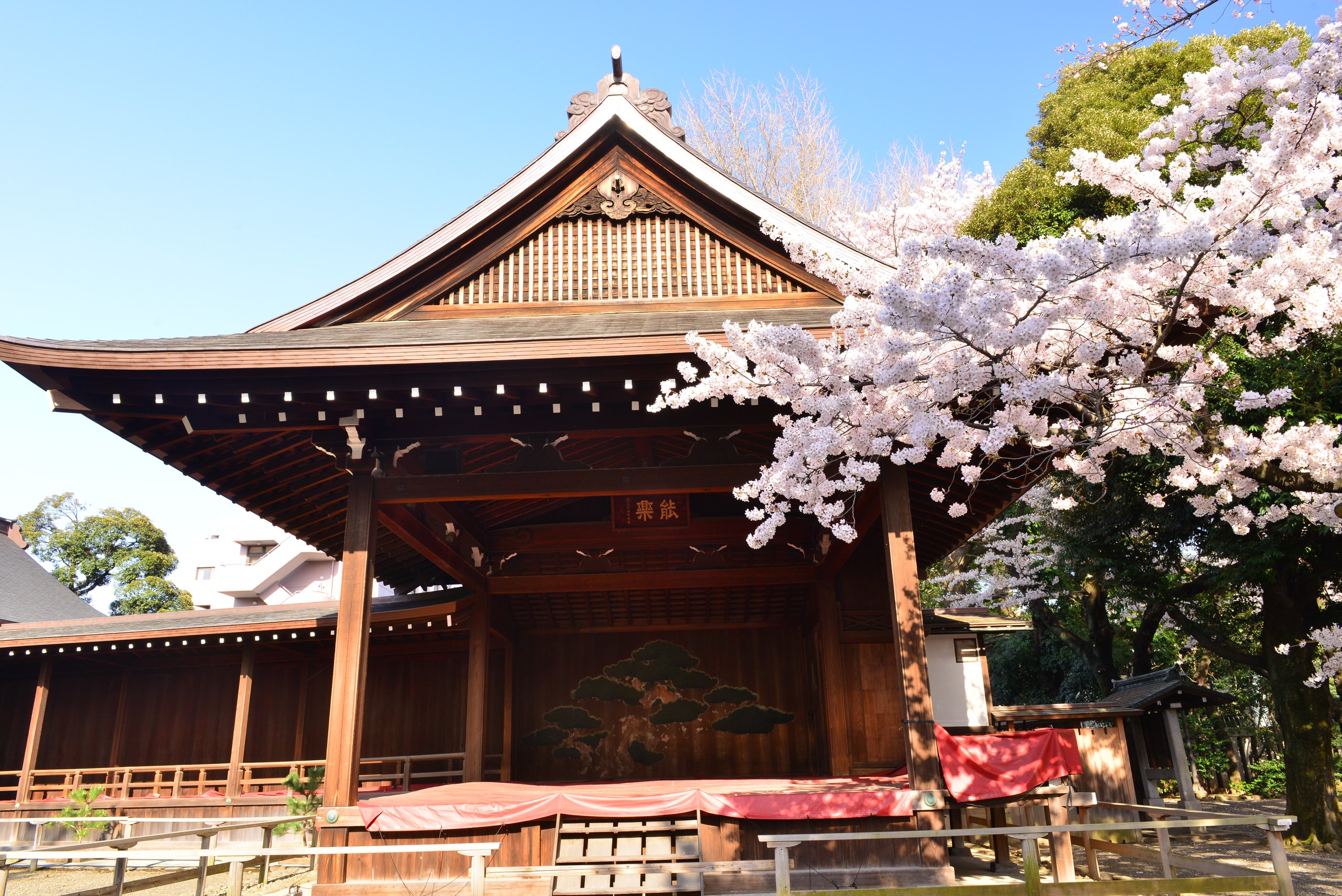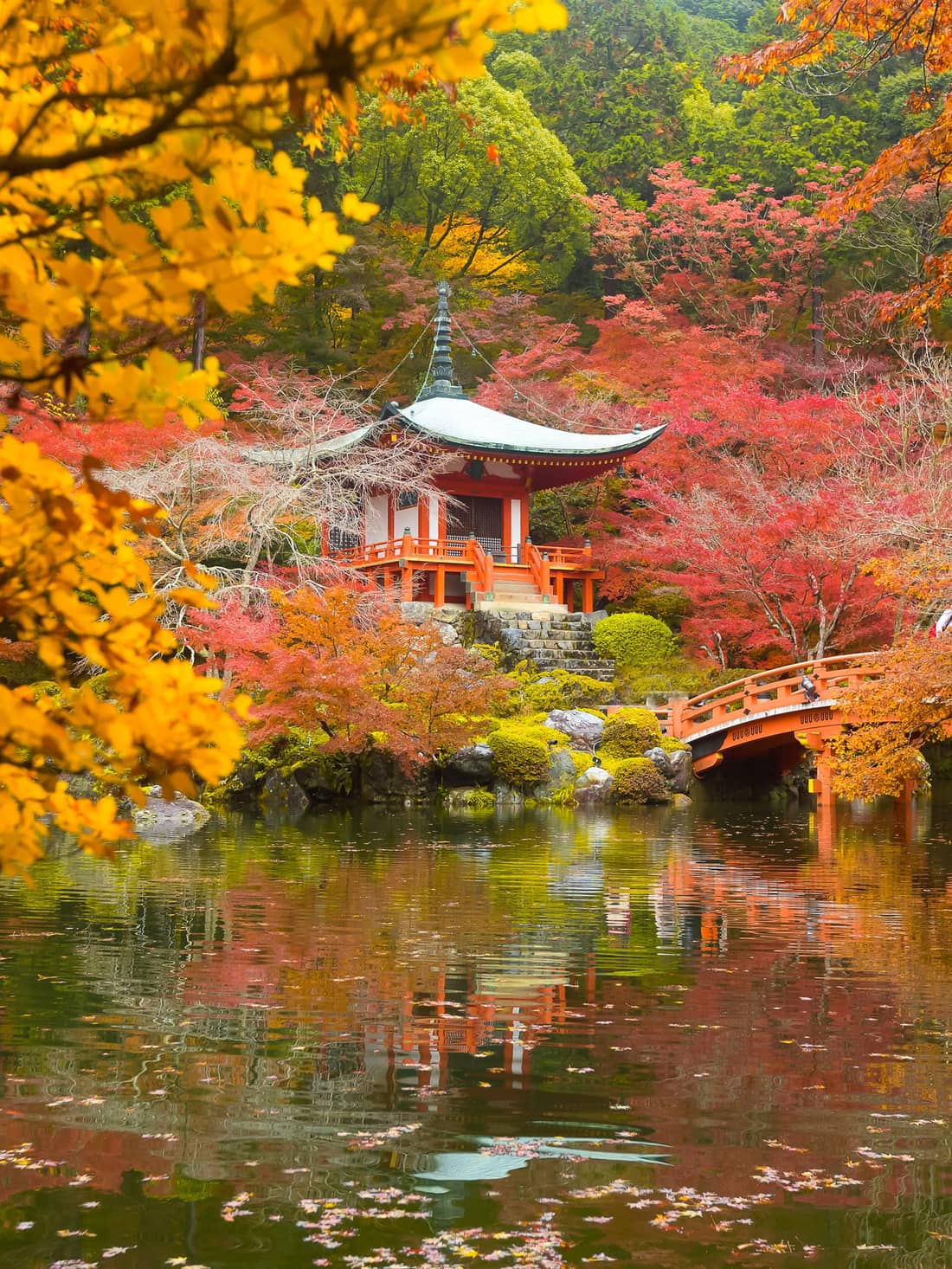

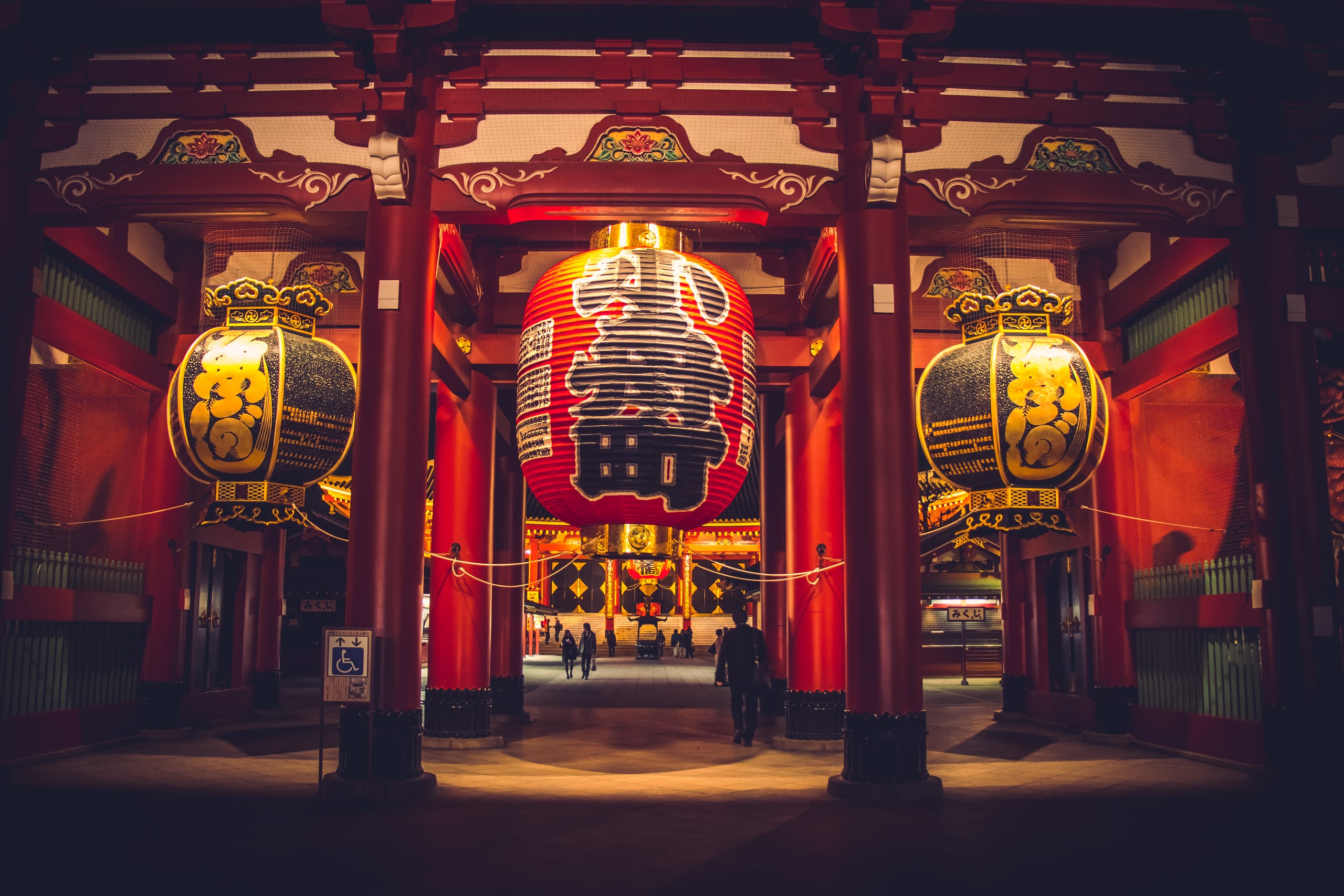
At Daigo-ji the path climbs through a sequence of gates and old precincts before the first pale branches appear, layered against timber, tile and the dark trunks of cedar, and only then does the five-storeyed pagoda rise above them. Kyoto keeps its densest cherry blossom inside its temple and shrine grounds, and each precinct shows the flower differently: framed by architecture, set against raked gravel, reflected in a pond, or brought low enough to touch.
the memory of power
Cherry blossom at Daigo-ji
Daigo-ji spreads across the lower and upper slopes of Mount Daigo in the south-east of the city, founded in 874 by the monk Shōbō of the Shingon school. Its five-storeyed pagoda, completed in 951 by an emperor honouring his father, stands close to thirty-eight metres tall and is the oldest wooden building in Kyoto whose age is documented, one of the few structures to survive the Ōnin War that levelled much of the city in the fifteenth century. Cherry branches reach across its dark lower roofs.
The temple's spring fame comes from a single afternoon: 20 April 1598, when Toyotomi Hideyoshi gave the Daigo no Hanami, a flower viewing on a scale Kyoto had never seen. Some seven hundred cherry trees were brought in and planted for the occasion, and around thirteen hundred guests, among them Hideyoshi's son Hideyori, his wife and his consorts, gathered beneath them at Sanbō-in. Hideyoshi died five months later, and the party at Daigo-ji was the last great spectacle of his life. On the second Sunday of April a costumed procession still winds through the temple in his memory, the Hōtaikō Hanami Gyōretsu.
The precinct is a sequence of thresholds: the garden of Sanbō-in, gates and sub-temples, a pond, the pagoda, and the mountain rising behind all of it. The weeping cherries open first, the double-flowered trees deeper in the grounds follow, and a walk through Daigo-ji passes from one to the next.
the falling branch
The weeping cherries of Heian Jingū
Heian Jingū was built in 1895 to mark the eleven hundredth anniversary of Kyoto's founding as the imperial capital, and the front of the shrine is all broad civic gesture: vermilion pillars, white gravel, a wide courtyard and a great torii over the approach.
Behind it lies the Shin'en garden, laid out in stages between 1895 and 1916 by the Kyoto garden maker Ogawa Jihei VII, a world of water, bridges and stepping stones. Its weeping cherries are yaebeni-shidare, a double-flowered strain of a far stronger pink than the pale Somei Yoshino elsewhere in the city, and their branches hang toward the pond in long pendant lines, bringing the flower down to the height of a person's face.
Every cherry above the pond is doubled in the water. The stepping stones across it, the covered bridge and the garden's arranged sightlines turn the walk into a series of framed pictures: water catching branch, branch framing bridge, bridge returning the eye to the shrine roofs beyond. In Jun'ichirō Tanizaki's novel The Makioka Sisters, the family's spring outing to Kyoto each year ends here, beneath the red weeping cherries of the shrine garden.
at different heights
Kiyomizu-dera and Ninna-ji in blossom
Kiyomizu-dera shows its blossom from above. The temple's wooden stage, rebuilt in 1633 under the shogun Tokugawa Iemitsu, stands thirteen metres above the slope of Higashiyama on a lattice of joinery made without a single nail, resting on a hundred and thirty-nine pillars of zelkova. From the stage Kyoto becomes a field of roofs, branches and haze, and the cherry blossom below fills the ravine in clouds of pink.
Ninna-ji, founded in 888, closes the city's spring. Its Omuro-zakura are low, late-flowering cherries no more than two or three metres tall, planted across the grounds in their hundreds and opening after the city's main wave has passed, into the middle of April. Visitors walk among the flowers at eye level, the temple's own five-storeyed pagoda rising behind the low branches. The Omuro-zakura were designated a National Place of Scenic Beauty in 1924.
restraint and abundance
Ryōan-ji, Tenryū-ji and the shrines of the north
At Ryōan-ji, raked white gravel surrounds fifteen stones placed so that no single vantage point shows all of them at once, a garden made in the closing years of the Muromachi period, around 1500. Spring leaves the rock garden itself unaltered. A branch shows above the earthen wall, petals settle on the raked lines, and colour gathers around the Kyōyōchi pond below.

At Tenryū-ji in Arashiyama, founded in 1339, the Zen master Musō Soseki laid out the Sōgen Pond so that the wooded slopes of Arashiyama, Kameyama and Ogura beyond the temple wall appear to belong to the garden, a technique called shakkei, borrowed scenery. In spring the cherries on those hills become part of the garden too, pond, mountain and blossom in a single view.
Hirano Shrine, moved to Kyoto from Nara in 794 at the wish of Emperor Kanmu, gathers some four hundred cherry trees of sixty varieties, which flower one after another across a month and a half. Its own sakigake-zakura, a variety that originated in the grounds, has long been the city's first herald of the season. The shrine's cherry festival, the Ōka Matsuri, has taken place every year since 985, and the trees have been lit for night viewing since the Edo period, when Hirano no yozakura was already famous.
Kamigamo Shrine, traditionally dated to 678 and among the oldest in Kyoto, gives the flower open ground. Its Saiō-zakura, a weeping cherry, spreads across the shrine lawn beside the trees known as Gosho-zakura and Umadashi-no-zakura, among gravel, a clear stream and the white sand cones of the shrine's ritual space, with the hills of northern Kyoto behind.
the journey
Kyoto's temples on a cherry blossom tour of Japan
The Classic Cherry Blossom Tour of Japan, from 30 March to 10 April 2027, gives Kyoto three nights in Gion, a short walk from the lanes of Higashiyama below Kiyomizu-dera. Its days in the city take in the thousand vermilion torii of Fushimi Inari, the Golden Pavilion at Kinkaku-ji reflected in its pond, and the cherry canopy of the Keage Incline, and a hanami picnic from a Michelin-starred kitchen is laid in the park of the Kyoto Imperial Palace.
Kaiseki is taken at a restaurant with two Michelin stars, and on the eighth evening a private teahouse room in Gion belongs to the guests, with geiko and maiko to dance, pour and lead the old games of the ozashiki. The tour is limited to 8 guests, and its Tour Directors travel every mile of it beside them.