
In the high north, autumn arrives before the calendar is ready for it. A slope that was green in late August takes on a rust-coloured edge, the grasses pale, and the first rowan leaves redden in dry, clean air that carries none of the humidity still hanging over the south. Mist lies low in the valleys in the morning, and the light has sharpened so suddenly that the far ridges seem to have moved closer overnight.
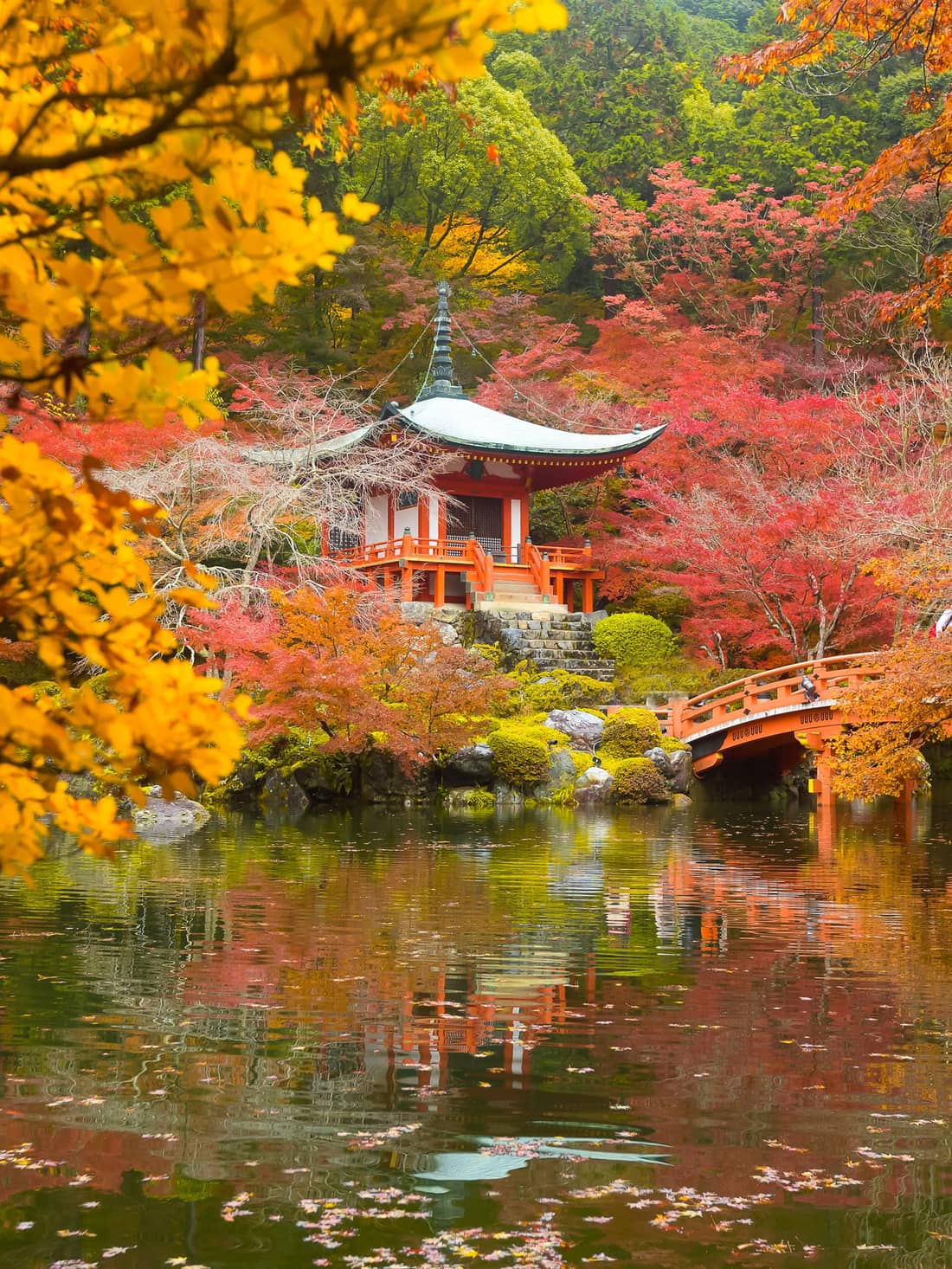
Tōhoku and Hokkaidō have Japan's earliest autumn, and its broadest. The colour begins there while Kyoto is still in summer clothes, and it covers whole mountain ranges, volcanic plateaus and beech forests at a scale no temple garden can match. Travellers who know only the late maples of the old capital find a colder, wider season in the north, and a different country to see it in.
the northern lead
Why autumn comes first to the north
Cold reaches the north first, and the colour follows the cold. In Hokkaidō's high mountains the leaves begin to turn in September, two months before the temple gardens of Kyoto. Tōhoku follows through October, its mountain slopes, highland forests and inland basins changing while the lowlands of central and western Japan are still green.
Latitude explains part of it, and altitude explains the remainder. Both regions are full of uplands, volcanic ranges and cold basins that respond quickly once the nights begin to cool, so the season comes down the mountains in order: the high ridges first, then the slopes, then the valleys, and last of all the towns and parks. A single mountain road in Tōhoku in October can run from thinning branches at the pass to full colour halfway down and green leaves by the river.
Daisetsuzan, the great mountain mass at the centre of Hokkaidō, is where Japan's autumn colour begins each year, the alpine plants reddening close to the ground around Asahidake before the forests below have changed at all. Winter is already in the air up there.
the broad shoulder
Tōhoku in autumn
Tōhoku is six prefectures, Aomori, Akita, Iwate, Yamagata, Miyagi and Fukushima, making up the northern third of Honshū, and each reaches its colour on its own week. Its autumn lacks the tight refinement of the old capitals and is the stronger for it. Colour runs across whole hillsides, the beech forests turn yellow and copper, the rice has been cut and stacked, persimmons hang outside the farmhouses, and woodsmoke and mist lie together in the morning air.
Aomori has mountains, apple orchards and a coastal light clear enough to strip the leaves of any softness. Akita has its old samurai districts, its farming valleys and forests made for yellow, russet and red. Iwate opens into long views and volcanic highland roads, and Yamagata, colder and inland, is a country of basins, fruit orchards and onsen towns where steam and leaves share the same air. Miyagi carries the season down towards the Pacific; Fukushima runs it across a high plateau into lake country.
The beech is the tree of this country, and its autumn colour is gold. Japanese beech once covered most of the mountains of northern Japan, and on the border of Aomori and Akita the Shirakami-Sanchi range keeps the largest stand of virgin beech forest left in East Asia, inscribed as a World Heritage Site in 1993. In autumn its slopes turn a soft yellow-bronze that seems to give off light on an overcast day, and the forest floor beneath them, kept moist by the heavy snows of the Sea of Japan coast, smells of leaf and water.
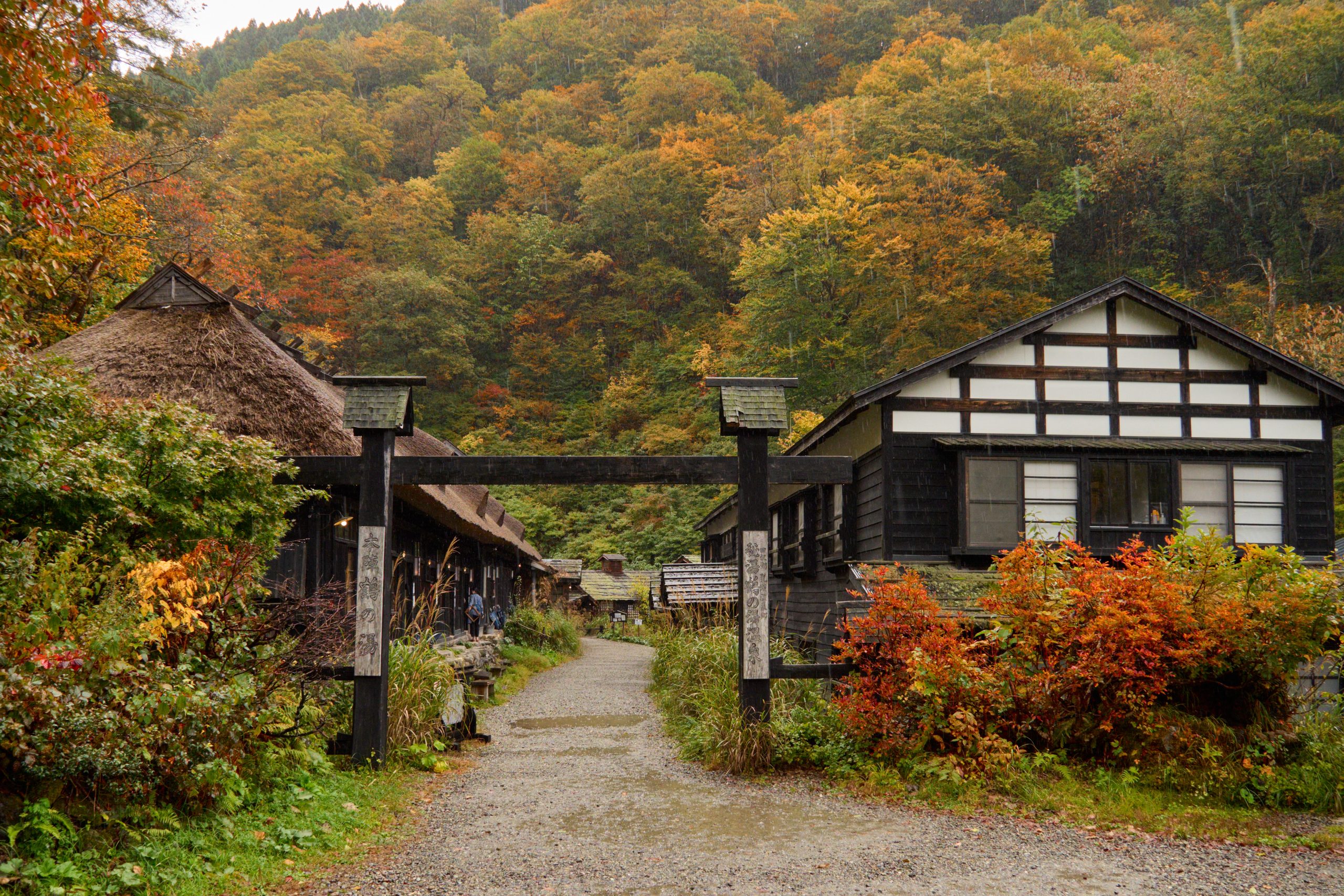
The onsen towns carry the season with particular force. A hot spring set in a river valley or a mountain fold puts the bather inside the same cold air that is turning the slopes above, and the contrast between steam and chill becomes part of the autumn itself. Many of these towns stand high enough to turn before the farmland below them, so a stay of a few nights sees the high colour arrive and then the valley's follow it down.
The region is large enough to spread its visitors thinly, and a hillside in full colour is met here without a queue.
the open north
Hokkaidō in autumn
Hokkaidō's autumn begins with altitude and spreads across an island of unusual openness, with wider roads, a larger sky and towns farther apart than anywhere on Honshū. Its highland colour has a clean austerity: rowan and dwarf shrubs red close to the ground, birch and larch gold above them, then dark conifer, grey rock and blue distance.
Lower down the season meets barns, brick, windbreaks and straight roads running towards the mountains. Sapporo, laid out on a grid in the nineteenth century, keeps its autumn in broad streets and in the ginkgo avenue of Hokkaido University, which turns that part of the campus gold. Eastern Hokkaidō is quieter, a landscape of marsh, lake, pasture and coast where the colour lies in long horizontal bands.
The island eats to the same calendar. Akiaji, the autumn salmon, run into the rivers as the water cools, and their roe is marinated in soy and piled over rice in the markets of Sapporo and Hakodate, while potatoes and pumpkins fill the farm stalls along the roads.
The light is what a traveller from the south notices first. Northern autumn light is clean and angled and reveals a hillside tree by tree; shadows fall harder, and colour reads with more contrast than it ever does in the hazier air of the Kyoto basin. Within a day the old capitals' idea of autumn colour has been replaced by a larger one.
the journey
A tour of northern Japan in autumn
The Autumn Leaves Tour of Northern Japan, from 2 to 13 November 2027, crosses both regions in the order the colour moves, from north to south. It opens with three nights above the Toyohira gorge at Jozankei, in the mountains beyond Sapporo, then crosses the Tsugaru Strait to Honshū, where the fourteen kilometres of the Oirase gorge are walked stretch by stretch, the car waiting at each, and the caldera of Lake Towada opens deep blue at its head.
Two nights follow in the beech forest at Nyuto Onsen, where the oldest of the village's inns has received travellers for more than three centuries, and the journey closes in Yamagata, at the gas-lit valley of Ginzan Onsen and on a private wooden boat down the Mogami River, through the canyon the poet Basho descended in 1689. The tour is limited to 8 guests.
questions
Questions
When does autumn colour start in Hokkaido and Tohoku?
In Hokkaidō's high mountains the leaves begin to turn in September, two months before the temple gardens of Kyoto. Tōhoku follows through October, its mountain slopes, highland forests and inland basins changing while the lowlands of central and western Japan are still green. Daisetsuzan, at the centre of Hokkaidō, is where Japan's autumn colour begins each year.
Where is the best place to see autumn leaves in northern Japan?
Daisetsuzan, the great mountain mass at the centre of Hokkaidō, where the colour begins each year. In Tōhoku, the Shirakami-Sanchi range on the border of Aomori and Akita keeps the largest stand of virgin beech forest left in East Asia, inscribed as a World Heritage Site in 1993, and its slopes turn yellow-bronze. In Sapporo, the ginkgo avenue of Hokkaido University turns gold.
Is Tohoku worth visiting in autumn?
Tōhoku and Hokkaidō have Japan's earliest autumn, and its broadest. The colour covers whole mountain ranges, volcanic plateaus and beech forests at a scale no temple garden can match. The region is large enough to spread its visitors thinly, so a hillside in full colour is met here without a queue, and many onsen towns stand high enough to turn before the farmland below.